The global carbonated beverage market is on a strong growth trajectory — according to Grand View Research, it was valued at $613.3 million in 2024 and is forecast to grow at a 6.4% CAGR through 2030. Yet many new brand owners entering this space focus almost exclusively on flavor, packaging, and branding — while overlooking the single most fundamental variable that defines how their drink actually feels in a consumer's mouth: the CO2 volume level.
The global carbonated beverage market is on a strong growth trajectory — according to Grand View Research, it was valued at $613.3 million in 2024 and is forecast to grow at a 6.4% CAGR through 2030. Yet many new brand owners entering this space focus almost exclusively on flavor, packaging, and branding — while overlooking the single most fundamental variable that defines how their drink actually feels in a consumer's mouth: the CO2 volume level. Get this number wrong, and no amount of great branding will save a beverage that feels flat, overly harsh, or out of step with its product category. This guide explains exactly what CO2 volume levels mean, what the right range is for your product type, and what specifications you must communicate to your OEM partner before production begins.
Key Takeaways
- CO2 volume is expressed in vol/vol (volumes of CO2 per volume of liquid) — the industry standard measurement for carbonation intensity.
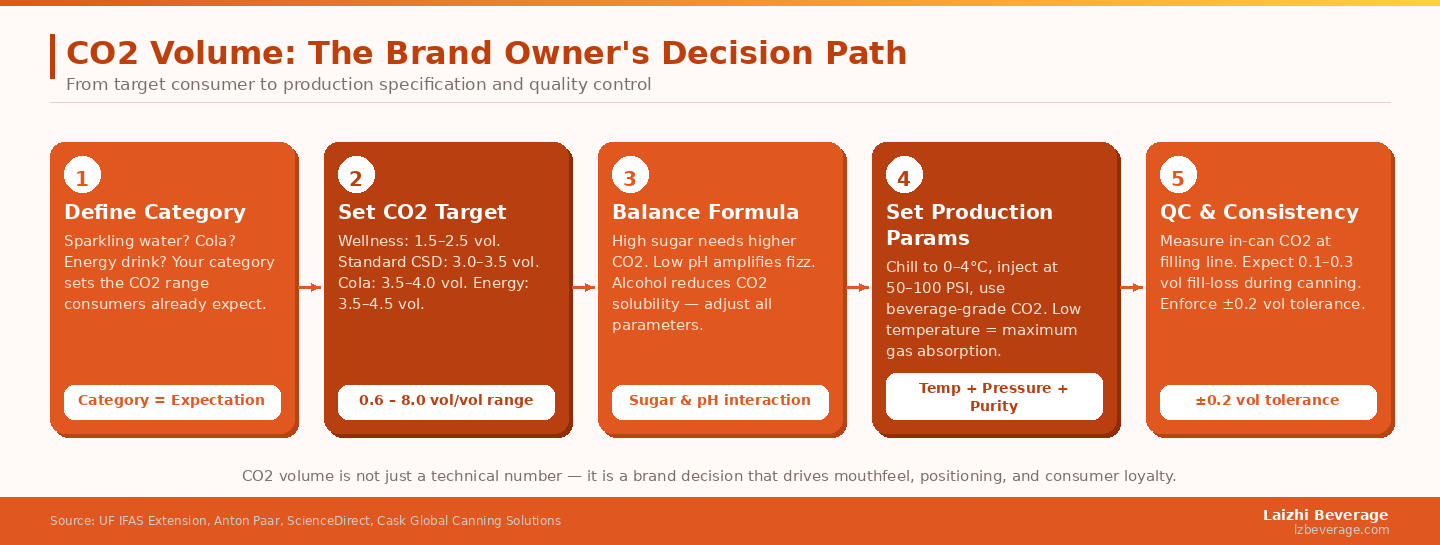
- Different drink categories have distinct expected CO2 ranges: sparkling water typically targets 2.0–3.0 vol, colas 3.5–4.0 vol, and energy drinks 3.0–4.0 vol.
- Carbonation level is not purely technical — it directly shapes brand positioning, consumer perception, and shelf-life packaging requirements.
- When working with an OEM manufacturer, you must specify CO2 volume target, acceptable tolerance (±0.2 vol), CO2 purity grade, and canning temperature parameters.
What "Volumes of CO2" Actually Means
The Two Measurement Units
When your OEM factory or beverage technologist talks about carbonation, they'll use one of two units. The most common in commercial production is volumes of CO2 (vol/vol): this represents how many liters of CO2 gas (measured at standard temperature and pressure) are dissolved in one liter of liquid. The second unit is grams per liter (g/L). According to the University of Florida IFAS Extension's carbonation guide, the conversion is approximately 1 vol/vol = 1.96 g/L — so a product carbonated to 3.0 vol/vol contains roughly 5.9 grams of CO2 per liter.
The practical measurement range that matters for commercial beverages spans from about 0.6 vol/vol at the low end — which is the minimum detectable threshold for the average consumer — to 8.0 vol/vol at the absolute maximum. Anything below 0.6 vol/vol is effectively perceived as flat; anything above 8.0 vol/vol creates an uncomfortable burning sensation and poses packaging safety risks due to excessive internal pressure.
Why Brand Owners Need to Understand This Number
Understanding CO2 volume matters at every stage of your product lifecycle. It shapes mouthfeel and flavor perception during formulation, determines the internal pressure your packaging must withstand during storage and shipping, and affects shelf life — since carbon dioxide's slight antimicrobial properties help inhibit bacterial growth. As Anton Paar's beverage quality resource notes, monitoring CO2 concentration in beverages is critical in the final steps of production, affecting everything from consumer satisfaction to brand reputation. Inconsistent carbonation batch-to-batch is one of the most common quality complaints in canned beverages, and it almost always traces back to an under-specified CO2 target in the original product brief.
CO2 Volume Ranges by Beverage Category
Sparkling Water and Wellness Drinks (1.5–2.5 vol)
Products positioned around health, hydration, and gentle refreshment cluster at the lower end of the carbonation spectrum. Sparkling mineral waters and lightly carbonated teas typically target 2.0–2.5 vol/vol. The carbonation at this level produces a soft, pleasant effervescence without aggressive bite — exactly the sensory signal that wellness-oriented consumers associate with "clean" and "natural." According to ScienceDirect's overview of soft drink carbonation science, fruit-flavored drinks (strawberry, cherry, grape, orange) fall in the 1.0–2.5 vol range, which also serves brands targeting younger consumers or those with lower sugar tolerance.
If you are building an RTD sparkling tea, infused water, or light soda SKU, starting your formulation trials in the 2.0–2.5 vol range gives you a positioning advantage in the wellness segment while keeping packaging pressure manageable for export logistics.
Lemon-Lime, Tonic, and Standard Fruit Carbonates (2.5–3.5 vol)
This mid-range is the workhorse of the global CSD category. Lemon-lime sodas, tonic waters, and most fruit-flavored carbonates sit comfortably between 2.5 and 3.5 vol/vol. The carbonation at this level creates a noticeable fizz with mild acidity — the "refreshing pop" that most consumers globally associate with a standard soft drink. Most soft drink formulas, including tonic water, are carbonated to 3.0–3.5 vol/vol.
Colas and Standard CSDs (3.5–4.0 vol)
Classic cola-style beverages require a higher CO2 charge to balance their sweetness. The acidity of carbonic acid formation counteracts the flat, sugary mouthfeel that would otherwise dominate a high-sugar formula. Real-world measurement data from Cask Global Canning Solutions' product analysis identified Coca-Cola's in-can carbonation at approximately 3.1 vol CO2 — a carefully engineered level that "distracts from the sugariness and flatter flavors." Higher carbonation in colas amplifies the tangy sensation and creates the sharp, immediate mouthfeel that consumers in this category expect. If your brand is targeting a cola-style product, expect to target 3.5–4.0 vol and plan for the corresponding higher internal can pressure.
Energy Drinks and High-Carbonation Products (3.5–4.5 vol)
Energy drinks represent one of the fastest-growing segments in the carbonated beverages space — according to Mordor Intelligence, carbonated sports and energy drinks are forecasted at a 7.62% CAGR through 2031, outpacing the broader market. Many energy drink formats target higher carbonation levels to create a distinctive aggressive mouthfeel that aligns with the category's "performance" brand identity. This range demands careful formulation: at CO2 volumes above 4.0, sugar interaction becomes critical — sweetness perception decreases as carbonic acidity rises, so your flavor balance must account for this. If you are developing a custom energy drink for private label or OEM production, defining your CO2 target precisely at the brief stage prevents costly reformulation after first samples are produced.
How CO2 Level Shapes Brand Positioning and Consumer Perception
Mouthfeel as a Brand Signal
Carbonation level communicates brand personality before a consumer consciously thinks about it. A gentle 2.0 vol/vol effervescence says "calm, natural, premium wellness." A sharp 4.0 vol/vol carbonation says "energy, intensity, boldness." This is not coincidental — beverage marketers have understood for decades that carbonation intensity maps directly onto brand archetype. When your formulator recommends a CO2 volume target, they are not just solving a technical problem; they are encoding a consumer emotion into your product. The fizz is the first moment of truth in your consumer's brand experience.
Interaction with Sugar, Flavor, and Alcohol
CO2 does not operate in isolation. Sugar content and pH both affect how carbonation is perceived. High-sugar formulas mask the sharpness of high CO2 levels; in contrast, a sugar-free formulation at the same CO2 volume will taste noticeably more acidic and intense. Alcohol (in RTD cocktails and beer) reduces CO2 solubility, requiring adjustment of pressure and temperature parameters at the filling stage. Fruit acids in juice-based carbonated beverages create a compounding tartness effect at higher CO2 levels. This means the CO2 target you specify to your OEM must be set in context of your full formula — not as an isolated number.
What Brand Owners Must Tell Their OEM Factory
The production capability behind a consistently carbonated product starts with precision filling. Laizhi Beverage's 50 production lines are equipped for controlled low-temperature carbonation, operating at 0–4°C to maximize CO2 absorption efficiency. Understanding what information to give your manufacturer is what separates a first-sample-correct product from a three-month reformulation cycle. You can learn more about Laizhi's production capacity and HACCP-certified quality system to understand the infrastructure behind carbonation control at scale.
Specifying Your Target Volume and Tolerance
Your product brief to any OEM partner must include three CO2-related parameters: (1) the target volume, e.g., 3.2 vol/vol; (2) the acceptable tolerance band, typically ±0.1 to ±0.2 vol/vol for commercial products; and (3) the measurement point — whether the specification applies at the filling line, after warming to room temperature, or at end-of-shelf-life. Expect to lose 0.1–0.3 vol/vol during the canning process as CO2 migrates to the headspace. A good OEM partner will account for this fill-loss in their process and carbonate to a slightly higher target to ensure the in-can final measurement meets your specification.
Why CO2 Grade and Purity Matter
Not all CO2 is equal. Commercial production requires beverage-grade CO2, which undergoes additional purification steps beyond standard food-grade gas. As Sure Purity's analysis of CO2 grades explains, impurities such as sulphur compounds or hydrocarbons in lower-grade CO2 can make a beverage taste flat, metallic, or sour — with consequences ranging from consumer complaints to full product recalls. Always confirm with your OEM factory that they source beverage-grade CO2 and have documented their supplier's purity certification. This is a quality audit question, not a minor detail.
Canning Constraints and Container Selection
Standard aluminum cans are rated to handle the internal pressure generated by carbonated beverages in typical CO2 ranges (up to approximately 5.0 vol/vol at room temperature). Above that, container integrity becomes a risk factor. For highly carbonated products, filling temperature must be tightly controlled — carbonation increases pressure as temperature rises, and a product filled cold but stored in warm climates during shipping can experience elevated pressure at the point of opening. For export brands targeting Southeast Asia, the Middle East, or Africa, this shipping-environment pressure variable is a real quality consideration that should be part of your OEM brief.
Keeping Carbonation Consistent Batch to Batch
CO2 volume consistency is fundamentally a process control problem. Three variables dominate: liquid temperature at the carbonation stage (cooler is better — production lines typically chill the beverage to 0–4°C to maximize dissolution efficiency), CO2 injection pressure (commercial lines typically operate at 50–100 PSI depending on product type), and dissolved oxygen content (oxygen competes with CO2 for dissolution and must be kept below threshold levels). A well-run OEM facility will measure CO2 in-can using an Anton Paar or similar instrument on the filling line, logging measurements across the production run and flagging any batch that falls outside tolerance before it reaches the seaming station.
If you are building a brand that depends on carbonation as a differentiator — a craft-style sparkling tea at 2.3 vol or a high-energy carbonated drink at 4.2 vol — your consistency requirement is actually tighter than for a commodity cola. Consumer loyalty to a distinctive product is partly loyalty to a precise sensory experience. A batch that drifts 0.4 vol from your target isn't just a quality problem; it's a brand integrity problem. Defining a formal carbonation specification and requiring production test data from your factory is not over-engineering — it is basic brand protection.
Frequently Asked Questions
What is the typical CO2 volume for a carbonated energy drink?
Most commercial energy drinks are carbonated in the 3.0–4.0 vol/vol range, with some premium or craft formats targeting up to 4.5 vol/vol. The exact target depends on the sugar content and flavor profile — high-sugar formulas often require higher CO2 to offset sweetness and create a crisp mouthfeel. If you are developing a custom energy drink formula, view the Laizhi energy drink OEM product line to understand the standard formulation and filling capabilities available.
Can the same production line carbonate to different CO2 levels?
Yes. Modern carbonated beverage production lines adjust CO2 volume by changing liquid temperature, injection pressure, and CO2 flow rate. A flexible OEM facility can typically carbonate the same base beverage to anywhere from 1.5 to 4.5 vol/vol within the same line run. The key is that the target must be specified before production begins, not adjusted in response to a complaint.
How does CO2 volume affect the shelf life of a canned drink?
Carbon dioxide has mild antimicrobial properties that help slow bacterial and yeast growth in sealed containers. Higher CO2 levels modestly extend the microbiological shelf life of a beverage. However, the dominant factor in shelf life for canned carbonated drinks is the integrity of the can seam and the internal coating, not CO2 level alone. A well-sealed, internally coated aluminum can from an ISO-certified filling facility will consistently deliver 12–18 month shelf life across most standard carbonation levels.
What happens if I set the CO2 volume too high for my formula?
Beyond the safety threshold of 8.0 vol/vol, the drink produces an unpleasant burning sensation and poses a can integrity risk. Even at commercially realistic levels above 4.5 vol/vol, high carbonation can overwhelm delicate flavors, mask important taste notes, and create excessive foaming when the can is opened — which consumers strongly associate with poor quality. Over-carbonation is just as damaging to brand perception as under-carbonation.
What is the difference between food-grade and beverage-grade CO2?
Food-grade CO2 meets basic purity standards for general food contact applications. Beverage-grade CO2 undergoes additional purification to remove trace contaminants — including sulfur compounds, hydrocarbons, and moisture — that can directly affect taste, aroma, and safety in a finished drink. Reputable OEM manufacturers source exclusively beverage-grade CO2 and should be able to provide a certificate of analysis from their CO2 supplier upon request.


