For buyers sourcing canned beverages from Chinese OEM manufacturers, quality control is not a single checkpoint at the end of a production run — it is a layered system that begins before the factory starts mixing and ends only after your shipment clears customs.
For buyers sourcing canned beverages from Chinese OEM manufacturers, quality control is not a single checkpoint at the end of a production run — it is a layered system that begins before the factory starts mixing and ends only after your shipment clears customs. Quality specialists who inspect goods at Chinese factories consistently report the same finding: buyers who skip mid-production checkpoints and rely solely on the factory's internal QC team receive the highest proportion of non-conforming shipments. Understanding where the real risk points are — and how to insert independent verification at each stage — is the practical skill that separates brands that scale from those that absorb a costly first-order loss.
Key Takeaways
- Build QC into the purchase contract, not as an afterthought — define AQL levels, COA requirements, and pre-shipment inspection rights before you sign anything.
- AQL sampling (ISO 2859-1) is the global standard for beverage OEM inspection — set critical defects at AQL 0, major defects at 2.5, and minor defects at 4.0 for canned beverages.
- Pre-shipment inspection should be booked when production is 80–100% complete and packed — too early and you are inspecting incomplete goods; too late and the goods are already on a truck.
- Certificates of Analysis (COA) must match the production batch number — a COA from a previous batch or a different factory line is worthless as a QC document.
- Third-party inspection bodies (SGS, Bureau Veritas, QIMA) are more reliable than factory-arranged inspectors — the inspector must be appointed and paid by you, not the factory.
Why Factory Self-Inspection Is Never Enough
Every reputable Chinese OEM factory runs internal quality checks. Most have dedicated QC departments, modern testing equipment, and written inspection protocols. None of this changes the fundamental conflict of interest: when a factory inspects its own output, the inspectors answer to the same management that is under pressure to ship on time and maintain production volumes. Independent verification is not a statement of distrust — it is the application of a principle that every serious quality system, from ISO 9001 to HACCP, treats as non-negotiable. A factory with nothing to hide will welcome independent inspection; a factory that resists it is telling you something important.
The Four Points Where Quality Can Break Down in Canned Beverage Production
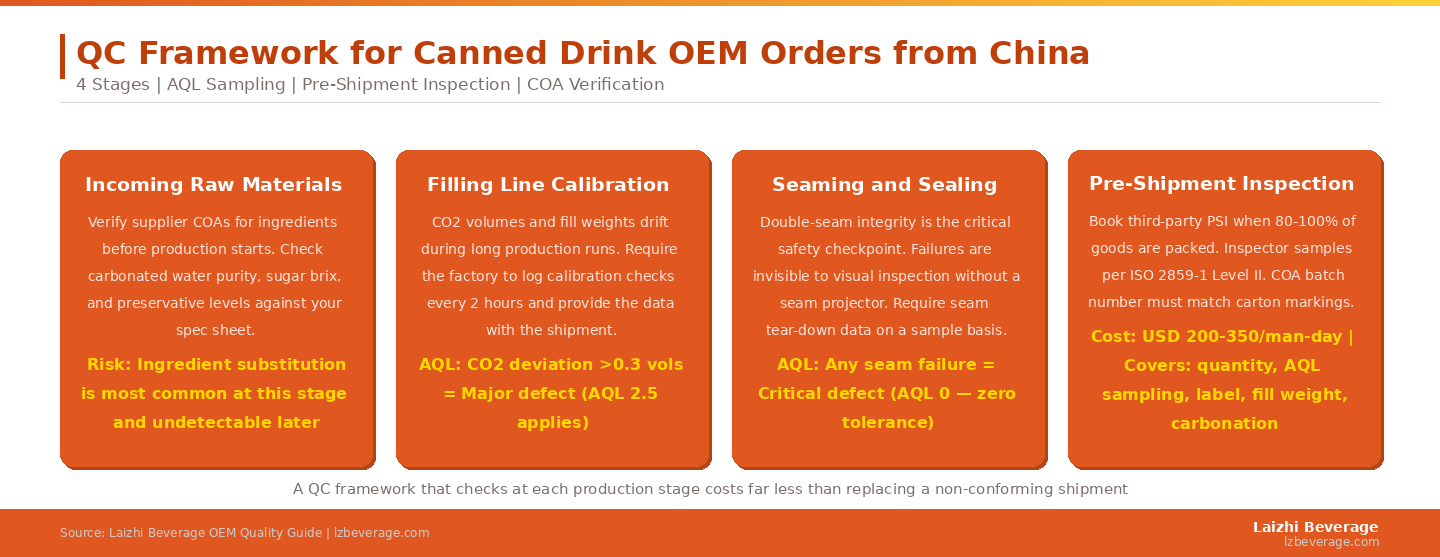
Quality deviations in canned beverage OEM manufacturing cluster at four specific stages: (1) incoming raw material acceptance — carbonated water purity, sugar brix levels, and ingredient COAs are often not verified by factories for OEM orders unless contractually required; (2) filling line calibration — CO2 volumes and fill weights drift across long production runs, particularly if the line has not been recalibrated since the last product changeover; (3) seaming and sealing — double-seam failures are the leading cause of field failures in canned beverages, and they are invisible without a dedicated seam projector test; and (4) packaging and labelling — wrong label version, incorrect batch codes, or non-compliant nutritional panels can trigger customs rejection in regulated markets even if the liquid inside is perfect. A factory that can demonstrate documented in-process checks at all four stages is a more reliable partner than one with the most impressive facility tour.
Understanding AQL Sampling for Canned Beverage Orders
AQL — Acceptable Quality Limit — is the statistical framework that determines how many units from a production batch to inspect, and how many defects can be found before the batch is rejected. ISO 2859-1 is the global standard governing this methodology, and it is the framework used by every professional third-party inspection agency operating in China.
Setting AQL Levels for a Canned Beverage Order
AQL values are set separately for different defect severities. As quality inspection specialists explain, the standard framework for food and beverage products applies three tiers: critical defects (those that could harm the end consumer, such as seam failures, unlabelled allergens, or CO2 pressure exceeding safe limits) receive an AQL of 0 — even a single critical defect in the sample triggers batch rejection. Major defects (those that make the product unfit for sale, such as label misregistration exceeding 3mm, fill weight more than 5% below stated volume, or carbonation more than 0.3 vols outside specification) are typically set at AQL 2.5. Minor defects (cosmetic issues that do not affect safety or salability, such as minor label scratching or can exterior scuff marks within acceptable limits) are set at AQL 4.0.
| Defect Class |
AQL Level |
Example Defects (Canned Beverage) |
Result if Exceeded |
| Critical |
0 (zero tolerance) |
Seam failure, unlabelled allergen, excess CO2 pressure, contamination |
Batch rejected — no exceptions |
| Major |
2.5 |
Fill weight <5% spec, CO2 outside ±0.3 vols, label misprint, wrong batch code |
Batch rejected / rework negotiated |
| Minor |
4.0 |
Can exterior scuffing, minor label crease, slight neck deformation within spec |
Batch accepted with documented discrepancy |
Building a Pre-Shipment Inspection Into Your OEM Contract
Pre-shipment inspection (PSI) is the single most valuable quality control mechanism available to remote buyers. The key rules for PSI in canned beverage OEM: it must be contracted before production starts (not requested after problems emerge); it must be booked when production reaches 80–100% completion and goods are fully packed; and it must be conducted by an inspector appointed and paid directly by the buyer, not arranged by the factory. Manufacturing contract specialists operating in China stress that PSI rights must be written explicitly into the purchase contract in Chinese — an informal agreement to "allow inspection" carries no enforcement weight if a factory later denies access.
What a PSI Inspector Checks on a Canned Beverage Order
A professional PSI for canned beverages should cover the following: quantity count against the purchase order; random sampling using ISO 2859-1 Level II; visual inspection of cans for seam integrity, deformation, label accuracy, and print quality; carbonation measurement using a calibrated gauge on a random sample (minimum 6 cans); fill weight verification against the stated net content; packaging carton integrity and correct export labelling; and cross-referencing batch codes against the Certificate of Analysis provided by the factory. Any discrepancy between the COA batch number and the cartons being loaded is an immediate red flag that should trigger shipment hold.
Verification Checklist for Certifications and COA Documents
In a professional OEM quality programme, no certification document is accepted at face value. The COA (Certificate of Analysis) provided with your shipment must carry the specific production batch number matching the cartons being shipped — a COA issued for a previous run is a cosmetic document, not evidence. HACCP certificates must be traceable to an accredited Chinese certification body; as China business verification specialists confirm, the certificate number can be cross-checked on the CNAS national accreditation registry. Laizhi Beverage's OEM resource library also covers the documentation expected at each production stage. For buyers supplying EU or US markets, HACCP-based food safety procedures are a legal requirement under EU Regulation 852/2004 and US FDA FSMA, meaning a supplier without a verifiable certificate cannot legally supply those markets regardless of how the product tastes.
Laizhi Beverage operates under HACCP certification and holds formal export qualifications — factors that matter not just for buyer confidence but for regulatory access to the markets you are building. You can review the factory's quality credentials and production standards before discussing an OEM order.
Escalation: What to Do When a Shipment Fails Inspection
When a PSI inspector issues a Fail or Hold result, the buyer has three contractual options: reject the shipment in full (appropriate for critical defects or systemic failures), approve rework by the factory at their cost (appropriate for major defects where rework is feasible), or accept under concession with a documented price reduction (appropriate for minor defects that do not affect safety or market compliance). The right option depends on the contract terms you negotiated before production started. Buyers who did not include rework liability clauses in their purchase contract will find themselves in a position where they must either accept substandard goods or absorb the cost of rejection — neither of which is a desirable outcome. The time to negotiate these terms is before the order is placed. If you are working toward your first OEM order, explore Laizhi's canned energy drink OEM programme as a starting point for understanding what a professionally managed production agreement looks like in practice.
Common FAQs
How much does pre-shipment inspection cost in China?
Third-party PSI in China typically costs USD 200–350 per man-day, and most canned beverage inspections can be completed in one man-day. Agencies such as QIMA, SGS, Bureau Veritas, and Intertek operate nationwide across Chinese manufacturing provinces with 48-hour dispatch capability. Treat this cost as compulsory, not optional — it is approximately 0.1–0.5% of the value of a typical canned beverage order and can prevent losses many times that amount.
Should I use the factory's QC team or hire a third-party inspector?
For final pre-shipment inspection, always use a third-party inspector you appoint and pay directly. Factory internal QC is a useful production monitoring tool but should not substitute for independent verification before final payment. The inspector's fee is a cost borne by you; if a factory offers to "arrange an inspector" as part of their service, that inspector's report cannot be treated as independent.
What is an AQL of 0 and when does it apply to canned beverages?
An AQL of 0 means that finding even a single defect of that class in the inspection sample triggers batch rejection. It applies to critical defects — those that could harm end consumers or create legal liability. For canned beverages, this includes seam failures that create pressure hazards, unlabelled allergens, microbiological contamination above safe limits, and CO2 pressure exceeding the can's rated pressure tolerance. Critical defects have no acceptable threshold; the only resolution is full batch quarantine and root cause investigation.
Does a COA from the manufacturer count as quality control?
A COA is a manufacturer's self-declaration, not a quality certification. It documents what the factory claims about a specific batch — the chemical composition, microbiological counts, pH, Brix, and so on. For it to be useful as a QC document, three conditions must be met: the batch number on the COA must match the cartons in the shipment; the COA must be issued by an accredited testing laboratory, not by the factory's own QC department; and the values declared must match the product specification you agreed to in the purchase contract. When all three conditions are met, the COA is a useful supporting document. When any one of them is absent, it is simply paper.
Can I conduct quality control remotely without visiting China?
Yes. Third-party inspection agencies operate across all major Chinese manufacturing regions and can conduct PSI on your behalf, providing a detailed written report with photographs within 24 hours of the inspection. For higher-stakes orders, live-stream factory audits via video call (offered by several inspection agencies) allow the buyer to participate in real time. You should also request that your factory uses a production monitoring system that provides batch records and fill-line data logs — factories with genuine transparency in their systems are significantly easier to manage at a distance. AQL-based inspection methodology is designed specifically to be applied by trained inspectors on your behalf, making physical presence by the buyer optional for routine production runs.


