Carbonation is so central to the canned beverage experience that buyers often treat it as a given — something the factory handles automatically. In practice, specifying the right CO2 level is one of the most consequential decisions a brand makes before an OEM order goes into production. Get it right and the product sparkles on the palate exactly as intended.
Carbonation is so central to the canned beverage experience that buyers often treat it as a given — something the factory handles automatically. In practice, specifying the right CO2 level is one of the most consequential decisions a brand makes before an OEM order goes into production. Get it right and the product sparkles on the palate exactly as intended. Get it wrong and even a perfectly formulated flavour can taste flat, sharp, or out of character for the category. This guide breaks down the science of carbonation, explains the CO2 volume targets for each major drink category, and translates that knowledge into practical specification language for buyers working with OEM manufacturers.
Key Takeaways
- Carbonation is measured in volumes of CO2 (vol/vol) — the ratio of dissolved CO2 gas to liquid volume at standard temperature and pressure.
- The detectable minimum is ~0.6 vol/vol; the safe maximum is 8 vol/vol — anything above 8 creates excessive pressure and becomes a safety hazard in sealed cans.
- Standard soft drinks target 3.0–3.5 vol/vol; craft beers 2.4–2.6 vol/vol; sparkling water 1.5–3.0 vol/vol — category norms exist for consumer experience reasons, not just manufacturing convenience.
- Temperature and pressure are the two primary control levers — colder liquid dissolves more CO2, and higher pressure forces faster absorption.
- Include vol/vol targets in your OEM product specification — without a written CO2 specification, the factory will default to its own standard, which may not match your product brief.
What Is Carbonation?
Carbonation is the process of dissolving carbon dioxide gas into a liquid under pressure, creating the fizz, sparkle, and mouthfeel that define a wide range of beverages from colas to craft beers to sparkling waters. When a sealed can is opened, the internal pressure drops, CO2 solubility decreases, and the gas escapes as the familiar stream of rising bubbles. The "tingling" sensation on the tongue is not solely from bubbles bursting — research has shown it is also triggered by carbonic acid (H₂CO₃) formed when CO2 reacts with water, which activates chemo-sensory receptors in the oral cavity.
How Carbonation Is Measured: Understanding vol/vol
The standard unit for measuring carbonation in commercial beverage production is volumes of CO2 (vol/vol): the number of volumes of CO2 gas, measured at standard temperature and pressure (0°C, 1 atm), dissolved in an equal volume of liquid. A beverage at 3.0 vol/vol contains three litres of CO2 for every litre of liquid. University of Florida food science research confirms that the minimum detectable threshold is approximately 0.6 vol/vol — any lower and the drink registers as flat to the human palate. The practical safe maximum is 8.0 vol/vol, above which the CO2 creates an unacceptable burning sensation and can generate dangerous pressure in sealed containers.
CO2 Volume Targets by Drink Category
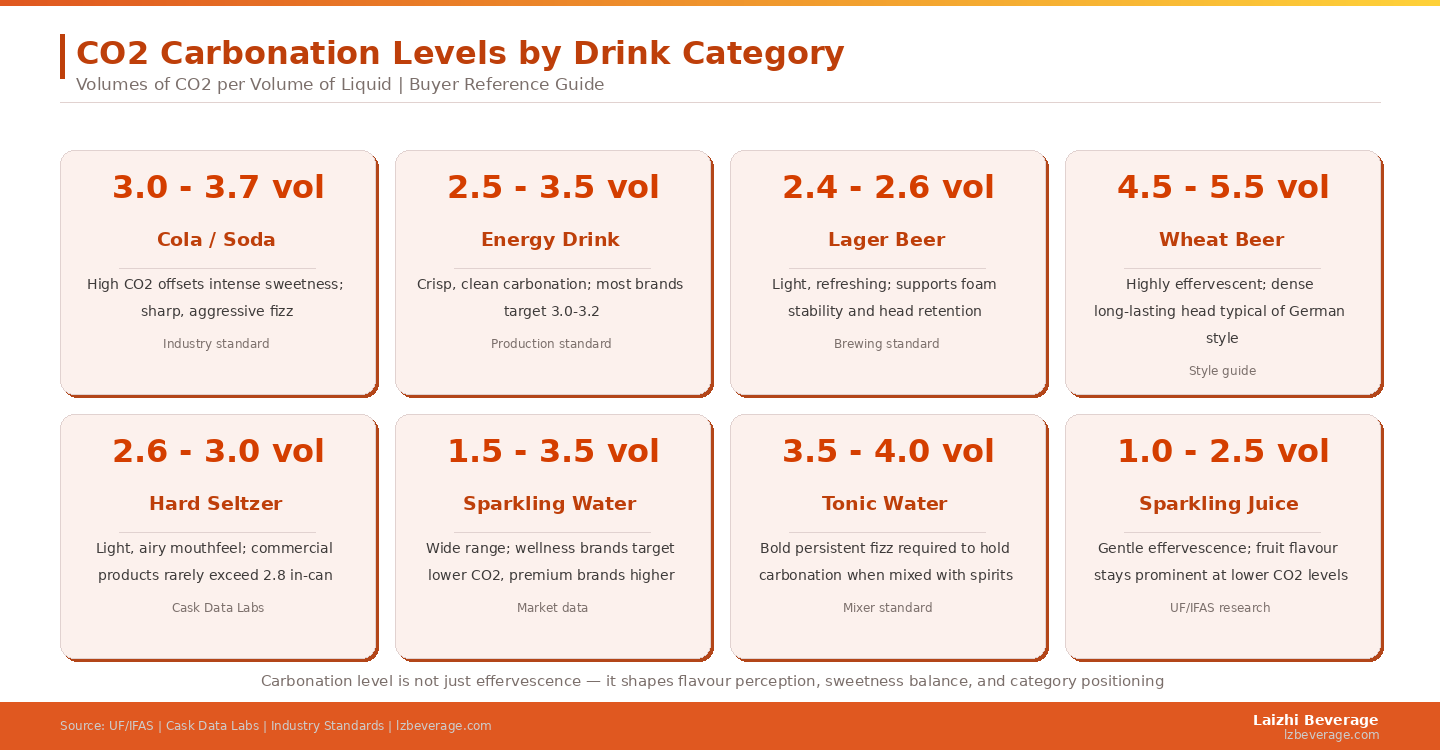
Different beverage categories have settled on distinct carbonation ranges based on decades of consumer preference data and production standards. As beverage carbonation specialists document, these ranges are not arbitrary — they reflect the interplay between CO2 level, flavour perception, mouthfeel, and consumer expectation for each category.
| Beverage Category |
Typical CO2 Range (vol/vol) |
Mouthfeel Description |
Buyer Note |
| Cola / Soda |
3.0–3.7 |
Sharp, aggressive fizz; CO2 offsets sweetness |
High sugar requires higher CO2 to balance |
| Energy Drink |
2.5–3.5 |
Crisp, clean carbonation; supports flavour lift |
Many brands target 3.0–3.2 for consistency |
| Lager Beer |
2.4–2.6 |
Light, refreshing; supports foam stability |
Standard for commercial lager globally |
| Craft Beer (Wheat) |
4.5–5.5 |
Highly effervescent; dense, long-lasting head |
Specify style carefully — can overshoot easily |
| Hard Seltzer |
2.6–3.0 |
Light, airy; bubbles dissipate quickly after opening |
In-can levels rarely exceed 2.8 in commercial products |
| Sparkling Water |
1.5–3.5 |
Light to bold effervescence depending on target |
Wellness positioning often means lower CO2 |
| Tonic Water |
3.5–4.0 |
Bold, persistent fizz; holds carbonation when mixed |
Mixer function requires higher baseline CO2 |
| Sparkling Juice |
1.0–2.5 |
Gentle effervescence; fruit flavour remains prominent |
Pulp and natural sugars can impede CO2 retention |
Data from canning industry analysis by Cask Global Canning Solutions confirms that commercially sold hard seltzers typically measure at or below 2.8 vol/vol in-can, even when the brand positions itself as "highly carbonated" — a valuable benchmark for brands developing new sparkling products.
How CO2 Level Shapes Mouthfeel and Flavour Perception
Carbonation does more than add bubbles — it chemically and mechanically alters how a drink is experienced. CO2 dissolving in water forms carbonic acid, which lowers the liquid's pH and imparts a slight tanginess. This acidity interacts with sweetness, bitterness, and fruit notes in ways that experienced product developers exploit deliberately. High carbonation in colas (3.0–3.7 vol/vol) counterbalances intense sweetness; lower carbonation in craft wheat beer (around 5.0 vol/vol in German styles) creates a dense, bread-like mouthfeel that supports the beer's flavour complexity. For OEM buyers developing new products, understanding this interplay means you can specify carbonation not just as a gas level, but as a flavour tool.
Why Soft Drinks Use Higher Carbonation Than Beer
The higher CO2 ranges in soft drinks (3.0–3.7 vol/vol) versus lager (2.4–2.6 vol/vol) reflect a functional difference. As beverage production specialists explain, sugar in solution reduces CO2 solubility — meaning sweetened beverages need higher injection pressure to achieve the same perceived effervescence as a sugar-free product. The CO2 also performs a flavour-balancing function: the carbonic acid it generates cuts through sweetness, preventing the drink from tasting cloying. For buyers developing canned RTD cocktails, high-sugar juices, or flavoured sparkling water, this physics is directly relevant to your carbonation specification. Industrial soft drink production data confirms that carbonation measurement at the factory must account for the specific sugar content of the formulation — not just the temperature and pressure parameters alone.
The Temperature-Pressure Relationship: Why It Matters for OEM Specification
CO2 solubility in liquid increases as temperature drops and as pressure rises. A carbonated beverage filled at 4°C retains significantly more CO2 than one filled at 12°C at the same injection pressure. This is why reputable OEM facilities use chilled mixing tanks and counter-pressure filling lines — both help maximise CO2 retention between the carbonation step and the sealed can. When specifying CO2 levels with your OEM manufacturer, always confirm that the stated vol/vol target is the in-can measurement after filling and sealing — not the pre-fill carbonation level in the mixing tank, which will be higher due to CO2 losses during transfer. Working with a manufacturer like Laizhi Beverage's RTD production line means carbonation targets are specified and measured at the finished product stage, ensuring what goes into the can matches what you signed off on during sampling.
Translating CO2 Science Into OEM Product Specifications
A professional product specification for a carbonated OEM drink should include three carbonation-related parameters: the target CO2 volume (in vol/vol, at a stated temperature), the permitted tolerance (typically ±0.2 vol/vol for standard production), and the testing method (manometric gauge at a defined temperature, or a laboratory dissolution test). Without all three, the factory has no objective standard to meet and you have no objective basis for a quality dispute. You can review how Laizhi Beverage structures its OEM production agreements to understand how carbonation targets are documented and enforced throughout the production run.
Common FAQs
What is the difference between carbonated water and sparkling water?
The terms are used interchangeably in most markets, but technically, sparkling water can refer to either naturally carbonated water (which contains CO2 from its source) or water to which CO2 has been added artificially. Carbonated water always refers to water with added CO2. For OEM purposes, the distinction matters only for labelling — the carbonation process and equipment are the same for both.
Can carbonation level be adjusted after the formula is finalised?
Yes — within limits. CO2 level is set by the filling line parameters (pressure, temperature, contact time), not by the liquid formula itself. This means carbonation can be adjusted between production runs without reformulating the drink. However, significant changes affect shelf life, can pressure ratings, and consumer perception, so any adjustment above ±0.5 vol/vol from the approved specification should be treated as a product change requiring new sample approval.
Why do some canned drinks lose carbonation faster than others?
CO2 retention in a sealed can depends on seam integrity, headspace management, fill temperature, and the absence of dissolved oxygen (which accelerates CO2 loss). Under-filled cans with large headspace volumes lose carbonation faster. Cans with micro-leaks in the double seam lose it faster still. This is why seam integrity testing and headspace measurement are standard quality checks in professional OEM production, not optional add-ons.
What vol/vol should I specify for a canned energy drink OEM order?
For a standard 250 ml or 330 ml canned energy drink targeting global markets, 3.0–3.2 vol/vol is the most widely used target range. It provides a crisp, clean mouthfeel that complements the typical sweet-sour flavour profile of energy drinks, and it is well within the pressure safety ratings of standard aluminium cans. If your product targets a more "light and refreshing" positioning, 2.6–2.8 vol/vol is appropriate. If it targets a bold, aggressive sensation associated with premium energy positioning, 3.3–3.5 vol/vol is used. Explore Laizhi Beverage's energy drink OEM options to discuss carbonation targets with an experienced production team before finalising your spec sheet.


