Every canned sparkling drink that reaches a retailer's shelf has passed through a precise, multi-stage industrial process where temperature, pressure, chemistry, and equipment calibration must all align within narrow tolerances.
Every canned sparkling drink that reaches a retailer's shelf has passed through a precise, multi-stage industrial process where temperature, pressure, chemistry, and equipment calibration must all align within narrow tolerances. For beverage brand owners working with OEM manufacturers, understanding how carbonation is actually added — not just that it is added — gives you the technical vocabulary to write meaningful product specifications, ask the right questions during factory vetting, and evaluate whether a facility's equipment matches the category you are trying to produce. This guide walks through each stage of the industrial carbonation process for canned beverages, from water treatment to sealed can, with the details that matter most to buyers.
Key Takeaways
- Industrial carbonation uses forced CO2 injection — not natural fermentation — for all standard canned soft drinks, energy drinks, and sparkling waters.
- Water de-aeration is a prerequisite — dissolved oxygen must be removed before CO2 injection or the liquid will reject the gas and lose carbonation rapidly after opening.
- CO2 solubility increases as temperature drops and pressure rises — reputable factories chill the liquid to 2–6°C before carbonation to maximise CO2 absorption.
- Counter-pressure filling lines are essential for canned carbonated beverages — atmospheric filling loses significant CO2 during transfer from the mixing tank to the can.
- Double-seam integrity is the final and most critical quality checkpoint — a seam failure produces either a leaking can or, in extreme cases, a pressure hazard.
Overview: The 6-Stage Industrial Carbonation Process
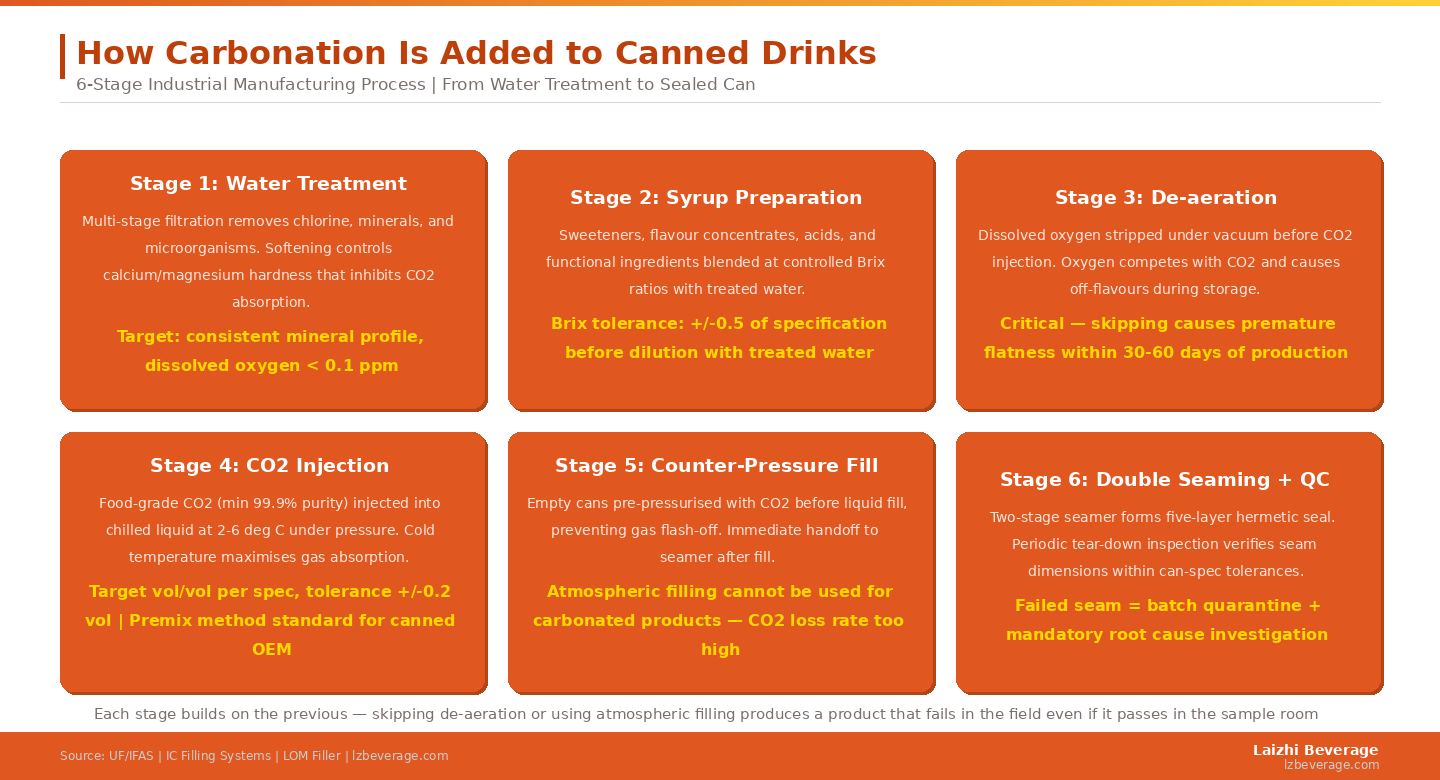
Producing a consistent, properly carbonated canned beverage at commercial scale requires a connected sequence of controlled steps. Each stage feeds the next — failures at any point compound in the finished product. The six core stages are: (1) water treatment, (2) syrup or concentrate preparation, (3) de-aeration, (4) CO2 injection and carbonation, (5) counter-pressure filling, and (6) seaming and quality inspection.
Stage 1: Water Treatment
The base of virtually every carbonated canned beverage — including those made from juice concentrates, flavour syrups, or malt extract — is treated water. Municipal or well water contains dissolved minerals, chlorine, and microorganisms that affect flavour, CO2 retention, and shelf stability. Industrial production lines pass source water through a multi-stage treatment system: coarse filtration removes particulates, a carbon filter eliminates chlorine and organic compounds, a softener removes calcium and magnesium ions that interfere with CO2 absorption, and a UV sterilisation or ozonation stage eliminates microbiological load. The output is a standardised water profile with consistent mineral content — a prerequisite for consistent carbonation across production batches.
Why Water Hardness Matters for Carbonation
Hard water — water with high calcium and magnesium content — resists CO2 absorption because the minerals compete with CO2 for dissolved positions in the liquid. A factory that does not actively manage water hardness will produce batch-to-batch variation in carbonation levels even with a stable CO2 injection rate. This is one of the reasons professional OEM facilities include water treatment as a documented step in their production records, not a background assumption.
Stage 2: Syrup and Concentrate Preparation
For flavoured carbonated beverages, a concentrated syrup is prepared before carbonation. The syrup contains sweeteners (sugar, HFCS, or alternative sweeteners), flavour concentrates, acids (citric, phosphoric, or tartaric), colour, and any functional ingredients. Industrial beverage production specialists document that sugar concentration is measured as Brix — the percentage of dissolved sugars by weight — and must be accurate to within ±0.5 Brix of specification before dilution. The syrup is then blended with treated water at a precisely controlled ratio in an automated mixing tank. This blend, before carbonation, is often called the "base product" or "flat beverage."
Stage 3: De-aeration — The Step Most Buyers Don't Know About
Before CO2 is injected, the flat beverage must have its dissolved oxygen removed. This is the de-aeration step, and it is critical. Dissolved oxygen (DO) in the liquid serves two damaging functions: it prevents CO2 from fully dissolving into the liquid (the two gases compete for the same dissolved positions), and it oxidises flavour compounds — causing the finished product to taste flat, stale, or metallic within weeks of production rather than months.
In a professional carbonated beverage production line, de-aeration is achieved using a vacuum-based de-aerator or a CO2-purge method. As beverage equipment engineers explain, the liquid enters a vertical column under vacuum or gentle CO2 atmosphere, which strips dissolved oxygen out of solution before the liquid reaches the carbonation unit. Target DO levels in de-aerated beverage should be below 0.1 ppm (parts per million). Factories that skip de-aeration or use inadequate equipment produce canned products that lose carbonation prematurely and develop off-flavours during storage — a problem that does not show up at the sample stage but becomes apparent within 30–60 days of production. You can review the production standards at Laizhi Beverage to understand how de-aeration is handled within their OEM carbonation process.
Stage 4: CO2 Injection and Carbonation
With the liquid de-aerated and blended to specification, forced CO2 injection begins. The de-aerated base product is pumped through a carbonation unit — typically a stainless steel vessel or inline carbonation system — where food-grade CO2 is injected under controlled pressure. The liquid is simultaneously chilled (typically to 2–6°C) because colder liquid absorbs and retains CO2 more efficiently. As food science research from the University of Florida confirms, CO2 solubility is a direct function of temperature — the colder the liquid, the more gas it can hold at the same pressure.
Premix vs. Postmix Carbonation
Two approaches are used in commercial canned beverage production. Premix (also called inline carbonation): the full product — base liquid plus syrup plus CO2 — is prepared together in a single batch before reaching the filler. The carbonated product is held in a pressure-sealed buffer tank and drawn continuously into the filling machine. This is the standard method for most canned beverage OEM. Postmix: the syrup concentrate and carbonated water are mixed at the filler nozzle. This is more common for fountain beverage systems than for canned production. For OEM buyers, premix carbonation is the norm — it produces more consistent vol/vol across the can batch. Buyers interested in launching a carbonated product can explore Laizhi Beverage's canned energy drink OEM programme as a starting reference for premix carbonation specifications.
Stage 5: Counter-Pressure Filling
Moving a carbonated liquid from the buffer tank into individual cans without losing CO2 requires counter-pressure filling technology. Standard atmospheric filling — used for still beverages — would cause CO2 to flash off as the liquid flows into the lower-pressure environment of the can, resulting in unacceptable carbonation loss and excessive foaming. Counter-pressure filling works by pre-pressurising each empty can with CO2 before liquid is introduced, creating an equal-pressure environment that prevents gas escape during fill. The liquid enters under positive pressure, the fill level is controlled volumetrically or by weight, and the can proceeds immediately to the seamer.
The speed at which the filled can reaches the seamer matters: excessive delay allows CO2 to begin escaping from the headspace, which is why professional filling lines operate as a continuous, tightly sequenced process rather than a batch-and-wait arrangement. Laizhi Beverage's RTD canned production lines use counter-pressure filling as the standard configuration for all carbonated products, covering energy drinks, sparkling waters, and carbonated RTD coffees.
Stage 6: Seaming, Inspection, and Pasteurisation (Where Required)
Immediately after filling, each can is fed into a double-seamer. The double seam is formed in two operations: the first seaming roller folds the can lid flange under the can body flange, and the second roller compresses the fold into a five-layer hermetic seal. A correctly formed double seam is measured by its countersink depth, seam thickness, seam length, and body hook length — all of which fall within tight tolerances defined by the can manufacturer. Industrial soft drink production specialists confirm that seam integrity testing — periodic seam tear-down, measurement, and projection — is a mandatory in-process check at commercial scale, not an optional quality layer.
For certain products (particularly juice-based carbonated drinks and some functional beverages), a tunnel pasteurisation step follows seaming — the sealed cans pass through a hot water tunnel to achieve commercial sterility. Standard carbonated sodas and energy drinks generally do not require post-fill pasteurisation because their sugar content, low pH, and CO2 antimicrobial properties provide sufficient preservation.
Common FAQs
What type of CO2 is used in commercial canned beverage production?
Food-grade CO2, purified to a minimum 99.9% purity and meeting relevant food standards (EU 958/2013, US FDA CFR 21, or equivalent). According to carbonation science specialists, the CO2 typically originates from industrial fermentation processes, ammonia synthesis, or natural underground sources. Food-grade certification means the gas has been tested for trace contaminants including volatile organic compounds, oil content, and moisture. Buyers should ask factories to confirm they use documented food-grade CO2 supply chains — CO2 quality directly affects flavour and product safety.
Why do some canned beverages taste flat even when the seal is intact?
Three primary causes: insufficient de-aeration before CO2 injection (allowing oxygen to remain in the liquid, which accelerates CO2 loss and oxidises flavours); under-carbonation at the filling stage due to calibration drift on the carbonation unit; or a micro-leak in the double seam that is too small to cause visible deformation but allows gradual CO2 loss during storage. All three are preventable through proper process control and in-line inspection. If you experience premature flatness in production samples, request the factory's DO (dissolved oxygen) measurement records and seam dimension data from that batch.
Can a factory that produces still beverages also produce carbonated drinks?
Not without specific equipment additions and production line reconfiguration. A still-beverage filling line lacks the de-aeration unit, the pressurised carbonation mixing system, and the counter-pressure filling heads required for carbonated production. A factory that claims it can produce carbonated beverages on a standard atmospheric filler is either misinformed or planning to produce a heavily under-carbonated product. Always ask for specific equipment lists and — if possible — a factory visit or video audit of the carbonation line before committing to a production order.
How can I verify that a factory's carbonation process will produce consistent vol/vol results?
Three practical methods: request the factory's calibration records for their carbonation mixing unit (showing when the CO2 measurement sensors were last calibrated and against what reference standard); ask for CO2 measurement data from their last three production batches of a similar product (vol/vol at fill temperature, measured at the filler exit); and include a COA carbonation measurement requirement in your purchase contract, specifying that the finished-product vol/vol must be measured and documented per batch as a delivery condition. Factories that refuse to provide calibration records or finished-product CO2 data are not operating a controlled carbonation process.


