The global craft beer market reached approximately USD 129 billion in 2025 and is projected to grow at a CAGR of 10.8% through 2035. Within that growth, a segment that draws consistently higher prices and stronger consumer loyalty is double-fermented craft beer — a category that importers, distributors, and private-label OEM buyers are increasingly asking about.
The global craft beer market reached approximately USD 129 billion in 2025 and is projected to grow at a CAGR of 10.8% through 2035. Within that growth, a segment that draws consistently higher prices and stronger consumer loyalty is double-fermented craft beer — a category that importers, distributors, and private-label OEM buyers are increasingly asking about. The terminology can be confusing: "double fermentation," "secondary fermentation," "can conditioning," and "refermentation" are sometimes used interchangeably, sometimes differently, and often without technical precision. This article explains exactly what double fermentation means in craft beer production, how it works in aluminum cans specifically, and what it means for OEM buyers evaluating whether to specify it for their own brand.
Key Takeaways
- Double fermentation means two distinct fermentation phases: primary fermentation produces alcohol, secondary (in-can) conditioning naturally carbonates the beer and develops complex flavor compounds.
- In-can conditioning adds 3–6 weeks to the production cycle versus force-carbonated beer — a premium positioning signal that justifies higher retail pricing.
- Natural carbonation produces softer, finer bubbles and greater mouthfeel complexity compared to CO₂ injection — a sensory difference that trained buyers and enthusiast consumers can detect.
- Cans are fully compatible with double fermentation: hermetically sealed aluminum provides the same CO₂-trapping environment as glass bottles, with superior light protection and export logistics.
- OEM buyers specifying double fermentation should expect 8–14 week total lead time from brew day to finished export product, versus 4–8 weeks for force-carbonated craft beer.
What Is Double Fermentation in Craft Beer?
The Definition — From the Source
Secondary fermentation is formally defined in brewing science as any phase of fermentation following the primary fermentation — that is, any fermentation activity occurring after the initial, vigorous conversion of wort sugars into alcohol and carbon dioxide. According to the Oxford Companion to Beer, secondary fermentation serves several purposes depending on the beer style: in lager production, it refers to the maturation and lagering period during which yeast reabsorbs diacetyl (a butter-like off-flavor compound) and the beer clarifies; in British ale brewing, it refers to the conditioning process where residual sugar is slowly consumed by yeast to build natural carbonation and mouthfeel; and in Belgian and Champagne-style beers, it refers to refermentation in the sealed package with added priming sugar and fresh yeast.
When applied to canned craft beer, "double fermentation" or "can conditioning" follows the same principle as bottle conditioning — defined as "bottle refermentation," the original method of naturally carbonating packaged beer by adding priming sugars that yeast ferment inside the sealed container. The difference is the container: an aluminum can instead of a glass bottle. The technical process is identical; the quality outcomes are the same.
Double Fermentation vs. Force Carbonation
Most commercial craft beer is carbonated by forced carbonation — injecting CO₂ gas directly into the finished beer under pressure in a bright tank, then transferring it to cans or bottles under counter-pressure. This process takes hours to days, produces consistent and controllable carbonation levels, and is the standard method for high-volume production. Double fermentation (can conditioning) takes three to six weeks longer, adds a complexity management step (priming sugar dosing and yeast addition before canning), and requires that the finished cans be stored at controlled temperatures for the refermentation period before the product is ready for distribution. The payoff is a flavor and texture profile that force carbonation cannot replicate: softer bubbles, more complex ester and phenol development, and a mouthfeel that experienced buyers describe as "creamy" or "rounded." These sensory attributes are what drive consumer preference for double-fermented products and justify the retail price premium.
The Double Fermentation Process: Stage by Stage
Primary Fermentation: Establishing the Flavor Base
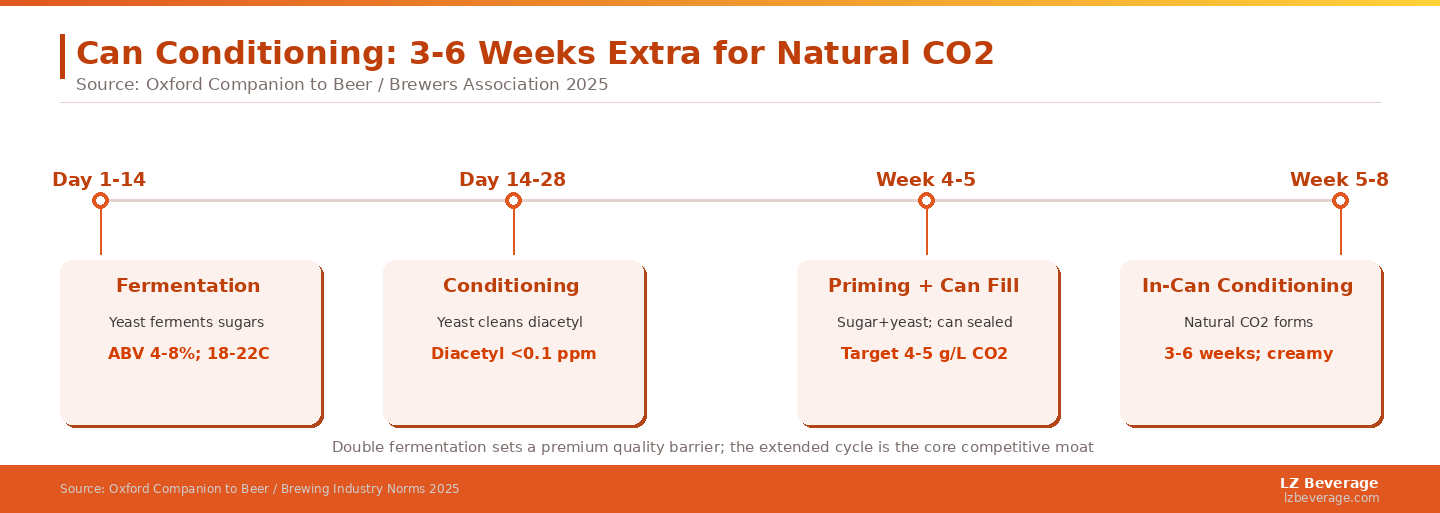
Primary fermentation is where the fundamental character of a craft beer is established. Yeast pitched into cooled wort consumes fermentable sugars, producing alcohol, CO₂ (which is vented rather than captured), and a range of esters and fusel alcohols that determine the beer's flavor profile. For ales, primary fermentation typically runs 7–14 days at 18–22°C. For lagers, fermentation runs at lower temperatures (8–14°C) over a longer period. By the end of primary fermentation, the beer has reached its target alcohol level and its core flavor compounds are in place, but it is not yet ready for packaging — it still contains elevated diacetyl, yeast in suspension, and insufficiently developed conditioning character. Understanding how OEM beer production manages this primary fermentation phase is a key due diligence question for buyers specifying craft production.
Conditioning and Secondary Fermentation: The Quality Development Phase
After primary fermentation, the beer is transferred to conditioning tanks where secondary fermentation occurs. During this phase, residual yeast reabsorbs diacetyl and other fermentation byproducts, the beer clarifies as yeast and proteins settle, and flavor compounds continue to develop and integrate. For double-fermented beer targeting a natural carbonation in the final can, the conditioning phase also determines the exact amount of residual fermentable extract remaining in the beer at the time of packaging — a critical variable, because this residual extract, combined with a precisely calculated priming sugar addition at the packaging stage, will determine the final carbonation level in the sealed can. The brewing team's ability to manage residual extract precisely is the technical competency that separates capable double-fermentation OEM partners from those who can only execute force carbonation.
Priming, Can Filling, and In-Can Conditioning
The final phase of double fermentation begins at the packaging line. A precisely calculated priming sugar solution — typically 4–5 g/L CO₂ equivalent, using dextrose, glucose syrup, or wort — is added to the beer along with a small quantity of conditioning-specific yeast (typically 1 million cells per mL, or approximately 5 g/hL of dry yeast). This mixture is canned immediately, with the can sealed hermetically. The yeast then consume the added sugar inside the sealed can, producing CO₂ that dissolves into the beer and creates natural carbonation. The in-can conditioning period runs 2–6 weeks at controlled temperatures (typically 18–22°C for ales) before the cans are cooled to below 5°C to stabilize the beer. According to Mordor Intelligence, cans represent 54.44% of the craft beer market in 2025 — and among premium craft SKUs, double-fermented can-conditioned products command significantly higher wholesale prices than force-carbonated equivalents. Learn more about beer OEM production specifications and quality processes that apply to double-fermented craft beer production.
Why Importers and Distributors Prefer Double Fermentation
A Genuine Quality Signal in a Crowded Market
The craft beer market is crowded. According to The Business Research Company, 9,796 U.S. craft breweries were operating in 2024 alone. For importers and distributors building a craft beer portfolio for Southeast Asian, Middle Eastern, or European markets, product differentiation is the central challenge. Double fermentation provides a genuine, verifiable, technically meaningful quality claim that differentiates a product from the mass of force-carbonated craft beers. It is not a marketing construct — the process is described in the same scientific literature that defines champagne production and Belgian ale brewing, and buyers who know the industry can validate the claim through sensory evaluation and brewery documentation.
Premium Positioning and Margin Expansion
The extended production cycle of double-fermented beer — 3–6 additional weeks beyond standard craft beer — justifies a production cost premium. At the OEM level, this additional production time adds to the total cost of goods. But the retail and wholesale pricing that double-fermented craft beer commands in premium channels typically offsets this cost multiple times over. According to Market Data Forecast, 65% of millennials globally are willing to pay a premium for craft beer. Among those consumers specifically seeking double-fermented, naturally carbonated products — a segment that has grown substantially as craft beer literacy has expanded — willingness-to-pay premiums are even more pronounced. Importers who establish early positioning in this segment, before competitors enter, build margin structures that are difficult to erode through price competition.
The Can Advantage for Double-Fermented Beer
A persistent misconception among buyers new to the category is that double fermentation requires glass bottles. This is false. Aluminum cans sealed with precision seamers provide the same hermetically sealed environment as glass bottles for in-package conditioning, with the additional advantages of complete UV light exclusion (protecting the delicate conditioning yeast and hop aromatics during the conditioning period) and superior shipping durability for export markets. The Brewers Association, the definitive authority on craft beer standards, does not specify package format as a quality determinant for craft beer. Specifying double fermentation in aluminum cans for your OEM craft beer brand combines the premium positioning of traditional conditioning craft with the logistics efficiency of modern can packaging — a combination that positions your product correctly in both premium retail and export distribution channels.
Frequently Asked Questions
Is double fermentation craft beer in cans the same as bottle-conditioned beer?
Yes, technically. The process is identical: priming sugar and conditioning yeast are added before sealing, and the refermentation occurs inside the sealed package. The only difference is the container — aluminum can versus glass bottle. The Oxford Companion to Beer's definition of bottle conditioning (natural refermentation in a sealed container producing natural carbonation) applies equally to can conditioning. The sensory outcomes — softer carbonation, complex esters, creamier mouthfeel — are the same in both formats when the process is executed correctly.
How do I specify double fermentation when placing an OEM craft beer order?
When briefing an OEM factory for double-fermented craft beer production, specify: the target final carbonation level in volumes of CO₂ (typically 2.2–2.8 volumes for ales; 2.4–3.0 for lagers); the type of priming sugar (dextrose, glucose, or wort); the conditioning yeast strain; and the minimum in-can conditioning period before the product is cold-stabilized and approved for shipment. Request the factory's technical specification document showing how they control residual fermentable extract before packaging — this is the most critical quality control point in double fermentation production. Factories that cannot provide this documentation are unlikely to execute the process consistently at commercial scale. You can also browse the full range of OEM beer and beverage product configurations to understand what production options are available alongside double fermentation.
Does double fermentation affect the shelf life of canned craft beer?
Double-fermented can-conditioned beer typically has a shelf life of 6–12 months at ambient temperatures (or longer when refrigerated), comparable to force-carbonated craft beer in well-sealed aluminum cans. The presence of small quantities of conditioning yeast in the finished beer means that temperature management during distribution is more important than for filtered, force-carbonated products — conditioning yeast can continue to develop flavor character if stored at elevated temperatures for extended periods. For export products targeting markets with warm ambient storage conditions, specify cold-chain requirements from factory to importer warehouse when placing your OEM order. Straits Research projects the craft beer market will reach USD 243 billion by 2033 at 9.5% CAGR — buyers who build double-fermented product lines now will be positioned in the premium tier of this expanding market for the rest of the decade.

