The global craft beer market reached an estimated USD 129 billion in 2025 and is projected to expand at a CAGR of 10.8% through 2035, reaching approximately USD 360 billion. Within this growth story, two shifts are reshaping how brands enter the market: the rise of the aluminum can as the dominant craft packaging format, and the normalization of contract manufacturing as a legitimate and commercially sound go-to-market strategy.
The global craft beer market reached an estimated USD 129 billion in 2025 and is projected to expand at a CAGR of 10.8% through 2035, reaching approximately USD 360 billion. Within this growth story, two shifts are reshaping how brands enter the market: the rise of the aluminum can as the dominant craft packaging format, and the normalization of contract manufacturing as a legitimate and commercially sound go-to-market strategy. For importers, regional distributors, and new beverage brands in Southeast Asia, the Middle East, and Africa, these two trends converge into a clear opportunity — bringing craft beer in a can to their markets through a strategic OEM factory partnership, without building a brewery from scratch.
Key Takeaways
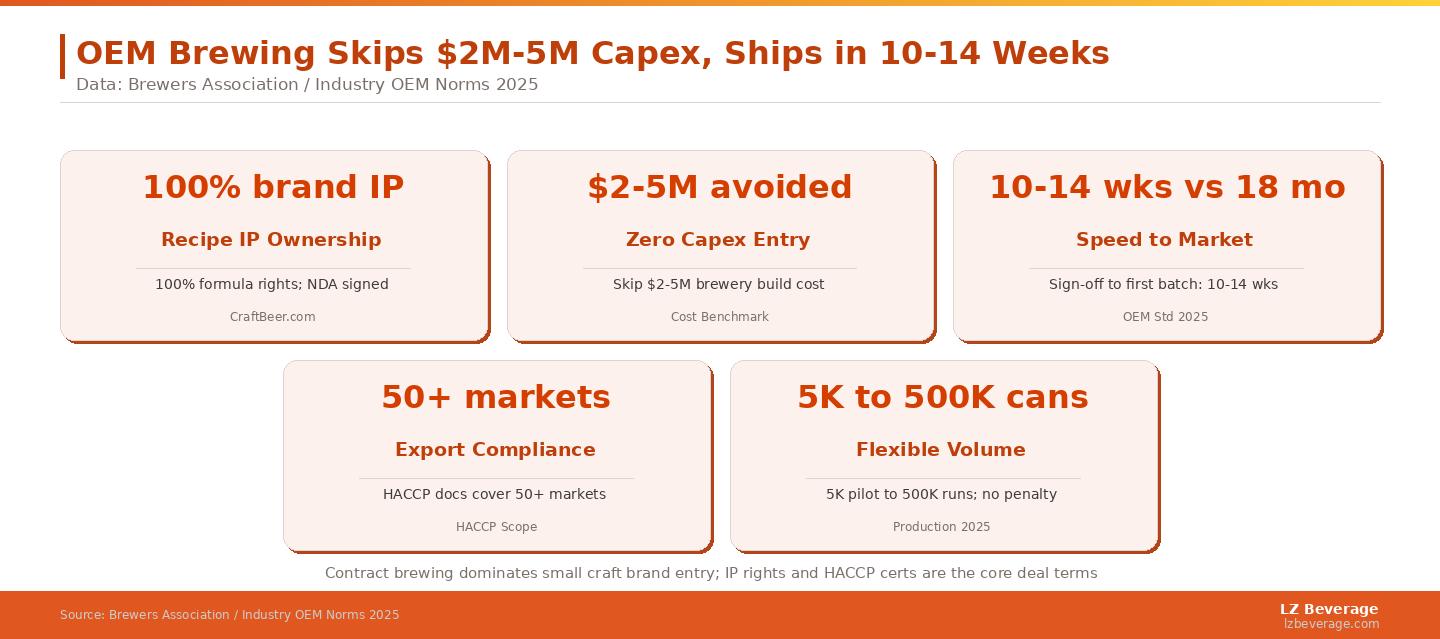
- Craft beer can legally and commercially be produced at an OEM (contract) brewery while the brand owner retains 100% of the recipe intellectual property.
- Cans captured 54.44% of the craft beer packaging market in 2025, overtaking bottles as the dominant format in the global craft segment.
- A small brand can reach retail shelves in 10–14 weeks through an OEM partnership — versus 12–18 months to build and license a brewery.
- Asia-Pacific dominates the global craft beer market with 32% share in 2025, growing at 12.09% CAGR — creating the largest OEM demand window in the category.
- HACCP certification at the OEM factory is the minimum threshold for accessing export markets; look for additional credentials covering food safety, allergen management, and country-specific import requirements.
What Makes Beer "Craft" and Why It Can Come From an OEM Factory
The Official Craft Brewer Definition — and What It Means for OEM Buyers
The most authoritative definition of a craft brewer comes from the Brewers Association, the not-for-profit trade organization representing more than 9,300 small and independent American brewers. Under their framework, a craft brewer must be small (annual production of 6 million barrels or less), independent (less than 25% owned or controlled by a non-craft beverage alcohol entity), and a recognized brewer — which includes brands that control the intellectual property for one or more beer products and have those products brewed for them by a licensed facility. This last point is critical for OEM buyers: according to the Brewers Association definition, a brand does not need to own a physical brewery to qualify as a craft brewer. It needs to control the recipe and have it brewed by a certified partner.
This means that a beverage brand in Malaysia, Saudi Arabia, or Nigeria can own a craft beer recipe, have it brewed and canned at a HACCP-certified facility with export credentials, and legitimately market the product as craft beer — provided the recipe, flavor profile, and quality standards belong to the brand. OEM beer production with full brand IP ownership is the standard model for hundreds of craft labels currently sold in export markets.
Contract Brewing vs. Selling Out: Setting the Record Straight
Some craft beer enthusiasts conflate contract brewing with inauthenticity, but this view misunderstands how most successful beverage businesses operate. As CraftBeer.com, published by the Brewers Association, explains: contract brewing is a common and respected strategy in the craft segment. Brands that choose this model often cite three advantages — reduced upfront capital requirement, faster time to market, and access to higher-quality production infrastructure than a startup brewery could afford. The beer is brewed to the brand's exact recipe, under the brand's quality specifications, and labeled and packaged as the brand's product. What the brand does not own is the physical brewing equipment — it rents certified capacity instead of building it.
Why Cans Have Become the Default Format for Craft Beer
Flavor Protection That Outperforms Bottles
According to Mordor Intelligence, cans captured 54.44% of the global craft beer packaging market in 2025. The technical case for cans in craft beer is unambiguous: aluminum provides a complete barrier against both light and oxygen — the two primary accelerators of hop degradation and beer staling. For unfiltered and unpasteurized craft styles (IPAs, wheat beers, hazy ales), this protection is not a preference but a quality requirement. The Brewers Association's data shows that craft can volume has grown substantially since the early 2010s, with perception among craft drinkers shifting positively as evidence accumulated that canned beer preserves flavor as well as — or better than — glass.
Logistics and Export Advantages
For brands targeting export markets, cans provide decisive logistics advantages. A recycled aluminum can weighs approximately 13 grams, versus roughly 200 grams for a standard glass bottle — a 15-fold weight advantage that directly reduces freight cost per unit of product delivered. Cans also survive the rigors of long-haul shipping more reliably than glass, eliminating breakage loss and the associated disposal and replacement cost. For OEM buyers shipping craft beer from a manufacturing hub to distribution markets in Southeast Asia, the Gulf, or Africa, can format is the practical default for landed-cost optimization.
How Small Craft Beer Brands Partner with an OEM Factory
Step 1: Recipe Development and IP Ownership
The most important document in any OEM brewing relationship is the non-disclosure and intellectual property agreement, signed before any recipe is shared with the factory. The brand's recipe — including ingredient specifications, water chemistry targets, fermentation parameters, and dry-hopping rates — must be clearly documented and contractually owned by the brand. A reputable OEM factory will readily sign an NDA and IP agreement; if a factory is reluctant, that is a signal to find a different partner. Brands without an existing recipe can work with the factory's brewing team under a formula development arrangement — where the brand briefs the flavor and style profile, the factory develops recipe options, and the brand signs off on a formulation that then becomes the brand's property under the agreement.
Step 2: Trial Brewing and Sensory Validation
Before committing to a full production run, brands should request a trial brew — typically 200–500 liters — for sensory evaluation and technical analysis. The trial brew validates that the factory's equipment, ingredient sourcing, and brewing process can reproduce the intended flavor, color, carbonation, and alcohol content to specification. For export markets with import lab requirements (common in the EU, UK, and several Gulf Cooperation Council states), the trial brew batch is also used to generate the analytical data needed for customs documentation. Factor 4–6 weeks into your project timeline for trial brewing, sensory review, and any minor formulation adjustments before production sign-off.
Step 3: Packaging, Label, and Export Documentation
Canned craft beer for export markets requires country-specific label compliance. Requirements vary: alcohol content positioning, health warnings, ingredient declarations, and barcode formats all differ across markets. A factory with export experience should be able to advise on labeling requirements for your target markets and provide sample labels for regulatory review before printing. Factories with established export credentials — including certificate of origin, quality inspection certificates, and phytosanitary documentation — significantly reduce the customs clearance burden on the importing side. Request copies of previously issued export documents to verify the factory's compliance track record before committing.
Step 4: First Production Run and Scaling
The first full production run typically follows within two to four weeks of trial brew approval. For a first-time OEM craft beer buyer, a single 20-foot container of 250 ml cans contains approximately 20,000–24,000 units — enough to test retail placement, gather consumer feedback, and validate reorder potential before committing to a larger run. Discuss beer OEM production configurations with your factory partner before the first run, including whether you want to include both 250 ml and 330 ml can options across the same order to serve different retail channels. According to The Business Research Company, there were 9,796 operating U.S. craft breweries in 2024 — but globally, the far larger demand signal is in export markets where OEM production enables brands to enter without domestic brewing infrastructure.
What to Look for in a Craft Beer OEM Factory
Brewing Credentials Beyond HACCP
For craft beer specifically, HACCP is the baseline, not the differentiator. Craft beer production involves fermentation management, yeast health monitoring, hop handling, and sensory quality control that require brewing expertise beyond standard beverage filling. Ask prospective OEM factories for their specific brewing capability credentials: What beer styles have they produced commercially? What is their brewmaster's background? Can they share referral contacts with existing craft beer clients? A factory that primarily produces carbonated soft drinks or energy drinks but claims to offer craft beer production should demonstrate its brewing competency specifically — not just its general beverage production credentials.
Export Market Coverage and Distribution Readiness
The best OEM factory for a craft beer brand targeting export markets is one that can produce, certify, and document the product for the specific import requirements of your target markets — not one that simply fills cans and hands them over at the factory gate. Understanding the full scope of OEM services — from recipe development through export documentation and logistics coordination — before choosing a manufacturing partner will prevent costly surprises at the customs clearance stage. According to Straits Research, the global craft beer market is projected to grow at 9.5% CAGR to USD 243 billion by 2033, with Asia-Pacific driving the fastest volume expansion — making export-ready OEM production the strategically correct model for brands positioned to capture this growth.
Frequently Asked Questions
Is craft beer produced at an OEM factory "authentic" craft beer?
Yes, by both the commercial and the Brewers Association definition. Authenticity in craft beer is determined by recipe ownership, ingredient quality, and brewing philosophy — not by which facility brews it. Hundreds of well-regarded craft beer brands globally are produced at contract or OEM breweries. The key requirement is that the brand controls the recipe, specifies the ingredients, and takes responsibility for the quality of the finished product. A contract-brewed craft beer produced to exact specifications at a HACCP-certified brewery is fully legitimate under industry standards.
What beer styles can an OEM factory produce in cans?
A well-equipped OEM brewery can produce the full range of commercial beer styles in cans: lager, pale ale, IPA, wheat beer, stout, and seasonal variants. Lager is the most globally accessible style for export markets (highest volume, most universal consumer acceptance) and is also the most production-efficient for OEM runs. Market Data Forecast research indicates that 65% of millennials are willing to pay a premium for craft beer globally — supporting a pricing strategy that justifies lager production alongside more specialized ale styles for premium positioning.
How do I protect my recipe when working with an OEM brewery?
The recipe protection framework consists of three elements: a signed NDA covering all technical documentation shared with the factory; an IP assignment clause in the manufacturing agreement confirming the brand owns any formulations developed under the relationship; and a non-compete or exclusivity clause preventing the factory from producing the same recipe for competing brands. These are standard terms in professional OEM brewing agreements. Any factory that resists signing these protections should be disqualified from the selection process regardless of other capabilities.


