Zero sugar is no longer a niche within the carbonated beverage market — it is rapidly becoming the default formulation direction for the entire category. Future Market Insights projects the zero sugar beverages segment at USD 5.0 billion in 2026, growing at a 14.7% CAGR to reach USD 19.6 billion by 2036 — with zero-sugar formulations forecast to exceed 50% of total CSD volume in North America by 2030.
Zero sugar is no longer a niche within the carbonated beverage market — it is rapidly becoming the default formulation direction for the entire category. Future Market Insights projects the zero sugar beverages segment at USD 5.0 billion in 2026, growing at a 14.7% CAGR to reach USD 19.6 billion by 2036 — with zero-sugar formulations forecast to exceed 50% of total CSD volume in North America by 2030. The market pressure is real: WHO's 2024 updated guidelines recommend limiting free sugar intake to less than 5% of total daily energy, accelerating both regulatory action and consumer demand globally. PepsiCo reported that Pepsi Zero Sugar achieved 30.8% year-to-date sales growth in 2025, and Keurig Dr Pepper converted from zero zero-sugar products in 2020 to over 40 distinct zero-sugar SKUs by January 2026. For OEM brand owners, the question is no longer whether to launch a zero-sugar variant — it is how to formulate one that consumers actually want to drink.
Key Takeaways
- Zero-sugar formulation is a system design problem, not an ingredient substitution. Removing sugar requires simultaneously rebuilding sweetness profile, mouthfeel, flavor stability, and pH balance.
- No single sweetener perfectly replicates sugar's sensory character. The most commercially successful zero-sugar carbonated drinks use a blend of two or more sweeteners, each covering a different part of the sweetness curve.
- Natural sweeteners (stevia, monk fruit) command consumer preference but present technical challenges: bitterness, solubility, and stability at low pH that must be managed through formulation engineering.
- The "zero sugar" label definition varies across the USA, EU, China, and other markets — your OEM brief must specify which jurisdiction's threshold you are targeting, as this determines the approved maximum residual sugar.
Why Zero-Sugar Carbonated Formulation Is Technically Demanding
Sugar in a carbonated drink is not just a sweetener — it is a structural ingredient. A 330 mL can of full-sugar cola delivers approximately 35–39 g of sucrose, which contributes sweetness intensity, viscosity and body perception, flavor compound stability, and the smooth sweetness onset-and-fade curve that consumers register as "refreshing." When you remove all of that sucrose, you are not just changing the flavor profile — you are fundamentally altering the physical chemistry of the beverage system. A 2025 PMC review on overcoming sensory barriers in sugar-free beverages describes this comprehensively: taste, viscosity, and mouthfeel each require independent solutions because they are governed by different mechanisms in solution. The review notes that in EFSA's 2022 consumer research across EU member states, taste was the most important food choice factor — and yet successful zero-sugar reformulation requires managing at least five sensory dimensions simultaneously.
The commercial consequence of underestimating this complexity is well-documented. Brand owners who brief an OEM factory with "same formula, replace sugar with sweetener" routinely receive first samples that taste bitter or artificial, feel thinner and less satisfying than the original, and lose carbonation perception faster after opening. The corrections required — flavor system overhaul, mouthfeel enhancement, pH re-balancing, and often a full sensory re-profiling — can add three to six months to a product launch timeline if not anticipated at the brief stage.
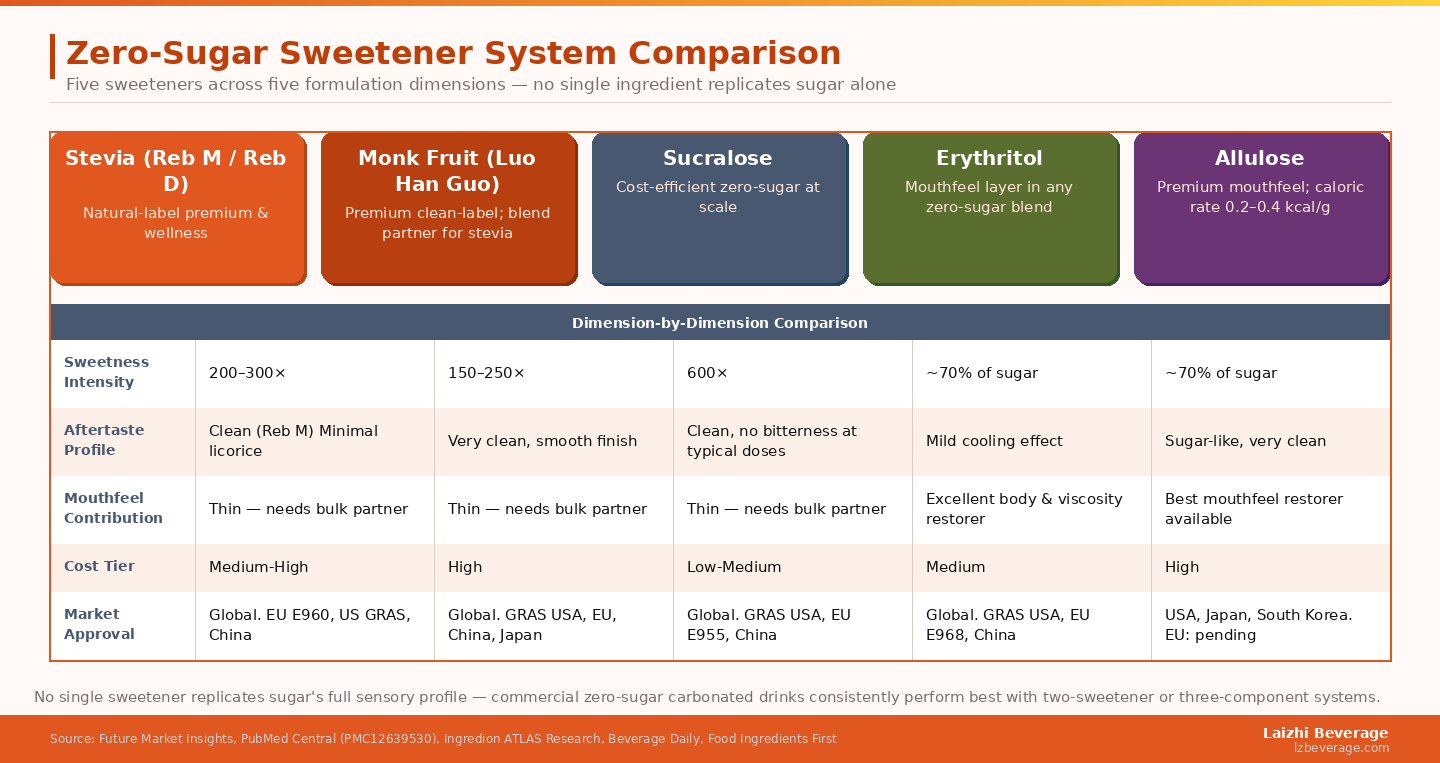
The Sweetener Toolkit: Properties, Trade-offs, and Combinations
Stevia (Steviol Glycosides)
Stevia has achieved mainstream status in zero-sugar beverage formulation and is the consumer's preferred natural sweetener: Ingredion's consumer research finds that nearly 75% of consumers consider stevia the most acceptable sweetener in nutritional beverages and energy drinks, with acceptance rising 15% from 2020 to 2023. The challenge with conventional stevia (Reb A) is a characteristic licorice-like aftertaste and bitterness at the concentrations needed for full sugar replacement in a carbonated format. Next-generation steviol glycosides — particularly Reb M and Reb D — deliver a cleaner, more sugar-like sweetness with a faster onset and shorter lingering. Beverage Daily reports that SteviUp M2, launched July 2025, delivers approximately 200× the sweetness of sugar with superior solubility and no clouding — critical for clear canned carbonated drinks where appearance is part of the consumer experience. Precision fermentation steviol glycosides were also approved for EU use in 2025, expanding supply options and potentially reducing cost barriers.
Monk Fruit Extract (Luo Han Guo)
Monk fruit delivers a smooth, clean sweetness with minimal aftertaste — typically rated higher than conventional stevia on perceptual sugar-likeness in consumer testing. It is 150–250× sweeter than sucrose, generally recognized as safe (GRAS) in the USA, and approved in the EU, China, Japan, and most major markets. Its cost is higher than stevia, but its cleaner taste profile makes it especially effective in combination with stevia: monk fruit covers the immediate sweetness onset while stevia provides mid-range intensity, and together they produce a rounder, fuller sweetness profile than either achieves alone. According to Food Ingredients First's 2025 sweetener innovation analysis, monk fruit concentrate use is growing the fastest of any sweetener category in new product development. For a premium zero-sugar carbonated energy drink or sparkling tea targeting health-conscious consumers, a stevia + monk fruit blend is increasingly the formulation standard. You can explore Laizhi's zero-sugar energy drink OEM options to understand how these systems are applied at commercial production scale.
Sucralose
Sucralose remains the most widely used sweetener in zero-sugar carbonated drink formulation globally — Innova Market Insights data shows sucralose leads all sweeteners in new product development applications. At 600× the sweetness intensity of sucrose, it is extremely cost-efficient and highly stable across the acidic, carbonated conditions that challenge other sweeteners. It produces no bitter or licorice aftertaste at typical use levels, and its flavor profile is clean and immediate. The growing consumer concern is on the "natural" positioning axis: in multiple studies, consumers prefer stevia and monk fruit over sucralose when asked about healthiness perception, even when blind taste tests show equivalent preference. For brands prioritizing clean-label and natural ingredient positioning — increasingly the requirement in European and premium North American retail — sucralose faces a perception challenge that affects label strategy even when taste performance is strong.
Erythritol and Allulose: The Mouthfeel Restorers
Neither erythritol nor allulose is capable of fully replacing sugar's sweetness on its own — erythritol is about 70% as sweet as sugar, and allulose about 70% as well. But both play a critical secondary role in zero-sugar formulation: they restore the body, viscosity, and mouthfeel that disappear when sugar is removed, without adding meaningful calories or raising blood sugar. Erythritol has excellent stability in acidic carbonated formats and produces a mild cooling sensation on the palate, which complements citrus-forward flavor systems. Allulose is metabolized at a caloric rate of 0.2–0.4 kcal/g (compared to 4 kcal/g for sucrose) and behaves more like sugar in solution — helping restore mouthfeel while qualifying for zero-calorie labeling in most markets. The trade-off is cost: both are more expensive than sucrose per kilogram, though the use rates needed for mouthfeel restoration are modest compared to sweetness replacement doses. As Satoria Nutrisentials' reformulation guide notes, hydrocolloids and prebiotic fibers can also serve a mouthfeel-restoration role when combined with a primary high-intensity sweetener system, offering additional label benefit (fiber content claim) beyond the structural function.
The System Design Approach: How Commercial Zero-Sugar Formulas Are Built
The Three-Layer Architecture
The most reliable framework for developing a zero-sugar carbonated canned drink treats the formulation as three distinct layers that must each be solved independently before being integrated. The first layer is the sweetness architecture: selecting the primary high-intensity sweetener (or blend), determining target sweetness intensity relative to the full-sugar original, and managing the onset-and-fade profile so that the sweetness "arrives" quickly, peaks at the right intensity, and dissipates without leaving a bitter or astringent residue. The second layer is the body and mouthfeel layer: using bulk sweeteners (erythritol, allulose) or soluble fibers to restore the physical texture that sugar provides in solution. The third layer is the flavor stability layer: sugar acts as a physical carrier and stabilizer for volatile flavor compounds, and its removal often causes fruit notes and top flavors to fade faster during shelf life. A slightly higher initial flavor loading, plus the right choice of flavor system format (plated vs emulsified), typically compensates for this.
pH and Acidulant Re-Calibration
Removing sugar changes the perceived acid balance of the beverage — the same pH and acidulant concentration that tastes well-balanced with 10 g/100 mL of sugar can taste sharp and aggressive at zero sugar. This is because sugar's sweetness masks acid perception, and without it, the tartness is more forward. Zero-sugar formulations almost always require pH adjustment (typically 0.1–0.3 units higher than the full-sugar equivalent) and sometimes a switch from a more aggressive acidulant (phosphoric in cola, high-concentration citric in energy drinks) to a more gentle one (malic acid, or a citric/malic blend) that delivers tartness without sharpness. This re-calibration step is frequently missed in brief-stage formulation discussions, leading to first samples that taste correctly sweet but are perceived as too acidic.
Regulatory Compliance: Defining "Zero Sugar" Across Markets
The "zero sugar" or "sugar-free" label claim is defined differently across key export markets, and your OEM brief must specify which standard you are targeting. In the USA, FDA defines zero sugar as less than 0.5 g per reference amount and per serving. EU regulations classify a beverage as "sugar-free" when it contains no more than 0.5 g sugars per 100 mL. China's standard (GB 28050) classifies "无糖" (no sugar) as ≤0.5 g per 100 mL. In all three major markets the threshold is identical — but residual sugars from natural flavor ingredients, fermented components, or minor ingredient contributions can bring a formula closer to the threshold than anticipated. A formula designed at "target zero" without accounting for these contributions can fail label compliance in the final production run. The practical recommendation is to target ≤0.3 g/100 mL at the formulation stage, leaving a 0.2 g buffer for production variability.
For brands targeting Muslim-majority markets across Southeast Asia and the Middle East, HALAL certification requires that all ingredients — including sweeteners, flavoring agents, and processing aids — meet HALAL standards. Most commercial grades of stevia, monk fruit, sucralose, and erythritol are HALAL-certifiable, but documentation must be verified at the ingredient supplier level before inclusion in a product for these markets. Laizhi's export-oriented production system is designed to support HALAL compliance documentation — the factory capabilities and certification overview provides the foundation for supplier documentation management across multiple market requirements.
What to Include in Your Zero-Sugar OEM Product Brief
A complete zero-sugar OEM product brief is substantially more detailed than a full-sugar brief, because each element of the sweetener system has downstream implications for taste, stability, cost, and labeling. The minimum specification includes: (1) target sweetener system — specific sweeteners by name and approved concentration range, not just "stevia-based"; (2) target sweetness intensity as a percentage of the full-sugar reference, typically 85–100% of the original; (3) mouthfeel specification — whether bulk sweetener or fiber addition is acceptable, and at what dose; (4) pH target and acceptable tolerance, with any required shift from the full-sugar pH; (5) acceptable acidulants and their approved combination ratios; (6) flavor system approach (natural vs artificial; specific flavor house or open competition); and (7) label compliance standard — which market's "zero sugar" threshold is the controlling definition.
Providing all seven elements at the brief stage typically reduces first-sample-to-approval time by 30–50% compared to iterative briefs that add constraints after first samples. It also reduces reformulation cost significantly when the product targets multiple markets simultaneously, since the brief becomes the single source of truth that all export variants reference. For brands starting from scratch with a zero-sugar carbonated concept, the Laizhi RTD product development service includes formulation consultation support alongside OEM production, ensuring that formulation decisions and production realities are aligned from the outset. Ready to discuss your zero-sugar carbonated canned drink concept? Contact the Laizhi team to start a formulation conversation.
Frequently Asked Questions
What is the cleanest-tasting zero-calorie sweetener for carbonated drinks?
Monk fruit extract and high-purity Reb M stevia (such as the SteviUp M2 launched in 2025) are currently rated highest for clean sweetness in carbonated beverage applications. Monk fruit produces a smooth, immediate sweetness with minimal aftertaste; Reb M delivers a more sugar-like sweetness curve than conventional Reb A stevia. The optimal choice depends on your flavor profile, pH environment, and label positioning — most premium zero-sugar carbonated drinks use a combination of the two rather than either alone.
Will a zero-sugar formula have the same shelf life as a full-sugar version?
Shelf life may be slightly shorter in zero-sugar formats if the flavor system relies on sugar for physical stability of volatile compounds. However, with appropriate flavor system design and controlled filling (low dissolved oxygen, proper seam integrity), zero-sugar carbonated canned drinks routinely achieve 12–15 month shelf life — comparable to full-sugar formats at equivalent quality specifications. The key variable is filling oxygen control, not sugar level.
Can I use the same production line for full-sugar and zero-sugar formats?
Yes, with proper CIP (clean-in-place) protocols between runs. High-intensity sweetener residues at parts-per-million levels can carry over between batches and affect flavor balance in the subsequent run if sanitation is incomplete. A professional OEM partner with experience in both formats will have validated changeover procedures that prevent cross-contamination. This is worth confirming explicitly in your OEM audit and quality agreement.
How do I prevent bitterness in a stevia-sweetened carbonated drink?
Four approaches reliably reduce stevia-related bitterness: use high-purity Reb M or Reb D rather than Reb A (the bitterness profile is significantly cleaner); blend stevia with a small amount of monk fruit or erythritol (which masks bitter notes through sweetness overlap); add a bitterness-masking flavor ingredient (commercially available from several flavor houses); and adjust pH slightly upward, as bitterness from steviol glycosides is more perceptible at lower pH levels. Addressing all four systematically typically produces a first sample that clears the bitterness threshold without requiring higher-cost sweetener systems.
Is zero-sugar formulation more expensive to produce at OEM scale?
The ingredient cost per liter is typically 10–25% higher for a zero-sugar formulation than a full-sugar equivalent, primarily due to the higher per-kilogram cost of high-intensity sweeteners compared to bulk sucrose. However, zero-sugar products routinely command a 15–30% retail price premium over full-sugar equivalents, and they avoid sugar tax liabilities in most regulated markets. Net margin on zero-sugar OEM production is typically comparable to or better than full-sugar formats when export market distribution costs and tax liabilities are fully accounted for.


