Every carbonated canned drink is, chemically speaking, an acidic system. The CO2 dissolved under pressure reacts with water to form carbonic acid; the acidulants added to balance sweetness push pH further down; and the resulting acidic environment is fundamental to how the drink tastes, how long it stays stable, and whether the aluminum can holding it lasts the distance to your target market.
Every carbonated canned drink is, chemically speaking, an acidic system. The CO2 dissolved under pressure reacts with water to form carbonic acid; the acidulants added to balance sweetness push pH further down; and the resulting acidic environment is fundamental to how the drink tastes, how long it stays stable, and whether the aluminum can holding it lasts the distance to your target market. According to a comprehensive pH study published in PubMed Central examining 380 commercially available US beverages, 93% had a pH below 4.0, with the mean pH of sodas at 3.12 and energy drinks at 3.13. For brand owners developing a carbonated canned product, understanding pH is not optional background chemistry — it is one of the three or four most consequential formulation decisions you will make.
Key Takeaways
- Most commercially carbonated drinks fall in the pH 2.5–4.0 range, a window defined by the competing demands of taste appeal, microbial safety, and packaging compatibility.
- pH directly controls flavor perception: below 3.0 creates a sharp, tart intensity; above 3.8 produces a softer, often flatter profile that may need additional acidulant to feel "alive."
- Low pH (below 3.0) is your primary antimicrobial shield in a carbonated canned drink — more important than preservatives alone for inhibiting yeast and bacteria.
- Very low pH (below 2.8) increases stress on the internal epoxy coating of aluminum cans; even a 0.1 unit drift over months of warm storage can affect flavor and shelf-life integrity.
What pH Actually Measures in a Carbonated Beverage
The Role of Carbonic Acid
When CO2 dissolves into water under pressure, it forms carbonic acid (H₂CO₃). This reaction is the chemical foundation of every carbonated drink's "bite." Carbonic acid is a weak acid — its contribution to pH is modest compared to citric or phosphoric acid — but it amplifies the overall acidic sensation and interacts with taste receptors in ways that pure CO2 fizz alone cannot. When a consumer opens a can and the pressure drops, CO2 escapes, carbonic acid concentration falls, and the perceived "flatness" that follows is partly a pH effect: the drink measurably moves toward neutral as carbonation dissipates, and the flavor balance shifts accordingly.
The Three Primary Acidulants and What They Do
As documented in ScienceDirect's comprehensive overview of soft drink science, the main acidulants used across commercial carbonated categories are phosphoric acid (dominant in cola), citric acid (most fruit-flavored and energy drinks), and malic acid (increasingly common in low-sugar and wellness formats). Each produces a distinctly different sensory character at the same pH: phosphoric acid delivers a dry, sharp astringency that is the signature of classic cola; citric acid creates a bright, clean tartness with a quick onset and fast fade; and malic acid produces a rounder, more lingering sourness that is particularly effective in masking sweetener aftertaste in zero-sugar formulas. Choosing the right acidulant — or the right combination — is therefore both a chemistry decision and a flavor architecture decision.
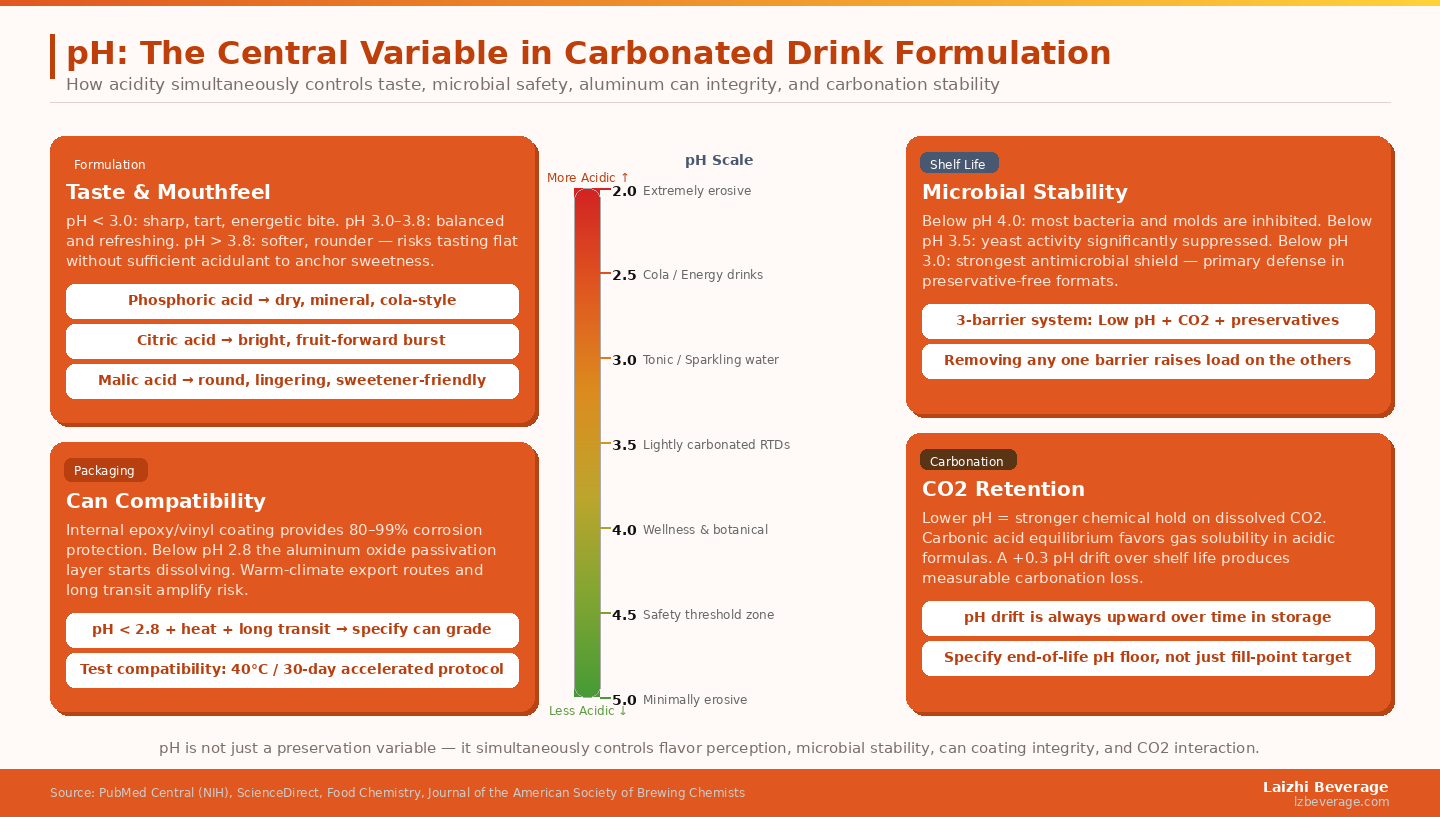
Typical pH Ranges Across Carbonated Drink Categories
The practical pH window for commercial carbonated drinks spans roughly 2.5 to 4.5, with the vast majority of mass-market products clustering between 2.8 and 3.8. Cola-style beverages typically target the lowest range, with peer-reviewed measurement studies placing Coca-Cola at pH 2.74 and Schweppes tonic water at 2.73. This extreme acidity results from the combined effect of phosphoric acid (cola's primary acidulant) and carbonic acid, and it is precisely calibrated to create the sharp, immediately refreshing sensation that the category relies on.
Energy drinks cluster slightly higher, with a mean pH around 3.13 and a range of 2.47 to 3.97. Most of their acidity comes from citric acid, which produces a different sensory experience than phosphoric acid at the same pH — brighter, more fruit-like, and less mineral. Sparkling waters and flavored seltzers typically occupy the 3.0–4.5 range, with the carbonation from CO2 being the primary acidifying mechanism and added flavors nudging the pH depending on the acidity of the flavor system used. Lightly carbonated teas and wellness RTDs, which often target a gentler acidic profile to preserve delicate botanical or tea flavors, typically sit between 3.5 and 4.5. You can view the full range of RTD formats available for private label production to understand how pH targets are set across different carbonated categories.
How pH Shapes Taste Perception
The Sweet-Acid Balance That Defines Every Formula
pH does not exist in isolation in a beverage formula — it interacts continuously with sweetness, carbonation level, and flavor intensity to produce the overall taste impression. The key dynamic is the balance between sugar (or sweetener) and acid: sweetness numbs the palate's sensitivity to acidity, while acid amplifies the perception of fruitiness and cuts through sweetness to prevent the flat, cloying sensation that a high-sugar drink would otherwise produce. In practice, this means that higher-sugar formulas typically require a lower target pH (more acid) to feel balanced, while zero-sugar formulas often use less aggressive acidification because sweeteners — particularly stevia and monk fruit — have inherent bitter or astringent notes that acidity can amplify rather than counterbalance.
pH and the Release of Flavor Compounds
The relationship between pH and flavor is not limited to simple tartness. Research published in Food Chemistry on pH effects in soft drink model systems found that increasing concentrations of citric acid — the mechanism by which pH is lowered in most fruit-flavored carbonated drinks — can actually suppress the release of key ester and limonene flavor compounds at high concentrations, even as it amplifies tartness perception. This creates a formulation tension: the optimal pH for microbial stability (lower is better) may not be the optimal pH for flavor expressiveness (particularly for delicate fruit and botanical notes). The practical resolution is to find the lowest pH at which the target flavor profile still reads clearly, and to build your acidulant selection around that constraint rather than adding acid first and balancing flavor afterward.
This interaction is especially important for energy drink formulations, where the high caffeine content already compresses the palate's sensitivity, and the acidulant choice determines whether the product feels "clean and sharp" or "harsh and sour." If you are developing a custom energy drink formula for OEM production, specifying your target pH alongside your acidulant type (not just citric acid dosage) gives your manufacturer the information needed to build a first-sample formula that is already in the right taste quadrant.
pH as the Primary Shelf-Life Defense Mechanism
Why pH Below 4.0 Is the Microbial Tipping Point
The low pH of carbonated soft drinks is not an accident — it is the product's most fundamental preservation mechanism. A peer-reviewed review of microbial stability in carbonated soft drinks identifies the three major barriers to spoilage in these products: low pH from acidulants (primarily citric and phosphoric acid), chemical preservatives such as potassium sorbate and sodium benzoate, and the CO2 content itself. Of these three, pH is the foundation. Most spoilage-relevant bacteria — including pathogens — cannot survive below pH 4.0 in an aqueous environment. Filamentous molds are similarly inhibited. The organisms that do present a risk in carbonated drinks are the acid-tolerant ones: fermentative and oxidative yeasts, and certain lactic acid bacteria that can survive down to pH 3.0.
What this means practically for brand owners is that a formulation with a target pH of 3.2 inherently has a different shelf-life risk profile than one at pH 3.8, even if everything else — carbonation level, preservative dosage, filling temperature, can seam quality — is identical. The higher-pH product requires more active reliance on preservatives and excellent oxygen control to achieve the same shelf stability. For export brands targeting warm-climate markets in Southeast Asia or the Middle East, where distribution chain temperatures can routinely exceed 30°C, a pH drift toward 4.0 during storage is a genuine shelf-life risk that must be accounted for in the formulation design stage, not managed as a quality exception after the fact.
The Synergy Between CO2, pH, and Preservatives
In a well-designed carbonated canned drink, pH, CO2, and preservatives work as an integrated system rather than as independent variables. CO2 itself has mild antimicrobial properties — it shifts the environment toward carbonic acid and creates a hostile atmosphere for aerobic spoilage organisms in the headspace. Low pH from acidulants inhibits the metabolic activity of both bacteria and yeasts. Preservatives (where used) provide the final backup against the acid-tolerant yeast strains that can survive the first two barriers. Removing or reducing any one element increases the load on the others. This is why brands moving toward preservative-free formulations — a growing trend driven by clean-label demand — must compensate with a tighter pH control specification, often targeting the lower end of their acceptable pH range, and must pay closer attention to oxygen pick-up during filling. Laizhi Beverage's HACCP-certified production system includes precise dissolved oxygen monitoring at the filling stage — learn more about our quality control infrastructure and how it supports the multi-barrier approach to shelf-life assurance.
pH and Aluminum Can Compatibility: What Every Brand Owner Must Know
How Low pH Attacks the Can Interior
Aluminum is a reactive metal. In its natural state, it forms a thin aluminum oxide (Al₂O₃) layer that passivates the surface and prevents further corrosion. Below pH 3.0, this passivation layer begins to dissolve, and without adequate protection, the beverage makes direct contact with the aluminum alloy. Modern aluminum cans are lined with a thin epoxy or vinyl-phenolic coating that provides a barrier between the beverage and the metal — and this coating is the reason colas at pH 2.5 can be safely stored for 12–18 months. Research published in PMC (National Institutes of Health) on the corrosion behavior of aluminum-coated cans found that internal coatings provide 80–99% corrosion protection compared to uncoated aluminum, but emphasizes that the protection is not absolute — under sufficient acidic stress over time, some aluminum migration into the beverage does occur.
The factors that accelerate this process are: pH below 2.8, elevated storage temperature (every 10°C increase roughly doubles the rate of migration), the presence of aggressive ions such as chloride and copper (which can come from water quality or certain flavor ingredients), and extended storage duration. For a standard cola-type product at pH 2.6–2.8 stored in a temperature-controlled supply chain and consumed within 12 months, the risk is well-managed by a properly coated can. For a high-acid, complex-formula product (such as a sour-style energy drink, a kombucha-hybrid, or a citrus-forward sparkling tea at pH below 3.0) targeted at an export market with long transit times and uncontrolled temperature storage, the can-beverage compatibility question must be addressed explicitly in the product development brief.
A further consideration: research in the Journal of the American Society of Brewing Chemists on sour beer canning found that lactic and acetic acids — common in fermented and probiotic-style beverages — promote accelerated aluminum can corrosion during storage, over and above what the pH alone would predict. If your product contains any fermentation-derived acids or probiotic cultures, this is an explicit compatibility issue to raise with your OEM partner's quality team before finalizing your packaging specification. You can explore Laizhi's beer OEM production capabilities, where managing the full spectrum of acidic and fermented products is part of standard quality protocol.
Specifying pH to Your OEM Partner: The Non-Negotiable Parameters
A complete pH specification in an OEM product brief must include four elements: the target pH (e.g., 3.2); the acceptable tolerance band (typically ±0.1 for consistency, ±0.2 as a production tolerance); the measurement point (at filling, post-warming, or end-of-shelf-life); and the specific acidulant(s) approved for use — because two products at identical pH using different acids (citric vs. phosphoric, for example) will have different flavor profiles, different buffering capacities, and potentially different interactions with the can coating. Providing a pH range without an acidulant specification leaves significant latitude in the formula that may produce samples that technically pass the spec but taste wrong or have different stability characteristics.
Controlling and Monitoring pH During OEM Production
pH can drift during production for several reasons: temperature variation in ingredient mixing, water quality inconsistency (tap water pH can vary ±0.5 between batches), CO2 absorption during carbonation (which adds carbonic acid and lowers pH slightly), and caramelization reactions in heated blending steps. A professional OEM facility monitors pH at a minimum of three production checkpoints: after syrup preparation (before carbonation), after carbonation and inline mixing (pre-fill), and on the filled, sealed can after warming to room temperature. The final in-can pH is the specification-relevant measurement — the one that determines whether the product the consumer receives matches the formula intent.
For brand owners launching across multiple markets, it is also worth specifying the maximum acceptable pH drift over the product's intended shelf life. A product that is pH 3.2 at filling and pH 3.6 at 18 months has experienced significant flavor change — the drink will taste noticeably flatter and less refreshing at end of life. Building pH stability testing into your product development process, and defining an end-of-shelf-life pH limit in addition to your fill-point specification, is the professional standard for any OEM product intended for export distribution.
Frequently Asked Questions
What is the ideal pH for a carbonated energy drink?
Most commercial energy drinks target a pH of 2.8–3.5, balancing the antimicrobial stability benefits of low pH against the harshness that becomes noticeable below 2.8. Citric acid is the most common acidulant in energy drink formulations. The optimal pH for your specific formula depends on your sugar or sweetener system, your flavor architecture, and your target consumer's taste preference. For brands developing a custom energy drink formula, the Laizhi energy drink OEM service includes formulation support from experienced technicians who can help define the right pH target based on your brief.
Can I use a higher pH to make my drink healthier or less acidic?
You can target a higher pH (closer to 4.0–4.5), and some wellness-oriented sparkling beverages deliberately do so to differentiate from the sharp acidity of traditional sodas. However, a higher pH reduces your microbial safety margin, typically requiring higher preservative levels, better oxygen control at filling, and potentially a shorter shelf-life target — unless the formula is structured to compensate through higher CO2 volume or other antimicrobial measures. It is a legitimate formulation strategy, but it requires conscious trade-off management, not just a pH reduction.
How does pH change during storage in a can?
pH typically drifts upward (becomes less acidic) over extended storage, primarily due to CO2 loss through the can seam and the gradual neutralization of acidulants through interaction with the beverage's own chemistry. The rate of drift depends on storage temperature, seam integrity, oxygen pick-up at filling, and the buffering capacity of the specific acidulant system. A well-formulated and properly filled canned drink should show less than 0.3 pH unit drift over 12 months at room temperature. Greater drift than this indicates either a formula stability issue, a filling oxygen problem, or a seam quality concern.
Does pH affect carbonation retention in the can?
Indirectly, yes. Lower pH increases the equilibrium partial pressure of CO2, meaning the beverage holds carbonation more readily at a given temperature and pressure. This is one reason why colas and energy drinks (with their low pH and higher CO2 volumes) tend to retain their carbonation well in sealed cans. Higher-pH sparkling waters, by contrast, have less chemical "grip" on their CO2, which is one reason they are perceived as losing fizz more quickly once opened, even if the in-can carbonation level at filling was identical.
What should I tell my OEM factory about pH in my product brief?
Your pH specification should include: (1) target pH at fill, (2) acceptable tolerance band (±0.1 to ±0.2), (3) approved acidulant(s) with dosage ranges, (4) end-of-shelf-life minimum pH, and (5) any can compatibility concerns based on your formula's acid profile or ionic composition. A complete brief prevents the most common reformulation issue in OEM carbonated drink development, where the sample meets pH spec but fails taste or stability review because the acidulant or its concentration was not specified.


