Choosing the wrong canned beverage OEM factory is one of the most costly mistakes a brand can make — not just financially, but in time lost, market opportunities missed, and brand reputation damaged by quality failures. Beverage industry advisors consistently emphasize that the vetting process requires as much attention as the product itself. The seven questions below represent the minimum due diligence every buyer should complete before signing any manufacturing agreement for canned beverages.
Choosing the wrong canned beverage OEM factory is one of the most costly mistakes a brand can make — not just financially, but in time lost, market opportunities missed, and brand reputation damaged by quality failures. Beverage industry advisors consistently emphasize that the vetting process requires as much attention as the product itself. The seven questions below represent the minimum due diligence every buyer should complete before signing any manufacturing agreement for canned beverages.
Key Takeaways
- Certifications are the baseline, not the finish line — verify they are current and relevant to your export markets.
- Formula IP ownership must be documented in writing before you share proprietary formulations with any factory.
- Ask for references from buyers in your target region — export experience for Southeast Asia does not automatically translate to European compliance knowledge.
- COA and batch records are non-negotiable for any brand selling through regulated retail channels.
- Scalability matters from day one — a factory that fits your first order may become a bottleneck at year two.
Why These Questions Matter
The beverage OEM market includes factories ranging from HACCP-certified export specialists with decades of experience to small workshops with minimal quality infrastructure but attractive pricing. Organizations like NSF International highlight that verifying food safety systems — not just taking a factory's word for it — is the foundation of responsible supply chain management. Without the right questions, buyers often discover problems only after a failed audit, a port rejection, or a product recall. The seven questions below are sequenced in order of risk priority.
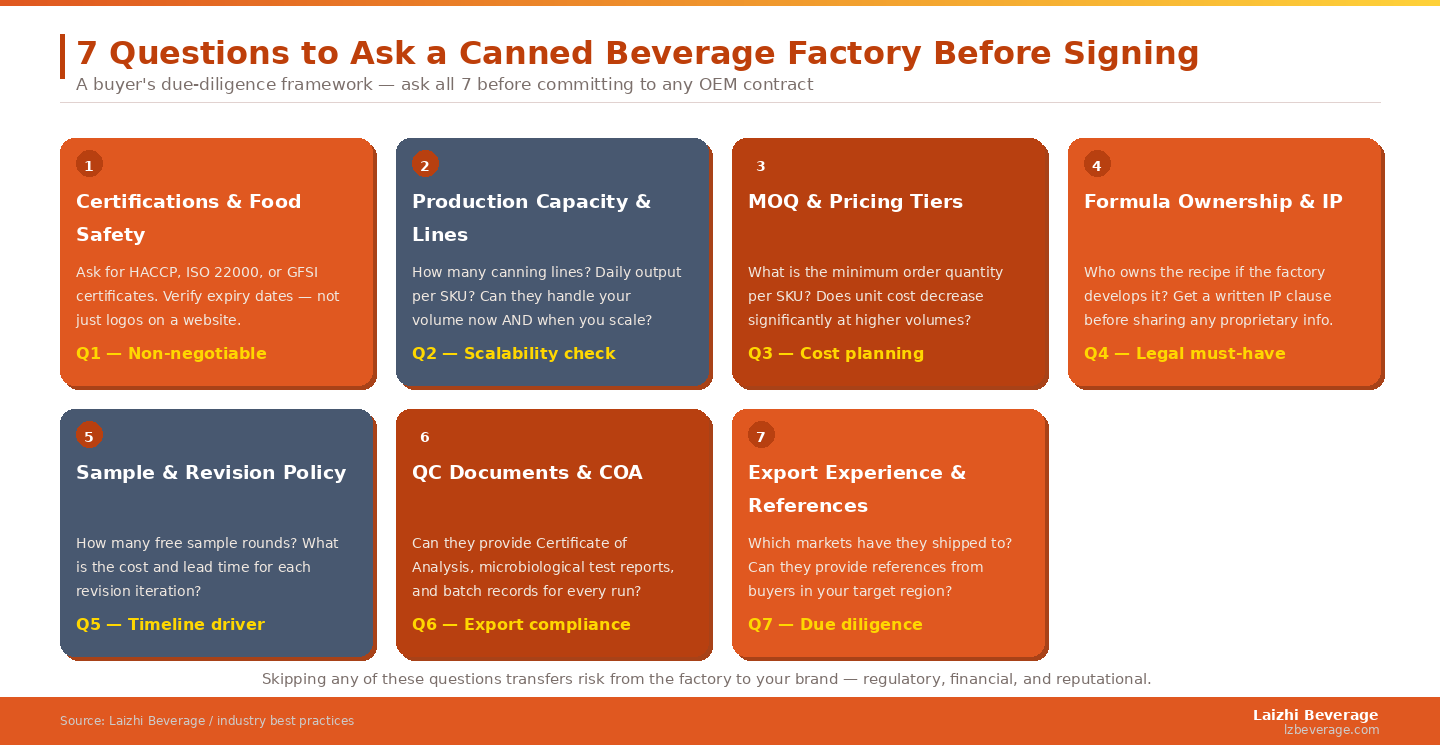
Question 1: What Food Safety Certifications Do You Hold — and Are They Current?
Certifications such as HACCP, ISO 22000, FSSC 22000, or BRCGS are the primary signal that a factory operates with structured, audited food safety practices. Food safety audit specialists note that HACCP is the backbone of any credible food safety program, and that certification bodies require regular surveillance audits to maintain status. Ask to see the actual certificate, not just a logo on a website — verify the issuing body, the scope of the certification, and the expiry date. A certificate that expired six months ago and has not been renewed is a significant red flag. Also ask whether the certification covers the specific beverages you intend to produce, since some factories hold narrow-scope certificates that do not apply to all product types.
Laizhi Beverage holds HACCP certification alongside export qualification credentials, with production processes that meet the regulatory requirements of multiple destination markets. This type of documentation is what you should expect to receive from any serious OEM partner.
Follow-up to ask
Request copies of the most recent third-party audit report — not just the certificate. An audit report reveals not only whether the factory passed, but whether there were any minor non-conformances and what corrective actions were taken. A factory that has never experienced any non-conformances in an audit has either never had a rigorous audit or is not being transparent with you.
Question 2: What Is Your Production Capacity and How Is It Allocated?
A factory's stated production capacity and the capacity actually available to your order can be very different numbers. Industry co-packer benchmarks emphasize that production scheduling is one of the most consequential variables in meeting delivery timelines. Ask how many dedicated canning lines the factory operates, what their daily throughput is per line, and how many active clients they are currently servicing. A factory running at 95% capacity with 30 concurrent clients will struggle to prioritize your order during peak season. Ask specifically about Q4 and Chinese New Year scheduling — these are the two periods when beverage factories most commonly face capacity crunches.
Equally important is asking about scalability. If your first order is 50,000 cans but your year-two forecast is 500,000, can the factory accommodate that growth without forcing you to switch suppliers mid-brand? Switching OEM partners mid-growth is one of the most disruptive — and expensive — moves a beverage brand can make.
Question 3: What Are Your MOQs and How Does Pricing Scale with Volume?
Minimum order quantities for custom-printed aluminum cans are driven largely by packaging material economics — print run minimums at the can supplier level typically determine the practical floor. For branded canned beverages, MOQs commonly range from 30,000 to 50,000 units per SKU, though some factories offer pilot run flexibility at higher per-unit cost. Ask for a tiered pricing schedule showing per-unit cost at three or four volume levels — this tells you both the current cost and the economics of your growth trajectory. Ask separately about MOQs for packaging materials versus for finished production — some factories (like Laizhi Beverage's OEM beer and RTD services) offer split-shipment models where you commit to the full packaging MOQ but produce and ship in smaller finished goods batches.
Question 4: Who Owns the Formula if You Help Develop It?
Intellectual property ownership is one of the most critical — and most overlooked — questions in OEM negotiations. If a factory's R&D team helps develop or refine your formula, you need a written agreement before the first sample is produced clarifying that all intellectual property in the formulation belongs to you as the client. Without this, some factories operate on the assumption that formulas developed using their internal ingredients and processes remain their IP — leaving you vulnerable if you ever want to switch manufacturers. This is not hypothetical: disputes over formula ownership have forced brands to restart product development from scratch after relationship breakdowns with their OEM partner.
Ask specifically: "If I switch to a different factory in the future, will you provide me with the full formulation documentation?" A factory confident in its service quality will say yes without hesitation.
Question 5: How Many Sample Revision Rounds Are Included, and What Is the Turnaround?
Sample development is where most first-time OEM projects experience unexpected delays. Supply chain planning guides note that predictability — not just speed — is the key to effective lead time management. Ask the factory: how many free sample iterations are included in the development process? What is the typical turnaround for each round? What happens if the fifth revision still does not meet your specifications — is there an additional charge? Understanding this policy upfront prevents a scenario where a slow sample revision process becomes a source of financial dispute during what should be a collaborative development phase.
Question 6: Can You Provide a Certificate of Analysis and Batch Records for Every Production Run?
A Certificate of Analysis (COA) is a document that confirms the test results for a specific production batch — covering parameters like sugar content, carbonation level (CO₂ volume), pH, fill weight, and microbiological safety. GMP audit standards require that facilities maintain documented batch records for every production run, traceable back to specific raw material lot numbers. If a factory cannot provide a COA on request, that is a serious compliance gap — particularly for brands selling through retailers in the EU, US, or Australia where this documentation is often required at customs or during retail audits.
Also ask about shelf life testing and stability data. For canned beverages targeting a 12–18 month shelf life, the factory should be able to provide accelerated shelf life test results or actual real-time data from comparable products.
Question 7: Which Export Markets Have You Shipped to, and Can You Provide References?
Export experience is not a single skill — it is market-specific. A factory with strong track record shipping to Southeast Asia may have no experience navigating EU food labeling requirements or US FDA registration procedures. Ask which markets they have successfully shipped to in the past 12 months and whether they can provide references from buyers in your target region. Certification specialists emphasize that GFSI-recognized schemes like SQF, BRCGS, and FSSC 22000 exist precisely because different markets have different regulatory expectations — a factory that has navigated multiple certification schemes is demonstrably better prepared for diverse export requirements.
Do not accept general claims like "we export to 50 countries." Ask for a specific recent example: a destination market, the certification or documentation required, and a buyer reference you can contact.
A Practical Approach: The Pre-Contract Audit
For orders above a meaningful threshold — typically USD 20,000+ — many experienced buyers commission a brief factory audit before signing. A third-party auditor from firms such as SGS or Bureau Veritas can conduct a one-day facility inspection covering GMP compliance, equipment condition, documentation systems, and food safety practices. The audit report provides an independent assessment that no sales presentation can replicate. For buyers who cannot travel to China, virtual audits conducted via video conference with a local inspector on-site have become a widely accepted alternative.
| Question |
Green Flag |
Red Flag |
| Certifications |
Current certificate + recent audit report |
Logo on website, no document provided |
| Capacity |
Named number of lines + scheduled availability |
Vague claims of "large capacity" |
| IP ownership |
Written clause confirming client ownership |
Hesitation or deflection on this question |
| COA / batch records |
Sample COA from a past client provided |
"We can do that" with no example shown |
| Export references |
Named market + buyer contact offered |
Generic "50 countries" claim, no specifics |
Frequently Asked Questions
Should I ask these questions before requesting a sample?
Yes — ideally in your first video call or email exchange. The answers will tell you whether it is worth investing time in the sample development process at all. Factories that cannot answer questions 1, 4, and 6 clearly should not receive your formula brief.
Is it normal to negotiate MOQ before signing?
Absolutely. MOQ is one of the most negotiable elements of an OEM agreement, particularly for new product launches. Factories prefer a lower first order from a promising brand over no business at all. Come to the negotiation with a clear 12-month volume forecast to support your case for a lower MOQ.
How important is factory location within China?
For ocean freight purposes, proximity to a major export port matters — factories near Qingdao, Shanghai, or Tianjin have access to frequent sailings and competitive freight rates. Interior factories may offer lower production costs but add 2–4 days of inland trucking to the shipping timeline.
Read Laizhi Beverage's complete guide to beverage contract manufacturing — covering certifications, production processes, and what to expect at each stage of your first OEM order.

