The beverage industry is currently defined by a "speed-to-shelf" race. Whether you are a startup founder with a secret recipe for a botanical elixir or a seasoned retail executive looking to launch a private label line, you will eventually face the billion-dollar question: Is beverage OEM right for my brand?
The beverage industry is currently defined by a "speed-to-shelf" race. Whether you are a startup founder with a secret recipe for a botanical elixir or a seasoned retail executive looking to launch a private label line, you will eventually face the billion-dollar question: Is beverage OEM right for my brand?
This "Buy vs. Build" dilemma is the fork in the road that determines your capital requirements, your operational complexity, and your ultimate scalability. To help you navigate this, we have compiled a deep-dive analysis of beverage OEM pros and cons, specific beverage co-packer use cases, and a strategic framework to help you decide.
Understanding the Landscape: How to Know if Beverage OEM is Right for You
Before weighing the advantages, we must first define the relationship. Beverage OEM (Original Equipment Manufacturer) is a partnership where a specialized facility—like LzBeverage—manufactures your drinks according to your specific formulation and branding.
How to know if beverage OEM is right for you often boils down to your core competency. Are you a world-class liquid engineer and logistics manager, or are you a visionary brand-builder and marketer? If your strength lies in the latter, the OEM model is likely your greatest ally.
The Modern Beverage Ecosystem
In the past, owning a factory was a barrier to entry. Today, it can often be an anchor. The modern beverage ecosystem is built on "Asset-Light" models. Brands like Red Bull and many successful functional tea lines often do not own their production lines; they own the "Brand Equity" while leveraging the "Manufacturing Excellence" of a co-packer.
Advantages of Beverage Contract Manufacturing: The Strategic "Pros"
Why do billion-dollar brands continue to outsource? The advantages of beverage contract manufacturing go far beyond just saving money; they are about strategic agility.
Drastic Reduction in CAPEX
The most obvious "Pro" is the elimination of Capital Expenditure. Building a facility that meets international food safety standards (HACCP, ISO) requires millions in investment for:
-
Multi-stage RO water treatment systems: Water is the largest component of any beverage, but using tap water directly cannot guarantee consistent taste. Establishing an industrial-grade multi-stage reverse osmosis (RO) water treatment system involves expensive filtration membranes, activated carbon filters, and UV sterilization units. These systems effectively remove impurities, residual chlorine, and trace minerals from the water, providing a pure, neutral base for delicate-tasting beverages like fruit tea. By utilizing the existing infrastructure of the OEM, you can avoid these high initial and maintenance costs while ensuring that every can of product has a pure and consistent base.
-
Automated blending and carbonation tanks: To achieve perfect recipe reproduction, food-grade stainless steel blending tanks equipped with precision stirrers, flow meters, and temperature control systems are required. If you plan to produce carbonated soft drinks or sparkling water, costs will soar further, as this requires specialized carbonation mixing units to precisely dissolve CO₂ into the liquid under specific pressure and low temperatures. Purchasing, installing, and maintaining these complex pressure vessels and mixing systems yourself requires significant financial resources and a professional engineering team for daily calibration. Beverage OEMs, on the other hand, can directly provide this high-precision mixing environment, ensuring your formula remains consistent in industrial production.
-
High-speed aluminum canning and seaming machinery: The core of a can production line is the filling and sealing machines, which are often the most expensive hardware in the entire workshop. High-speed aluminum can filling lines must capture the liquid level in an extremely short time and maintain micron-level precision to ensure a perfect "double seal." This precise mechanical interlock is the only barrier against oxidation, leakage, and maintaining carbonation pressure. Purchasing these machines and hiring specialized technicians for commissioning and maintenance is a significant financial burden. Choosing an OEM partner allows you to immediately access world-class sealing technology, ensuring your brand delivers impeccable industrial quality without incurring millions of dollars in equipment premiums.
-
Pasteurization and sterilization tunnels: To ensure beverage shelf life without relying on excessive preservatives, advanced heat treatment equipment, such as pasteurization tunnels or UHT (Ultra-High Temperature) systems, is essential. These systems are not only massive in size but also extremely energy-intensive, representing a significant expense when building your own factory. They are crucial for eliminating harmful microorganisms while preserving the taste and nutrition of natural ingredients like rambutan or ginseng. By utilizing Hainan Laizhi's existing sterilization facilities, you can easily produce products that meet international food safety standards with a shelf life of over 12 months, significantly reducing the investment barriers for your brand in utilities and specialized equipment.
Access to Professional R&D and Quality Control
When you partner with a specialized manufacturer, you inherit their laboratory and their scientists. Creating a stable, shelf-worthy product like our White Peach & Oolong Flavored Fruit Tea requires precise balance in pH, Brix, and thermal processing. An OEM ensures that every batch—whether it's the 1st or the 1,000,000th—tastes exactly the same.
Regulatory and Compliance Peace of Mind
Food safety laws are complex and vary by region. A professional OEM manages the compliance burden, ensuring your labels are legal, your ingredients are traced, and your facility audits are up to date.
The Challenges: Beverage OEM Pros and Cons
To be truly supportive, we must address the "Cons." While the model is powerful, it requires a different set of management skills.
Higher Per-Unit Cost vs. In-House (At Scale)
If you were to produce 100 million cans a year, your per-unit cost in your own factory would eventually be lower than an OEM, as you wouldn't be paying the manufacturer's profit margin. However, for most brands, the "Opportunity Cost" of the capital tied up in a factory makes the OEM model more efficient in the long run.
Minimum Order Quantities (MOQs)
Every production run requires hours of cleaning and calibration. Therefore, OEMs have MOQs. For custom printed cans, this is often 50,000 to 150,000 units. If your brand is still in the "ultra-niche" phase, meeting these MOQs can be a challenge for your warehouse space and cash flow.
Loss of Direct Physical Control
When you outsource, you are no longer the one standing at the filling valve. You must trust your partner's reporting and quality systems. This makes beverage OEM manufacturer selection the most critical step in your journey.
Beverage Co-packer Use Cases: When Does it Make Perfect Sense?
Identifying with these beverage co-packer use cases can help you validate your decision.
The "Market-Entry" Startup
You have a brilliant concept—perhaps a functional tea similar to our 330ml Pomegranate and Ginseng Tea. You need to prove the "Product-Market Fit" without risking your life savings on a warehouse lease. The OEM allows you to launch professionally and iterate quickly.
The "Geographic Expansion" Strategy
An established brand in Europe wants to enter the Asian market. Instead of shipping heavy liquid across the ocean (which is mostly water), they partner with a local OEM in the target region. This reduces carbon footprint, avoids high import duties, and ensures the product is fresh.
The "Line Extension" Test
A successful soda brand wants to test a "Limited Edition" probiotic tea. Rather than disrupting their main production lines, they use an OEM to handle the small-scale, specialized run. If it succeeds, they bring it in-house; if it fails, they have lost very little.
Decision Matrix: When to Choose In-House over OEM Manufacturing?
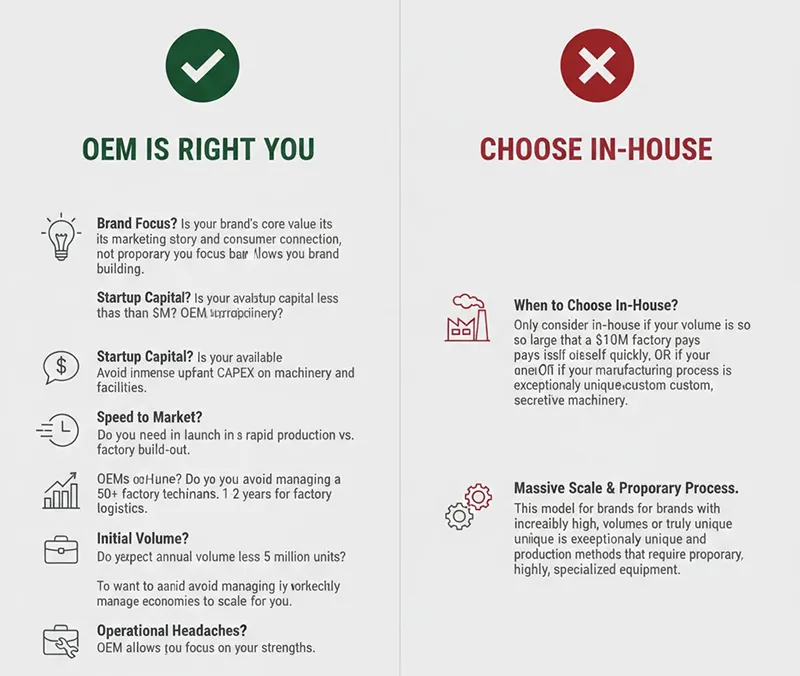
To simplify your choice, use this Beverage OEM Decision Matrix. If you answer "Yes" to more than three of the following, an OEM is almost certainly your best path.
-
Is your brand's core value its marketing/story rather than a proprietary mechanical process?
If your core competency lies in brand positioning, unique flavor creation, or innovative marketing strategies, then contract manufacturing is the ideal choice. The vast majority of globally renowned beverage success stories (such as Genki Forest or Red Bull) are built on brand premium and channel penetration, not on operating stainless steel tanks in-house. By outsourcing complex production processes, you can free up your core team to fully dedicate themselves to marketing and customer acquisition, ensuring your brand's voice isn't drowned out by mundane factory maintenance and equipment depreciation.
-
Is your current capital less than $5M?
While this sounds like a huge sum, in the highly automated beverage manufacturing industry, it only covers the most basic entry points. Building an internationally compliant factory involves substantial capital expenditures, including factory leasing, environmental approvals, industrial power upgrades, and expensive bottling line purchases. Considering the "burn-through rate" during construction, investing this capital in inventory turnover and aggressive channel development would be far more rewarding. By leveraging the OEM model, you can start with a lower barrier to entry, maintaining a lightweight balance sheet while ensuring your products meet the craftsmanship standards of top international brands.
-
Do you need to launch in less than 6 months?
If "Time-to-Market" is your top priority, building your own factory is physically nearly impossible. Ordering just one set of precision filling equipment from Germany or Italy often has a delivery cycle exceeding a year, not to mention the cumbersome compliance processes such as factory permit applications and QS/HACCP certification approvals. Established OEM partners like Laizhi Industry already possess readily available infrastructure, cleanrooms, and a highly trained technical team. This allows you to shorten the timeline from formula finalization to finished product delivery to just a few weeks, ensuring you accurately enter the market when trends are at their peak and capture the traffic dividend.
-
Is your expected annual volume less than 5 million units?
The economics of beverage manufacturing are highly dependent on economies of scale. Before reaching mass production, the fixed indirect costs of operating a factory—including land taxes, factory insurance, basic electricity load, and the salaries of essential maintenance engineers—will significantly increase your unit costs. Contract manufacturers, by consolidating orders from dozens of clients, achieve economies of scale in raw material and packaging procurement and energy utilization, passing these cost savings on to you. For mid-sized brands, contract manufacturing not only reduces risk but also typically offers better gross margins than low-capacity in-house factories.
-
Do you want to avoid managing a workforce of 50+ factory technicians?
Operating a high-speed beverage bottling line requires at least 50 skilled technicians, quality control engineers, safety officers, and logistics personnel working multiple shifts. Managing such a capital-intensive human resource system involves continuous skills training, substantial insurance expenditures, and stringent labor law compliance. If your expertise lies in sales strategy, creative design, or capital operations, then heavy factory management can be a huge drain on your energy. Partners like LzBeverage can address these operational headaches for you, allowing your elite team to remain agile and focus on expanding your brand footprint rather than dealing with mundane factory tasks.
When to Choose In-house?
You should only consider in-house manufacturing when your volume is so massive that the $0.05 margin per can pays for a $10M factory in less than three years, or if your process is so incredibly secret and unique that it cannot be performed on standard industrial equipment.
Next Steps After Deciding on Beverage OEM
Once you have decided that an OEM is the right path, you move into the execution phase. Here are your next steps after deciding on beverage OEM:
-
Finalize Your Formula: Transition from "kitchen scale" to "industrial scale."
-
Audit Potential Partners: Visit the facility. Check for cleanliness, certifications, and "Cultural Fit."
-
Request a Pilot Run: Never skip the prototype stage. You need to see how your liquid reacts to the heat of the pasteurizer.
-
Secure Your Packaging: Finalize can designs and ensure they meet beverage packaging and labeling requirements.
Conclusion
So, is beverage OEM right for your brand? For 95% of the brands entering the market today, the answer is a resounding "Yes." It provides the technical foundation, the safety, and the scalability that allow you to focus on the most important thing: The Consumer.
At LzBeverage, we don't just fill cans; we build brands. Whether you are looking to replicate the success of a premium White Peach & Oolong Flavored Fruit Tea or innovate in the functional space, we are here to be your manufacturing backbone.
Ready to turn your liquid dream into a retail reality? Contact Us today to discuss your project.
FAQ
Q1: How much does it cost to start a beverage line with an OEM?
A: While the OEM eliminates the cost of the factory, you still need to pay for raw materials, can printing, and the first production run. For a professional launch in aluminum cans, you should typically budget between $30,000 and $70,000 for your initial inventory and setup.
Q2: Do I lose my recipe if I share it with a co-packer?
A: No. Any reputable beverage contract manufacturer will sign a robust Non-Disclosure Agreement (NDA). Your formula is your intellectual property; the manufacturer is simply a service provider executing your design.
Q3: What certifications should I look for in an OEM?
A: At a minimum, look for HACCP (Hazard Analysis and Critical Control Points) and ISO 22000. If you are targeting global markets, check for BRC or SQF certifications, which represent the highest levels of global food safety standards.


