A botanical mocktail becomes production-ready only when its flavor architecture—the intended top note, mid-palate, and finish—still makes sense after the alcohol-free base, process, package, and target market are fixed. The difficult task is not finding another herb. It is deciding which note should arrive first, what will carry the palate after that aroma fades, and where a dry or bitter finish stops feeling deliberate.
Build a Botanical Mocktail as a Flavor Architecture
A botanical mocktail brief must name the job of its top note, mid-palate, finish, final pack, and target market before sampling. That sentence is more useful than a list of rosemary, hibiscus, ginger, citrus, or floral extracts because it tells a development team what each component must accomplish.
- Top note: the first aromatic cue that tells the drinker what kind of serve this is.
- Mid-palate: the taste and texture that stop the drink from becoming fragrant water.
- Finish: the lingering dry, bitter, spicy, or cooling signal that creates adult complexity without turning harsh.
- Proof: a process-matched final pack and a target-market record, not a favorable bench impression.
Use the architecture to compare directions rather than to prescribe ingredients. A citrus-rosemary spritz, a tea-led bitter aperitif, and a floral-spice cooler can all be viable routes, but each needs a different definition of body, finish, and acceptable variation after processing.
Give the Top, Middle, and Finish Different Jobs
Alcohol-free beer studies report that removing ethanol can change perceived body, lingering sensation, and aroma release. In one 2024 study, the no-alcohol conditions were perceived as lighter or more watery, while ethanol changed headspace aroma release and viscosity; the result is not a formula for every RTD, but it is a useful warning against judging an alcohol-free beverage by nose alone. The sensory study matters here because a mocktail that smells layered on a bench may still lose continuity once it is swallowed.
Polyphenols are commonly bitter, and some are astringent, so a dry botanical finish needs a stated sensory boundary. Astringency is the drying, puckering mouthfeel that can accompany some botanical materials; it is not interchangeable with bitterness and should not be treated as automatic proof of sophistication. This sensory review gives a reason to specify the finish in plain language before a supplier starts chasing a more “adult” profile.
Once those layer roles are visible, a team comparing a brewed middle can compare tea-based RTD routes as a base-system choice. The comparison should ask whether the brewed character carries the intended middle and finish in the finished RTD, rather than whether tea merely adds another botanical cue.
Use the top note to create arrival, not the whole drink
Aromatic botanicals should provide a recognizable arrival cue, while the rest of the system supplies depth and finish. For a bright route, the brief might ask for lifted citrus peel with a cool green-herb edge. For an aperitif-like route, it may ask for a restrained floral or spice cue that opens the palate without reading like perfume.
Write this as an observable target: “noticeable on opening, clean after the first sip, not medicinal.” That is a better development instruction than asking for “more botanical.” It also creates a test question for the process-matched sample: does the desired cue still arrive at the first nose and first sip, or did it become muted, oily, or disconnected from the palate?
Use the mid-palate to replace missing weight
The mid-palate should supply continuity after the top note, especially because alcohol-free formats can read lighter than their alcoholic reference points. The choice is not simply more sweetness. Acid, tea-like brewed character, fruit depth, carbonation, and a controlled bitter note can each change the bridge between aroma and finish.
For example, a team can compare a crisp citrus-herb route with a tea-led route that carries more tannic depth. The relevant question is whether the base makes the finish more coherent in the actual RTD, not whether it expands the ingredient list.
Use the finish to signal adult complexity without harshness
Botanical bitterness or astringency can add a deliberate finish, but it needs an explicit sensory boundary rather than a vague adult cue. Name what the panel should detect after swallowing—brief citrus peel dryness, a gentle tea-like grip, a warming spice trace—and name the reject condition as well, such as persistent roughness, bitterness that eclipses the top note, or a drying finish that makes the next sip less inviting.
The order matters. First set the arrival. Then decide how the middle will carry it. Only then decide how much dry, bitter, or spicy character can remain. A team that starts with the finish may overcorrect a thin product with more botanicals, creating a longer aftertaste without creating a more complete drink.
| Flavor layer |
Job in the RTD |
What the brief should say |
Reject condition |
| Top note |
Create recognition on opening and first sip |
Desired aromatic cue and intensity |
Muted, perfumed, or disconnected aroma |
| Mid-palate |
Carry flavor after the first aroma fades |
Target body, acid, sweetness, and base character |
Thin, syrupy, or abruptly hollow palate |
| Finish |
Leave a controlled adult signal |
Allowed dryness, bitterness, spice, or cooling |
Harsh, metallic, rough, or overly persistent aftertaste |
Based on this comparison, formulate toward a sequence rather than an ingredient count. The sample that wins is the one whose three layers remain connected after swallowing, not the one with the most recognizable botanical note.
Test Whether the Flavor Survives the Process and Pack
Flavor stability can be affected by temperature, pH, storage, enzymes, and oxygen, so a botanical RTD needs process-and-pack checks. A review of flavor-compound stability identifies those variables as part of the degradation picture. For an innovation manager, the consequence is practical: a formulation request should state the planned process, package, storage assumption, and the sensory attributes that must be retained.
That does not mean every botanical route needs an elaborate technical intervention. It means the team should stop treating stability as a final shelf-life checkbox. If a bright herb note is the product's entry point, it deserves an agreed check after the intended heat exposure and in the intended pack. If the product's value is a dry tea-like finish, the team should check that the finish has not become rougher or flatter during the same journey.
Encapsulation can be a technical option for certain volatile flavor substances, but its suitability depends on the matrix, process, and intended release. The food-applications review notes that many flavor substances are vulnerable to evaporation and poor stability in air, light, moisture, and heat. That is a reason to ask what the protection route changes in the finished beverage, including clarity, release, and sensory balance, rather than treating encapsulation as a universal answer.
A simple development record can prevent confusion later: list the intended top note, the final package, process assumptions, storage condition, and the panel's acceptance wording on one page. When a production-matched sample fails, this record makes it easier to isolate whether the problem is aroma retention, palate balance, or a finish that was never precisely defined.
For an OEM/ODM discussion, LZ Beverage can work from that record to assess the formulation route alongside filling and packaging requirements. The commercial value of the record is that it makes a revision traceable: the buyer can see whether the next sample changes an aroma-protection choice, a base-system choice, or the permitted finish rather than receiving a general “improved” version with no defined comparison point.
Approve the Route in Its Intended Drinking Condition
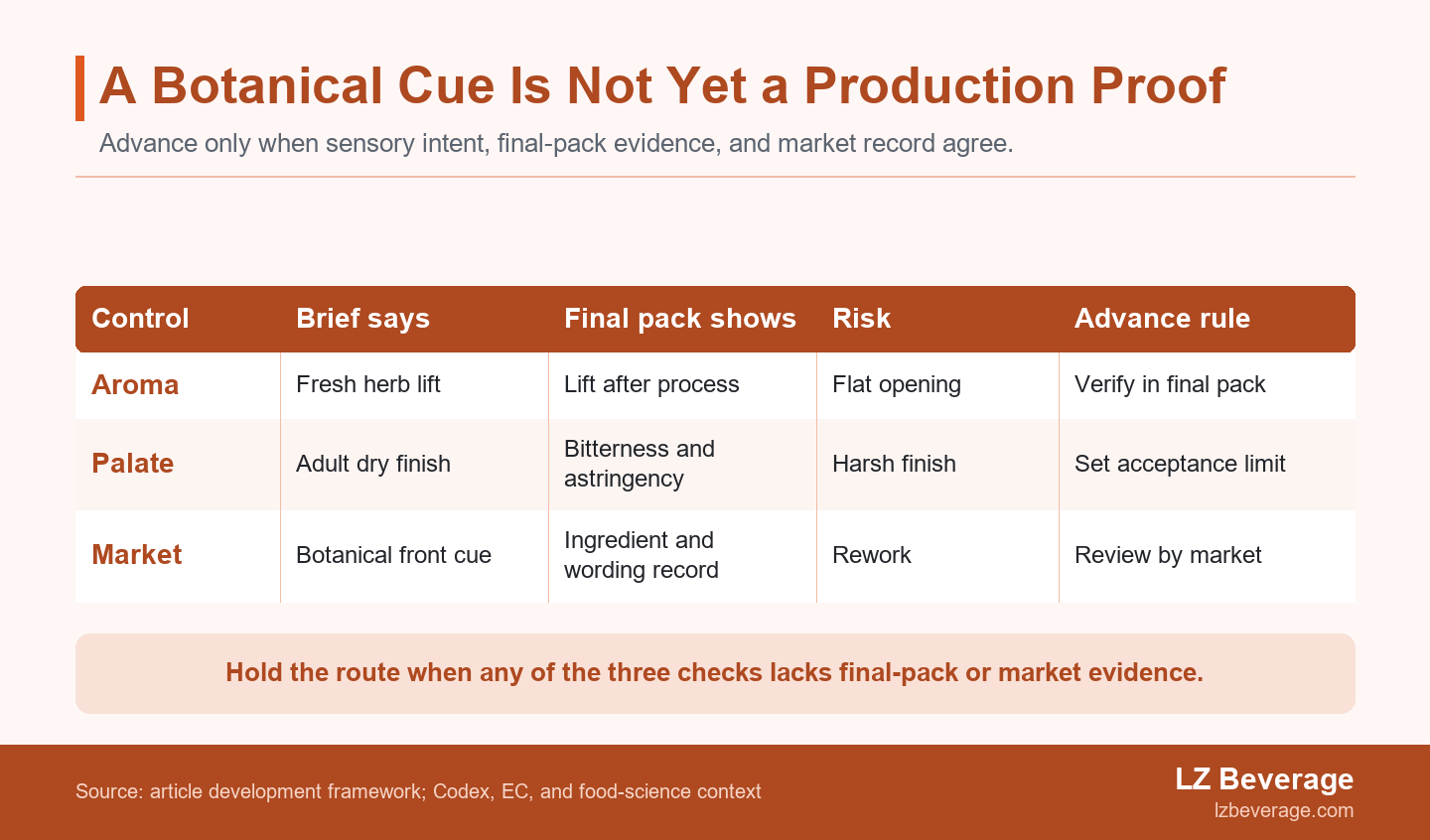
A bench sample with a pleasant aroma but no process-matched final-pack proof is a hypothesis, not a production-ready botanical mocktail route. The most useful final-pack test is a taste check in the actual can or bottle made with the intended process, served as the customer will receive it. It should compare the first aroma, mid-palate continuity, finish, and any change after opening—not only an analytical result or a chilled beaker sample.
Alcohol-free beer research likewise cautions that reformulation cannot rest on physicochemical analysis alone when retronasal perception, taste, and mouthfeel can differ. That study's sensory discussion is directional context for an RTD buyer: the finished drinking experience has to be checked as a whole.
Codex category 14.1.4 includes herbal-based drinks within water-based flavoured drink context. The Codex category description is useful framing for the finished beverage route; it is not a claim that an individual formula or label is cleared for every market.
Once the drinking condition is chosen, use it as a locked comparison condition. If the concept is lightly sparkling, do not approve it from a still benchmark. If it is designed for a slim can and chilled service, do not make the final choice from a warm laboratory glass. At that point, the reader can review RTD format options with a clear sensory job instead of choosing a format before the product evidence exists.
Keep Market Review Separate From Sensory Approval
EU rules set general requirements and definitions for flavourings, including use and labelling context. European Commission guidance makes the boundary clear: a botanical direction must travel with the relevant ingredient-source and proposed-wording review for the European market, not just a sensory description.
FDA material describes flavors and spices as ingredient categories and notes relevant collective label declarations. The FDA ingredient overview is a useful US reminder to keep an ingredient record and proposed label wording together. Neither source substitutes for legal or regulatory advice on a particular formula.
This is where the business handoff becomes concrete. An OEM/ODM partner can assess a request more effectively when the buyer provides the intended flavor architecture, packaging route, process assumptions, target market, and proposed wording together. Those inputs connect formulation development with filling, packaging, and export coordination without claiming that sensory acceptance alone resolves market eligibility.
Before a route is sent to pilot, confirm that the current document identifies the pack, the serving condition, the target destination, the ingredient direction, and the wording under review. This does not turn the manufacturer into a legal reviewer. It does make the open questions visible early enough for the formula, packaging, commercial, and market-review workstreams to respond to the same version of the product brief. It also gives the buyer a clear basis for comparing supplier responses. Buyers needing supplier background can review the LZ Beverage manufacturing profile.
Illustrative Pilot: Hold the Route When the Final Pack Changes the Drink
When the process-matched pack changes aromatic lift or finish and market wording is unresolved, hold the pilot route for parallel retest and review. This is an illustrative development decision, not a claim about an LZ Beverage project or a validated commercial result.
When the Process-Matched Can Changes the First Impression
When the process-matched pack changes aromatic lift or finish and market wording is unresolved, hold the pilot route for parallel retest and review. An innovation manager is preparing a citrus-herbal alcohol-free spritz for specialty retail. The chilled bench sample has a clean citrus-herb nose and a restrained dry finish.
The planned order is 18,000 cans across one 250 mL pilot.
The intended canned process and the target-market wording are still open.
The process-matched can retains the citrus opening but loses part of the herb lift and shows a drier, more persistent finish.
The team has a botanical ingredient list but has not completed a target-market review of the proposed front-label language.
Those are two observations, not one cosmetic flaw. The first changes the sensory experience in the actual package. The second leaves the commercial record incomplete. Treating the bench sample as decisive would mix a product hypothesis with an unfinished market decision.
The appropriate analysis is a three-way mismatch: the written brief asks for lifted herb aroma, the final pack gives a flatter aroma and drier finish, and the market record is not yet settled. The pilot is still within one product family, but the evidence does not yet support advancing the route as if all three checks agreed.
Hold the artwork and final pilot route while the team runs a controlled comparison with one change per sample. It may compare aroma protection, base balance, or finish intensity, but it should not change several variables at once and then guess why the preferred sample won.
Record the exact pack, process condition, serving temperature, accepted finish description, current ingredient list, and proposed wording with the comparison result. That gives the supplier and commercial reviewer the same evidence set instead of separate taste notes and label drafts.
Advance only when the preferred final-pack sample has a documented sensory decision and the product brief states the target market and wording-review status. The cost is a slower pilot decision; the benefit is avoiding an 18,000-can route built around a bench impression that did not survive its own package.
Illustrative scenario only; it does not describe an LZ Beverage client, formula, test result, or approval.
Send a Sample Request That Can Be Evaluated
A usable OEM/ODM request names the target market, flavor layers, final pack, process assumptions, and expected volume. It should also say which sensory condition is non-negotiable: a bright opening, a tea-like middle, a short dry finish, or another observable outcome.
- Name the market: US, EU, or another defined destination, plus the current wording question.
- Describe the three layers: intended arrival, mid-palate, and finish, including the reject condition.
- Lock the sensory test: pack, process assumption, serving condition, and comparison method.
- Attach the current record: ingredient direction, proposed wording, and any label constraints already known.
- State the scope: expected volume, launch window, and which question the sample must answer.
If those inputs are assembled, ask for the development response to separate formula questions from pack, production, and export-readiness questions. The useful deliverable is a scoped feasibility view, not a promise that every botanical cue will behave the same at production scale. For a scoped response from LZ Beverage, review a botanical RTD feasibility brief.
Common Questions About Botanical Mocktail Development
These questions address flavor architecture, finished-pack assessment, and market considerations for alcohol-free botanical RTD concepts.
What makes an alcohol-free botanical RTD taste layered?
A layered alcohol-free botanical RTD gives aroma, palate, and finish separate jobs instead of relying on one loud herb or citrus note. Start with the arrival cue, then define what carries the palate and what level of dryness or bitterness may remain. The finished package must be tasted under the intended serving condition because a strong aroma alone does not guarantee a complete drinking experience.
Should botanical mocktails be sparkling or still?
Choose the format that supports the intended finish, then test the actual pack at the intended serving temperature before approving the route. Sparkling formats can sharpen the first impression and change the finish, while still formats may make a tea-like or fruit-led middle easier to read. The choice is sound only when the final condition supports the agreed flavor architecture.
Can a botanical flavor be described as natural in every market?
No. The permitted description depends on the ingredient source, the formula record, and the target market's applicable flavouring and labeling rules. Keep the intended words in the development brief from the start, then route them for the appropriate market review. A pleasant botanical sample does not establish that a particular claim or descriptor is suitable for US or EU use.
What should a botanical mocktail OEM sample request include?
Include the target market, flavor-layer target, intended pack, process assumptions, proposed wording, and expected volume in the first request. Add the key sensory accept/reject conditions, such as the desired opening and maximum acceptable dry finish. That gives the manufacturer a clear sample question and makes it easier to compare process-matched options without confusing flavor preference with compliance readiness.


