Salted citrus works when citrus carries the mineral signal into a refreshing finish; it fails when acid is used to hide an unresolved bitter, metallic, or salty aftertaste. For an innovation manager, the useful starting point is not “lemon plus electrolytes.” It is a short set of choices about the desired salt cue, citrus arrival, finished format, and target market. Those choices make a supplier conversation testable instead of leaving the team to judge a bright bench sample by instinct.
The Decisions That Make Salted Citrus Feel Intentional
A salted citrus brief should specify a salt signal, citrus role, final drinking condition, and target-market review before sampling. Define the salt signal as a light saline lift, a mineral finish, or a more overt savoury cue; those are different sensory targets. Then state whether citrus should arrive as juicy, peel-like, sharp, or rounded. Finally, name the pack and serving condition that the buyer will approve, plus the country or market where the product representation will be reviewed.
- Salt signal: What should remain after the first sip?
- Citrus role: Is citrus providing aroma, acid structure, or both?
- Final condition: Will the drink be still or sparkling, chilled, and evaluated in a can or bottle?
- Market review: Which ingredient, nutrition, and wording questions must be answered before release?
Start With the Flavor Job, Not an Ingredient List
A salted citrus electrolyte drink needs an explicit flavor job before a buyer can choose a still or sparkling product route. A useful one-sentence brief might read: “Bright yuzu-style top note, restrained saline lift, clean mineral finish, low sweetness, served cold in a lightly sparkling 330 mL can.” This gives R&D a sensory direction and gives commercial teams a way to decide whether a sample is on brief. It also keeps “salted” from becoming an unhelpful instruction to simply add more mineral ingredients.
Codex describes carbonated water-based flavored drinks as including citrus types and other permitted food additives within Food Category 14.1.4.1. The Codex category description is useful category context, not formula permission for every country. Once the intended format is clear, buyers can map the RTD format choices against their own pack, price point, and launch route.
Build the Citrus–Salt Balance in the Right Order
A peer-reviewed review reports that organic acids can enhance the characteristic flavor of fruit beverages. The review of taste and flavor in fruit beverages supports treating acid as part of flavor architecture, rather than a late correction for a weak concept. In practice, write down the desired order of perception: citrus aroma first, acid lift next, a controlled mineral cue, then a clean exit. That order helps the team hear whether a change has improved the finish or only made the opening brighter. Buyers considering an adjacent functional format can scope an electrolyte energy-drink route only after that flavor architecture is documented.
Choose the Acid and Aroma Role Together
A controlled study examined how citric, malic, and lactic acids changed the release and sensory perception of selected fruity esters in water. The study of acid–ester interactions does not prescribe a production dosage, but it gives a practical reason to test acid and aroma as a pair. Ask panelists two separate questions: “Does the citrus arrive clearly?” and “Does it remain fresh after the mineral note appears?” A sample that scores well only on the first question still has an unresolved finish. Before the session, specify whether the aroma should suggest fresh peel, ripe juice, or a blended citrus note.
Assess the Mineral Finish After the Citrus Structure Is Clear
A recent sensory review notes that common sodium substitutes can impart bitter, astringent, or metallic tastes. That sensory context on sodium substitutes is why a “more citrus” adjustment should not be the default response to a harsh finish. Change one variable at a time: first the acid direction, then aroma intensity, then the relevant mineral system or sweetness support. The comparison should expose the finish, not disguise it.
Citrus should carry a mineral signal into a refreshing finish, not be used to hide an unresolved bitter, metallic, or salty aftertaste. The most useful tasting sheet therefore separates first impression, mid-palate, finish length, and willingness to take a second sip. It prevents a strong top note from winning the sample ranking while the intended mineral cue remains unpleasant.
| What the panel hears |
Likely question |
Controlled next comparison |
| Bright opening, dry ending |
Is the acid doing all the work? |
Hold the citrus aroma and compare the acid direction. |
| Clear citrus, metallic tail |
Does the mineral cue persist after aroma fades? |
Keep citrus constant and compare the mineral system. |
| Salt reads as savoury |
Is the target a saline lift or a food-like note? |
Rewrite the sensory target before adjusting intensity. |
| Sweetness shortens the finish |
Has the issue been corrected or covered? |
Retest with the same serving condition and a lower masking effect. |
For a functional concept that may sit next to energy-oriented products, LZ Beverage can discuss a feasible RTD development route from the stated pack, volume, and sensory brief, without assuming that one electrolyte or citrus profile fits every market.
Test the Flavor in the Final Drinking Condition
A recent carbonated-beverage study reports that carbonation intensity can modulate sweetness perception, aroma, and overall liking. The carbonation study is a reason to stop treating a still bench sample as a proxy for a sparkling can. Carbonation changes the way a citrus opening and a mineral finish meet, so the team should compare samples at the intended level of carbonation and serving temperature.
Codex lists sports drinks containing electrolytes within its non-carbonated water-based flavored drink category. The non-carbonated category description helps frame the still route, but the commercial decision still belongs to the intended product and market. A still drink can make the salt signal easier to isolate; a sparkling drink can make the first sip more lively while changing the perceived finish.
A salted citrus concept should be approved in its intended final drinking condition, not by a bench sample that omits the chosen format. Use a final-pack test: taste the beverage from its actual can or bottle under its intended cold-or-ambient condition. Record pack type, fill condition, carbonation where relevant, serving temperature, sample age, and the same panel questions for every comparison. Without that record, a team cannot tell whether it is approving flavor direction or merely approving a convenient laboratory moment.
Turn the Prototype Into a Compliance-Aware OEM Brief
FSANZ maintains Proposal P1030 to assess composition and labelling requirements for electrolyte drinks and to revisit their definition and purpose. The FSANZ proposal record illustrates why a promising formula cannot settle representation questions by itself. For an OEM/ODM inquiry, attach the target market, full ingredient direction, nutrition information under development, pack, and proposed consumer-facing wording so that sensory feasibility and market review are not confused.
Singapore's Nutri-Grade beverage rules require specified nutrition information and can require front-of-pack marks and advertising restrictions by grade. The Singapore Ministry of Health notice is one market-specific example, not a universal launch rule. Ask the relevant regulatory adviser to confirm current scope and wording before production decisions are locked. If osmolality is relevant to the market definition being assessed, state it plainly: it measures how many dissolved particles are present in a liquid. For supplier context at this handoff, buyers can review the manufacturing background.
Illustrative Pilot: Do Not Let a Bright Bench Sample Bypass the Final Can
Consider an illustrative innovation manager preparing a salted citrus hydration-product pilot for a hot-climate retail market.
The proposed run is 12,000 cans across one 330 mL lightly sparkling pilot.
The bench concept has a lemon-lime aroma and a declared mineral direction, but the final pack and market wording have not been locked.
At the intended cold serving temperature, the bench sample reads bright and clean, while the lightly sparkling can leaves a longer mineral note.
The proposed front-of-pack wording describes hydration before the target-market review has classified the representation.
These are two separate gaps: final-format sensory proof and market-specific wording review. A pleasant bench sample cannot close either one, and a compliant wording route cannot repair the mineral tail.
When a final can changes the mineral finish or the target-market representation remains unresolved, hold the pilot brief rather than letting a bright bench sample decide the route.
Create a two-sample comparison that changes one flavor-system variable at a time, record the final serving condition, and attach the current ingredient and nutrition record to the market-review request.
Advance only when the preferred final-can sample has a documented sensory result and the commercial brief names the target market, pack, and proposed representation.
This is an illustrative scenario, not an LZ Beverage client result, formula, or approval.
At this point, the useful handoff is factual: beverage type, target consumer, citrus-and-salt direction, intended pack, target market, and expected volume.
Use a Three-Gate Brief Before You Request Samples
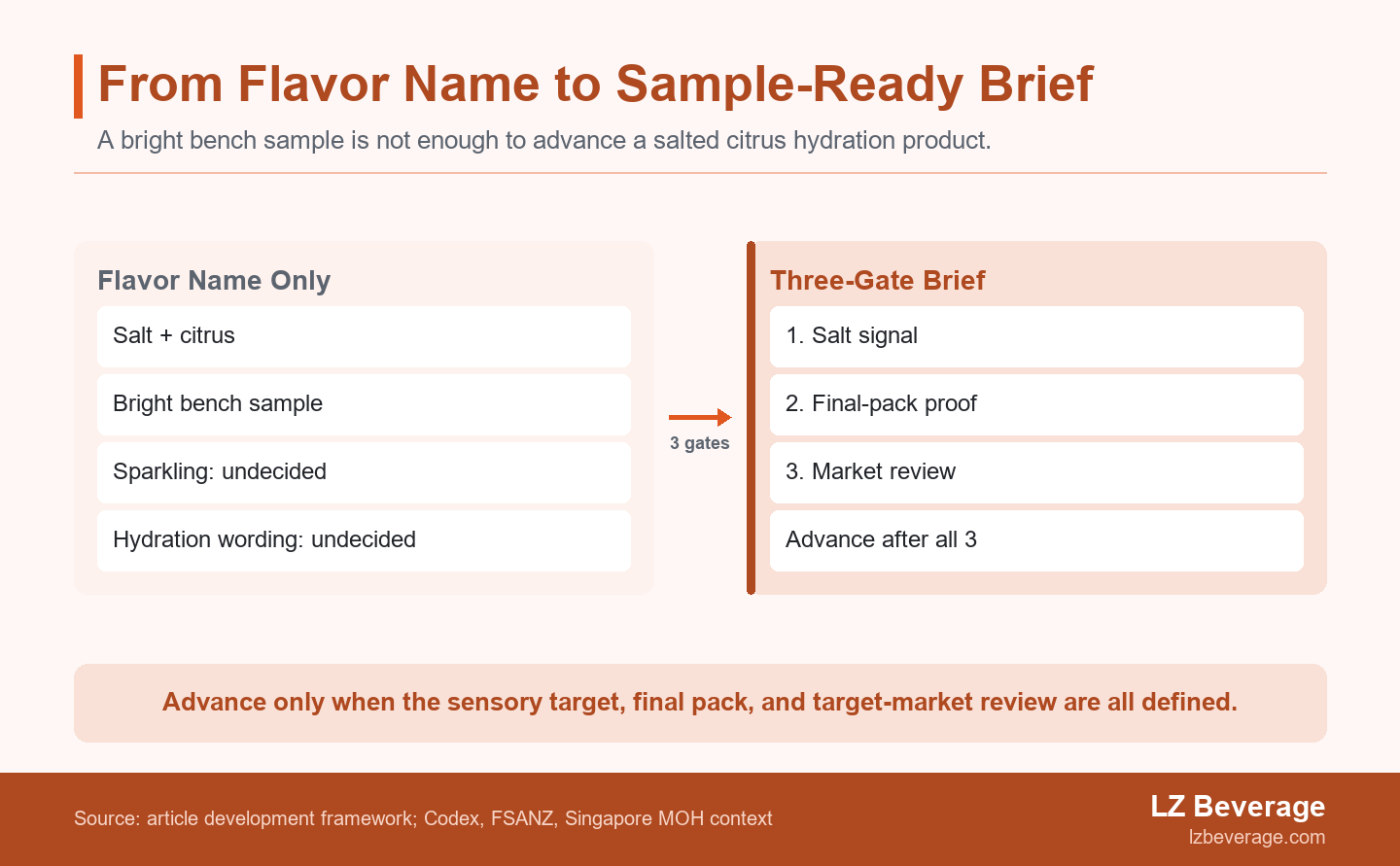
A three-gate brief makes a salted citrus OEM request more usable by separating sensory target, final-pack proof, and market review. Treat the gates as an ordered release path rather than a score: a concept should not move forward because one attractive bench sample has answered only the first question. This is an illustrative development framework, not a formula specification, legal advice, or an efficacy claim.
- Gate one — sensory target: Write the salt signal, citrus arrival, acid role, sweetness direction, and the finish that would count as acceptable.
- Gate two — final-pack proof: Name the can or bottle, still or sparkling route, intended serving temperature, and the comparison record that will select the sample.
- Gate three — market review: Add target market, ingredient and nutrition record, intended product representation, pack, and expected volume before feasibility or quotation decisions.
The handoff becomes much clearer when these gates are complete. Send LZ Beverage the product type, target consumer, flavor direction, function, pack, target market, and expected volume for an OEM/ODM feasibility conversation. That request gives both teams a defined scope without implying that a sensory preference has already cleared a market claim. To evaluate compatible category paths, compare beverage formats for your brief.
Common Questions About Salted Citrus and Electrolyte Drinks
These questions address flavor targets, serving condition, and market considerations for salted citrus and electrolyte beverage concepts.
Should a salted citrus electrolyte drink be still or sparkling?
Choose still when the brief depends on a softer citrus opening, and choose sparkling only when carbonation is an intentional part of the finished sensory target. Still format often makes it easier to hear the mineral cue without carbonic bite. Sparkling can add lift and refreshment, but it should be tested in the intended can or bottle because it may also change aroma, sweetness perception, and finish length. Pre-agree the serving temperature and panel questions for both routes. Choose the route that supports the sensory job, not the one that sounds more functional.
How can citrus reduce a harsh electrolyte finish?
Use citrus to create a clear aroma-and-acid direction, then test whether it shortens a harsh finish rather than simply making the sample taste more sour. Start by separating the first sip from the aftertaste on the tasting sheet. Compare one variable at a time, such as acid direction or aroma intensity, while holding the mineral system and serving condition steady. Have the same panelist describe the tail before and after each change. If the finish remains metallic, bitter, or overly salty, the next task is to reassess the system rather than intensify citrus.
Can electrolyte wording be used as a hydration claim?
No single electrolyte statement automatically clears a hydration, performance, or medical claim, because product representation and permitted wording depend on the target market and formula. Treat proposed wording as a market-review input, not as proof that a formulation route is approved. Provide the current ingredients, nutrition information, pack, intended consumers, and proposed wording to the appropriate local reviewer before finalizing artwork or committing to production. Let market-specific professional advice determine whether the proposed wording can appear on the finished pack. Drafted pack language should follow, rather than lead, that review.
What should an OEM sample request include first?
Start with the beverage type, target consumer, salt-and-citrus direction, final pack, target market, and expected volume before asking a manufacturer to quote or sample. Add the desired sweetness, still or sparkling route, intended serving condition, and any relevant ingredient or nutrition constraints. State what evidence will advance the concept: a final-can sensory comparison, a defined market-review packet, or both. If the concept is sparkling, include the desired carbonation character as well. Attach a dated brief so later changes can be traced. A complete request saves time because the manufacturer can assess the right development questions from the first conversation.


