A successful sweet-and-spicy carbonated drink is not decided by a chili level alone. It is decided by whether fruit arrival, the moment warmth begins, peak heat, and finish land in the intended order once the drink is chilled, carbonated, and packed. For an innovation manager, that sequence is the starting specification: it makes Mango-Chili and Yuzu-Chili comparable without pretending they should share one formula.
What Must Be Fixed Before a Swicy Sample Can Be Compared?
A swicy carbonated drink becomes manufacturable when the buyer specifies fruit arrival, heat onset, peak heat, and finish in the final pack instead of requesting a generic sweet-and-spicy profile. Here, heat onset is the point in a sip when the spicy sensation first becomes noticeable; the coined term swicy refers to a sweet-and-spicy flavor direction, not a single fruit, chili, or consumer heat preference.
- Choose the route first: Mango-Chili normally asks for a fuller fruit body, while Yuzu-Chili asks for a protected citrus opening.
- Describe heat by its timing and finish, then score it in the intended carbonated package.
- Keep the bench formula, pack, serving temperature, and sensory target in one versioned record before a pilot is ranked.
- Send an OEM a decision-ready brief rather than a trend phrase or an unqualified request for a “spicy fruit soda.”
IFT's 2026 flavor-trend coverage describes swicy as a continuing sweet-plus-spicy trend with layered profiles. Its useful implication is modest: market interest can justify exploring the direction, but it cannot decide whether mango should carry the body or yuzu should lead the aroma in a finished drink.
Choose the Fruit Route Before You Tune the Chili
FDA describes flavors, spices, sweeteners, preservatives, and color additives as ingredient categories with different functions and label contexts. In practice, the brief should assign each element a job: fruit for first impression and body, acid for lift or compression, the heat delivery for timing, and any preservation or color direction for its own review.
That division matters because a fruit-forward profile and an aroma-forward profile can fail in different ways after carbonation. A team that begins with “make it hotter” may hide a weak fruit opening; a team that begins with the desired first sip can ask whether the chili is supporting the route or taking it over.
| Decision point |
Mango-Chili starting route |
Yuzu-Chili starting route |
| Fruit arrival |
Broad, rounded fruit body should register first. |
High, bright citrus lift should register first. |
| Role of heat |
Warmth supports the fruit body and finish. |
A restrained heat stage follows the citrus opening. |
| Acid question |
Check whether acid trims body too early. |
Check whether acid keeps the citrus signal clear rather than sharp. |
| Final-can proof |
Fruit remains recognisable before heat lengthens. |
Citrus remains recognisable before heat is assessed. |
Mango-Chili Needs a Broad Fruit Body Before Controlled Warmth
A Mango-Chili route normally treats heat as support for a broad fruit body, not as the first sensory event. Treat that as a development hypothesis, not a universal preference rule: the bench target is a rounded fruit arrival, followed by warmth that gives the finish definition without making the first sip seem thin or abrasive.
Ask the supplier to show the route in two named moments: fruit body at the opening, then heat length at the finish. If a pilot starts with pepper and reaches mango later, do not correct it simply by adding more fruit. First confirm the heat-delivery direction, acid level, carbonation condition, and chilled serving condition that produced the shift.
Yuzu-Chili Protects Citrus Lift Before It Adds Heat
A Yuzu-Chili route needs its high citrus opening protected before a restrained heat stage is evaluated. This is another starting hypothesis, not a promise that every yuzu profile will perform the same way; its first question is whether the citrus signal is still clear in the final carbonated drink.
The trade-off is different from mango. Extra chili may make the concept read more boldly, yet it can mask the short, high aroma window that makes yuzu distinct. A useful sample request therefore separates “citrus is present” from “citrus arrives first,” then asks the panel to judge heat only after that opening has been captured.
Design Heat as a Timed Sensory Event
A controlled sensory study found that capsaicin increased aroma-perception ratings in flavored solutions without significantly changing measured aroma concentration. The study does not set a beverage dosage, but it is a useful boundary: a chili decision can alter what a panel perceives, so aroma, heat, and fruit should be evaluated as one sequence rather than as separate flavor add-ons.
A mechanistic review describes carbonation as engaging multiple sensory systems, including chemosensory and somatosensory responses. That is why a still bench base is not a substitute for the agreed final-can condition; carbonation can change the way the route is experienced even when the non-carbonated base seemed directionally right.
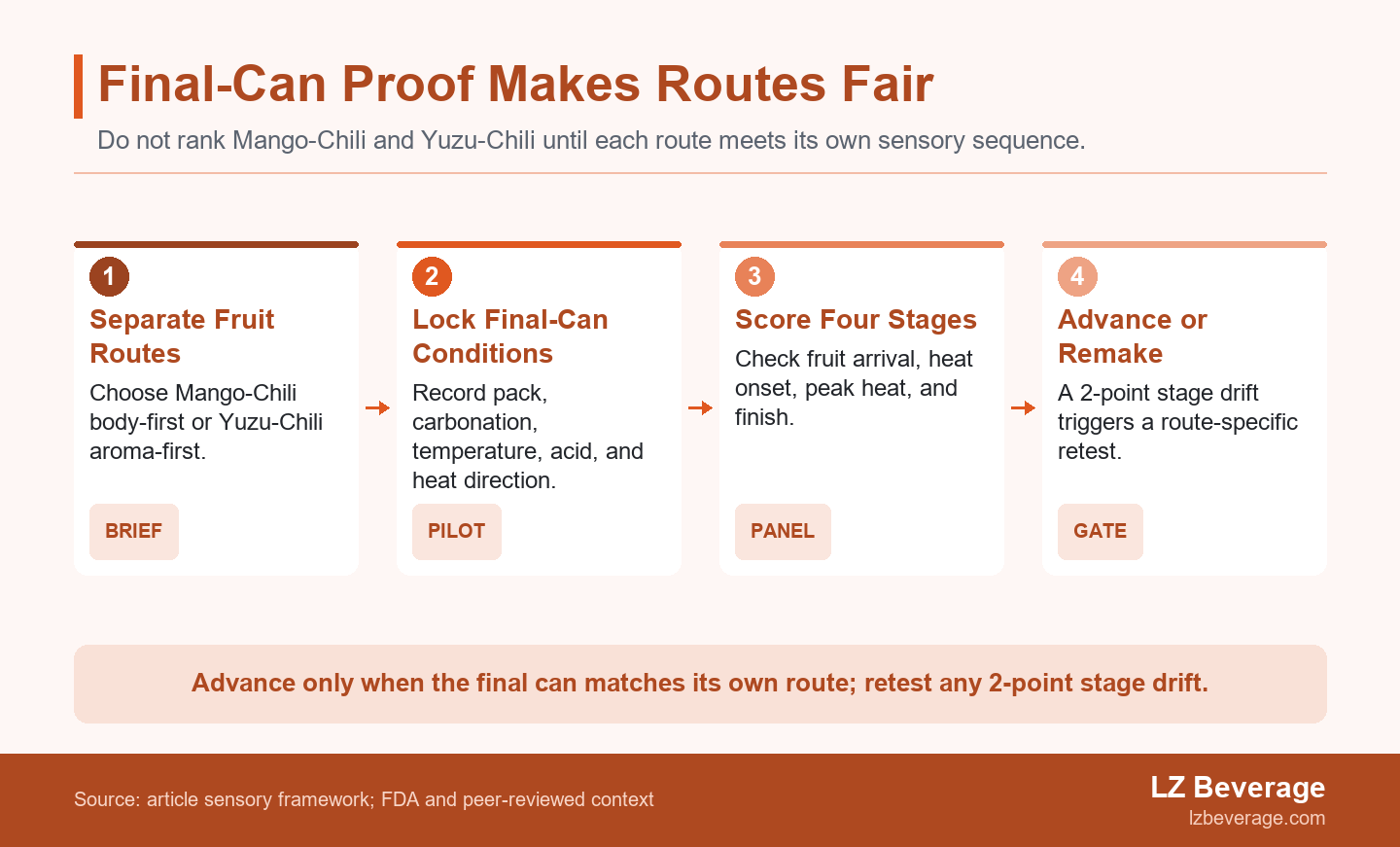
A buyer can make a swicy route testable by scoring fruit arrival, heat onset, peak heat, and finish in the stated final-can condition. Use a simple 1-to-5 acceptance score for each stage, write the target for each route before tasting, and treat a two-point shift in any agreed stage as a reason to remake or separate the sample rather than as proof that one fruit is inherently better.
The decision rule is deliberately narrow. It helps an innovation team compare its own targets under stated conditions; it does not predict consumer preference, prescribe a universal carbonation level, or replace product-specific sensory work.
Keep the Pilot, Pack, and Preservation Questions in One Record
A swicy bench sample should not advance without a stated carbonation condition, pack, ingredient-purpose record, and storage-review question. A final-can sample is the version tasted in the intended carbonated package, rather than only as a bench base. Naming that condition prevents a directional bench preference from becoming an incomparable commercial choice.
The record can be compact: formula version; fruit and heat direction; acid direction; carbonation condition; 330 mL or other intended pack; serving temperature; target market; and the four-stage sensory score. Add the question that could change the route at pilot scale, such as whether the heat arrives earlier, whether citrus lift fades, or whether a preservation direction needs a separate review. Teams considering a ready-to-drink format can review ready-to-drink product directions while keeping that sensory record attached to the request. For an OEM/ODM conversation with LZ Beverage, this gives the project a stated sample basis rather than an undefined trend phrase.
FDA says benzene can form at low levels in some beverages containing benzoate salts and ascorbic or erythorbic acid, and heat and light can stimulate formation in some such beverages. This is not a safety finding about a proposed swicy drink; it is a concrete reason to flag that ingredient-and-storage combination for formula and market review if those directions are being considered.
Illustrative Pilot: Hold Both Routes When the Final Can Changes the Sequence
When a carbonated pilot no longer matches the approved bench sequence, hold and remake the mismatched route before ranking the alternatives. The following is an illustrative development scenario, not an LZ Beverage client case or a guarantee of any production result.
The Bench Was Directional; the Pilot Must Be Comparable
Bench and pilot samples must be compared under the same carbonated, serving, and version-controlled conditions. Otherwise, a panel can mistake a scale-up change for a genuine preference between fruit routes.
An illustrative innovation team is preparing two non-alcoholic swicy concepts for a regional carbonated launch.
The working commercial context is 120,000 cans across two 330 mL formula tracks, so choosing a route before the pilot is comparable would commit the team to a weak reference.
The bench concepts have directional acceptance, and a carbonated pilot comparison is due before either supplier route advances.
In the Mango-Chili pilot, the expected fruit body is present, but the heat appears earlier and lingers longer than in the bench reference.
In the Yuzu-Chili pilot, the bright opening aroma remains detectable, but it loses its intended lift before the panel reaches the planned heat stage.
Those cans no longer describe the same sensory sequence as the approved bench examples. Ranking them now would mix two questions: which route the team prefers and which route changed between bench and pilot.
The team holds both routes conditionally and does not turn the bench preference into a production decision. A route can move forward only after it matches its own agreed sequence; the hold is a comparison control, not a verdict on either fruit.
The team records the exact flavor and heat-delivery direction, carbonation condition, serving temperature, and target sequence for each route, then remakes only the samples that no longer match those conditions.
A blinded final-can tasting is the gate: advance a route only when the panel confirms its agreed four-stage sequence without a two-point stage drift.
This illustrative scenario does not describe an LZ Beverage factory outcome, a client result, or a guaranteed commercial performance.
Send an OEM Brief That Preserves the Intended Flavor Path
A supplier-ready swicy brief names the desired sensory sequence, heat-source direction, final-can conditions, market, and evidence required to advance. It gives an OEM a comparison standard before samples, quotation, or packaging copy begin to drift in different directions.
- Route and target: name Mango-Chili or Yuzu-Chili, then state the desired fruit arrival, heat onset, peak heat, and finish.
- Formula questions: state the fruit, acid, and heat directions to test; distinguish the intended sensory job from a finished ingredient declaration.
- Finished conditions: state carbonation condition, pack format, serving temperature, and the version of the bench reference.
- Advance evidence: request the final-can tasting record and define the score drift that triggers a remake or a hold.
- Market boundary: identify the intended market and keep any claim or label review separate from a flavor feasibility decision.
FDA describes ingredient order, preservative-function declaration, and nutrition-label context for carbonated soft drinks. For a U.S. route, the practical handoff is the current formula record plus the intended wording for review, not a label promise made before the formula is stable.
European Commission guidance lists ingredients and a nutrition declaration among the mandatory particulars for EU prepacked foods. The target market should therefore travel with the sample brief, because the final product facts and the information required for that market must be reviewed together.
European Commission guidance sets conditions for nutrition claims such as low sugars and no added sugars. A flavor direction is not final claims copy; keep the sensory decision, formula record, and market-specific claim review as distinct workstreams.
When the route and evidence are ready, a team can scope an OEM/ODM feasibility discussion for the finished drink, review LZ Beverage's published manufacturing background, or compare beverage categories before a feasibility review. Those pages are a starting point for a scoped conversation, not proof that any untested swicy formula will be approved or commercialised.
Frequently Asked Questions
These questions address sensory sequence, final-can assessment, and practical choices in mango-chili and yuzu-chili beverage development.
How hot should a swicy carbonated drink be?
Set heat by when it appears, peaks, and fades in the chilled final can, not by a generic “mild” or “hot” label. For Mango-Chili, the target may be warmth that follows a broad fruit body; for Yuzu-Chili, it may be a restrained stage after the citrus opening. Confirm that target in a chilled final-can tasting, then record the condition that produced it. A preferred bench heat level is not enough when carbonation or serving temperature changes the experience.
Is Mango-Chili easier to scale than Yuzu-Chili?
Neither route is automatically easier to scale. Mango-Chili often needs proof that fruit body remains clear before the heat lengthens, while Yuzu-Chili often needs proof that citrus lift remains clear before the heat is judged. The relevant comparison is whether each route reproduces its own agreed sequence in the actual carbonated package. Keep the routes separate until both have final-can evidence, rather than forcing a winner from a still or unmatched sample.
Does carbonation make a chili note feel stronger?
Carbonation can change how a chili note is experienced, which is why the finished carbonated sample should carry the decision. It does not mean every formula will feel hotter at one fixed carbonation level, nor does it set a universal recipe. Use the same pack, serving temperature, and stated carbonation condition for the bench reference and pilot comparison. If a heat stage moves materially, remake or separate that route before treating the difference as a consumer preference.
What belongs in an OEM swicy drink formula brief?
Include the chosen flavor route, the intended fruit-to-heat sequence, heat-source direction, acid direction, final-can conditions, target market, expected volume, and the evidence needed to advance. Also include the observed sensory drift that would trigger a remake, such as a citrus opening that fades before the heat stage. This makes the initial supplier conversation more comparable without presenting an unreviewed formula, label, claim, or compliance position as final.


