A clean-label carbonated drink becomes a viable OEM project only when its ingredient direction, finished sensory system, process-and-pack conditions, and market route are specified together. A short ingredient list does not tell a supplier what the drink must taste like under carbonation, which pack will carry it, or how the intended market may describe it. For this checklist, clean label means a buyer-defined direction for ingredients and finished-product communication in a named market. A finished system is the drink as it will be made, packaged, and assessed—not one ingredient viewed in isolation.
What a Clean-Label Feasibility Decision Must Prove
The buyer's job is not to prove that every proposed ingredient sounds familiar. It is to give a manufacturer enough connected information to judge whether a matched sample, pack route, and label review can proceed. That makes the first supplier conversation more useful: the team can identify what is still unknown instead of exchanging several attractive but incomparable bench concepts.
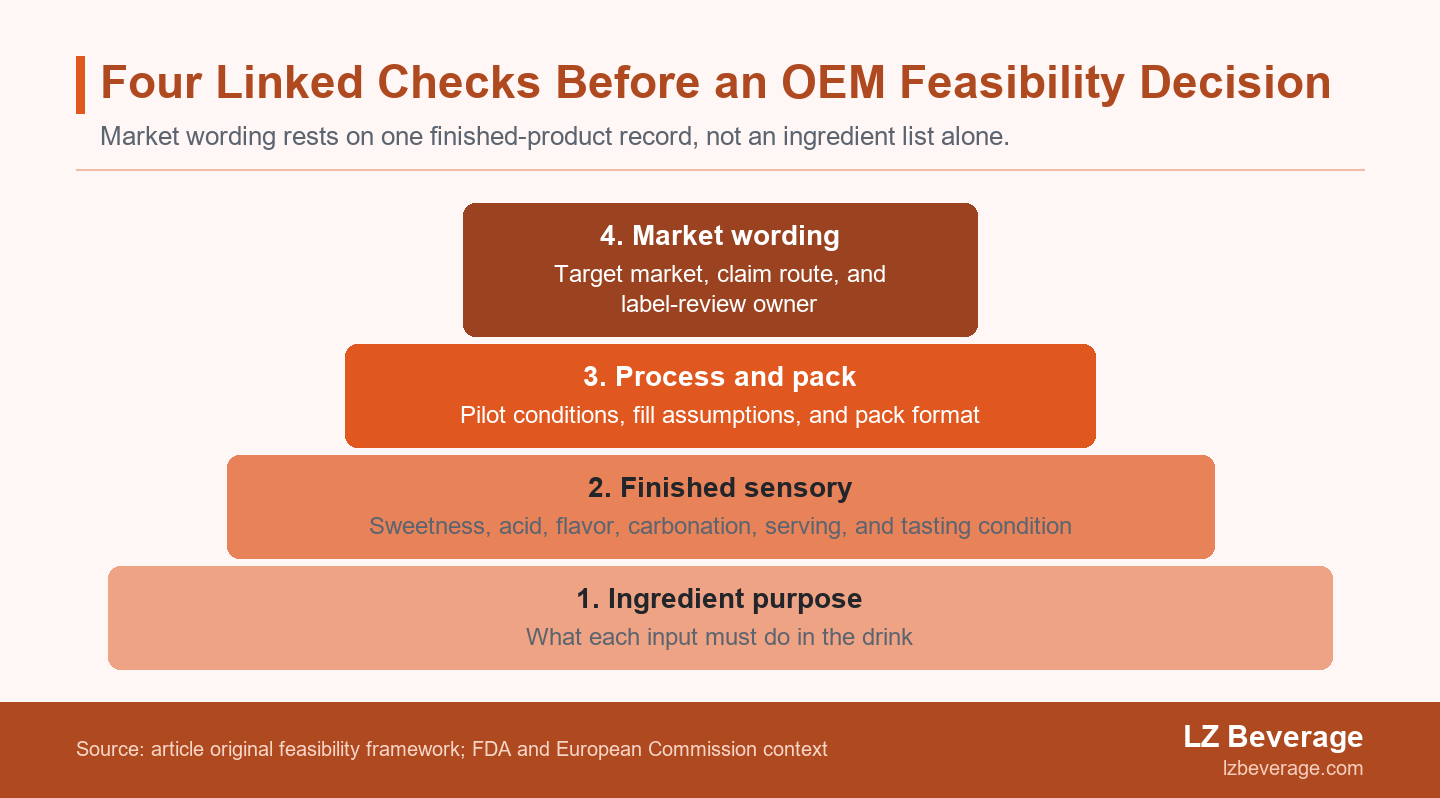
- Ingredient purpose: state what each included or excluded input must achieve in the drink.
- Finished sensory: define the sweetness, acid, flavor, carbonation, serving, and tasting condition together.
- Process and pack: name the intended format and pilot conditions instead of treating a still sample as the product.
- Market wording: fix the target market before claim language is treated as settled.
These checks are linked. A flavor direction that needs more intensity once carbonated can affect the formula record; a formula change can affect the declaration question; and a market route can determine which wording needs review. A clean-label carbonated drink OEM brief should therefore advance as one versioned record, not as four separate checkboxes.
Define the Boundary Before You Choose Ingredients
FDA has not established a formal definition for natural in human food labeling, so a clean-label brief should not treat natural as a globally settled product specification. In the United States, the FDA's policy page explains its longstanding approach. That is a useful boundary for buyers: a preference such as “no artificial flavors” or “recognizable ingredients” may guide the brief, but it does not by itself decide global product feasibility or claim approval.
FDA says ingredients are listed in descending order of predominance by weight, which makes ingredient purpose and order practical questions for a finished-product brief. The agency's ingredient guidance supports that visible-label context. Record the sweetening direction, acid direction, flavor type, any exclusions, color approach, preservative position if relevant, and the words the buyer hopes to use in market communication.
The important distinction is between a preference and a finished-product rule. “Use a citrus flavor with a simple declaration” is a direction. “Use a citrus profile that meets the agreed taste target in a 330 mL carbonated can, with a declaration draft reviewed for the target market” is a testable rule. The second version gives a supplier something concrete to compare across formula options.
Use Four Checks to Test the Finished Product
A buyer should use one record to test ingredient purpose, finished sensory system, process-and-pack conditions, and market-route wording before calling a clean-label carbonated drink feasible. This does not rank ingredients from best to worst. It checks whether the same proposed drink can clear four different questions. If one answer changes, update the record before treating a sample, quotation, or declaration draft as the current project version.
| Check |
What the buyer should state |
What it prevents |
| 1. Ingredient purpose |
What sweetness, acid, flavor, color, or other input must do—and what is excluded. |
A list that looks simple but does not define the product task. |
| 2. Finished sensory |
Flavor direction, sweetness profile, acid lift, carbonation condition, serving size, and tasting basis. |
Choosing a formula from a still or unmatched sample. |
| 3. Process and pack |
Can or other pack format, fill route assumptions, and the pilot condition to be assessed. |
Calling a bench preference a finished-product decision. |
| 4. Market wording |
Target market, intended claim direction, declaration draft, and review owner. |
Using a formulation preference as if it were approved label copy. |
Think of this as a dependency stack rather than a sequence of independent approvals. Market wording rests on the completed product record below it. A change to the sweetening system may alter the sensory result and the declaration discussion at the same time. That is why the most useful comparison between supplier routes is the route that can assess one defined record, not the route that merely offers the shortest preliminary ingredient list.
Test Sweetness, Acid, Flavor, and CO2 as One System
A formulation comparison is more useful when it keeps sweetness, acid, flavor, carbonation, serving, and pack conditions explicit instead of judging a single ingredient in isolation. A peer-reviewed mechanistic study describes carbonation as engaging chemosensory and somatosensory responses. That does not prescribe a formula target, but it gives buyers a clear reason to hold the carbonation condition within the finished sensory record. The decision is not “does this sweetener work?” It is “does this full set of choices create the intended first impression, mid-palate, and finish in the drink the customer will open?”
That framing changes how a buyer asks for samples. A still citrus base can be useful for early flavor direction, but it should be identified as directional. The matched sample should state the carbonation condition, serving temperature, flavor intensity, acid direction, and intended pack. If two samples change both sweetening and carbonation, the team may learn that one tastes different, but not which choice created the difference.
Use a controlled comparison instead. Hold the pack and tasting condition constant, then change one agreed lever: sweetness approach, acid direction, flavor concentration, or carbonation target. The result is not a universal formula rule. It is a cleaner attribution path for a buyer deciding whether the formula is ready for the next pilot step or needs another adjustment.
Keep Process and Pack in the Feasibility Record
A clean-label request needs a stated pack and pilot condition because a bench preference alone does not describe the finished product a supplier must make and assess. A 330 mL can, a different serving format, and a still bench sample are not interchangeable decision units. The buyer does not need to prescribe a factory process; the buyer needs to make the intended commercial format visible enough for a supplier to assess the correct route.
Include the proposed pack, fill size, carbonated or still status, pilot goal, sample condition, and the evidence needed to move forward. That creates a common version for product, sourcing, and label conversations. It also keeps a quotation from silently drifting away from the sample the buyer preferred. For a ready-to-drink route, the buyer can use ready-to-drink beverage directions published by LZ Beverage after those finished-product facts are defined.
Illustrative 75,000-Can Brief: Hold the Shortlist When the Record Drifts
When the versioned formula and declaration draft no longer describe the same carbonated product, the next action is to reconcile and recheck them rather than advance the supplier shortlist.
The Conflict Was Between the Product and Its Declaration
A product result and declaration draft must point to the same version before the supplier route advances.
An importer is choosing an OEM route for three 330 mL citrus carbonated concepts aimed at one export market.
The planning volume is 75000 cans, conventionally written as 75,000 cans, across three flavor concepts.
The buyer has a short ingredient preference list but has not frozen whether the flavor carrier, sweetening system, and declaration language match.
A bench sample meets the desired citrus profile when still, but the carbonated pilot needs a stronger flavor direction.
The proposed flavor carrier changes the declaration review question for the intended market.
The commercial issue is not whether either sample tastes acceptable; it is that the formula record and the communication record no longer describe the same finished product.
Hold the supplier shortlist until one versioned formula, ingredient declaration draft, and carbonated sensory sample are aligned.
Reconcile the flavor-carrier declaration with the finished formula, then run the matched carbonated check.
Advance only after the same versioned formula, 330 mL pack, and market-facing declaration draft are reviewed together.
Illustrative scenario only; it does not state a client order, regulatory result, or manufacturing outcome.
Separate Formula Feasibility From Claim Approval
FDA explains that labels for foods and beverages with added sugars list grams and percent Daily Value for added sugars, so a U.S. formula brief should separate that label fact from a general clean-label preference. The FDA's added-sugars guidance supports the label context. The serving basis, actual ingredients, and label route still have to match.
The same separation matters when buyers use words such as “low,” “reduced,” or “source of.” The FDA distinguishes a nutrient-content claim from a statement that only gives a nutrient amount. Treat that distinction as a handoff rule: product developers can define the formula direction, while the final market-facing statement is reviewed against the applicable route.
European Commission guidance gives conditions for no-added-sugars wording, so an EU-facing brief needs the actual sweetening ingredients and final label route before that wording is approved. The Commission's nutrition-claims guidance notes, for example, that the product must not contain added mono- or disaccharides or other food used for sweetening; naturally occurring sugars may require an indication. This is a market-specific legal context, not a universal copy template.
The declaration review should be part of the same commercial handoff. The Commission also lists an ingredient list and nutrition declaration among mandatory information for prepacked foods in its food-information guidance. In practice, route the current formula version, intended pack, and proposed wording to the appropriate market review together. Do not ask a supplier to guarantee compliance from an ingredient preference alone.
Send an OEM Brief That Can Be Tested
An OEM buyer gives a supplier a usable feasibility brief by stating the target consumer, ingredient direction, sensory target, pack, market, expected volume, and the evidence needed to advance. A formula brief is a practical specification for the drink a buyer wants evaluated. That is enough to make the first feasibility discussion specific without pretending that the buyer already has a final formula.
For an EU-facing prepacked route, the European Commission lists the ingredient list and nutrition declaration among the mandatory information for consumers in its food-information guidance. Treat this as a market-specific label handoff: send the current formula, intended pack, and proposed wording together for the applicable review.
Begin by naming the decision that the first sample must answer. Is the buyer comparing two sweetening directions? Checking whether a citrus profile survives the planned carbonation condition? Deciding whether the intended pack and market wording can stay in the same project version? A clear question lets the supplier propose a controlled sample route rather than responding to “clean label” with generic options. Once those inputs are ready, a buyer can start an OEM/ODM feasibility conversation with LZ Beverage around the actual finished-product brief.
- Describe the drink and target consumer in one sentence.
- List the flavor, sweetness, carbonation, and ingredient direction that must be tested together.
- Name the intended pack, target market, and any proposed claim direction.
- State the expected volume and the evidence that moves the project from sample to the next commercial decision.
Keep the specification versioned. If a flavor carrier, sweetening choice, pack, or market changes, update the record before treating earlier feedback as current. This does not create more paperwork for its own sake. It prevents the common situation in which the commercial team is discussing one sample, product development is adjusting another, and label review is reading a third description. Buyers evaluating the supplier relationship can also inspect LZ Beverage's published manufacturing background once the project has a defined decision path.
Finally, use the first inquiry to narrow the project, not to make a broad compliance promise. Ask which information is still required for the chosen product route, what sample condition will be compared, and who owns the market-facing review. When the formula brief is complete enough to answer those questions, buyers can compare available beverage product categories against the intended format and consumer proposition before moving to detailed development.
Frequently Asked Questions
These questions address formulation, label, and market considerations for clean-label carbonated drinks.
What does clean label mean for a carbonated drink OEM brief?
For an OEM brief, clean label should describe a defined ingredient-and-communication direction, not a promise that a short ingredient list is automatically feasible or compliant. State the intended ingredients or exclusions, the finished sensory target, the pack, and the target market. That gives the supplier a working boundary while leaving market-specific label review to the appropriate stage.
Can a carbonated drink use a no-added-sugars claim?
It can only use that wording when the finished product and intended market meet the relevant conditions, so the ingredient list and final label must be reviewed together. In an EU route, the Commission's conditions for the claim apply; other markets have their own rules. Treat the claim as a final market-review question, not as an assumption made when the first sample is requested.
Which formula choices need a pilot before quotation?
Sweetness system, acid direction, flavor intensity, carbonation target, pack, and market route should be fixed enough to test as one finished product before a supplier prices the route. The buyer does not need every production detail, but the sample question must be clear. A still base can support early direction, while the matched carbonated format supports the commercial comparison.
What should an OEM buyer send before requesting samples?
Send the target consumer, flavor direction, sweetness approach, ingredient exclusions, pack format, target market, and expected volume so the manufacturer can assess a real route. Also state which decision the sample must support and whether any market-facing wording is being considered. That prevents a sample request from becoming a loosely defined product search.


