A mineral target that tastes acceptable in a still bench sample is not yet a decision for a canned sparkling water. Once the drink is carbonated, the salt choice, acid direction, flavor, serving size, and intended market determine whether the development team has one defined beverage ready for the next controlled step.
The useful starting point is not “how many milligrams can we add?” It is “what job must the mineral do in the finished drink, and what evidence will let us approve that job?” That distinction keeps a 330 mL can brief from becoming a loose collection of nutrition numbers, sensory notes, and copy ideas that do not refer to the same formula.
What the Formula Has to Prove
An electrolyte sparkling water needs one matched mineral, carbonation, sensory, and market-route record before it becomes a commercial formula. Here, an electrolyte is a dissolved mineral that contributes ions to the drink.
- Set the mineral role and per-serving target before choosing consumer-facing wording.
- Taste the selected mineral in the intended carbonated system, not only in a still base.
- Record the salt, acid, flavor, CO2 condition, and can format for each comparison.
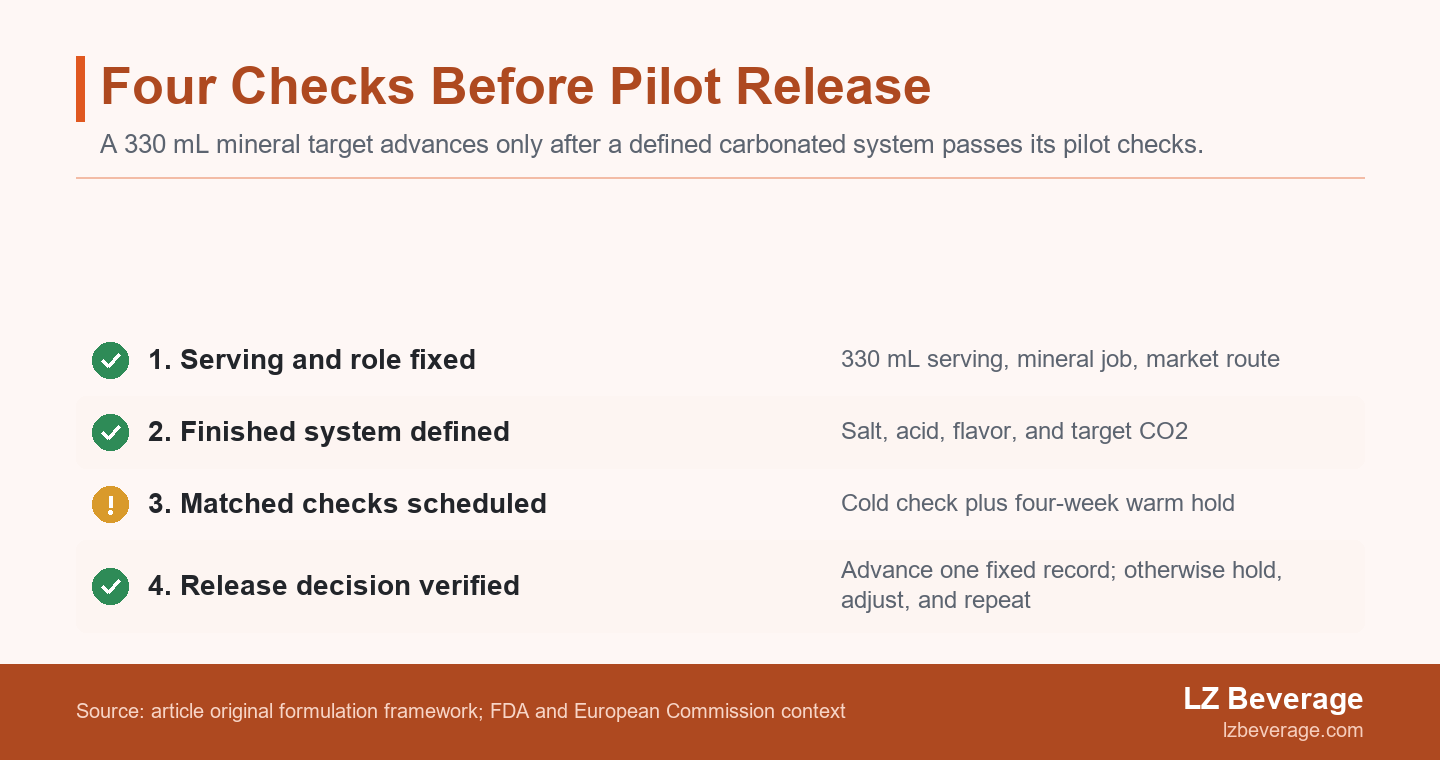
- Advance a pilot only after cold and warm finished-drink checks support the same record.
Set the Mineral Job Before You Set a Milligram Target
A mineral amount needs a stated sensory and product role before it becomes a useful formulation target.
In a beverage brief, an electrolyte is a dissolved mineral that contributes ions in the drink. Its role can be practical: support a specified nutrition presentation, create a particular taste direction, complement a positioning concept, or fit a market-specific brief. It should be written in one sentence beside the target amount. “Add electrolytes” is not a formulation instruction. “Evaluate a 330 mL sparkling-water serving with a defined potassium direction, light citrus profile, target carbonation, and no unresolved claim language” is a testable instruction.
This order also makes internal category conversations more useful. A buyer who needs to place the brief in a broader product discussion can map the mineral target to available beverage categories after the role is clear. The link should not decide the formula; it simply helps keep the commercial route visible while the technical brief is taking shape.
Use the Serving as the Decision Unit
Using FDA's 4,700 mg potassium Daily Value, an illustrative 100 mg potassium target in a 330 mL serving is about 2.1 percent Daily Value. FDA’s Daily Value guidance provides the 4,700 mg denominator. Here, the serving basis is the amount of drink used for the nutrition calculation and formula work.
The arithmetic is intentionally modest: 100 ÷ 4,700 × 100 is approximately 2.1. It gives a serving-basis context, not a recommended intake, a nutrient-content claim, or a verdict on taste. A mineral direction that looks small in percent-Daily-Value terms can still create a meaningful finish in a lightly flavored carbonated drink. The next development question is therefore not whether the calculation is correct; it is whether the stated amount, salt form, and finished sensory target belong together.
Carbonation Changes the Sensory Context
A mechanistic mouse study describes carbonation as generating somatosensory and chemosensory response, so carbonation belongs in the finished sensory test even though the study does not set a consumer preference rule. The open full-text study is a mechanism source, not a consumer-preference study.
In practice, that means a still base can be valuable for early direction but cannot stand in for the proposed canned drink. Carbon dioxide (CO2) changes the first impression, acid lift, perceived dryness, and finish that a panel or development team actually encounters. Record whether the sample was at the planned carbonation condition and serving temperature. If the condition differs, call the sample directional rather than treating it as a release candidate.
This is also why “mineral balance” should not mean a balance sheet of milligrams alone. It describes the relationship among mineral choice, acid, flavor, sweetness if used, and carbonation in the drink a buyer plans to sell. The right answer is formula-specific: a bright citrus route, a neutral water-like route, and a fuller flavored drink can require different work even when their mineral numbers are similar.
Test Salt, Acid, Flavor, and CO2 as One System
A useful formulation comparison changes one controlled lever while keeping the serving, target carbonation, and flavor direction explicit.
A matched trial uses one chosen variable while the product brief remains fixed. It avoids a familiar trap: a team corrects a metallic note with an acid adjustment, then also changes carbonation or flavor and cannot tell which move created the new result. FDA identifies acidulants and pH-control agents as ingredients that control acidity, and gases such as carbon dioxide as ingredients that create carbonation in carbonated beverages. That limited functional context is a reason to keep those variables in the same finished-system record; it does not prescribe a mineral salt, an acid level, or a formula. See FDA’s ingredient-function overview.
| Control point |
Keep visible |
One planned change |
Decision it supports |
| Serving |
330 mL reference and intended mineral amount |
None during a sensory comparison |
Whether the result belongs to one nutrition context |
| Mineral salt |
Salt identity and anion direction |
One named salt or level change |
Whether the finish remains usable |
| Acid and flavor |
Flavor profile and test temperature |
One acid or flavor adjustment |
Whether the correction holds in the drink |
| Carbonation |
Target CO2 condition and package format |
One controlled CO2 condition |
Whether the finished carbonated sample is acceptable |
The table is a trial-control aid, not a recipe. Its value is that it protects attribution. If a test changes the mineral salt, acid direction, and CO2 condition together, the sample may inspire another idea, but it cannot support a clear commercial decision. A manufacturing conversation with LZ Beverage should begin with that controlled comparison, not with a still-sample preference. Teams exploring a ready-to-drink route can check RTD routes against the carbonate-and-mineral brief once their proposed finished system is defined.
Set a Pilot Window Before You Call the Formula Ready
A pilot should have a declared release condition that includes the finished carbonated result, rather than relying on the best single bench sample.
For this type of project, the pilot window is the written interval between a promising sample and a commercial release decision. It should identify the can format, serving basis, target carbonation condition, flavor direction, minimum sensory checks, and the market route that still needs review. It does not promise shelf life, pack compatibility, or regulatory approval. It tells the team what must be true before a directional sample can become a defined pilot.
Partner research belongs beside—not in place of—that record. The technical question remains specific to the formula: what will be checked, under what conditions, and what result would hold the product for rework?
Illustrative 20,000-Can Pilot: Hold, Rework, Then Re-Inspect
When a corrective adjustment changes the acid-mineral relationship and the warm carbonated result, the right next action is a matched re-test rather than release.
Illustrative scenario: a product-development manager is evaluating a lightly flavored electrolyte sparkling water in a 330 mL can.
A 20,000-can pilot is planned for one initial market route, with a cold sensory check and a four-week warm-hold check written into the brief.
The formula has not been cleared for commercial release; it is a controlled pilot candidate.
First observation: the cold carbonated sample shows a metallic finish after the initial potassium-salt direction.
Second observation: a revised acid direction reduces the first metallic note, but the four-week warm-hold sample tastes sharper and less integrated at the target carbonation level.
The second result is not proof that the acid correction failed or that the mineral direction cannot work. The change affected the acid-mineral relationship and the perception of the finished carbonated drink at the same time. The comparison cannot identify one commercial winner, so releasing the 20,000-can run as a specification would overstate what the trial proved.
The decision is to hold the pilot formula rather than release it as a commercial specification.
The next action is to adjust the mineral anion and acid pair, then run matched carbonated trials with the same 330 mL serving, flavor direction, can format, and target CO2 condition.
Advance only after cold and warm checks at the target carbonation condition support an acceptable finished profile and the intended-market review is complete.
This is an illustrative formulation-control scenario, not an LZ Beverage client case, production result, or universal stability outcome.
For published partner background, inspect LZ Beverage's published manufacturing background
Keep Mineral Amounts Separate From Claim Language
A numeric mineral amount and wording that characterizes a nutrient level are not interchangeable under labeling rules. FDA’s label-claims guidance gives a clear U.S. example: a statement of an amount is not automatically the same as language that characterizes a nutrient level.
This distinction matters well before package copy is final. The formula brief may record an amount for technical and nutrition work while the commercial team is still deciding whether any label or marketing language will be proposed. Keep those tracks separate. For sodium context, FDA also explains that 5% Daily Value or less is considered low and 20% Daily Value or more is considered high, illustrating why percentage context and claim wording should not be treated casually. See FDA’s sodium explanation.
The practical rule is simple: document the amount, document the intended market, and send proposed characterizing language for the appropriate product-specific review. Do not make a health, hydration, performance, or compliance promise because a bench formula contains a mineral.
Route the Brief Through the Intended Market
European Commission guidance states that nutrition claims may only be used when listed and compliant with their conditions of use, which is why the intended market belongs in the formulation handoff. The Commission’s nutrition-claims guidance is the relevant EU context.
The U.S. Daily Value example and the EU claims example operate under distinct rules. The destination market should be fixed early because it influences label-reference work, claim review, and the information a manufacturing partner needs. It also determines which version of the formula brief, nutrition presentation, and proposed copy must be reviewed together. Market-specific legal review remains necessary for final formula, presentation, and claims decisions.
Hand Off a Finished-Product Brief, Not an Electrolyte Slogan
A manufacturer can evaluate an electrolyte sparkling-water route more efficiently when the serving, mineral role, sensory system, can format, market, and verification gate arrive together.
Before sampling, assemble one short handoff rather than forwarding separate notes from formulation, commercial, and sourcing teams. It can be incomplete, but it should identify what is fixed and what is still open. That makes a feasibility conversation about a defined beverage instead of an undefined “electrolyte water” concept.
- Name the serving: record the 330 mL or other intended reference.
- State the mineral job: include the target direction and salt questions.
- Describe the finished sensory brief: flavor, acid, sweetness, temperature, and target carbonation.
- Fix the can and route: state package format, destination market, and pilot volume.
- Write the gate: specify the cold and warm checks required before advance.
LZ Beverage can use this kind of defined record as the starting point for a product-route discussion, without turning an early feasibility conversation into a guarantee. When the inputs are ready, start an electrolyte sparkling-water feasibility review.
Frequently Asked Questions
These questions address mineral balance, carbonation, finished-pack performance, and market considerations for canned electrolyte sparkling water.
Does carbonation change how much mineral can be added?
Yes, because carbonation adds a sharp sensory layer, so the acceptable mineral level must be judged in the finished carbonated drink. The formula team may start with a per-serving mineral target, but it should taste that direction at the intended CO2 condition, flavor profile, temperature, and pack route. The goal is not to find one universal limit; it is to identify a controlled formula record that can be evaluated again.
Can potassium chloride work in a sparkling beverage formula?
It can be evaluated, but its sensory contribution should be tested with the selected acid, flavor, carbonation level, and serving basis. Potassium chloride is not automatically suitable or unsuitable. Record the salt direction, hold the other finished-product conditions steady, and compare one planned change at a time. That produces a more useful next decision than judging the ingredient in water or a still base.
Is a mineral amount the same as a nutrient claim?
No, a stated amount and language that characterizes a nutrient level can be treated differently under applicable labeling rules. Use the amount for the formula and nutrition record, then review proposed claim wording against the final product and market. The article’s U.S. and EU examples explain why the destination route must be recorded; they do not provide approval for any label copy.
What should an OEM receive before an electrolyte pilot?
An OEM needs the target serving, mineral direction, flavor and sweetness brief, carbonation target, can format, market route, and pilot objective. Add the controlled comparison record and the release gate, including cold and warm sensory checks. When each input is visible, the first discussion can focus on the real unresolved questions instead of trying to infer a finished product from a short positioning phrase.


