Apple cider vinegar soda formulation is not a recipe exercise once the drink is intended for a retail can. The working brief has to connect the vinegar identity, the desired acid impression, the sweetness system, the carbonation direction, the serving basis, the target market, and the proposed pack. If those inputs move independently, a pleasant bench sample can still leave the team unable to explain what should be scaled or what the can review needs to assess.
The most useful development sequence is therefore simple: lock the beverage configuration first, adjust one sensory lever at a time, taste the carbonated drink rather than a still proxy, and review the pack against that finished configuration. This keeps an apple cider vinegar soda project focused on buyer decisions instead of assumptions about a broad “wellness soda” category.
Decisions to Lock Before the First Carbonated Trial
- Name the vinegar ingredient route and the intended apple-and-acid character.
- Set sweetness on the stated serving basis and retain the matching label route.
- Taste the carbonated finished drink before deciding the acid–sweetness balance.
- Send the finished configuration—not a generic can assumption—for package review.
The cited FDA guidance distinguishes vinegar from diluted acetic acid, so a formula brief should state which ingredient it uses. FDA’s acetic-acid labeling guidance is a useful U.S. context for that distinction; it is not a substitute for destination-market legal review.
For product development, “vinegar” should mean more than an acid number on a worksheet. Record the ingredient description, the intended flavor character, the dosage range to be explored, and whether apple notes are expected to be ingredient-led or supported by a separate flavor system. Those choices influence what the buyer expects in the first sip: a light apple cue, a clear fermented note, or a sharper acid-forward profile. They also prevent a supplier, a sensory panel, and a packaging team from working from different product definitions.
Set the sensory brief on a matched basis. Name the serving size and pack volume, then describe the intended sweetness position, the acceptable vinegar character, the finish, and the target consumer occasion. A 330 mL can may be the agreed commercial container, but it is not a universal sensory standard; the same formula direction can read differently when the serving expectation or target market changes.
Sweetener selection should be recorded by serving basis because applicable U.S. labels list added sugars in grams and percent Daily Value. FDA’s added-sugars information explains that disclosure context. The formulation question is not simply “less sugar or more sugar”; it is which sweetness system gives the specified vinegar profile the desired balance while leaving the commercial team with a clear, market-specific label route.
A practical first brief can be written as five fixed lines: ingredient identity; desired acid and apple character; sweetness direction; 330 mL serving and pack; target market and required label review. Teams can review beverage product categories before fixing the brief. Once those lines are held constant, a trial can test a real question—for example, whether a modest sweetness adjustment changes the perceived vinegar character—rather than testing several unrelated changes at once.
Carbonation Must Be Tested in the Finished Sensory System
FDA lists carbon dioxide as a gas used to create carbonation in carbonated beverages, so carbonation belongs in the finished-beverage testing plan. FDA’s overview of food-ingredient functions supports that limited point; it does not prescribe a carbonation target for an apple cider vinegar soda.
In practice, the team should not declare the acid–sweetness balance finished while tasting an uncarbonated liquid. Carbonation is part of the product experience: it changes aroma release, attack, texture, and how the selected acid and sweetness system are encountered. The useful question is not whether one fixed level is “correct.” It is whether a defined carbonation direction makes the proposed vinegar character feel integrated, too sharp, too sweet, or too short on the intended finished-beverage basis.
Build a small, controlled tasting sequence. Keep the vinegar identity, serving basis, flavor direction, and base formula fixed; then compare carbonated samples that change only the approved sensory variable. Capture the sample code, carbonation condition, temperature, and panel observations on the same record. This does not turn a bench panel into a universal consumer claim. It makes the next formulation decision auditable: retain the base, adjust sweetness, alter the vinegar expression, or repeat the carbonated trial.
The production discussion should follow the same configuration. FDA notes that carbonated soft drinks are subject to food-safety and ingredient requirements, while food-contact questions can involve the cans or bottles that hold the product. Its carbonated-soft-drink overview is a helpful high-level reference, not a validation of a particular process. For an early format conversation, teams can also compare RTD directions against the intended pack before asking for a feasibility view.
Can Compatibility Is a Finished-Beverage Question
A food contact substance is a packaging or process material that contacts food but is not intended to change the beverage itself. Intended use means the specified beverage, pack, and conditions for which that material is proposed. Those definitions matter because “we use cans” is not an answer to the question posed by an acidic, carbonated apple cider vinegar soda in a particular pack format.
FDA describes food-contact review as considering migration data for the intended use, which is why package review should match the finished beverage configuration. FDA’s consumer information on food packaging and food-contact substances provides that regulatory context. It does not approve a particular can, liner, closure, or commercial formula.
For the development brief, provide the proposed vinegar route, acidity direction, sweetness system, carbonation direction, processing assumptions, fill volume, can specification, and target-market route together. That package of information lets a packaging review focus on the beverage actually proposed. A generic successful soda example may be commercially useful background, but it cannot stand in for assessment of a different acid profile, ingredient system, or intended use.
FDA notes that can liners can act as a barrier between food and the can surface, but the article does not treat that general role as compatibility approval for a proposed soda. FDA’s discussion of can linings explains the barrier role in its stated context. The commercially useful action is to ask whether the specific finished beverage and pack specification need further review, not to infer approval from the presence of a liner.
Documentation also has a timing benefit. If the team changes the sweetener, the vinegar source, the carbonation direction, or the can specification after a promising sample is chosen, mark that as a new configuration rather than silently carrying the old result forward. This reduces the chance that sensory notes, a pack discussion, and a label worksheet refer to different versions of the product. Buyers evaluating a manufacturing partner can pair a product-specific feasibility discussion with an opportunity to review LZ Beverage's published manufacturing background.
Before artwork, market entry, or commercial release, confirm applicable food, packaging, and labeling requirements for each destination market with qualified specialists and the relevant authorities.
Keep a single configuration record with a version date, formula reference, sensory-panel conditions, pack specification, and destination-market assumptions. When an input changes, create a new record rather than overwriting the old one. The comparison then remains useful: each sample can be traced to the pack and label route that were in scope at the time it was judged. That discipline makes it easier to decide whether the next action is a revised tasting, a packaging question, or a market-specific compliance check.
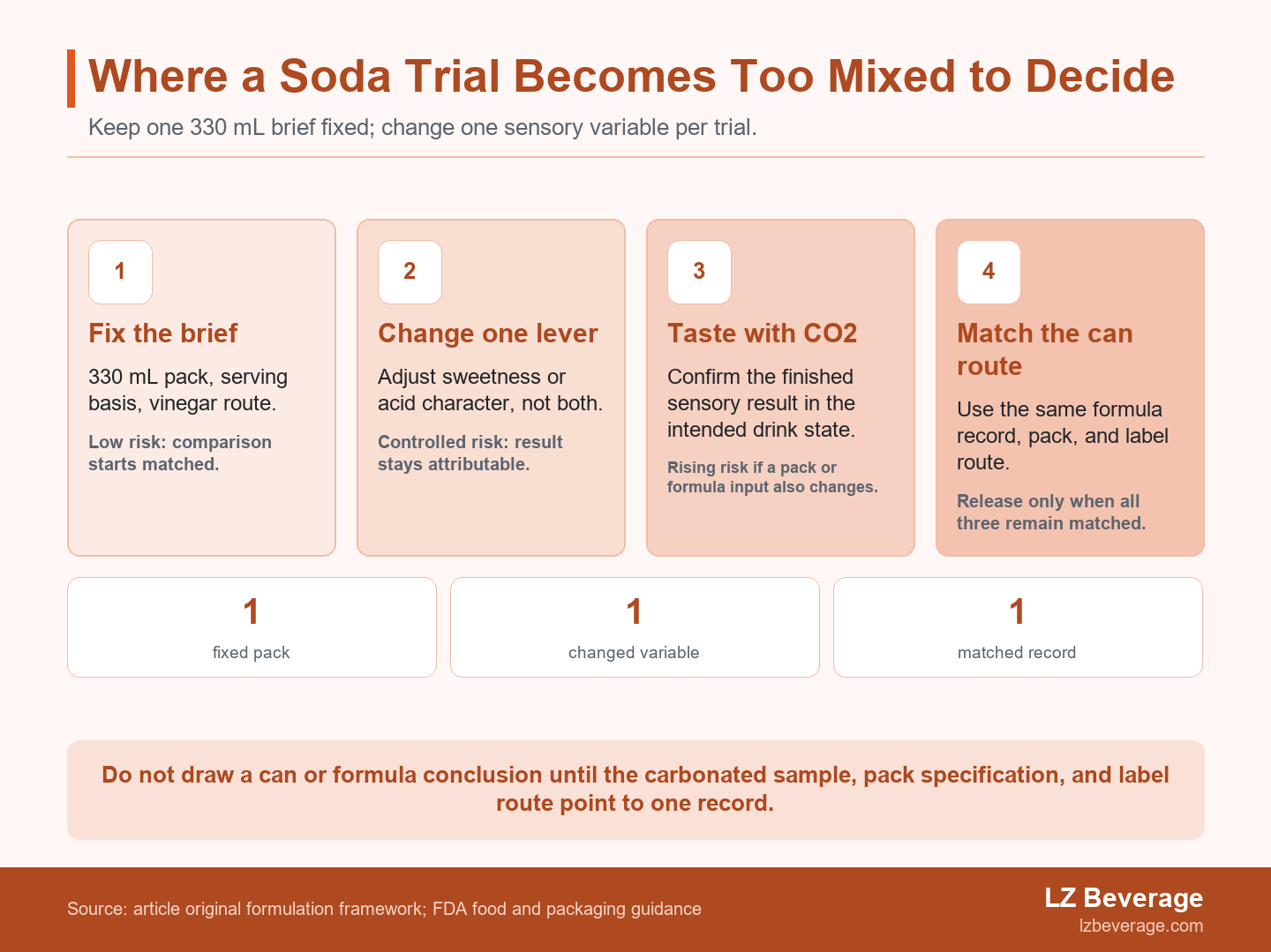
Illustrative Pilot: When Two Good Samples Do Not Answer One Question
An illustrative pilot should hold the pack and serving basis constant while it changes one sensory input at a time.
A pilot run is a controlled trial of the proposed formula, process, pack, and market route. For an apple cider vinegar soda, its value is not merely that it produces cans to taste. It should reveal whether the evidence recorded for the selected sample belongs to the same beverage configuration that will be reviewed for packaging and labeling. The following composite is illustrative, not a description of a verified LZ Beverage project.
Imagine a product manager requesting one 330 mL apple cider vinegar soda for two target markets. The pilot covers 2,400 cans, one flavor, and two sweetness builds. The team has a can concept but no final sensory or pack record. The first sample reduces sweetener while raising vinegar character. The second sample changes carbonation and uses a different can specification. Both samples may be useful directional learning, but neither represents one fixed commercial configuration.
Hold the Mixed-Variable Result Until the Trial Is Matched
When sweetness, acidity, and carbonation change together, the result is directional rather than attributable to one input.
Illustrative composite: a product manager requests a 330 mL apple cider vinegar soda for two target markets.
The pilot scope is 2,400 cans across 1 flavor, 1 can size, and 2 sweetness builds.
The team has a can concept but no final sensory or pack record.
The first sample reduces sweetener while raising vinegar character.
The second sample changes carbonation and uses a different can specification.
Neither sample isolates the reason for the taste difference or represents the proposed commercial configuration. The samples can inform the next question, but they should not become the evidence for a final sweetness position, carbonation direction, or pack conclusion.
Hold both as directional samples and release no package conclusion.
Fix the 330 mL pack and serving basis, then vary one sensory factor per build. The next set can retain one vinegar route and can specification while comparing the chosen sweetness or carbonation change in carbonated samples.
Compare carbonated samples using the same formula record, pack specification, and destination-market label route. Only then is the result tied to a single proposed product configuration.
This is an illustrative planning scenario, not a verified LZ Beverage project.
Build a Feasibility Brief Before You Request Sampling
A feasibility brief should name the ingredient identity, sensory target, carbonation direction, pack, serving basis, and target market before a supplier assesses the route.
The handoff can stay compact, but it should be precise enough to prevent a generic reply. Share the proposed apple cider vinegar identity and flavor direction; the intended acid character and sweetness system; the carbonated serving target; the can size and pack specification; the destination market; and the expected volume. Add any target label language, ingredient exclusions, or launch timing that may materially change the route. This gives an OEM/ODM discussion a common reference point from the first review.
For example, a label route should not be bolted on after the tasting is complete. The European Commission describes mandatory information for prepacked foods, so label-route inputs belong in the feasibility brief before sampling. Its nutrition-labelling guidance explains the per-100 g or per-100 mL presentation in its regulatory context. Review the Commission’s mandatory-food-information overview and nutrition-labelling guidance for the applicable EU framework, then obtain market-specific advice for the final product.
For the first supplier conversation, share the beverage type, target consumer, flavor direction, function, pack format, target market, and expected volume for an OEM/ODM feasibility review. Include the latest configuration record so the discussion starts from the same sensory and packaging assumptions. If a product-specific supplier conversation is the next step, start an apple cider vinegar soda feasibility review.
Frequently Asked Questions
How much apple cider vinegar belongs in soda formulation?
There is no universal amount because the practical level depends on the vinegar character, sweetness system, carbonation, serving size, and target market. Start with a stated sensory target instead of a universal dose. Compare matched carbonated builds, record the serving basis, and decide whether the selected level gives the intended apple-and-vinegar expression. The final commercial amount also needs to align with the ingredient identity, label route, and pack review for the proposed market.
Does carbonation make vinegar soda taste more sour?
Carbonation can change the way sourness and sweetness are perceived, so the acid and sugar balance must be tasted in the carbonated finished beverage. It is better to treat carbonation as part of the trial configuration than as a last-minute finishing step. Hold the base formula and serving basis steady, compare defined carbonated conditions, and capture the panel’s observations. That approach supports a product decision without claiming that one carbonation level will suit every vinegar soda.
Can any beverage can hold apple cider vinegar soda?
A can choice needs review against the finished acidic carbonated formula and the proposed intended use; a familiar format is not proof of compatibility. Provide the formula direction, carbonation, process assumptions, fill volume, liner or can specification, and target-market route together. If any of those inputs changes after tasting, update the configuration record before drawing a packaging conclusion. Product-specific assessment and applicable market requirements remain necessary.
Is apple cider vinegar the same as diluted acetic acid?
No; FDA guidance distinguishes vinegar from diluted acetic acid, so the ingredient identity and label treatment should match what the formula actually uses. For a soda project, state the ingredient route plainly in the brief and ensure the sensory, purchasing, and label teams use the same wording. The FDA material cited here provides U.S. guidance context; the final label and product route should be reviewed for each destination market.


