A fiber-led carbonated soda becomes difficult when a team treats the fiber as the whole product decision. A fiber choice can look promising in a bench base, then become ambiguous after acid direction, sweetness, carbonation, serving basis, package, and market route are changed in separate trials. The practical risk is not merely an imperfect sample. It is a record that cannot show which finished beverage the team has actually approved for a pilot.
A usable brief connects those variables before sensory work becomes expensive. The team should name the ingredient route and intended wording, set a finished-beverage sensory target, hold the commercial pack and serving basis visible, and carry the target market into the same record. That sequence does not predict stability, compliance, or consumer response. It gives a buyer and an OEM/ODM partner a clearer question to test: whether one specified carbonated drink is ready for the next development decision.
What Must Stay Matched Before a Fiber-Led Soda Moves to Pilot
- Separate the named fiber from the consumer-facing positioning and destination-market review.
- Taste acid, sweetness, and carbonation together in the proposed finished drink.
- Keep the serving basis and intended pack on the same record as each sensory result.
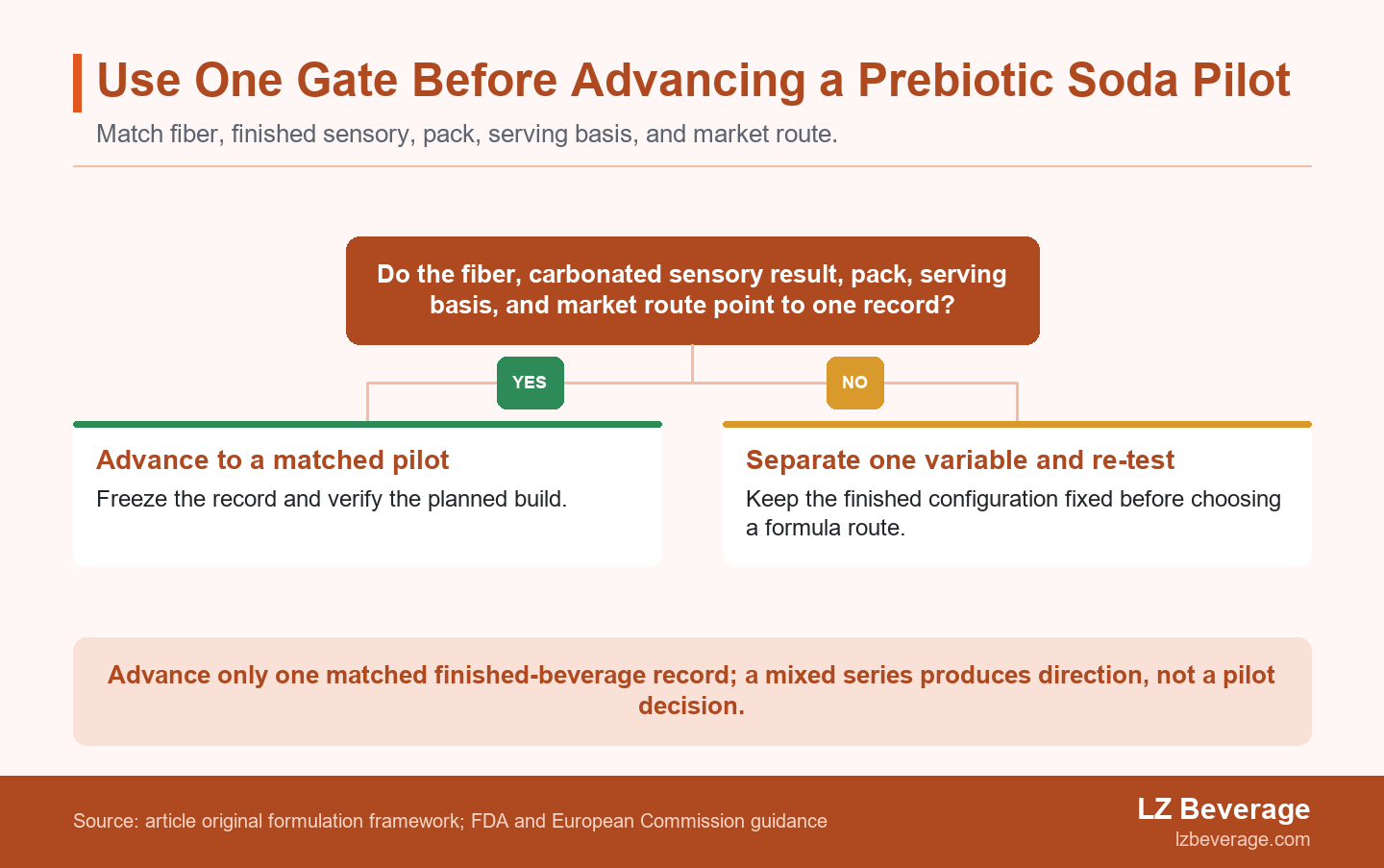
- Advance only matched carbonated builds, not the most appealing isolated sample.
Select the Fiber Route Before You Select the Claim
In the cited FDA context, an isolated or synthetic non-digestible carbohydrate needs the applicable dietary-fiber basis rather than simply being described as a fiber ingredient. FDA’s dietary-fiber Q&A explains the U.S. labeling context for certain isolated or synthetic non-digestible carbohydrates. That context is a reason to record the ingredient identity and intended wording early; it is not a shortcut to a finished label or claim decision in every market.
Use a prebiotic positioning only after it is separated from the ingredient identity and reviewed for the intended market. Here, “prebiotic” is a positioning term: it needs to be assessed separately from the named fiber and the market where the beverage will be sold. A formula brief is the concise record that keeps the ingredient, intended sensory experience, pack, and market assumptions together. It should say what the fiber is, what the commercial team wants to say about it, and which destination-market review remains open.
That separation prevents two common handoff errors. The first is sending a supplier only an ingredient name and assuming the consumer wording follows automatically. The second is choosing a phrase before anyone has agreed on the formula, serving basis, or destination market that the phrase must fit. Neither error is solved by a more elaborate claim. They are solved by naming the unresolved decision: ingredient identity, evidence route, label language, or all three.
For early sensory work, turn the fiber choice into a controlled set of trial inputs. State the intended fiber source, the range to be explored, the base flavor direction, the serving size, and the properties that must be watched in the actual drink, such as clarity, body, sweetness perception, or settling. The goal is not to promise that one fiber will suit every soda. It is to avoid comparing samples that quietly use different ingredient assumptions while the team thinks it is comparing only taste.
A useful first screen asks a narrow question: can this named fiber direction support the intended citrus profile at the stated serving basis once the drink is carbonated? Keep the pack, market, and basic sensory target visible even if they are not yet final. If a sample is being judged for mouthfeel, do not also change the intended consumer wording, sweetness system, and can size without noting the change. Each additional moving input makes a favorable result less attributable to the fiber decision the buyer needs to make.
The product-category choice also affects how that discussion starts. Teams that need to compare an RTD or carbonated route can review beverage product categories before fixing the fiber brief. The useful outcome is a short, shared product description—not a generic functional-beverage label. With that description in hand, sourcing, formulation, and commercial teams can tell whether the next trial should explore a fiber range, a flavor correction, or a market-specific wording question.
Treat Acidity, Sweetness, and Carbonation as One Finished System
FDA lists pH-control agents and acidulants as controlling acidity and carbon dioxide as a gas used to create carbonation, so acidity and carbonation belong in the same finished-beverage testing plan. FDA’s overview of food-ingredient functions supports that limited functional distinction. It does not recommend a target acid level or carbonation level for a particular fiber-led soda.
In a bench program, it is tempting to decide the acid profile in a still base and add carbonation later. That approach can hide the question the consumer-facing drink must answer. The first sip, aroma release, perceived sweetness, and finish are experienced together in the carbonated beverage. A sample can therefore be useful learning without being a finished-system comparison. The record should say whether the beverage was carbonated, how it was served, what temperature was used, and which sensory lever changed.
For applicable U.S. labels, foods and beverages with added sugars list grams and percent Daily Value for added sugars, so sweetness direction should be recorded by serving basis. FDA’s added-sugars information provides that disclosure context. The immediate formulation implication is modest but important: a note such as “lower sweetness” is incomplete unless the team also records the serving basis and the market route that frame the label work.
Build the sensory plan around matched comparisons. Keep the fiber identity, flavor direction, serving basis, and pack target fixed. Then choose one approved lever for each trial: acid direction, sweetness direction, or carbonation condition. A small table can make that discipline visible before samples are requested.
| Variable |
What stays recorded |
What one trial may change |
Decision it supports |
| Fiber route |
Named ingredient and tested range |
One stated loading change |
Whether body and flavor remain aligned |
| Acid and sweetness |
Serving basis and flavor target |
One approved sensory direction |
Whether the profile remains balanced |
| Carbonation |
Carbonated serving condition |
One defined carbon dioxide condition |
Whether the finished drink, not a still proxy, is acceptable |
| Pack and market |
Can format and destination assumptions |
Nothing during a sensory comparison |
Whether the result belongs to one proposed commercial route |
The table is a trial-control aid, not a recipe. A team may need several iterations, and the order of the sensory levers can vary. What should not vary without a new record is the context used to interpret the sample. When a carbonated test changes both acid character and sweetness while a second sample changes carbonation and serving note, the comparison may still generate ideas, but it cannot identify which change produced the preferred result.
Once the intended finished beverage is explicit, the format conversation becomes more productive as well. Buyers exploring a ready-to-drink route can compare RTD product directions against the finished-beverage brief. That keeps the format link close to the actual question: whether a specified fiber, sensory target, and pack direction can move into a product-specific feasibility discussion with an OEM/ODM partner such as LZ Beverage.
Use a Matched Pilot Gate Instead of Trusting the Best Bench Sample
FDA describes food-contact review as considering migration data for the intended use, which is why a pilot record should name the proposed finished beverage and pack configuration. FDA’s food-packaging information gives the relevant U.S. context. It does not approve a particular can, liner, closure, or formula, so a familiar soda pack should never be treated as automatic confirmation for a new finished beverage.
A food-contact substance is the pack material that touches the drink and needs assessment for its stated use. For this kind of project, that stated use means the proposed beverage, pack, and conditions under review—not simply the fact that the product uses a can. That is why a pilot record needs the pack specification beside the fiber, acid, sweetness, carbonation, serving basis, and market assumptions.
A prebiotic soda pilot is decision-ready only when the fiber identity, finished sensory system, pack, serving basis, and market route point to one matched record. This five-variable gate is an original development-control rule, not a regulatory protocol or stability claim. Its purpose is to make the next decision clear: advance a matched comparison, revise one documented input, or stop treating an attractive bench sample as proof of a commercial configuration.
Use the gate before a supplier discussion becomes a loose list of preferences. Put the current formula reference, the intended sensory target, the carbonated state, the proposed pack, the serving basis, and the destination market in one version-controlled record. If any of those inputs changes, label the next sample as a new configuration. This takes little time compared with retracing why a sales, sensory, and packaging conversation are referring to different variants of the drink.
Manufacturer background can support the partner-evaluation side of that work, while the product record still carries the technical question. The article does not infer technical approval from company information; the finished-beverage brief remains the basis for a feasibility conversation.
Escalate Three Directional Builds Into Two Matched Carbonated Trials
When three bench builds change more than one finished-beverage variable, the next useful step is two matched carbonated trials rather than a winner declaration. The reset preserves what the team learned while replacing a mixed comparison with a decision that can be checked against one commercial configuration.
Illustrative buyer scenario: a functional-beverage team is preparing an initial 2,400-can pilot for 1 citrus flavor and wants a fiber-led positioning route.
The brief names 1 can size and 1 launch market across 3 bench builds, but the records use different serving notes and do not preserve one carbonation condition.
The team has a preferred fiber direction but no single finished-beverage record that represents the proposed pilot.
Build A changes fiber level and sweetness before carbonation is checked.
Build B changes acid character and carbonation while keeping a different serving note.
Build C tastes acceptable but does not state the intended can configuration.
The repeated pattern matters more than any one favorable taste note: three builds provide directional observations, but none isolates the chosen fiber route in one finished commercial context. The missing link is not another broad preference ranking. It is a matched comparison where the fiber, serving basis, pack, and market assumptions remain visible while one sensory lever changes.
Pause the pilot conclusion and escalate to two matched carbonated builds rather than selecting the preferred sample by taste alone.
Freeze the fiber identity, serving basis, can format, and market route; then change only one sensory lever in each new build. For example, retain the same carbonated base and compare two approved acid directions, or hold the acid direction and compare two sweetness positions. Record the same pack and serving details for both samples.
Proceed only when two carbonated samples share the same recorded fiber route, pack, serving basis, and market assumptions. The team can then state exactly what changed and what the next feasibility discussion must assess.
This is an illustrative development-control scenario, not a client case or a claim that a particular formula will be compliant, stable, or preferred by consumers. Buyers can see LZ Beverage's published company background after the product record is ready for a feasibility discussion.
Hand the Supplier a Formula Brief, Not a Functional Slogan
The European Commission lists ingredients and a nutrition declaration among the mandatory particulars for EU prepacked foods, so the destination market belongs in the feasibility brief before sampling. The Commission’s mandatory-food-information overview is a useful framework for that route. It does not replace market-specific legal review for a finished product.
European Commission nutrition-labelling guidance states that nutrition information is expressed per 100 g or per 100 mL and may also be expressed per portion, which makes serving basis a route-specific handoff input. Its nutrition-labelling guidance supplies that limited EU context. The decision for a beverage team is practical: record the same serving basis in the sensory brief, nutrition work, and supplier packet rather than letting each function use a different reference.
A supplier can assess a prebiotic soda route more efficiently when the ingredient, sensory, pack, market, and volume assumptions arrive in one brief. Add the target flavor, acid and sweetness direction, carbonation condition, serving basis, can format, destination market, expected volume, and any ingredient exclusions that can materially change the route. If information is still undecided, call it open rather than leaving it implicit.
- Identify the fiber route: name the ingredient, the proposed range, and the positioning question that still needs review.
- Describe the finished drink: state the flavor direction, acid and sweetness target, carbonation condition, and how the sample will be served.
- Fix the commercial reference: record the intended pack, serving basis, launch market, and current label-review assumptions.
- Attach the comparison record: show which variables were held constant and which single lever changed in each carbonated build.
- State the decision requested: ask for a feasibility view, a sampling plan, or a question about one specified configuration.
That packet creates a cleaner starting point for an OEM/ODM conversation because it exposes the real unknowns without turning them into promises. It also gives LZ Beverage a concrete basis for discussing a carbonated product direction within the published scope of its beverage manufacturing work. When the brief is ready, teams can request a prebiotic soda formulation feasibility review.
Frequently Asked Questions
Does every added fiber support the same consumer-facing position?
No added fiber supports the same consumer-facing position automatically across every finished beverage and destination market without separate evidence and route review. Treat the ingredient identity, the supporting evidence, and the intended market as separate inputs before using consumer-facing wording. That approach avoids turning a sourcing choice into an implied health or label conclusion. The appropriate review route depends on the finished beverage and the market where it will be sold.
Should fiber loading be finalized before carbonation testing?
Yes, the fiber direction should be fixed before final carbonated comparisons so the sensory result remains attributable to one documented finished drink. The team can still test a documented fiber range early, but each final comparison should preserve the selected fiber route, serving basis, pack assumption, and target market while one sensory lever changes. Otherwise, the preferred sample may not represent one defined commercial drink.
How should a low-sugar fiber-led soda handle label planning?
Build label planning into the formula brief because sweetness choices and nutrition presentation depend on the intended market and serving basis. For an applicable U.S. route, added sugars are disclosed in grams and percent Daily Value; EU nutrition information follows its own stated framework. Record the serving basis used for tasting and handoff, then obtain market-specific advice before final label or claim decisions.
What should an OEM receive before prebiotic soda sampling?
Send the fiber identity, sensory target, acid and sweetness direction, carbonation target, pack, market, and expected volume together. Include the current serving basis and the latest comparison record so the supplier can see which variables were fixed and which were tested. That makes the first discussion about a defined finished beverage rather than a broad category or a slogan.


