“Reduced sugar” and “no added sugar” can both appear on beverage briefs, but they answer different questions. Reduced sugar is a comparison route: the team must establish what the product is reduced against. No added sugar is an ingredient-and-purpose route: the team must show what was not added and whether an ingredient is being used for sweetening. Treating them as interchangeable can send formulation, artwork, and regulatory review toward different versions of the same product.
The practical starting point is a claim route, not a substitute sweetener. Once the route is fixed, a product manager can give R&D a much sharper request: compare against a reference product, or audit the ingredient system and naturally occurring sugar context. The finished beverage still needs to taste coherent, but a good sensory result does not replace the record required for the words on pack.
Start With the Claim Route, Not a Sweetener Swap
A beverage brief must choose either a comparative reduction route or an added-sugar-absence route before it asks the formulary team to rebalance sweetness. That discipline keeps the project from using one recipe, one reference point, and one set of label words for two claims that need different proof.
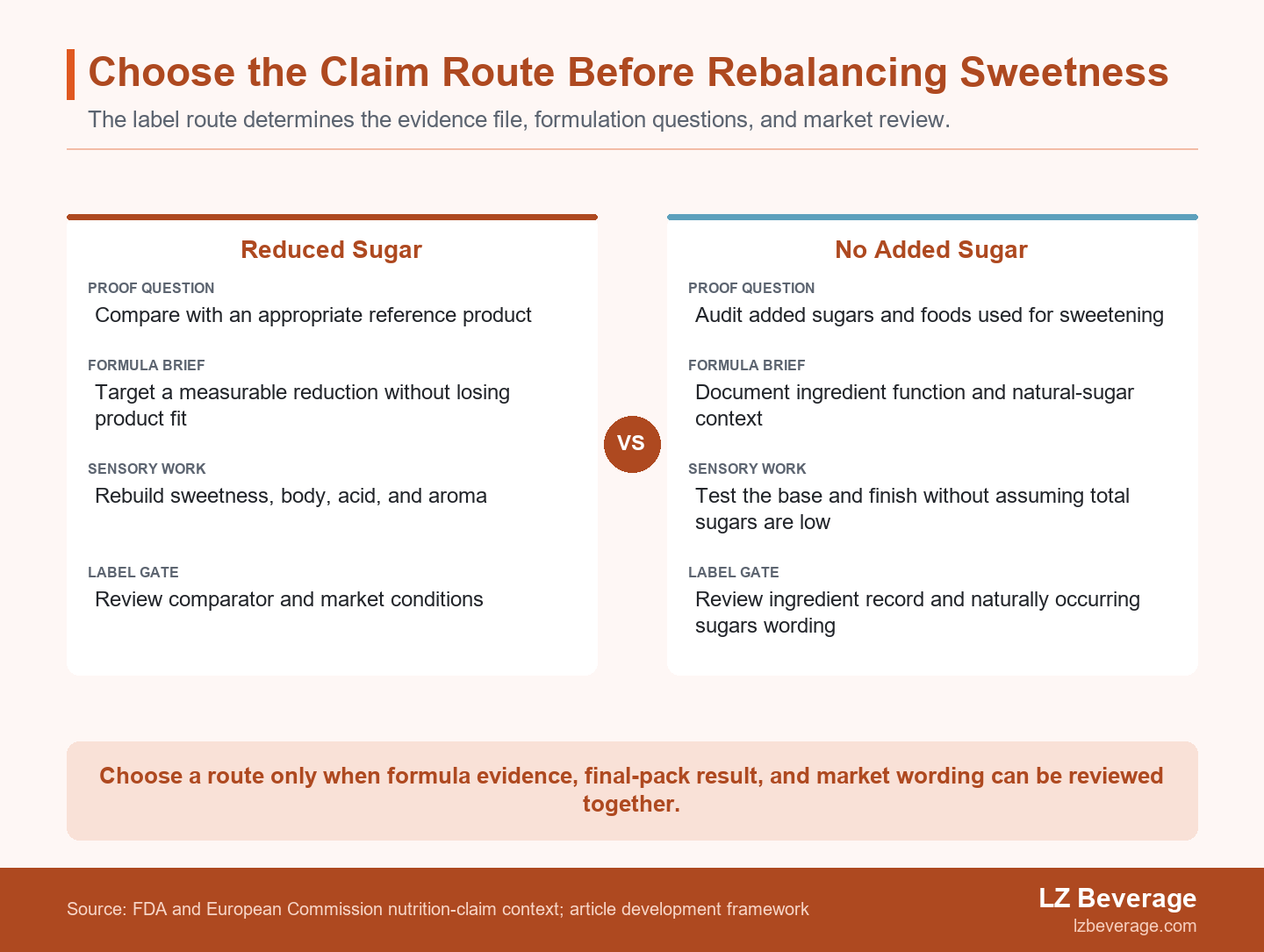
- Reduced-sugar route: define the appropriate comparable product, the serving basis, the target reduction, and the market where the wording will be used.
- No-added-sugar route: record each ingredient, its function, and whether any ingredient or food is used for sweetening; also identify sugars that occur naturally in the base.
- Shared work: set the package, process assumption, sensory targets, and final market-review gate for the actual beverage.
Neither route is a shortcut to a general “better-for-you” promise. The World Health Organization’s sugars guideline addresses free sugars in public-health policy; it does not define commercial claim eligibility for an individual beverage. That distinction keeps product-label planning separate from dietary guidance.
The Claims Ask Different Formula Questions
Reduced sugar and no added sugar are not interchangeable claims: the former depends on comparison, while the latter depends on what was added or used for sweetening. FDA reference material describes reduced sugars against an appropriate reference food and lists no-added-sugars conditions separately, while the European Commission also presents separate conditions of use. FDA’s reference table and the European Commission’s nutrition-claim page are useful starting points, but product-specific review is still market dependent.
A no-added-sugar route can still contain total sugars, so its formulation and label review must not imply that total sugars are absent or low. FDA explains that Total Sugars include naturally occurring sugars as well as any added sugars that may be present. Its Added Sugars label explainer is particularly useful when a fruit, juice, dairy, or plant-based component changes the total-sugars picture.
The two routes can lead to very different sample questions. A reduced-sugar sparkling drink may need its reference product locked before the team decides how much sweetness, acid, carbonation, aroma, and body to rebalance. A no-added-sugar tea drink may need a source-and-purpose review first: is the brew, concentrate, or fruit component contributing natural sugars, and is any added ingredient functioning as a sweetener? A buyer who is exploring brewed body can consider a tea-led low-sugar route, but tea is a formula direction, not proof for either claim.
Reduced Sugar Starts With a Comparable Reference
A reduced-sugar route should define the comparable reference product, serving basis, and target reduction before sweetness is rebuilt through acid, aroma, body, or texture choices. The reference is not an after-the-fact spreadsheet line. It informs which version of the product is genuinely comparable in flavor profile, format, serving, and commercial role.
In the EU, the “reduced sugars” condition includes at least a 30% reduction compared with a similar product, and the product’s energy must be equal to or less than that similar product. Those conditions are not a universal formula specification; they are a reason to decide the reference and market route before the R&D team treats sweetness reduction as an isolated change. A product manager should also avoid using an old pack declaration as a proxy for a current formula record.
No Added Sugar Starts With an Ingredient-Purpose Audit
A no-added-sugar route should document each ingredient’s function and test whether any food is being used for sweetening under the intended market’s conditions. In EU nutrition-claim material, the route is framed around no added mono- or disaccharides and no other food used for sweetening; where sugars are naturally present, the label indication is also relevant. Read the exact Commission conditions before treating an ingredient list as self-explanatory.
An ingredient-purpose audit is simply a disciplined formula record: list the ingredient, why it is present, what it contributes to taste or process, and whether it creates a sweetening question. It is especially useful when a concept uses juice, concentrate, a flavored base, a syrup-like botanical ingredient, or a sweetener system that is treated differently on the Nutrition Facts label. FDA notes that some sugars and high-intensity sweeteners have distinct labeling treatment, which is one reason to keep the formula record and target-market label review connected. FDA’s explanation of sugars metabolized differently is context, not permission to reuse the same claim language across markets.
Rebuild Taste Without Letting the Claim Decide the Recipe
No added sugar is not the same as sugars-free or low sugars, because those are separate concepts with their own conditions of use. The European Commission lists low sugars, sugars-free, no-added-sugars, and reduced-sugars as different claim categories. The category conditions matter when a beverage contains naturally occurring sugars or when the commercial team wants a stronger-sounding phrase than the formula record supports.
From a formulation perspective, a sweetness change can expose acidity, bitterness, astringency, or a thin mid-palate. The answer is not automatically a high-intensity sweetener, more flavor, or a different claim. Build a sensory brief around observable outcomes: first-sip sweetness, acid lift, body through the middle, finish length, and the point at which bitterness becomes rough. When the base can carry more character, compare the actual RTD format rather than approving from a laboratory glass.
| Decision point |
Reduced-sugar route |
No-added-sugar route |
What the team must not assume |
| Primary proof |
Appropriate reference and measurable comparison |
Ingredient and sweetening-purpose record |
One proof file works for both claims |
| Formula question |
How can reduction preserve the intended product experience? |
What is added, and what role does each ingredient play? |
Claim wording dictates the recipe |
| Sugar context |
Compare against the reference product |
Check naturally occurring sugars and proposed wording |
No added sugar means low or zero total sugars |
| Release gate |
Final-pack result, comparator record, target-market review |
Final-pack result, ingredient record, target-market review |
A favorable bench sample resolves label conditions |
Write a Formula Record That Survives the Handoff
Removing or reducing a sweetening component can change perceived sweetness, acidity, body, and flavor release, so the revised route needs a finished-pack sensory check. This is a formulation inference, not a claim that every sweetener change has the same effect. It is a practical reason to state the target process, package, storage assumption, and sensory accept/reject conditions before a pilot is approved.
A sweetener substitute is not automatically a claim solution; its ingredient role, label treatment, and finished-beverage effect must be recorded for the target market. That record lets a formulation team distinguish a sensory experiment from a claim route. It also helps a regulatory reviewer see which formula version, ingredient statement, and proposed front-of-pack words are actually being assessed.
For an OEM/ODM handoff, keep the record short but specific: target market; selected claim route; reference-product details or ingredient-purpose table; current formula version; pack and process assumption; serving condition; and the question each sample must answer. LZ Beverage can use that information to discuss feasibility across formulation, filling, and packaging. The buyer can then compare RTD format routes against the same claim brief instead of asking a supplier to infer the proof path from a marketing phrase.
Use Label Evidence and Final-Pack Evidence as Separate Gates
A satisfactory bench sample does not establish a reduced-sugar or no-added-sugar claim; the formula record and proposed wording require their own market-specific review. The team should taste the product in its intended can or bottle, made through the intended process, while a separate review checks the claim route’s underlying record.
FDA explains that Total Sugars include naturally occurring sugars and any added sugars that may be present in the product. The label distinction is why a no-added-sugar concept should never be approved from a front-label phrase alone. Check the current ingredient system, the nutrition panel inputs, and the proposed wording as one version-controlled package. FDA’s label guidance provides the terminology context for US planning.
The final-pack check should compare the same factors on both routes: sweetness perception, acid balance, body, aroma after opening, finish, and whether the product still fits its intended use occasion. It should not be used to guess claim compliance. If the sensory answer is positive but the route lacks a defendable reference or ingredient audit, the appropriate action is to resolve the missing evidence, not to rename the claim.
Translate the Route for US and EU Review
For the EU, a reduced-sugars claim requires at least a 30% reduction compared with a similar product and the product’s energy must be equal to or less than that similar product. The Commission also describes no-added-sugars conditions and an indication for naturally occurring sugars where applicable. The Commission’s nutrition-claim material should be read alongside the current product and destination-market review.
For US planning, Added Sugars is shown within the Nutrition Facts label context and should be reviewed alongside the ingredient record and proposed claim wording. FDA describes the Nutrition Facts label as the format for packaged-food information and explains how Added Sugars sit within the broader total-sugars context. Review FDA’s Nutrition Facts overview with the product’s actual serving and formula data.
The buyer does not need to turn an OEM into a legal adviser. The useful handoff is more modest: name the destination, give the selected route and evidence file, attach the current formula and pack specifications, and identify wording that is still under review. That makes it possible for formulation, packaging, commercial, and regulatory stakeholders to work from the same product version. Buyers can see the LZ Beverage production background before deciding how a manufacturing discussion fits their launch process.
Illustrative Pilot: Split the Routes When the Reference Changes
When a late reference revision affects only the reduced-sugar SKU, separate the two claim routes rather than treating the entire program as one unresolved formula. This is an illustrative decision framework, not an LZ Beverage client case or a validated commercial result.
Keep the Two Proof Files Separate
When a late reference revision affects only the reduced-sugar SKU, separate the two claim routes rather than treating the entire program as one unresolved formula. A product manager is preparing two 250 mL sparkling RTD concepts for US/EU review.
The working scope is 2 traceable 24,000-can pilots: one proposed reduced-sugar route and one proposed no-added-sugar route.
The bench formulas are acceptable, but the reference-product record for the comparative route changes shortly before artwork review.
The revised comparison leaves the reduced-sugar route below the planned reduction target. Separately, the no-added-sugar route has no new sweetening ingredient, but its base contains naturally occurring sugars.
The team can trace the reference issue to one SKU and can trace the ingredient record to the other, so the two evidence gaps are visible rather than mixed together.
The formula work has not failed as a single program. The comparative claim now needs a rebuilt reference file for 1 traceable reduced-sugar SKU of 2 planned SKUs, while the no-added-sugar route needs its own ingredient-purpose and wording review. Combining the files would hide the reason each route is being evaluated.
Hold reduced-sugar artwork and continue the no-added-sugar route only through its own final-pack and market-review gate. This is a split decision, not a conclusion that either claim is automatically ready.
Rebuild the comparator documentation for the first SKU. For the second, attach the current base, ingredients, naturally occurring sugar context, package, and proposed wording to the sample record.
Advance each pilot only after its finished-pack result and claim-specific record agree for the intended destination. The benefit of separating the routes is not speed for its own sake; it is a clearer answer to what evidence is still missing for each 24,000-can pilot.
Illustrative scenario only; it does not describe an LZ Beverage client, formula, test result, or approval.
Send an OEM Brief That Can Be Tested
A usable OEM/ODM request names the target market, claim route, formula and reference records, final pack, process assumptions, and expected volume. It should say what the next sample must prove: sensory continuity after a reduction, a complete ingredient-purpose record, a packaging question, or a market-review input.
- Name the route: reduced sugar or no added sugar, not a blended shorthand.
- Attach the relevant evidence: the comparable reference for reduction, or the ingredient-purpose table for no added sugar.
- Describe the beverage: base, flavor direction, carbonation, sweetness target, pack, and serving condition.
- Set the finished-pack check: what must hold after the intended process and in the intended package.
- State the commercial scope: destination, projected volume, timing, and wording still awaiting review.
A manufacturer can respond more clearly when the request separates formula feasibility from market approval. For a focused conversation about product format and development scope, review beverage formulation options for your claim route.
Common Questions About Reduced-Sugar and No-Added-Sugar Drinks
These questions address claim route, formula records, finished-pack evidence, and destination-market considerations for reduced-sugar and no-added-sugar drinks.
Is reduced sugar the same as no added sugar?
No. Reduced sugar is a comparative route that depends on an appropriate reference product and applicable claim conditions. No added sugar is a route about what the product contains or uses for sweetening, with separate considerations for naturally occurring sugars. A product can be formulated to pursue either route, but it should not assume one proof file supports both phrases.
Can no-added-sugar drinks contain total sugars?
Yes. Total sugars can include naturally occurring sugars as well as added sugars when present. The implication for a beverage buyer is practical: document the base and ingredient system before deciding what the front label should say. Do not equate no added sugar with low sugars or sugars-free unless the applicable conditions and product facts independently support those separate terms.
What is the reference product for a reduced-sugar drink?
It is the appropriate comparable product used to substantiate the reduction in the applicable market and claim context. Define the comparison early, keep the formula and serving basis traceable, and review the proposed wording against the destination market. A similar-looking drink or a historic label is not automatically a sufficient reference for a current product decision.
What Should an OEM Beverage Sample Request Include?
Include the target market, selected claim route, formula and reference records, final pack, process assumptions, expected volume, and the question the sample must answer. That allows the OEM/ODM discussion to distinguish sensory development from claim evidence and lets all reviewers work from the same version of the beverage brief.


