A canned-drink sweetener choice is not a three-way popularity contest; it is a decision about sweetness character, formula role, process evidence, and target-market documentation.
That frame prevents a common R&D mistake: asking which ingredient is “best” before deciding what the beverage needs the ingredient to do. A high-intensity route, a bulk-sweetening route, and a market-ready label file are related, but they are not the same workstream. Start with the drink matrix, final can, process, market, and acceptance criteria; then compare candidate routes against that brief.
The Formula Job Comes First
For a canned beverage, sweetness is only one part of the target. The team also needs to decide how the formula should finish, whether it needs bulk or body from the sweetening system, what it will face during processing and storage, and which market will receive the finished pack. This is why a useful comparison does not begin with an ingredient reputation or a per-kilogram price.
Choose the Formula Role Before Choosing a Name
A useful comparison begins by separating high-intensity sweetening, bulk contribution, and market documentation; one ingredient name cannot settle all three jobs.
- Use the sensory brief first. Specify the desired sweetness curve, finish, flavor base, carbonation level, and the conditions in which people will taste the product.
- Quote a route, not a headline ingredient. A meaningful commercial comparison needs the material specification, intended use level, pack, volume, and yield assumptions.
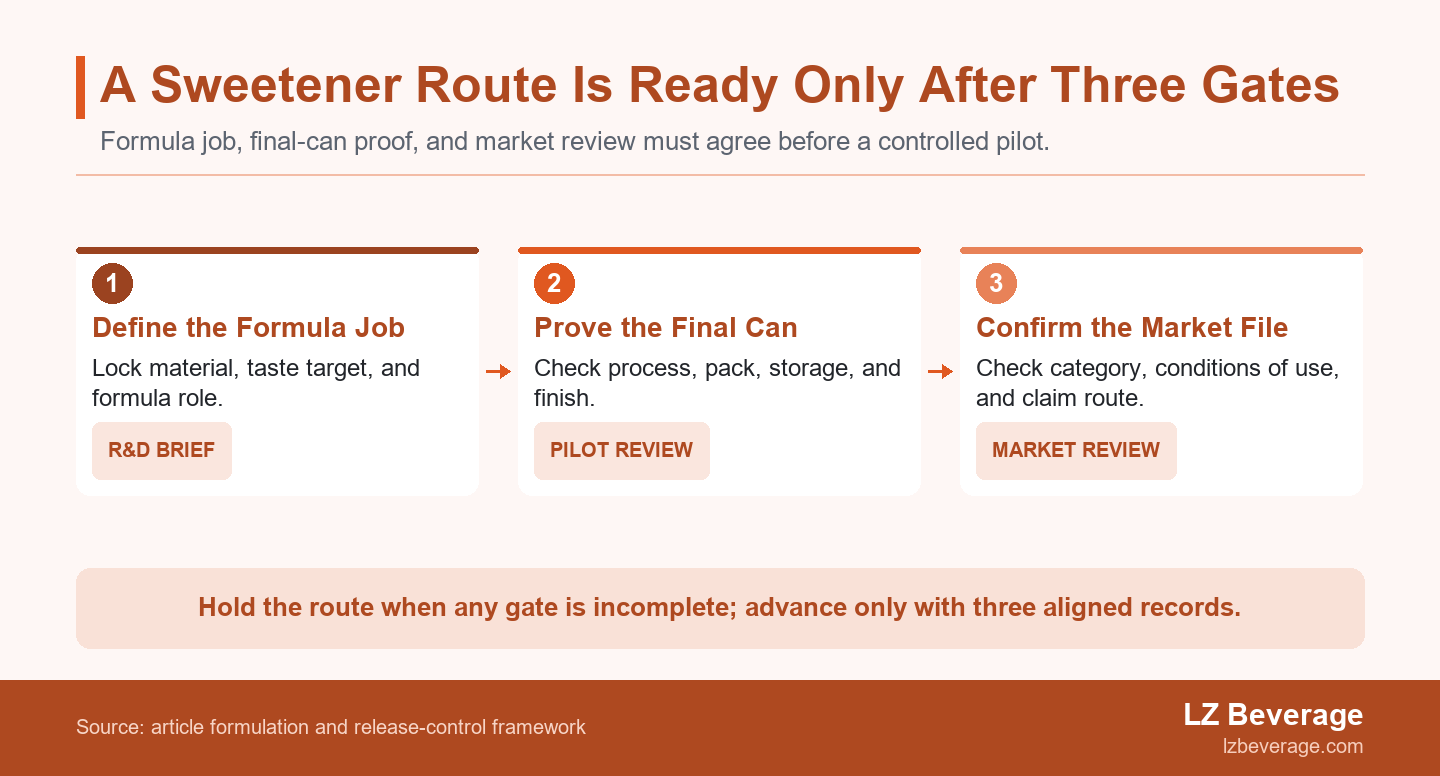
- Keep formula proof and market review in parallel. A successful pilot is not a substitute for checking the target market’s additive and claim conditions.
The practical result is a better sampling conversation. For buyers preparing a brief for LZ Beverage or another OEM/ODM partner, that means replacing “make it taste like sugar with stevia” with a defined sweetener specification, a final-can sensory target, and a test sequence that shows what changes after processing and storage.
| Decision dimension |
Steviol glycosides |
Sucralose |
Erythritol |
| Primary question |
Which specified glycoside gives the required finish in this base? |
Does the intended process and storage window preserve the target profile? |
How does its bulk and cooling contribution behave in the final matrix? |
| Commercial comparison |
Quote the exact material specification and use level. |
Quote the exact material specification and use level. |
Quote the material with the body, solubility, and yield assumptions stated. |
| Proof before release |
Final-can sensory review against a defined finish target. |
Process-matched and storage-matched review. |
Dissolution, sensory, and storage review in the intended beverage. |
| Market file |
Check the specific material and destination-market rules. |
Check the specific material and destination-market rules. |
Check the specific material and destination-market rules. |
Based on this comparison, the right route is conditional. The team should select the candidate that can meet the intended taste brief and complete its process, commercial, and market checks with the fewest unresolved assumptions—not the candidate that appears strongest in a generic comparison.
How the Three Options Change a Canned-Drink Brief
Steviol glycosides, sucralose, and erythritol should be compared as different formulation roles rather than as a single three-way taste ranking.
That distinction changes how the R&D team writes a trial. High-intensity materials call for a precise sensory and process question. A sugar alcohol route asks an additional question about its physical and sensory contribution to the beverage. In all cases, the exact ingredient specification matters: “stevia” is not a complete specification, and neither is a generic promise that a sweetener will be stable.
Steviol Glycosides: Specify the Material and Test the Finish
A consumer sensory study found differences in bitterness and lingering sweetness among rebaudioside A, D, and M, supporting a material-specific sensory test rather than a generic stevia assumption.
Here, steviol glycosides means purified sweetening compounds derived from stevia. The useful brief therefore names the material rather than stopping at a plant-origin label. It should describe the flavor base, target sweetness onset, acceptable linger, and any finish attributes the panel must flag. A bright citrus or tea-led base may expose a finish differently from a fuller flavored drink, so the final product matrix matters more than a generic sensory statement.
A practical first test is a blinded, side-by-side final-can panel using a small set of agreed descriptors. Record the material specification, the flavor system, the serving temperature, and whether the panel is evaluating the first sip, mid-palate, or aftertaste. Those records make a later adjustment traceable instead of turning feedback into an unrepeatable preference debate.
Sucralose: Validate the Intended Process, Not a Generic Assumption
A review of sucralose literature describes thermal experiments in aqueous solutions at different pH values and elevated temperatures, so process-specific validation is more useful than a blanket stability assumption.
For an R&D manager, that is a testing instruction rather than a warning label. Define the process that the actual beverage will experience, the package, the expected storage range, and the sensory checkpoint. Then compare the pilot against a control under the same drinking conditions. If the intended product is carbonated, assess the carbonated, packaged sample—not only a still bench solution.
This route can be commercially straightforward only when the proof plan is equally straightforward. The sample request should state the intended process and the decision rule in advance: what difference in sweetness, finish, appearance, or flavor continuity would trigger another trial? Setting that rule first keeps the team from accepting a formula merely because it performed well at bench scale.
Erythritol: Test Bulk, Cooling, and Storage Behavior Together
A peer-reviewed review reports that dissolved erythritol has a strong cooling effect, making its sensory role a test item rather than a neutral bulk replacement.
That makes erythritol different from a simple “sweetness equivalent” conversation. The team should assess how the route changes the first sip, perceived body, flavor release, and finish in the actual beverage. A cooling sensation may support one flavor direction and be distracting in another. It should be treated as a deliberate part of the sensory brief, not discovered after artwork or pricing has been approved.
Storage is part of the same question. Confirm dissolution and appearance in the intended can and planned storage window, then compare the result with the same acceptance criteria used at the first panel. The point is not to predict a problem from a generic ingredient fact; it is to ensure that physical behavior, taste, and pack condition are reviewed as one route.
Turn Cost Into a Delivered-Formula Comparison
The relevant cost comparison is a controlled quote for the specified material, intended use level, pack format, target market, and expected yield—not a universal ingredient price ranking.
That rule is especially important when a buyer asks which option is cheapest. A purchase price without a locked material specification, use level, expected loss, freight assumptions, and formulation purpose is not a decision number. It may compare unlike materials while ignoring how the rest of the beverage changes to meet the same taste target.
Build a small quote sheet with five fixed fields: the exact ingredient specification, the intended use level, the beverage base and pack, the target market, and the planned batch or order volume. Add the yield assumption and any mandatory testing work. Then ask suppliers to quote the same brief. The result is a comparable input to product development, not a public claim about ingredient pricing.
For example, a tea base may need the sweetener system to be assessed alongside astringency and aroma rather than in water alone. Buyers developing that application can review tea-base sweetener applications before treating the quote as a finished formula decision.
Before comparing routes, keep the base, acid profile, flavor system, and pack assumptions fixed. A change in any of those inputs can change the sensory outcome and obscure the reason a trial moved. This discipline also protects the quotation: the team can separate a genuine material difference from a change introduced by a different flavor load, carbonation target, or production condition.
Make Stability a Route-Specific Proof Task
A stable bench sample is not sufficient release evidence for a canned drink; the chosen route needs checks in the intended process, package, and storage window.
The simplest proof sequence is staged. First, confirm that the specified ingredient dissolves and reaches the target profile in the base. Next, test a process-matched pilot. Finally, evaluate the beverage in its intended can after the agreed storage interval and at the intended drinking temperature. Each stage answers a different question, so passing one should not erase the need for the next.
Keep the records lean but usable: formula version, ingredient specification, process condition, can format, storage condition, sensory descriptors, and the accept-or-repeat decision. This is where an OEM/ODM discussion becomes operational. LZ Beverage can use that information to align a canned-drink sample plan with the relevant format; buyers can also explore canned RTD format options once the proof plan is clear.
For comparison to be useful, every route should use the same final-can review sheet. Capture appearance, carbonation impression, aroma continuity, sweetness curve, finish, and any physical observation. The team can then see whether a difference comes from the sweetening route or from an uncontrolled change in the product build. That is much more informative than averaging broad “like” scores across different sample conditions.
Do not ask whether a sweetener is stable in general. Ask whether this specified route keeps the agreed taste, appearance, and physical behavior in this beverage, this can, and this storage window.
Run Market Review Beside Formula Work
In the United States, FDA lists sucralose among food-additive high-intensity sweeteners, describes certain highly purified steviol glycosides as the subjects of GRAS notices, and lists erythritol among sugar alcohols. Read the FDA category overview.
For EU planning, EFSA's sweeteners topic identifies sucralose as E 955, erythritol as E 968, and steviol glycosides as E 960 variants; it also says a sweetener's presence must be indicated by its name or E number. Review EFSA's sweetener topic.
These are category and planning boundaries, not a substitute for product-specific clearance. Put the target market in the first formula brief so the regulatory review can proceed beside, rather than after, sensory and process work. For a buyer evaluating an OEM/ODM partner, the relevant manufacturing context and published company background can be checked by choosing to inspect LZ Beverage manufacturing capabilities.
Use the Target Market's Conditions of Use
In the EU, additives must be authorised and listed with conditions of use; therefore an R&D team must check product category and current conditions of use rather than assume an ingredient's broad availability. Review the European Commission's EU additive rules.
In plain language, conditions of use are the category-specific rules that limit where and how an additive may be used. The exact material, beverage category, use level, and label route should be reviewed against the target market's current sources. If the project will make a nutrition statement, keep that work separate from the ingredient decision.
EU nutrition claims are permitted only when they appear in the Regulation's Annex, and the conditions must be met. Review the European Commission's nutrition-claim conditions.
That is why “reduced,” “low,” “no added,” and similar language should not be selected from a sweetener comparison alone. Treat market wording as its own review gate, with the final formula, nutrition information, and destination-market conditions available to the responsible regulatory reviewer.
Illustrative Pilot: Escalate a Repeating Finish Shift
The 24,000-can pilot below is an illustrative decision frame; actual acceptance depends on a product-specific test plan and agreed criteria.
Hold the Route Until Final-Can Evidence Explains the Pattern
When the same finish shift recurs across controlled canned pilots, the decision should escalate from local adjustment to a defined process-and-pack investigation.
A global beverage R&D manager is preparing a carbonated canned-drink pilot for one export-market concept.
The scope is a 24,000-can pilot across 3 controlled sweetener routes.
Bench formulas exist and the pilot canning window is planned, but final-can storage observations have not yet been accepted.
The panel records a repeating finish shift after the canned samples enter the planned storage window.
The bench samples do not show the same pattern with the same clarity.
The evidence gap is not a single preference score; it is the missing connection between formula, process, package, storage, and the recurring finish observation.
Pause expansion of the affected route and investigate the process-and-pack condition before selecting a release path.
Repeat controlled pilots with one change at a time, preserve ingredient specifications and process records, and compare the intended drinking condition.
Recheck the selected route in the final can after the planned storage interval using pre-agreed sensory acceptance criteria.
This illustrative example shows a decision sequence only and supplies no prediction of a real product outcome.
Build an OEM/ODM Brief That Can Be Tested
An OEM/ODM brief is testable when it names the sweetener specification, target taste profile, process assumptions, intended market, package, and acceptance criteria.
Before asking for samples or a quotation, put the following items in one shared document:
- The beverage base, flavor direction, carbonation expectation, and target serving temperature.
- The named sweetener material or candidate routes, plus the sensory attributes that must be protected.
- The intended can format, target market, anticipated process, storage window, and panel acceptance rule.
- The quote volume, yield assumptions, and the information needed for the destination-market review.
For an early-stage canned drink, share the target market, can format, flavor direction, sweetener specification, and acceptance criteria before requesting a pilot. When those inputs are ready, a buyer can request a sweetener-system development brief.
Related product pages help a buyer place the sweetener decision in a broader RTD development discussion.
The next useful conversation is usually about the whole beverage route: base, flavor, can format, process, market, and the evidence needed to move from a promising sample to a controlled pilot.
Common Questions About Sweetener Selection
These questions cover practical trade-offs in sweetener selection for canned drinks; the appropriate choice depends on the product goal and finished beverage system.
Can one canned drink use more than one sweetener?
Yes, but the brief should still define the job of each component and test the blend in the intended can and storage conditions. A blend does not remove the need for a sensory target, process record, or market review. It simply makes it more important to document the exact materials and the purpose assigned to each one.
Which sweetener is cheapest for a canned drink?
There is no reliable universal cheapest option because the commercial comparison changes with specification, use level, volume, logistics, yield, and the rest of the formula. Ask for controlled quotations against one shared brief. If two quotes do not use the same material specification and assumptions, they should not be treated as a cost ranking.
Does EU authorization cover every beverage use?
No; the relevant product category and current conditions of use still need to be checked for the intended beverage and market. EU authorisation is not a shortcut around the category-specific review. The final formula, proposed label, and market destination should be available to the responsible reviewer before the product is released.
What should a first sample brief include?
Include the target market, can format, flavor base, sweetener specification, target taste profile, process assumptions, and acceptance criteria. Add the planned storage window and the intended drinking condition. That gives the development team a clear test rather than an open-ended request to make a drink “taste better.”


