A sour-forward drink can be technically acidic and still miss the target: it may taste thin, abruptly sharp, or harsh at the finish. The better starting point is an acid system—acid identity, total acid load, sweetness, aroma, and carbonation judged together in the finished beverage. That gives an R&D team a way to ask for a specific kind of tanginess rather than simply asking a supplier to make the formula more sour.
Four Controls Keep Tanginess From Turning Harsh
- Choose a flavor shape before an acid. A bright citrus opening, a green-apple tartness, and a cola-style bite are different sensory objectives.
- Track pH and titratable acidity separately. One reflects the active acidity of the system; the other helps describe the total acid that must be neutralized in a standard test.
- Compare samples in the intended pack condition. Temperature, carbonation, sweetness, aroma, and pack all affect the experience of the same acid system.
- Give an OEM a decision rule, not just a flavor name. The brief should say what a successful opening, mid-palate, and finish feel like.
Acid identity deserves that level of attention. A peer-reviewed review of organic acids notes that molecular structure, dissociation behavior, and acid anions can affect sour perception; it also describes how the sugar-to-acid relationship influences the flavor intensity of fruit beverages. That is useful formulation context, not a dosage instruction: a bright acid note and a long, mouth-coating acid note should be treated as different hypotheses from the first bench round. The review of organic acids in foods provides the mechanism context behind that distinction.
Use pH and Titratable Acidity for Different Jobs
pH is a useful process and product measure, but it is not a complete flavor score. Titratable acidity is the amount of alkali needed to neutralize the acids in a defined test, so it is a practical way to describe total acid load. In plain language, pH helps describe the active acidity at that moment; titratable acidity helps describe how much acid is present across the system. A team that changes one while assuming the other will move in the same sensory direction can easily create a finish it did not intend.
Neither measure replaces a trained tasting protocol. In a coffee study, sour, citrus, and fruity attributes were positively associated with titratable acidity and negatively associated with pH in that particular product set. The result does not transfer a coffee formula to an RTD drink, but it makes the basic point clearly: sensory attributes can relate to both measurements, and the relationship is matrix-specific. The sensory analysis of brewed coffee over time is a useful example of why an R&D record should retain pH, titratable acidity, and panel observations together.
Write the target as a tasting sequence
Instead of “high sourness,” write a sequence that a panel can recognize. For example: “immediate citrus lift, clean peak after one sip, no metallic or throat-catching finish, and fruit aroma still visible after the bubbles fade.” This wording does not dictate a raw-material dosage. It tells the formulator what has to be protected when acid, sweetener, flavor, and carbonation are adjusted. It also gives purchasing and marketing teams language they can evaluate without pretending that a single lab result decides consumer preference. Use the same wording in the sampling brief, then ask every taster to record the exact point where the target holds or breaks. That keeps the test comparable when different teams review the same can.
Choose an Acid Route From the Flavor Shape
Citric, malic, phosphoric, and blended systems are not a universal ranking. They are useful starting routes because each can support a different flavor direction, depending on the base, sweetener system, aroma, and market. The first goal is to choose a small number of contrasts that will teach the team something; it is not to trial every acid at once.
| Starting route |
Useful sensory hypothesis |
What can go wrong |
First comparison question |
| Citric-led |
Fast, familiar citrus lift for lemon, lime, tropical, or fruit profiles. |
The opening can become sharp before the fruit body has time to appear. |
Does the flavor arrive before the acid peak, or does the acid erase it? |
| Malic-led |
A tart, often longer apple- or berry-compatible line of acidity. |
The finish can linger beyond the intended refreshment cue. |
Does the longer finish feel juicy, or does it become dry and tiring? |
| Phosphoric-led |
A cola-style or darker-profile bite where fruit brightness is not the lead cue. |
It can be a poor sensory fit if the brief calls for a fresh fruit opening. |
Is the desired signal bite and depth, or fruit-led tanginess? |
| Intentional blend |
Two acids used to shape the opening and finish as separate parts of one experience. |
Too many moving parts can make the reason for improvement impossible to identify. |
What is each acid meant to contribute, and what will remain fixed in the next trial? |
The table is a formulation conversation, not a permission list. The appropriate additive, use conditions, and label treatment depend on the actual food category and destination market. For a citrus sparkling drink, a practical first comparison might be a citric-led and a citric-malic route with the same base and serving condition. For a darker adult-style soda, the better contrast may be a phosphoric-led route against a fruit-acid blend. The winning route is the one that meets the stated sequence with the fewest compensating changes elsewhere in the formula.
Do not use sweetness as a cover for a confused acid target
Sweetness can round an acid edge, but it can also make a drink feel heavy or hide the fruit character the brief is trying to highlight. Aroma works the same way: it may make a beverage read as fresher without resolving an unpleasant finish. When a trial is harsh, the useful question is “what changed in the tasting sequence?” rather than “what can hide it?” Record the sweetness or aroma level as a controlled variable, then let the panel decide whether the underlying acid route still needs work. That keeps the project focused on a stable sensory target instead of a chain of compensating adjustments.
Judge the System in the Final Beverage, Not a Still Base
A still bench base can be useful for screening, but it is not enough to select a carbonated drink. Carbonation has its own sensory and textural role. A recent consumer study found that participants repeatedly described carbonation intensity, cooling, bite, and overall fizziness as important characteristics, and it notes that consumers associate carbonation with the balance of sweetness and flavor. The consumer research on carbonation perception supports the practical rule: the final choice should be tasted under the intended carbonation, temperature, and pack conditions.
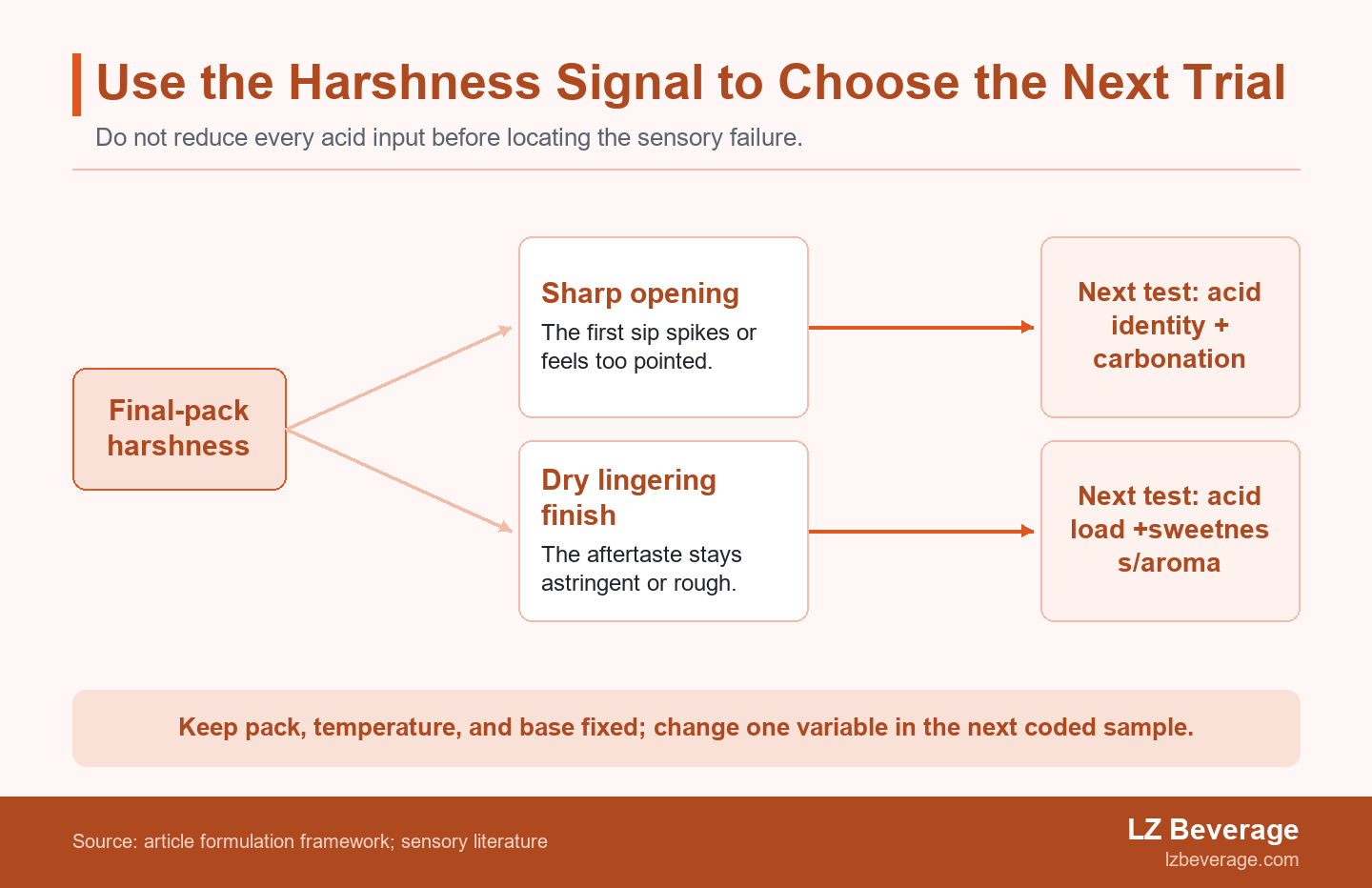
For this purpose, final-pack conditions mean the chilled, packaged sample the consumer will actually experience. Lock the base, pack size, serving temperature, carbonation condition, and flavor version before comparing acid routes. Then ask the panel to score four moments: aroma at opening, first-sip tang, mid-palate fruit or body, and the aftertaste. When a finish is harsh, record whether the issue is an immediate spike, a dry linger, an aroma collapse, or a mismatch between bubble bite and acid bite. Those observations point to a more useful next sample than a generic instruction to reduce acid.
A study of low-carbonated beverages reported method-dependent sweetness findings, which is a useful reminder to document the tasting method rather than treat sweetness as an automatic correction. The low-carbonation sweetness study provides that limited context.
That is also the point where a format discussion can become concrete. If the concept is moving into a ready-to-drink launch, the team can review ready-to-drink product directions with the pack, sensory target, and market in view. LZ Beverage can then scope the discussion around the beverage category and the required sample comparison, rather than around an undefined “sour drink” request.
Separate a Sensory Pass From a Release Decision
A panel preference is one proof point, not a release decision. Before a concept proceeds, the project record should identify the exact base version, acid-system version, flavor version, sweetener direction, carbonation condition, package, and serving temperature. It should also state which question the round is meant to answer. For example, “Does the malic-led route improve the juicy finish without reducing citrus aroma?” is a solvable question. “Make it smoother” is not. This discipline is especially useful when several teams are involved: brand teams can describe the desired consumer impression, R&D can define the controlled variables, and a manufacturer can prepare samples that are genuinely comparable.
The same record creates a practical bridge to production planning. LZ Beverage does not need a vague promise of a “sour beverage”; it needs the beverage type, target sensory route, package direction, target market, and test condition that will govern the next sample. That makes an OEM/ODM conversation more efficient because the discussion starts with evidence a pilot can test. It also makes it easier to hold a concept when the sample has a pleasing opening but the wrong finish, rather than advancing a version that will need a broad reformulation later.
A Controlled Test Matrix Finds the Cause of Harshness
An illustrative first round can use three coded samples: Sample A is the baseline acid system, Sample B changes only the acid route, and Sample C changes only the total acid load within the chosen route. Keep sweetness, flavor load, carbonation, pack, and serving temperature constant. This is not a production specification. It is a simple way to discover whether the objection is caused mainly by acid identity, acid load, or a broader sensory interaction.
- Set a pass statement. Define the desired opening and finish in reader-friendly sensory language before anyone tastes a sample.
- Keep one change visible. Record the formulation version and the one intentional difference in each sample.
- Taste blind at the agreed condition. Do not let an uncarbonated bench cup decide a chilled sparkling product.
- Choose the next experiment from the failure mode. A weak opening calls for a different question than a lingering, throat-catching finish.
This approach also limits rework. If two variables change together, a “better” sample may not tell the team why it is better or whether the improvement will survive scale-up. If only one variable changes, the panel result becomes a usable instruction for the next pilot. A qualified supplier can use that record to prepare comparable samples, and the brand can retain a clear decision trail when packaging, label, or market questions arrive later.
What an OEM Needs Before Sampling
Sourness design and market review must travel together, but they are not the same task. The U.S. Food and Drug Administration notes that only food and color additives determined to be safe may be used in carbonated soft drinks, with citric acid given as an example of an additive used as a flavoring or preservative. FDA’s carbonated-soft-drink guidance is useful U.S. context, not a product approval.
For broader product-category research, the Codex GSFA database organizes provisions by additive, functional class, and food category.
EU-bound products also need their own review: EFSA explains that labels identify both an additive’s function and the specific substance used.
A supplier-ready brief therefore needs more than a flavor name. Include the beverage type; target consumer; desired opening, mid-palate, and finish; candidate acid route or routes; sweetness direction; carbonation or still condition; pack format; target market; expected volume; and the blind-tasting rule used to advance a sample. State clearly which items are exploratory and which are fixed. That boundary prevents a feasibility conversation from being mistaken for a final formula, a label approval, or a shelf-life commitment.
When the sensory target is complete, the next step is to compare beverage categories before a feasibility review. Buyers evaluating a production partner can also review LZ Beverage’s published manufacturing background while they align the sample plan with the intended product route. Share the beverage type, acid-system direction, pack, target market, and expected volume to begin a scoped OEM/ODM feasibility discussion.
Frequently Asked Questions
Is a lower pH always more sour?
No. Lower pH is important context, but acid identity, titratable acidity, sweetness, aroma, and carbonation can change how sourness and harshness are perceived. Treat pH as one controlled measure, then judge the intended sensory result in the finished beverage. A lower reading may be appropriate for one concept and counterproductive for another if it produces the wrong opening or finish.
Should a sour drink use citric acid or malic acid?
Choose a starting route from the intended flavor shape, then compare it under final-pack conditions; neither acid is automatically better across every beverage. A citrus-led concept may begin with a citric route, while an apple- or berry-led concept may warrant a malic comparison. The decision comes from the agreed tasting sequence and the actual formula matrix, not from a generic “best acid” rule.
Can a still bench sample predict a carbonated drink?
Not reliably enough for a final choice, because carbonation contributes its own sensory response and can change the overall flavor experience. A still base can narrow early options, but the selecting panel should taste the chilled, carbonated, packaged version when that is the product being developed. Lock the comparison conditions so the team knows what changed and why.
What should an OEM receive before sour-drink sampling?
Provide the beverage type, desired tangy profile, candidate acid direction, sweetness target, pack, target market, expected volume, and the tasting rule used to compare samples. Add any fixed ingredients, claims under consideration, and market restrictions that the team already knows. This gives the OEM a usable feasibility brief while preserving the distinction between an exploratory sample and a final commercial approval.


