The fastest way to make a reduced-sugar RTD taste thin is to replace the sweetness number and leave the rest of sugar’s work undefined. Sugar does more than make a drink sweet. It contributes to perceived fullness, changes how flavour arrives, and can soften the way acidity or bitterness is noticed. A successful project therefore does not start by asking for a single substitute. It starts by deciding what the finished drink must feel like, then proving that result in the intended pack.
The Formula Job Comes First
For a ready-to-drink (RTD) beverage, “less sugar” is a commercial target, not yet a formulation brief. The brief becomes useful when it names a sweetness reference, the body words the panel should use, the expected finish, the beverage base, the pack, and the market where the drink will be sold. Those inputs keep a team from trying to solve a flavour-timing problem with a texture change, or a market-claim question with a bench sample.
The same recipe does not travel unchanged across acidic systems, flavour profiles, functional ingredients, carbonation levels, packages, storage plans, and markets. Specify the variables that matter before changing ingredients. That discipline keeps an early sample from becoming a premature promise about the finished drink.
A Lower-Sugar RTD Needs Three Formula Jobs
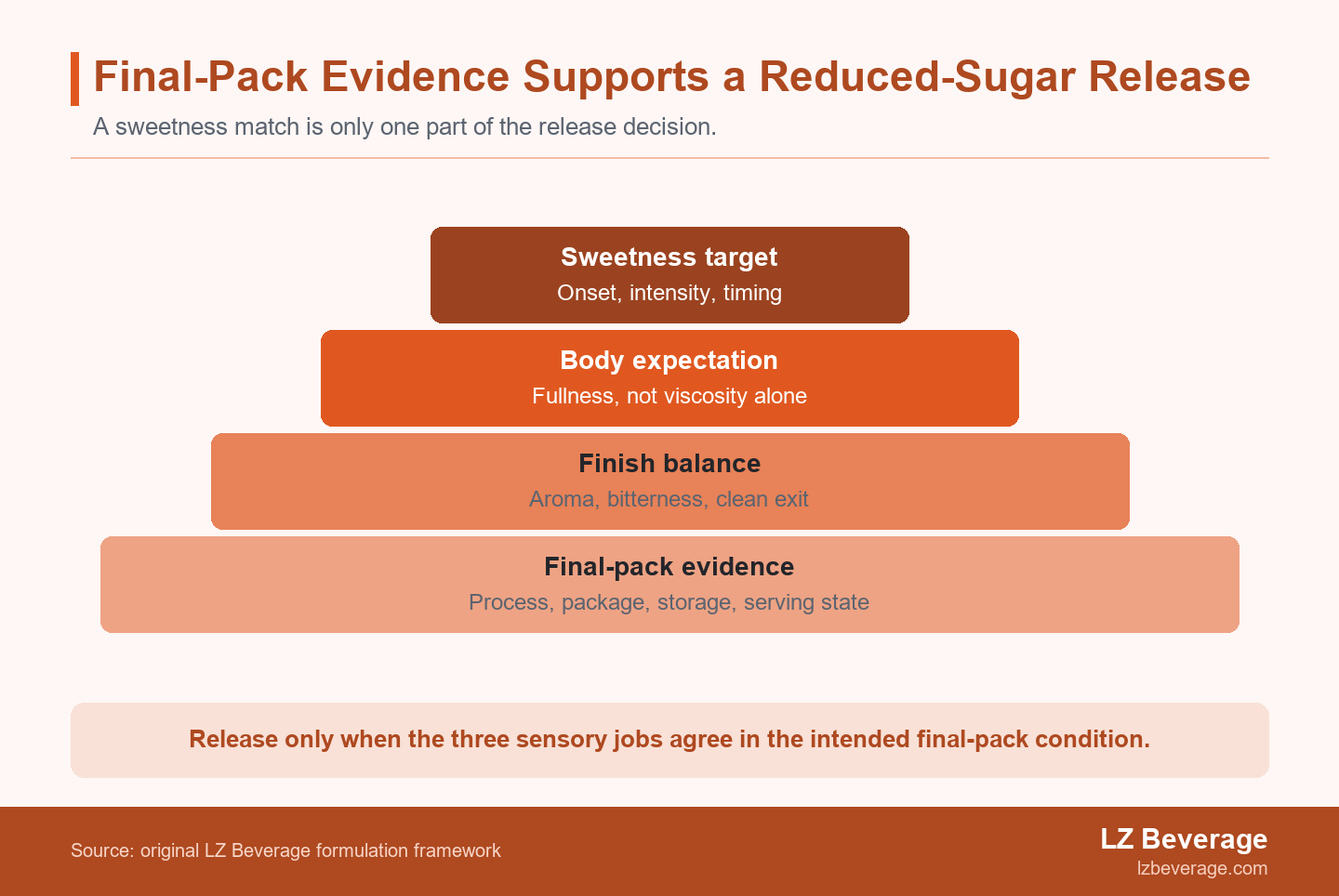
A lower-sugar RTD needs separate targets for sweetness, body, and finish. Treating these as three jobs makes a pilot easier to diagnose. If a sample misses its target, the team can identify whether the issue is sweetness timing, perceived fullness, or the way flavour fades after swallowing.
- Sweetness target: define the desired onset, peak, and lingering sweetness against a reference sample.
- Body target: define words such as full, rounded, watery, dry, or coating, then agree on what is acceptable.
- Finish target: define what should happen to acidity, bitterness, aroma, and flavour after the first sip.
What Sugar Was Doing Before You Reduced It
Sugar reduction changes a multisensory system, not only sweetness intensity. A recent review of sensory barriers in sugar-free beverages describes how sweetness, mouthfeel, flavour perception, masking, and temporal effects can move together. That is why a formula can hit a sweetness target yet still feel watery, short, sharp, or artificially persistent.
Start by documenting what the original formula delivered. Was the key experience a quick bright sweetness, a rounded mid-palate, a juice-like density, a creamy glide, or a clean dry finish? The answer determines what the reduced-sugar route has to rebuild. It also keeps the sensory panel focused on observable descriptions instead of a vague request to “make it taste like the original.”
Set a Sensory Target, Not a Sweetness Number
The acceptable reduction point should be found through sensory targets in the target matrix. Begin with a reference that represents the current product or intended consumer position. Then compare small, planned changes against it and record not only overall liking but also onset, peak sweetness, flavour release, and finish. A fruit-based, tea-based, dairy-style, carbonated, or functional drink will not necessarily tolerate the same change in the same way.
Define a pass rule before tasting. For example, a route might have to meet the agreed sweetness character without increasing a declared bitter or metallic finish beyond the panel’s acceptance rule. This avoids the common failure mode in which a sample is approved because it is “sweet enough,” then later rejected because the sweetness arrives too late or stays too long.
Rebuild Body Without Treating Viscosity as a Substitute
Body should be evaluated as perceived fullness and lubrication, not viscosity alone. A study of texture–taste interactions shows why changes in thickener concentration and rheology can also change sensory perception. In practical terms, a thicker sample may still feel less rounded, less flavourful, or less refreshing than the reference.
Give the body route its own comparison. Hold the sweetness target steady, then compare the candidate body systems under the same acid, flavour, process, and package conditions. Ask the panel whether the drink feels full or thin, whether it coats or clears cleanly, and whether the body supports the flavour rather than muting it. This is more useful than asking whether the sample merely feels “more viscous.”
Where a formula uses a high-intensity sweetener, define the role of any body-supporting component separately. The body route should not be expected to correct a mismatch in sweetness timing, nor should a sweetness adjustment be expected to restore the lost mid-palate. Separate assignments make rework faster because each change has a stated reason.
Check the Finish and Aroma After Body Changes
A body adjustment can alter flavour perception, aroma, and the finish. Research on a chocolate-milk beverage illustrates the broader point: changing texture and sweetness does not automatically restore the same sensory balance, and higher viscosity need not restore sweetness perception. That is a useful boundary from sensory-interaction research, not a direct prediction for every RTD matrix.
Build the finish into the scorecard. Include aroma lift, acidity, bitterness, astringency where relevant, cooling or drying sensations, and the time it takes for the flavour to clear. If the product is carbonated, evaluate at the planned carbonation state. If it is tea-led, include astringency. If it contains functional ingredients, make their sensory impact an explicit part of the brief instead of treating it as background noise.
Choose a Reduction Route Before Buying Ingredients
Route choice should follow declared sensory jobs and evidence needs, not a generic ingredient ranking. In an LZ Beverage OEM/ODM discussion, that means choosing a route to test rather than treating an early sample as an off-the-shelf solution. In most projects, the first pilot falls into one of three routes. The table does not recommend a specific ingredient. It shows the question each route must answer before it earns a wider trial.
| Route |
When it may fit |
First sensory risk to test |
First proof needed |
| Direct sugar reduction |
The reference drink has room to reduce sweetness without rebuilding a large body gap. |
Loss of flavour roundness or stronger acid and bitter notes. |
A matched reference comparison at the planned package state. |
| Sweetening-plus-body route |
The project needs a larger reduction while preserving an established sensory position. |
Late sweetness, off-notes, or a body system that changes flavour delivery. |
A same-sweetness comparison across candidate body routes. |
| Hybrid route |
The team can retain some sugar while using other tools to close a narrower sensory gap. |
Formula complexity without a clear sensory benefit. |
A simplified-versus-hybrid panel comparison with agreed pass criteria. |
Choose the route with the clearest evidence path, not the most attractive bench narrative. A direct reduction route may be the most efficient if the panel still accepts the body and finish. A more complex route may be justified only when it resolves a specific, documented gap. In either case, write the decision rule before suppliers, samples, and processing conditions multiply the variables. If provider context matters at this stage, compare it before sharing the pilot brief, then review LZ Beverage factory background.
Treat Final-Pack Testing as the Mouthfeel Decision
Final-pack testing is the mouthfeel decision gate. Bench samples can narrow the options, but the decision should be made on product that has passed through the intended process and sits in the intended package. A simple way to design an early pilot is an illustrative 12-sample grid: three sweetness targets × two body routes × two package states. It is a planning tool, not an industry standard or a claim about how every beverage should be tested.
The grid forces useful trade-offs into the open. It asks whether a candidate still works after the planned process, whether the package state changes the perceived body, and whether the same sensory route remains acceptable at the planned storage point. It also prevents the team from comparing a fresh bench sample from one route with a finished can from another and calling that a controlled decision.
Keep the record beside the samples. For each coded can, note the formula revision, process conditions, package state, storage point, serving temperature, panel descriptors, and pass-fail result. That record does not make the result universal. It makes the next decision traceable: the team can see whether a change in body, aroma, or finish follows a route change, a package-state shift, or a missing acceptance rule.
Define final-pack pass criteria in plain language: which descriptors must match, which may shift slightly, which defects are unacceptable, and who has authority to call the result. Where an RTD development discussion is the next step, teams can review RTD beverage development options after the package and process questions are clear. LZ Beverage should receive the brief as a test request, not as an assumption that a standard formula will transfer unchanged.
Run Claim and Ingredient Review Beside the Formula Work
Ingredient conditions, label declarations, and nutrition claims require intended-market review beside formula work. In the United States, the FDA’s high-intensity sweetener guidance explains that these sweeteners are used in small amounts and that their intended use and labeling remain relevant. The FDA also explains that added sugars are declared separately from total sugars on the U.S. Nutrition Facts label. For EU-facing work, the European Commission’s nutrition-claims guidance makes clear that claims depend on relevant conditions of use. These are planning boundaries, not approval conclusions for a particular formula.
Bring qualified market and label review into the pilot while changes are still inexpensive. A formula target may shape the commercial direction, but it is not a ready-to-use claim. Keeping those decisions in parallel also avoids redesigning packaging copy after a sensory route has already been selected.
Illustrative Pilot: When the Brief and Finished Can Disagree
A finished-can problem can expose a brief that documented sweetness but not body acceptance. The following composite is illustrative. It is not an LZ Beverage customer case, production record, or performance promise.
Hold the Pilot Until the Final Can Is Accepted
The pilot should pause when final-can evidence contradicts an incomplete sensory brief. A product development manager is preparing an 18,000-can acidic RTD pilot across 3 sweetness targets and 2 body-system candidates. Bench samples reach the stated sweetness target, but the brief does not define an acceptable final-pack body or a planned-storage check.
The buyer wants a familiar, rounded drinking experience for a branded launch, not merely a lower sweetness reading.
The pilot covers 18,000 cans, three sweetness targets, and two body-system candidates.
The bench stage has a sweetness reference, but it lacks a documented final-can body and finish rule.
After processing, the panel describes the finished cans as thin and flat even though the target sweetness is reached.
The formula log shows a sweetener change, while the body system and sensory pass rule remain open.
The conflict is not proof that the sweetener is wrong. It shows that the project defined only one of the three sensory jobs, so a sweetness match cannot support expansion.
The appropriate decision is to hold scale expansion and compare both body routes at the same sweetness target under the intended process and package conditions.
The team locks the body descriptors, serving temperature, storage point, and pass-fail rule, then records each final-can result against those criteria.
The route is selected only when the final-can panel accepts body, flavour balance, and finish at the planned storage point.
This is an illustrative composite pilot. It does not represent a customer order, formula, or guaranteed result.
Give the OEM/ODM Team a Brief It Can Test
An OEM/ODM team can test a route only when the brief states base, target, pack, process, and acceptance criteria. A useful request specifies the beverage base; consumer target; flavour direction; functional ingredients; current and intended sweetness position; desired body and finish words; acid and carbonation condition where relevant; pack; planned market; process assumptions; storage point; and planned volume.
Make the sensory criteria observable. “Less sweet but still premium” is not enough to test. “Keep a rounded mid-palate, clean citrus lift, and no lingering bitter finish at the planned serving condition” gives the development team a hypothesis it can evaluate. If the base is tea, the same brief should identify the tea character and astringency target; teams can consider tea-led reduced-sugar formats when that route fits the product concept.
For LZ Beverage, this is the point at which an OEM/ODM feasibility conversation becomes productive: the brief connects formulation, filling, packaging, and export-market review without claiming that any single route will fit every beverage. The value of the first discussion is a scoped test plan and a clear list of open decisions. It should also identify which choice is still provisional, such as a sweetener route, a body system, a processing condition, or a package format. That distinction prevents a promising bench sample from being treated as a release-ready formula.
Related format pages are useful only after the formulation route is defined. Category navigation can help a team see where the intended product sits in a wider portfolio, but it is not evidence that a route will transfer across bases or packs. Keep the original sensory brief attached to that exploration so that a format discussion does not erase the body, finish, package, and market conditions already agreed by the team.
Move Forward Only When the Formula Brief Is Testable
A feasibility discussion becomes useful when the formula brief contains testable inputs. Before requesting one, assemble the beverage type, target consumer, flavour direction, functional brief, pack, launch market, planned volume, sweetness reference, body descriptors, finish criteria, and desired storage point. That information lets the next conversation focus on a pilot decision rather than an unsupported promise.
If the brief is ready for a feasibility conversation, decide which development route should be scoped first, then explore beverage format options for your brief.
Common Questions Before a Reduced-Sugar Pilot
Can a reduced-sugar RTD keep the same mouthfeel as its original formula?
It can only be judged by a defined sensory comparison in the final pack. The useful question is not whether an ingredient is known for body, but whether the intended beverage meets its agreed body, flavour-balance, and finish criteria after the planned process and storage point. Some products may meet that bar; others may need a different route or revised sensory target.
Will adding a thickener solve a thin reduced-sugar beverage?
No. A thicker drink can still miss the intended sweetness timing, aroma, refreshment, or finish. A body-supporting route may be appropriate, but it should be tested at a matched sweetness target with the same acid, flavour, package, and storage conditions. The panel should decide on perceived fullness and the overall drinking experience, not viscosity in isolation.
Why must reduced-sugar mouthfeel be tested in the final pack?
Because process, package, storage, and serving conditions can change what the panel perceives. Bench tasting is useful for narrowing options, but it does not replace a packaged-product decision. Final-pack testing also creates a traceable record of the criteria used to select or reject a route before a wider pilot or launch decision.
When should a reduced-sugar claim be reviewed?
Review it as the formula route is being selected for the intended market. That gives the development, label, and commercial teams time to compare the formula with relevant ingredient, labeling, and claim conditions before packaging text is committed. A sensory target or sugar-reduction objective is not, by itself, a conclusion that a specific market claim is available.


