A private-label sweetener choice is a system decision: ingredient route, beverage matrix, intended package, and target market must all be named. That is a more useful starting point than asking which ingredient is “best.” Monk fruit, stevia, and blends can each earn a place in a development plan, but only when the team defines the sensory job, the exact material, the finished drink, and the market review that will govern release.
Choose a Sweetener System, Not a Single Ingredient
A sweetener system is the ingredient route plus the beverage matrix, package, and market context in which it must work. It gives an innovation manager a testable unit of choice. A generic ingredient name does not: it leaves open which extract or glycoside profile is being considered, how the drink should taste over time, what happens after filling, and what the finished label can say.
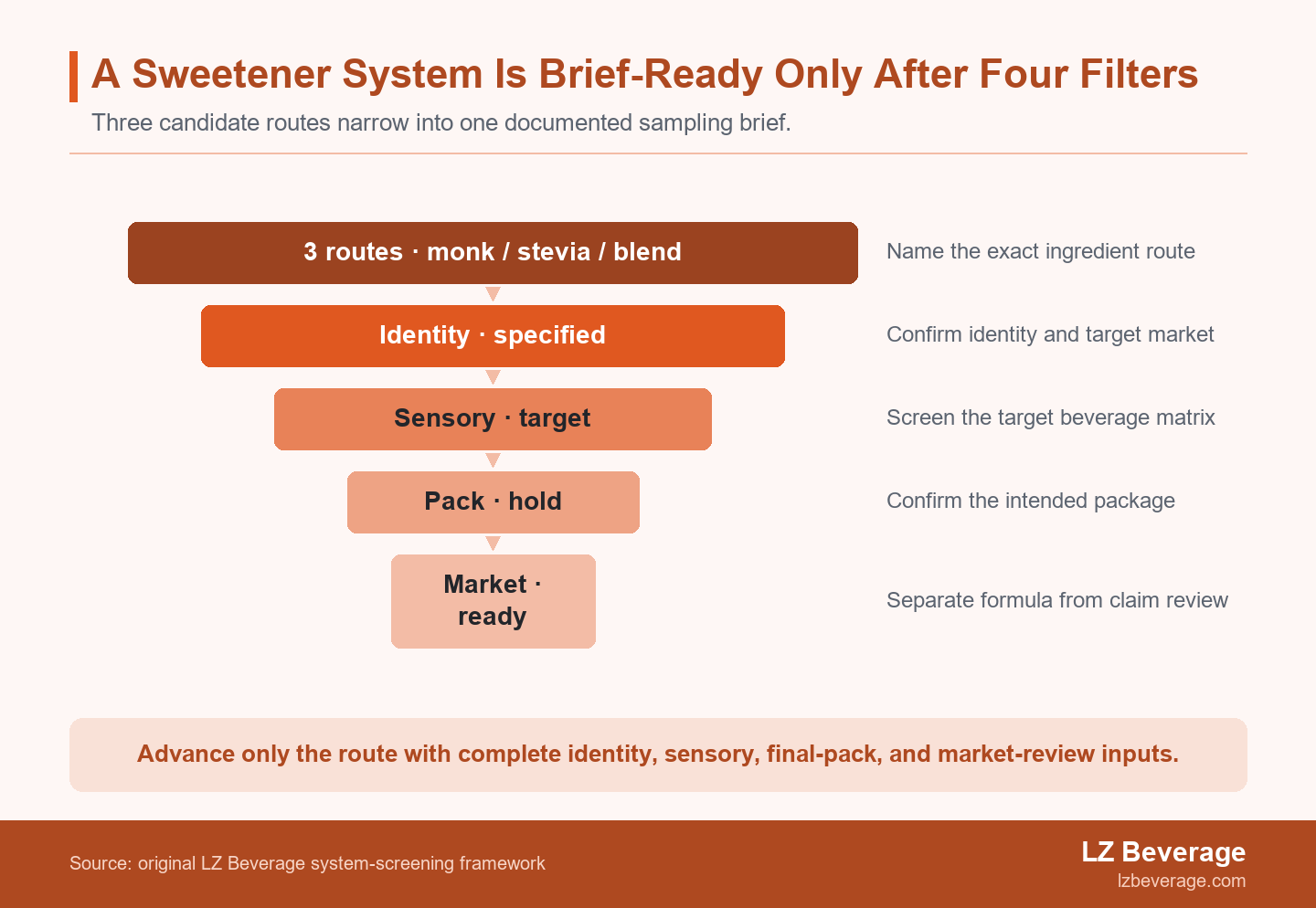
Start the project with four short statements. Name the beverage base and flavor direction. Name the desired sweetness onset, middle, and finish. Name the intended can, bottle, or other final pack. Then name the launch market or markets. These statements make it possible to compare candidates without transferring a result from one tea, juice drink, or carbonated RTD into another.
The goal is not to create a long ingredient scorecard. It is to narrow a small set of candidate systems into one brief that a formulation and production team can actually test. That approach also makes it easier to explain why a route was held, changed, or released.
Natural Is a Sourcing Cue, Not a Release Decision
In the United States, FDA has not established a formal definition of natural through rulemaking, so the word alone does not settle a finished-product claim route. FDA explains the limited scope of its policy on the use of the term “natural”; it does not turn a sourcing description into a general health or nutrition conclusion. The WHO guideline on non-sugar sweeteners is also population public-health guidance, not a product-specific health claim. For a private-label team, that means “natural” belongs in a review file, not at the end of the release process.
Keep health-outcome language separate as well. The guideline does not replace toxicological safety assessments, and it is not a basis for promising that a particular beverage formula will deliver a health result.
- Sourcing question: What is the exact sweetener route and how is it documented?
- Product question: Does the route deliver the intended sensory profile in the finished drink?
- Market question: Which label and claim review applies where the product will be sold?
Answer those questions in parallel. A strong sensory sample does not answer the market question, and a familiar ingredient name does not answer the package question.
Start With Ingredient Identity and the Market File
Before ranking taste, document the exact sweetener identity and the destination market because permitted material and label treatment are not interchangeable questions. FDA’s overview of high-intensity sweeteners distinguishes certain high-purity steviol glycosides from whole-leaf and crude stevia extracts for sweetening use. A “stevia” line in a concept deck is therefore not yet a sufficient formulation instruction.
For each candidate, record the supplier specification, identity description, flavor objective, beverage pH range if known, package, storage expectation, and destination market. A high-intensity sweetener is simply a sweetener used in small amounts because of its sweetness intensity; that does not make its sensory role small. At low use levels, timing, lingering sweetness, bitterness, and aroma balance may still determine whether the drink feels on-brief.
This is also where OEM feasibility becomes concrete. LZ Beverage can assess a documented beverage brief against development and packaging inputs; it should not be asked to infer a market claim from an ingredient nickname. Buyers who need factual context before that discussion can review LZ Beverage manufacturing background.
Where Monk Fruit Can Help—and What It Does Not Prove
Monk fruit can be screened as an extract route with mogrosides, but its fit still depends on the target drink and the label review. FDA identifies mogrosides as characteristic sweet constituents in its overview of sweeteners used in food. That fact helps specify the material under discussion. It does not establish a preferred flavor result, a “cleaner” label position, or a claim outcome in every market.
A useful monk fruit hypothesis names the job it is expected to do. For example: support a rounded fruit profile, reduce a perceived gap in mid-palate sweetness, or work with a separate flavor-balance route. The team can then compare the hypothesis against a reference drink rather than asking the panel whether monk fruit is good in the abstract.
Keep the test narrow. Use the same beverage base, the same flavor direction, and the same final-pack plan for every candidate in that pass. If the sensory result moves, the team can trace it to a defined system change instead of a loose ingredient substitution.
Treat Stevia as a Glycoside System, Not a Generic Ingredient
Treat stevia as a defined glycoside system because different preparations can produce different sensory profiles in beverage evaluation. A peer-reviewed consumer sensory study of steviol glycosides compared distinct routes rather than treating all stevia materials as identical. For export work, the EU’s steviol glycoside specification is another reminder that ingredient identity needs precision.
In a private-label brief, “stevia” should therefore be followed by the planned identity or specification, the sensory issue it is meant to address, and the acceptance language the panel will use. Describe what the drink should do: bright lift at the front, a less persistent finish, or a more balanced interaction with a tea or fruit flavor. Avoid writing a generic “no aftertaste” target, because it gives the panel no reference point and gives the formulator no decision rule.
Use a controlled comparison. Keep base, acid, flavor direction, carbon dioxide level where relevant, and pack format consistent while the sweetener route changes. That does not make a research finding universal. It gives the team a credible way to learn which defined route fits this product family.
Use Blends to Solve a Defined Sensory Job
Use a blend only when it has a named sensory job, such as shaping onset, finish, or flavor balance, and test that job in the target matrix. A study of steviol glycoside systems in a peach juice matrix illustrates why composition and beverage context matter to sweetness and sensory response. It supports a matrix-specific testing discipline, not a universal blend formula.
Blending can be sensible when one route meets the main sweetness target but leaves a documented gap. The gap might be a slow onset, a finish that competes with the flavor direction, or an imbalance that appears after a tea note or acid profile is set. In that case, state the desired correction before introducing the second route. If the team cannot name the sensory job, the extra complexity has not earned a place in the pilot.
Use a simple candidate record for every blend:
- Primary job: what the first route is expected to deliver.
- Gap: the observed sensory issue in the defined base.
- Secondary job: what the added route is meant to correct.
- Acceptance rule: which descriptors must improve, and which must not regress.
This record keeps the conversation focused on evidence. It also makes it easier to remove a route that adds cost or label complexity without a demonstrated sensory contribution.
Run Two Passes Before You Rank Candidates
Run a bench screen to narrow candidates, then confirm the remaining system in the intended final pack before release. The first pass should ask which defined routes meet the sensory hypothesis in the target beverage base. The second should ask whether the survivor still meets the agreed descriptors after the intended process, package, storage point, and serving condition. A final pack is the finished drink in its intended package; it is not a bench sample poured into a similar container.
Set the comparison before tasting. Use a shared reference, a short descriptor list, and a pass-or-hold rule for each candidate. Keep the bench pass limited to questions the bench can answer. It is useful for narrowing the field. It is not proof that the route will survive packaging or support a launch claim.
Test the System in the Finished Drink
A bench winner remains conditional until the finished drink in its intended package meets the agreed sensory and stability acceptance criteria. The acceptance criteria do not need to be elaborate, but they should be visible: flavor direction, sweetness timing, finish, appearance, and any product-specific stability observations that matter to the release decision.
For a tea RTD, a useful final-pack check may include whether bitterness arrives later than expected, whether aroma still supports the flavor direction, and whether the sweetener route feels integrated rather than separate. For a fruit-led drink, it may focus on whether the route preserves the intended brightness and finish. The same checklist should be applied to all remaining candidates under the same planned condition.
Record the formula revision, ingredient identity, processing state, package, storage point, serving condition, and panel decision. This does not claim that one test result transfers to every production run. It gives the team a traceable reason to advance, revise, or hold a route. When the project is an RTD program, buyers can also review RTD pilot development options after the final-pack evidence plan is defined.
Separate Formula Feasibility From the Claim Route
Formula feasibility and a nutrition, health, or natural claim route are separate reviews that must be checked for the destination market. FDA’s label-claims guidance describes distinct claim categories for conventional foods. In the EU, the European Commission explains that nutrition claims operate with defined conditions of use.
Practical implication: do not wait until artwork is nearly finished to ask whether a claim route can be supported. Give the market-review owner the exact ingredient identity, final formula inputs, nutrition information, proposed product description, and destination market. Give the formulation team the response in a form that changes the brief where necessary. This is a coordination step, not legal advice or a market-clearance decision.
Keeping the workstreams separate also protects the sensory decision. A candidate can be technically promising and still need a different wording path, additional documentation, or a market-specific change before the commercial plan is complete.
Illustrative Pilot: A Bench Winner Fails the Final Can
When a final-pack result changes the sensory decision, the appropriate pilot status is conditional rather than released. The following is an illustrative process example, not a customer case or a production result.
This pilot scope covers 3 candidate systems across 2 tea base variants, so the team should not treat a result in one base as a release decision for the other.
Keep the Candidate Conditional Until Evidence Closes
Conditional release should specify the missing evidence, the retest scope, and the acceptance rule before the candidate returns to the launch path.
An innovation manager is selecting a reduced-sugar tea RTD route for a private-label launch.
24,000 cans across a pilot order, with final-pack review scheduled before any release decision.
conditional release status: final-pack evidence remains open across the defined product family.
A bench blend met the target sweetness curve in one tea base.
The same route finished more bitter after final packaging in a second tea-base variant.
The candidate was ranked at bench stage without a complete system profile in final pack across 3 candidate systems and 2 tea base variants.
Hold the candidate and retest three routes against defined final-pack acceptance criteria.
Align extract identity, sensory targets, and sample logs across both tea variants.
Release only the route that meets agreed final-pack acceptance criteria for the defined product family.
Illustrative process example; it does not predict a customer result.
The corrective action is traceable: align the material record, apply the same sensory target, and record the package-state result. If the system passes only one tea base, the brief should say so. That may still be a workable commercial route, but it is a different decision from claiming that one blend fits every tea RTD.
Give the Private-Label Team a System Brief
An OEM feasibility review starts with a system brief that names the base, flavor direction, function, package, market, and expected volume. Add the target consumer, the reference product or sensory reference, the candidate ingredient identities if already known, and the acceptance descriptors that matter most. This information turns “we want monk fruit” into a development question that can be scoped.
- Beverage: tea, juice drink, carbonated RTD, or another defined base.
- Consumer and flavor direction: who the drink is for and how it should taste and finish.
- Function and nutrition context: only the inputs relevant to the product brief, without assuming a claim outcome.
- Pack and market: intended format, target market, and key storage or serving conditions.
- Commercial scope: expected volume and the evidence needed before a pilot is released.
When tea is the intended base, buyers can consider tea-format sweetener system options while keeping the same identity, sensory, final-pack, and market filters in the brief.
RTD and tea format context can change which sensory variables a system brief needs to prioritize. Use related format information to refine the base and package assumptions, not to bypass the qualification sequence described above.
Move to Sampling With a Testable Sweetener Brief
Sampling can begin with a testable brief instead of a request to make one ingredient taste like sugar in every beverage. Share the beverage type, target consumer, flavor direction, function, pack format, target market, and expected volume. LZ Beverage can use those inputs to assess an OEM feasibility review and identify what should be tested first.
Before sending the brief, confirm that the preferred route is specific enough to test. The first request should identify the reference beverage, the sensory descriptors that determine acceptance, and the package state in which that comparison will be made. It should also identify what information is still open: an ingredient specification, a packaging choice, a destination-market review, or a sensory correction. That discipline prevents an early request from being answered with a generic blend recommendation that cannot be evaluated against the finished product. It also gives the development team a clear rule for deciding whether the first sample should advance, be revised, or be held for additional evidence.
Make sure the chosen format matches the final-pack and market assumptions before moving to a scoped comparison of defined routes. Then review private-label beverage formats before sampling.
Frequently Asked Questions
Is Monk Fruit Automatically a Cleaner Label Choice Than Stevia?
No; neither ingredient can be treated as a cleaner-label choice until its identity, processing, market rules, and finished label have been reviewed. Use the exact material description and proposed market language in the review file. Then let sensory and final-pack evidence decide whether that specified route fits the drink. A familiar consumer term is not a substitute for that work.
Can a Stevia System Replace Sugar One for One in a Private-Label Drink?
No; a stevia system needs matrix, flavor, and final-pack design rather than a one-for-one sugar replacement ratio. Define the glycoside route and the sensory descriptors first. Then compare it against the same reference drink and package condition as the alternatives. That produces a decision record instead of a conversion assumption.
When Is a Blend Better Than One High-Intensity Sweetener?
A blend is better only when it solves a named sensory gap and the final packaged drink confirms that the added complexity improves the intended profile. State the primary route, the observed gap, and the correction expected from the added route. If that correction cannot be observed in the target matrix or final pack, keep the formula simpler and hold the blend.
What Should an OEM Partner Receive Before Sampling a Sweetener System?
Send the beverage base, consumer target, flavor direction, function, pack format, target market, and expected volume so the sample plan can be reviewed as a system. Include a reference drink or descriptor list when available, plus the candidate identities and release conditions already known. The more complete the brief, the easier it is to design a controlled first pass and identify what final-pack evidence will be needed next.


