Teams get clearer answers when they describe the finish, isolate a single change, and retaste the intended drink before deciding that an aftertaste issue has been corrected.
Start by Naming the Finish
Aftertaste is the sensation that remains after swallowing. In beverage R&D, it should be recorded as a timed sensory observation rather than treated as a verdict on one ingredient. A comment such as “it lingers” does not tell a team whether the problem is delayed sweetness, bitterness, metallic character, dryness, or a flavor note that arrives after the front taste has faded.
The practical implication is simple: do not start by replacing a sweetener. First decide what the panel will observe, which variables will remain constant, and what result would justify another trial. That sequence makes a sweetener aftertaste beverage formulation project easier to discuss with flavor, packaging, quality, and manufacturing partners.
For LZ Beverage, that disciplined record also creates a more useful starting point when a brand moves from early R&D work to an OEM/ODM feasibility discussion.
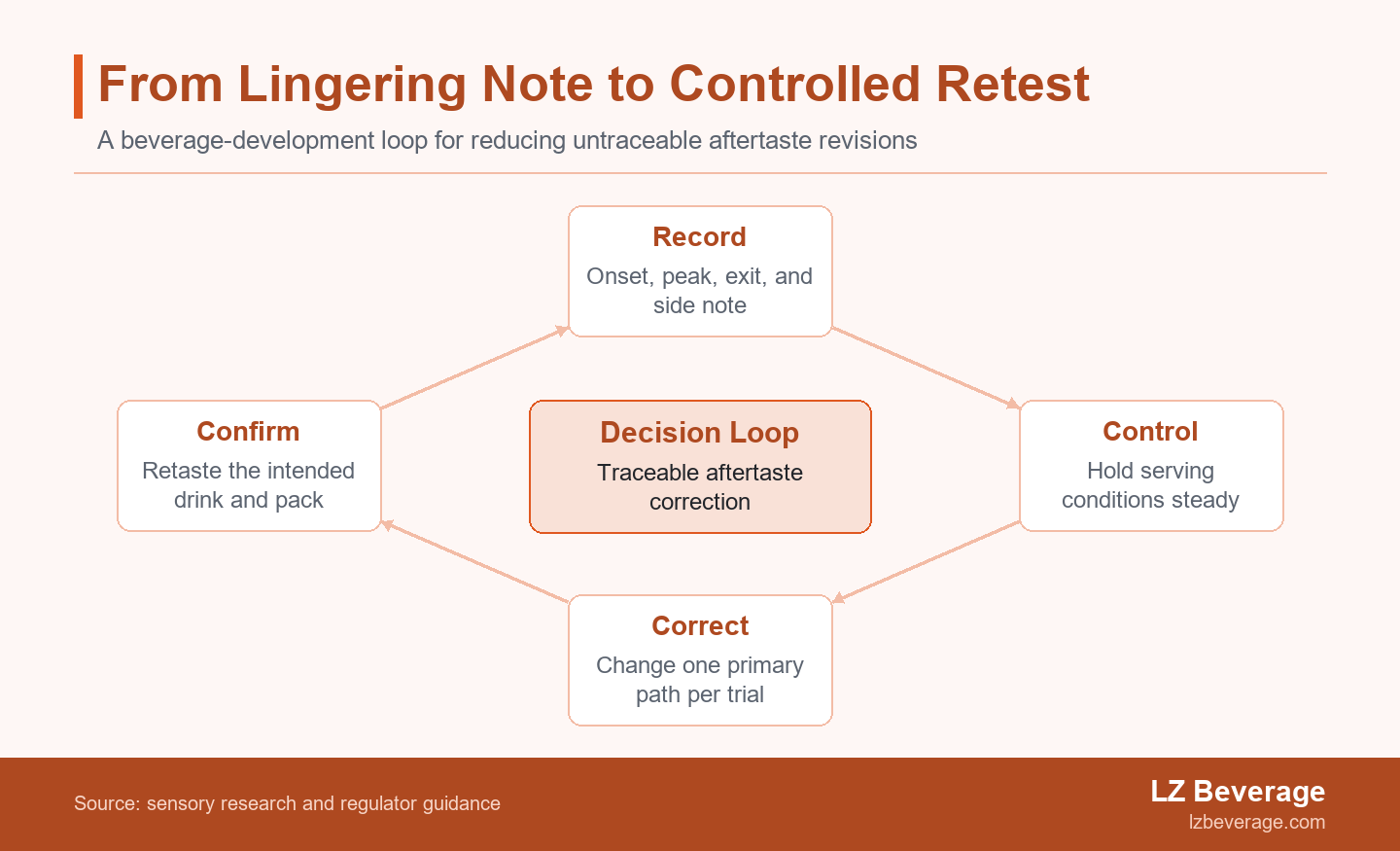
- Describe the finish over time. Record onset, peak, exit, and the most relevant side note.
- Use a matched comparison. A sample cannot answer a formula question if serving, flavor direction, or carbonation changed at the same time.
- Change one primary path per round. This preserves the reason for any improvement or regression.
- Keep sensory, ingredient, and claim decisions separate. A preferred finish is not a safety or label conclusion.
Make the Finish Observable Before You Change the Formula
A Wageningen University & Research temporal sensory study evaluated sweetness and side tastes over a 60-second period. Its value for a beverage team is not that it supplies a universal ranking. It shows why time belongs in the record: what the drink does immediately after a sip can differ from what remains several seconds later.
A practical panel note can separate four fields: onset (when the note begins), peak (when it is strongest), exit (how it fades), and side note (what it resembles). Use a short, agreed vocabulary such as bitter, metallic, drying, cooling, botanical, artificial, or flavor-lingering. The point is not to make tasters sound clinical. It is to make two coded samples comparable.
Start with the product promise. A bright citrus soda, creamy coffee drink, and lightly sweetened tea do not create the same expectations at the finish. A note that feels structured in a tea can feel persistent in a lemon soda; a rounder finish in coffee can appear muddy in a clear drink. Ask the panel to judge the finish against the intended beverage, not against plain water or a generic sweet solution.
Use a Residual-Note Record, Not a Single Like-or-Dislike Score
Give each taster a coded sample and a one-line record: “At ___ seconds, the finish feels ___; it is ___ in intensity; I would notice it again before the next sip: yes/no.” Keep the field short enough that it is completed during the tasting. A long questionnaire usually produces less useful language, because the panel begins explaining instead of noticing.
Panel agreement matters more than a forced consensus. If several people identify a mouth-drying finish after a similar delay, that is a useful hypothesis. If the group divides between “more sweet” and “more bitter,” the next round should resolve the disagreement with a more controlled comparison, not with a broad list of simultaneous changes.
Build a Test Matrix That Represents the Drink
A correction trial is interpretable only when the team holds the relevant beverage context as steady as possible. A bench sample is a small R&D sample used before pilot production. Its job is not to prove final shelf life. Its job is to answer one bounded question while preserving enough of the intended drink for the answer to matter.
For an early sensory comparison, document the base recipe code, flavor direction, target sweetness, acid system, carbonation condition where relevant, serving temperature, package or cup, and the one proposed change. The FDA lists flavors, pH-control agents, preservatives, and gases as distinct ingredient-function categories in its food-ingredient overview. That is a helpful reminder not to interpret a changed finish as a sweetener result when other functional parts of the drink have also moved.
| Hold steady |
Document as the trial variable |
Ask the panel |
| Serving temperature, sample volume, base flavor direction |
One correction path |
When does the finish begin? |
| Carbonation and acid target for a sparkling drink |
Sample code and version |
What does it resemble? |
| Tasting order and rinse routine |
Reason for the next round |
Does it fade before the next sip? |
The actual product context matters beyond the liquid. For carbonated drinks, the FDA notes that food-contact substances include the bottles and cans in which the drink is sold in its carbonated soft drink guidance. That does not mean every bench comparison must begin in a final can. It means a preference observed in an open cup should be treated as an interim signal until the intended drink and pack context are checked.
When format exploration is still open, reviewing the available RTD beverage options can help a team state the intended serving and pack assumptions before a manufacturer evaluates the trial brief.
Choose One Correction Path per Trial
Changing one primary correction path per trial protects the team’s ability to interpret the next tasting result. Published temporal sensory work has recorded sweetness and side tastes over a 60-second interval. That timing perspective helps frame the next correction question without assuming a universal ingredient ranking. The path can be a sweetener-system adjustment, a flavor-system adjustment, or a balance adjustment that the team believes changes how the finish is perceived. The important discipline is to name the path and avoid adding unrelated changes merely because they are available.
For example, a team may decide that the observed note is mainly a delayed sweet finish. Its first question could concern the sweetener system. If the record instead points to a flavor note that remains after sweetness declines, the next question could concern the flavor system. If the drink feels sharp or dry at the finish, the team may investigate the overall balance. These are hypotheses, not rules about which ingredient is “better.”
Write the trial decision in a single sentence: “For Sample B, we are testing whether this named change reduces the drying finish at the intended serving condition while holding the base flavor direction constant.” It prevents a discussion from drifting into a bundle of untraceable edits. If the first change improves one attribute but damages another, document the tradeoff. That result is still useful because it narrows the next question.
For teams comparing prospective formats, a broader beverage product range is a useful reminder that a correction path should be judged in the beverage it is meant to become, not in a detached ingredient screen.
Illustrative Scenario: A Lime Sparkler With a Lingering Finish
This is an illustrative development scenario, not a client project or production result. A product-development team is considering a 12,000-can pilot for a lightly carbonated lime beverage.
The 12,000-can pilot decision follows two 250 mL bench samples.
The project is in bench development before pilot approval.
The note is not equally strong in every sample, suggesting a comparison is needed before assigning a cause.
The existing notes say only aftertaste, so they cannot distinguish delayed sweetness from a bitter or mouth-drying finish.
The team codes the existing base as Sample A and makes Sample B with one documented correction route. Both are chilled to the same serving condition, presented in a randomized order, and recorded with onset, descriptor, and fade questions.
The team chooses the preferred direction only as the next candidate for an intended-pack check.
It changes one documented correction path while holding the beverage context steady.
The preferred direction is repeated in the intended pack and reviewed against market-specific use and claim conditions.
This example has not proven stability, market compliance, or commercial readiness; it has simply turned an ambiguous complaint into a traceable next decision.
Check the Intended Pack and Claim Boundary
A good sensory outcome does not make an ingredient decision by itself. In the United States, the FDA explains that high-intensity sweeteners are regulated as food additives unless their intended use is generally recognized as safe; the agency’s high-intensity sweetener guidance is a useful starting point for understanding that intended-use boundary. Target-market review remains necessary, particularly when a project moves from development language to label language.
The same separation applies to claims. The European Commission defines a nutrition claim and a health claim differently. “The finish tastes cleaner” may be useful internal sensory language, but it is not a label claim and should not be promoted into one without the appropriate market-specific review.
Before pilot release, repeat the preferred direction in the intended beverage context. Note the serving state, pack, and the exact question being checked. This final sensory step does not replace a stability program or a compliance review. It prevents a preliminary cup preference from silently becoming the final product decision.
Prepare a Better OEM/ODM Test Brief
A structured tasting record gives an OEM or ODM partner a more usable starting point than a generic request to “remove aftertaste.” For LZ Beverage, an early feasibility discussion is most useful when it includes the beverage type, target consumer, flavor direction, function, pack format, target market, expected volume, and the observed finish at the intended serving condition.
Attach the sample codes, the one change tested in each round, and the question still unanswered. That allows the discussion to stay factual: what should be evaluated next, what must remain fixed, and which decisions belong to formulation, packaging, or market review. Teams can also review the company’s factory and company background before deciding whether to share a development brief.
For a concise starting point, beverage manufacturing insights can support the next discussion. Share the beverage type, target consumer, flavor direction, function, pack format, target market, and expected volume for an OEM/ODM feasibility review.
Questions Beverage Teams Ask During Aftertaste Testing
How many people should test a sweetener aftertaste sample?
Use a small, consistent internal panel for early screening, then expand only when the decision requires broader consumer evidence. The first round needs people who can apply the same observation fields and compare coded samples under the same conditions. If the team is choosing between two viable directions for a public launch, a broader, appropriately designed consumer test may answer a different question.
Should samples be tasted warm or chilled?
Taste samples at the intended serving condition because temperature can change both the beverage experience and the comparison’s usefulness. If the drink will normally be chilled, a room-temperature bench result can still be a diagnostic check, but it should not be treated as the final sensory decision. Record the condition so later results can be compared honestly.
Can flavoring hide a sweetener aftertaste?
Flavor can change how a finish is perceived, but it should be tested as a defined correction path rather than assumed to erase the underlying note. If a flavor adjustment is the hypothesis, hold the other named variables steady and ask whether the finish changed in timing, character, or both. That protects the team from confusing a new flavor cue with a resolved aftertaste issue.
When should an OEM partner join aftertaste testing?
Bring an OEM or ODM partner in once the brief identifies the beverage context, the observed finish, and the next controlled question to test. It is not necessary to have a perfect formula before the conversation. It is necessary to distinguish what has been observed from what still needs checking in the intended beverage, package, target market, and manufacturing context.


