Clean Label Is a Product Policy, Not a Formula Shortcut
Clean label is a product policy, not a formula shortcut.
For a shelf-stable drink, the useful question is not “Which ingredients make this clean?” It is “What does this brand want the ingredient statement and product story to communicate, and how will the finished beverage still be controlled in its intended market and package?” A short list can be a good outcome, but it is not the development plan. The plan must also account for flavor, acidity, texture, processing, package performance, storage assumptions, and label review.
That distinction matters because a consumer-facing preference can be clear while the technical route remains open. A founder may want familiar-sounding ingredients, no artificial colors, or no conventional preservatives. Each direction can be valid as a brand policy. None of them, by itself, identifies a safe process, a suitable container, or a permitted claim. A strong clean label beverage formulation brief therefore converts a positioning request into a set of questions that formulation, quality, packaging, and commercial teams can answer together.
What a Defensible Clean-Label Brief Needs to Decide
- Start with a narrow policy. Name the target consumer, market, preferred language, exclusions, and the evidence needed before a statement reaches artwork.
- Keep every technical job visible. Removing or preferring an ingredient does not remove the job it performed in the beverage.
- Evaluate a finished configuration. Formula, process, package, storage assumptions, and label records should describe the same commercial version.
- Use supplier conversations to test feasibility. A well-scoped OEM/ODM brief gives a partner something concrete to assess without implying a guaranteed outcome.
Write an Ingredient Policy Before You Choose an Ingredient List
Regulator ingredient pages describe functions and disclosure; they do not supply one universal clean-label ingredient list.
An ingredient policy is a brand’s documented rules for ingredients it prefers, excludes, or requires evidence to use. It should be narrower than a slogan. Instead of writing “make it clean,” write the intended consumer, destination market, the ingredient categories the brand wants to avoid, the ingredients it is comfortable considering, and the claims or phrases that require a separate review. That gives the technical team a brief they can test, revise, and explain.
Begin with the consumer boundary, not a borrowed blacklist
A useful policy starts with the reason for the direction. Is the brand trying to make an ingredient statement easier to understand? Avoid a category associated with its target audience? Keep a flavor story recognizable? Or align an existing portfolio rule across markets? Those are different decisions. They can produce different formulas even when the front-of-pack language looks similar.
FDA’s ingredient overview organizes ingredients by what they do, including preservation, pH control, texture, sweetness, and color. The European Commission likewise describes food additives as having technological purposes, including preservation and antioxidant protection; its additives guidance sets out 26 technological purposes in that framework. Those descriptions are useful precisely because they do not turn “clean label” into a single regulatory category. They remind a product team to ask what job will remain after a policy choice is made.
An ingredient's technical function is not a consumer-facing claim.
For example, a brand may prefer not to use an ingredient that previously supported a particular stability, color, texture, or flavor outcome. The decision may be appropriate, but the brief should state the consequence: “This function still needs to be assessed through the chosen formula, process, and pack.” That sentence is more useful than treating a familiar ingredient name as proof of either quality or safety.
| Policy question |
Technical question it creates |
Evidence to request before artwork |
| Which ingredient categories does the brand want to avoid? |
What role did each category play in the current formula? |
Current formula version and ingredient-function map |
| What should the ingredient statement feel like to the buyer? |
Which names, sources, and declaration details need market review? |
Destination market and draft ingredient statement |
| Which sensory qualities cannot be compromised? |
How will sweetness, acidity, body, color, and flavor be checked after change? |
Defined sensory and finished-pack checkpoints |
| Which pack is intended? |
What process and package questions apply to that finished configuration? |
Container, closure, fill concept, and storage assumptions |
The table is deliberately not a yes-or-no ingredient filter. It is a way to keep the policy connected to the beverage. When the product is an RTD concept, the intended format matters early. The next section turns that format choice into a technical control discussion.
Keep the Technical Control Job Visible
Beverage ingredients can have different technological jobs, including preservation, pH control, texture, sweetness, and color. FDA’s ingredient-function overview provides that useful formulation context.
The pivotal clean-label formulation question is not “What can replace this ingredient?” It is “What conditions must the finished beverage control after this change?” Sometimes the answer is a different formulation approach. Sometimes it is a different flavor balance, processing route, package, storage assumption, or a decision to narrow the initial concept. The correct answer depends on the actual beverage rather than a general clean-label checklist.
Use the formula to frame the process question
For FDA regulatory context, an acidified food has a finished equilibrium pH of 4.6 or below and water activity above 0.85. This definition, available in FDA’s acidified and low-acid food guidance, is a useful illustration of why finished-product characteristics matter. It is not a recipe and it is not a universal instruction for every market. It simply shows that the technical conversation starts with the product as made, not with a marketing adjective. A formula that changes acidity, solids, inclusions, or other relevant characteristics may need a fresh process discussion rather than an assumption that an earlier route still applies.
That is the practical value of an ingredient-function map. If a policy rules out a conventional preservative system, the team does not declare that function irrelevant. It identifies the stability question that must now be addressed elsewhere and asks what evidence is appropriate for the exact beverage. Similarly, if a policy changes a color, flavor, sweetener, or texture system, the formula should be checked for the consumer experience and finished-product behavior the brand still expects.
Processing and packaging are one control conversation
FDA maintains a dedicated guide for aseptic processing and packaging as a linked food-industry system.
That linkage is a helpful mental model even when aseptic processing is not the proposed route. FDA’s aseptic processing and packaging guide treats both parts as a system. For a product team, the takeaway is simple: do not decide the formula in one meeting, the process in another, and the package at the end without reconciling them. A shelf-stable concept needs one version of the finished product for the relevant technical review.
This is also why “preservative-free” should not be used as a proxy for any one process. A particular route may be considered because it fits the formula and pack, but the finished beverage, operational controls, and market requirements still determine what evidence is needed. LZ Beverage can evaluate custom formulation, filling, packaging, and export-coordination questions within a shared brief; the brief should identify the product question rather than request a vague clean-label outcome.
When the product direction is a ready-to-drink format, teams can review RTD beverage options at this point to clarify the intended category and pack before asking which process and stability questions apply.
Evaluate the Formula as a Finished Configuration
Food-contact materials can affect the chemical safety and quality of food, including taste, smell, and appearance.
The package is not only a design surface. A food-contact material is a material intended to touch the beverage during packaging or storage. The European Commission’s food-contact materials overview notes that such materials can affect chemical safety and product quality, including taste, smell, and appearance. For a clean-label drink, that reinforces a practical rule: the ingredient policy, package, and intended product experience should be considered together.
Artwork and evidence should describe the same finished configuration.
“Finished configuration” means the particular formula version, process concept, pack and closure, storage assumptions, target market, and label draft being discussed. It does not require a brand founder to become a process authority. It requires the team to stop treating a formula change, a package change, and a copy change as unrelated tasks. If one changes, the brief should identify which record or check needs to be revisited.
That rule also makes supplier conversations more efficient. Before deciding whether to compare the beverage product range, a team can state its expected pack, consumption occasion, and ingredient policy alongside the product direction. LZ Beverage can then evaluate whether the request is sufficiently defined for a formulation and manufacturing discussion, rather than infer the missing stability and packaging assumptions from the phrase “clean label.”
A document conflict is a product-configuration question, not just a copy-editing task.
Illustrative Scenario: Artwork Paused After a Supplier Document Changes
A brand founder is preparing a clean-label brief for a shelf-stable citrus botanical beverage.
An 18,000-can pilot is being scoped with an OEM/ODM partner.
The project is in formula and label-artwork review before the pilot release decision.
The latest supplier specification for the flavor system differs from the earlier document used when the artwork wording was drafted.
The project file does not show a completed reconciliation between the current formula version, the ingredient statement, and the label language.
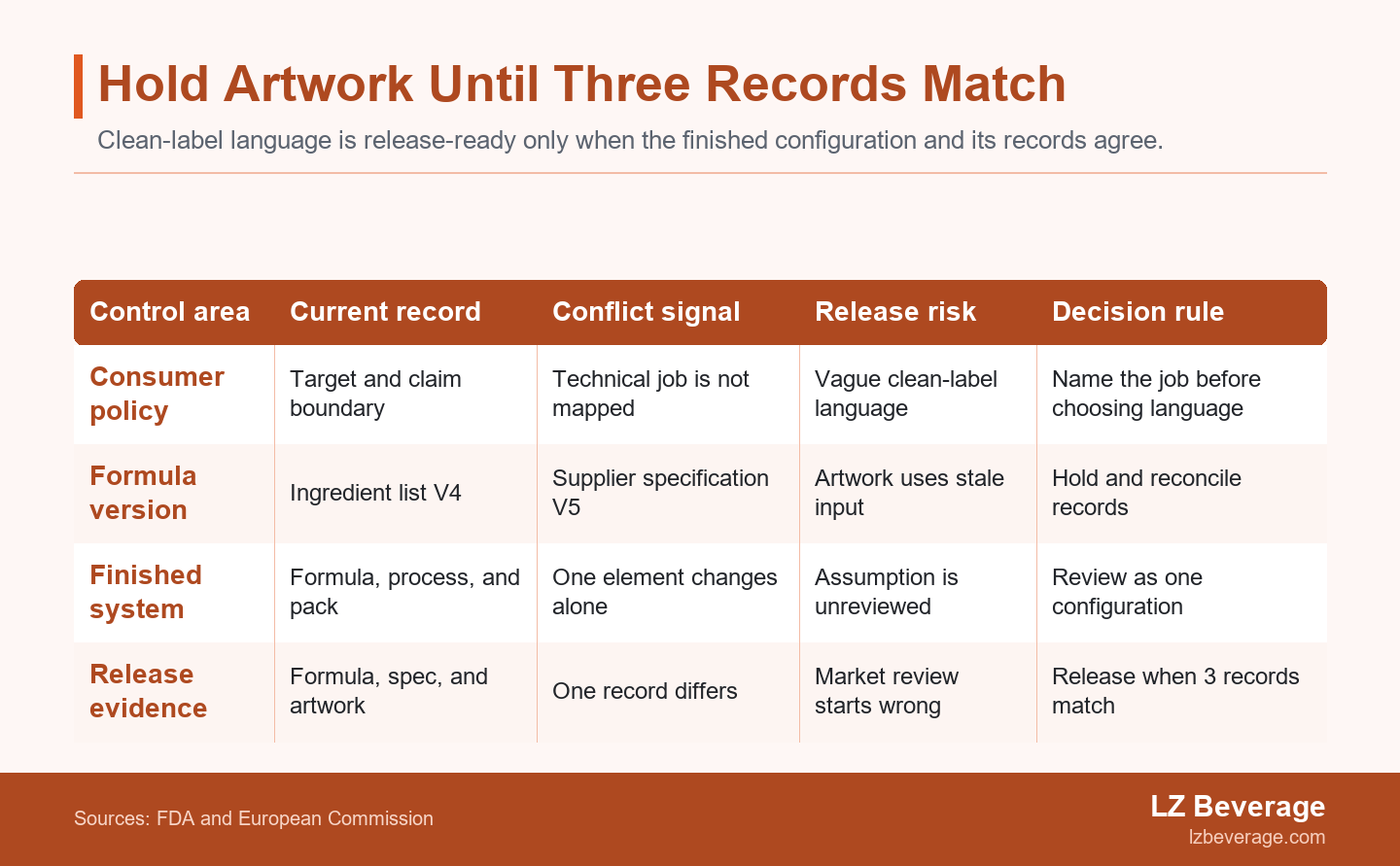
The issue is not whether the beverage is good or bad. The documentation no longer describes one finished product. The 3 linked records—the formula version, supplier specification, and label-artwork draft—no longer agree. A technical sample may remain useful, but the brand cannot assume that earlier wording applies to the version currently proposed for the pilot.
The team places final artwork on hold and treats the record conflict as a product-configuration question rather than a copy-editing task.
It confirms the current ingredient documents, identifies the allowed policy language, and updates the formula-to-label record before sending the pack and market details for review.
The label language, ingredient documentation, product configuration, and destination-market inputs must align before artwork and pilot decisions resume.
This illustrative scenario does not decide whether a claim is permitted or prescribe a formula, package, process, or shelf life.
Separate Technical Evidence From Market-Ready Label Review
Ingredient intended use and prepacked-food label information are separate target-market review questions.
Teams often try to resolve all uncertainty through one label phrase. That is rarely productive. A technical review asks whether the current formula, process concept, package, and storage assumptions have the information needed for a development decision. A market-ready label review asks whether the actual product information, ingredient statement, and claims are appropriate for the destination. The two workstreams inform each other, but they should not be treated as proof of the same thing.
FDA’s overview of food additives and GRAS ingredients explains the relevance of intended use, food type, use level, exposure, and safety information in the U.S. ingredient context. For the EU, the European Commission’s labelling overview lists mandatory information for prepacked foods, including the ingredient list. These sources do not approve a product concept. They show why a brand should bring the actual formula and destination-market details to the review rather than rely on a generic policy statement.
Use two linked checkpoints before you lock the message
- Technical checkpoint: Identify the current formula, intended pack, relevant processing question, storage assumptions, and the evidence still needed for the development decision.
- Market checkpoint: Review the current ingredient documentation, label draft, claim direction, and destination-market requirements as one version-controlled set.
The two-checkpoint approach reduces a common failure mode: a team approves a promising sample or attractive label phrase, then discovers that its documentation or pack specification describes a different version. The correction is not to add more marketing language. It is to align the records and return to the decision that the finished configuration can actually support.
Give an OEM/ODM Partner a Brief They Can Evaluate
A scoped OEM/ODM feasibility review gives a beverage partner a more useful starting point than an undefined request for a clean-label drink.
An OEM/ODM feasibility review is a structured discussion of whether a beverage brief can be evaluated for manufacturing. It is not a promise that a particular formula, claim, shelf life, or quotation will be approved. Its value is that it exposes the decisions that need a product-specific answer before a pilot, supplier selection, or market launch can move forward.
For a clean-label shelf-stable concept, the first packet should include the beverage type, target consumer, flavor direction, functional intent if any, ingredient policy, known non-negotiables, desired pack format, target market, expected volume, and current formula or ingredient documents where available. It should also state the open questions: for example, whether a package has been selected, what storage conditions are expected, and which label direction still needs market review.
LZ Beverage’s stated scope covers custom formulation, filling, packaging, and export coordination. When the brief is ready, a founder can review factory and company background before sharing the technical inputs. Then, rather than ask for “a clean label drink,” ask for an assessment of the specified beverage and the decisions required to evaluate it.
If the product direction is still being narrowed, prepare the packet first and review beverage manufacturing insights as you refine the choices. The most useful next step is to share the beverage type, target consumer, flavor direction, function, pack format, target market, expected volume, and ingredient-policy boundary for an OEM/ODM feasibility review.
Questions Founders Ask When Building a Clean-Label RTD
Is clean label a legal ingredient category?
No universal ingredient category can replace target-market rules, so clean label should be treated as a documented brand policy reviewed against the actual formula and label. The policy can state what the brand prefers or excludes and why, but the ingredient statement and any claims still need to be assessed for the destination market. Use the policy to guide development rather than to assume a legal outcome.
Can a short ingredient list guarantee shelf stability?
No. A short ingredient list does not establish how the finished beverage will be controlled through its formula, process, package, storage assumptions, and market review. A concise list may be the right consumer outcome, but it does not replace a product-specific technical discussion. If the formula or package changes, the team should ask whether the earlier evidence still matches the beverage now proposed.
When should a label draft be reviewed again?
Review the draft again whenever the formula, ingredient documentation, package, target market, or product claim direction changes in a way that affects what the label describes. The trigger is not a minor wording preference; it is a change that could make the artwork refer to a different finished configuration. Holding the draft until the records align is usually more efficient than correcting a promise after the pilot is scoped.
What should a clean-label OEM brief include?
Include the beverage type, consumer, flavor direction, function, ingredient policy, pack format, target market, expected volume, and the questions you need the partner to evaluate. Add the current ingredient documents and any non-negotiable label direction when available. This does not guarantee feasibility, but it lets the OEM/ODM team identify missing data, relevant process or package questions, and the next practical review step.


