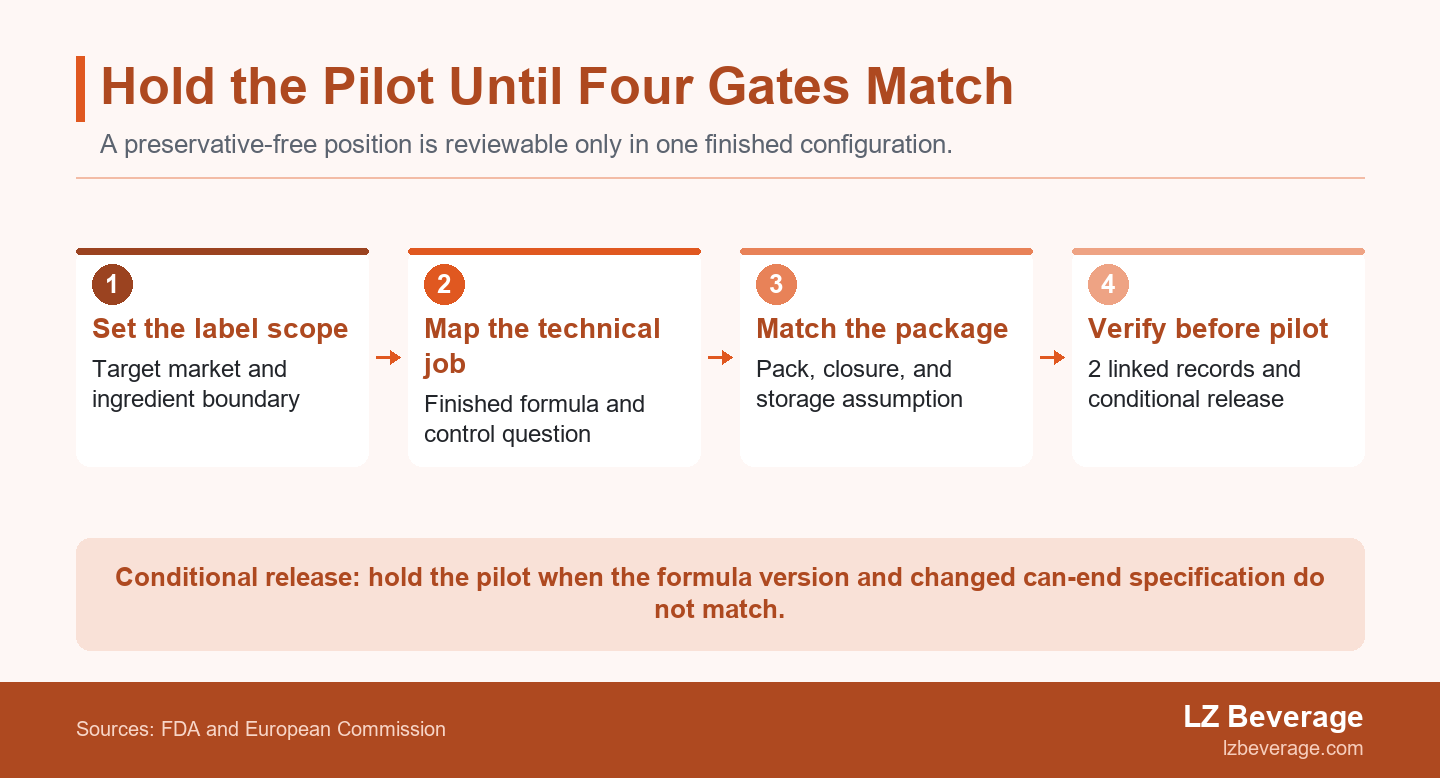
The expensive mistake is to treat an ingredient exclusion as though it settles the stability question. A preservative-free position is not a preservation method. It states a boundary for an ingredient list or product message; it does not, by itself, show how the finished drink will be controlled through its intended process, package, storage assumptions, and target-market review. A stronger development brief keeps those decisions visible together before a pilot, artwork, or supplier commitment is allowed to move forward.
What a Preservative-Free Brief Must Resolve Before Release
- Define the boundary. Record what the position means for the intended ingredient statement and market; do not turn it into a general safety promise.
- Keep every technical job visible. Removing one approach does not remove the product condition that approach was intended to address.
- Choose controls as a finished configuration. Formula, processing route, package, storage assumptions, and label review need one current version.
- Hold a changed configuration until it is reviewable. A new component, process assumption, or formula version can create a different decision question even when the product name stays the same.
A Preservative-Free Position Is Not a Preservation Method
For a founder or product manager, the phrase can be useful only when everyone reading the brief understands its limits. One team may use it to mean a narrow exclusion from the ingredient list. Another may assume it implies a particular thermal route, a certain package, or a shelf-life outcome. Those are separate questions. The first is a positioning decision. The others concern how a particular beverage is made and evaluated. Combining them too early creates a false sense that a concept is ready when only its messaging direction has been chosen.
The practical handoff is to write two lines, not one. The first states the intended consumer and ingredient-positioning boundary. The second lists the questions that remain open for the finished beverage: formula characteristics, process route, pack format and closure, expected storage, and target market. That is not bureaucracy. It gives R&D, manufacturing, packaging, regulatory, and commercial teams a shared object to discuss instead of asking one word on a concept sheet to carry all of the technical meaning.
Define the Label Scope Before You Remove an Ingredient
Food ingredients can have distinct technological jobs, including preservation, acidity control, texture, sweetness, and color. FDA’s ingredient-function overview is useful because it separates the job an ingredient performs from the consumer message a brand may choose. The European Commission likewise lists 26 technological purposes for additives in its additives guidance, including preservation and protection against oxidation. Neither source supplies a universal preservative-free ingredient list; both point back to the function that still needs to be considered in a finished product.
An ingredient exclusion should be documented as a positioning boundary, not presented as a standalone safety conclusion. A clear brief can say which ingredient category the brand prefers to avoid, what the intended consumer expects, and which market will review the final wording. It should not suggest that a shorter list automatically makes every formula appropriate for every use, nor that an ingredient choice answers all processing or package questions. This distinction helps prevent a copy decision from being mistaken for a technical release decision.
It also gives the formulator a better question. Instead of asking only, “What can replace this preservative?” ask, “What condition of this drink was that system helping to control, and what evidence will be needed if the formulation changes?” The answer may involve acidity, product texture, oxygen exposure, flavor stability, microbial control, or another product-specific issue. A preferred ingredient policy can guide options, but it cannot remove the need to identify the relevant technical job.
Ingredient assessment and intended use are also not interchangeable with marketing language. FDA’s explanation of food-additive and GRAS considerations discusses intended use, use level, food category, exposure, and supporting science. For a brand, that is a useful restraint: an ingredient-positioning statement should be reviewed against the intended use and market requirements, rather than being treated as a conclusion about the product as a whole.
Make the Process Carry the Right Control Job
For the FDA definition, an acidified food has a finished equilibrium pH of 4.6 or below and water activity above 0.85. FDA’s acidified and low-acid food guidance places that definition in a specific U.S. regulatory context, not in a universal beverage recipe. Its value in an early discussion is that it makes the finished product characteristics visible: a process question cannot be resolved from an ingredient preference alone.
FDA process-filing context differentiates products by factors including product style, container size and type, and processing method. The agency’s acidified and low-acid food guidance is a reminder that product, container, and process cannot be treated as independent variables when a relevant filing framework applies. A scheduled process is a documented process selected for a specific product and package configuration. The term does not tell a buyer which route to choose; it describes why the selected route needs to be tied to the actual beverage and pack under review.
Use the Formula to Frame the Process Question
Start with the drink that is intended to be sold, not with a process name that sounds compatible with the positioning. Capture the beverage type, ingredient system, intended acidity and solids assumptions where relevant, carbonation condition, inclusions, target serving experience, and initial pack concept. Then ask what the selected route must protect or control in that particular configuration. A sparkling citrus drink, a still botanical drink, and a dairy-adjacent beverage may each create different development questions even when all three carry an ingredient-exclusion goal.
This is where an OEM/ODM discussion becomes more useful than a generic request for “shelf stable without preservatives.” The manufacturer can respond to a defined set of product questions: what is in scope, what is not yet decided, which process paths may need evaluation, and what pilot evidence will be relevant. If the project is an RTD concept, teams can review RTD beverage options while documenting the intended format and pack. The page is not a substitute for technical review; it can help keep the product category and commercial direction explicit before the brief becomes more detailed.
Aseptic packaging is designed to prevent microorganisms from entering the package during and after packaging. FDA’s aseptic processing and packaging guide treats processing and packaging as a linked system. That is the important decision lesson for a preservative-free concept: a process route may be part of the control strategy, but it is not an ingredient-for-ingredient replacement that can be selected without reference to the finished package and product conditions.
Before moving from bench work to a pilot, name the evidence question in plain language. For example: “Does this selected formula, processed and packed in this intended configuration, have the information needed for the next project decision?” That phrasing keeps the team from treating a bench sample as final release evidence. It also makes later changes easier to notice. If the formula, process route, container, closure, or storage assumption changes, the question may need to be asked again for the changed configuration.
Give Packaging an Explicit Preservation Job
A package has a preservation job only when it is evaluated as part of the finished beverage configuration. A can, bottle, closure, liner, pouch, or other format is not merely a design choice after formula work is complete. It is part of the system that holds the selected product condition through filling, storage, distribution, and consumer use. The relevant question is not whether a package looks robust in isolation, but whether it is the package used for the version of the product and process that the team intends to evaluate.
Food-contact materials can affect the chemical safety and quality of food, including taste, smell, and appearance. The European Commission’s food-contact materials overview explains why materials that touch food are subject to controls. A food-contact material is a material intended to touch the beverage during packaging or storage. For beverage development, that definition is a useful boundary: package evaluation should be included because the pack is part of the product experience and control context, not because every format change automatically produces the same result.
Make the package question explicit in the brief. Record the format, relevant material or component specification, closure or can-end arrangement, filling relationship, and the storage assumptions the team is using. When a component changes, identify what remains valid and what must be checked again. This prevents a common handoff gap: the formula version and process notes may be current while a packaging component has moved to a new version that no longer matches the evidence package.
A changed can-end specification creates a configuration gap when package-matched closure evidence is absent. The phrase “configuration gap” is not a formal regulatory category; it is a practical signal that the project records no longer describe one version of the drink. Teams can compare the beverage product range when they need to clarify the intended product and package direction, then return to the actual component and process questions that require a project-specific review.
Illustrative Scenario: A Pilot Paused After a Can-End Change
This illustrative example is not a client project, production result, or shelf-life claim. An R&D manager is preparing an OEM/ODM pilot for a preservative-free sparkling yuzu beverage. The brand has agreed on the consumer direction and has bench formula notes, but the project is still in pilot scoping rather than production release.
The proposed next step is a 24,000-can pilot after a formula and pack-concept review. The order scale is large enough to make a late change costly in time and materials, yet it is still early enough to avoid treating a preliminary configuration as fixed.
The readiness state is pilot scoping before production release. The team has a process outline and a specified sparkling yuzu formula, but the records have not yet been confirmed against every final component in the pilot configuration.
Before the pilot is scheduled, the proposed can end changes to a different component specification. The product recipe has not changed, so the commercial team initially sees the switch as a purchasing detail rather than a product decision.
The project file also shows formula notes and the process outline, but it does not include package-matched closure evidence for the new component. The affected scope is 2 linked items: the sparkling yuzu formula and the changed can-end specification.
The change creates a configuration gap because the available records no longer describe one finished product, process, and package combination. An earlier bench or component review may still be useful background, but it cannot be assumed to cover the changed closure arrangement. The issue is not that the new can end is automatically unsuitable; it is that the relevant question has changed before the pilot decision has been supported.
The team places the pilot on hold rather than treating the unchanged recipe as sufficient evidence. This is a conditional-release decision: the project can proceed once the actual configuration is described and the next verification question is agreed, rather than after a broad claim that the formula itself has already passed.
The corrective action is to pause the pilot configuration, update the brief with the actual can end and closure setting, and re-establish the review plan for that selected combination. The work is deliberately targeted; the team is not instructed to restart unrelated formula development simply because one package component changed.
Before restarting the pilot decision, the team confirms the product-process-package configuration and the target-market review inputs for the current version. That verification gate makes the subsequent pilot a defined learning step instead of an inference drawn from a partially matched record set.
This illustrative example does not prescribe a can, process setting, shelf life, or regulatory result. It illustrates a handoff rule: a physical component change can require a focused review when it breaks the match between the evidence plan and the product that will actually be made.
Build Evidence Around the Finished Configuration
Evidence is decision-ready only when the formula, process, package, storage assumptions, and market destination are version-matched. This does not require every early concept to carry a finished validation dossier. It does require the team to know which decision its current evidence can support, what configuration that evidence represents, and what change would make the evidence no longer sufficient for the next decision.
Use a simple record set before the pilot is released: the current formula version, process concept, pack and closure specification, storage assumptions, target market, label direction, open questions, and the owner of each unresolved item. The record should distinguish facts already confirmed from assumptions that still need review. A product team can then see whether a requested change affects the same configuration or introduces a new one. That makes commercial conversations faster because a supplier is asked to evaluate a defined project rather than infer hidden conditions.
Target-market review belongs in that record as well. The European Commission’s overview of mandatory food information includes the ingredient list among the information required for prepacked foods in the EU. The exact requirements depend on the destination and product, but the planning implication is broad: formula and label wording should be reviewed as linked records rather than as two teams working from different versions.
Where an additive or ingredient use question remains open, EFSA’s food-additives topic page describes assessment of safety, proposed uses, use levels, and dietary exposure in the EU authorization context. That is not a release shortcut for a beverage project. It is a useful reminder that a label position and an ingredient’s intended use are related but different review questions, each requiring the right market-specific input.
| Brief element |
What it should identify |
What triggers another look |
| Formula |
Current ingredient system and product characteristics |
Ingredient, flavor, acidity, texture, or carbonation change |
| Process |
Route being evaluated for the specified beverage |
Route, filling, or critical product-condition change |
| Package |
Format, component version, closure, and intended storage context |
Container, can end, closure, liner, or component-specification change |
| Market message |
Ingredient-positioning scope and destination review inputs |
Formula version, intended claim, or target-market change |
The table is a handoff aid, not a generic pass/fail checklist. Its value is that it records a reason to pause rather than allowing an unchanged product name to conceal a changed product configuration. The next question becomes concrete: which record is now out of date, and what review is needed before the team treats the pilot, label, or purchase decision as ready?
Turn the Concept Into an OEM/ODM Feasibility Brief
A scoped OEM/ODM feasibility review can evaluate a beverage brief across formulation, filling, packaging, and export coordination. Here, an OEM/ODM feasibility review means a structured discussion of whether a beverage brief can be evaluated for manufacturing. It is not a promise that every ingredient-positioning request can use the same route or reach the same commercial outcome. Its purpose is to make the next technical and commercial decisions visible early enough to be evaluated.
A useful first package for that conversation includes the beverage type, target consumer, flavor direction, intended function, ingredient-positioning scope, pack format, expected volume, target market, storage assumptions, and the specific decision the brand wants to make next. A short list of open questions is more useful than an overconfident finished claim. For example, the brief can state that the team wants to understand which process-and-package questions need to be resolved before a pilot, rather than asserting that the beverage is already shelf stable.
LZ Beverage’s relevant scope is custom formulation, filling, packaging, and export coordination. Before asking a partner to evaluate a concept, teams may review factory and company background to place the discussion in the context of the company’s public manufacturing and product information. That context does not replace a formula-specific assessment, but it can help a buyer prepare a realistic conversation about the product category, packaging direction, and production handoff.
During the review, separate the decisions that must be made now from those that can remain open. The immediate set usually includes the product scope, process question, intended pack, current market, and pilot objective. Later decisions may include final artwork refinement, commercial scale, or a broader flavor portfolio. This separation protects a development team from either extreme: launching a pilot with no defined configuration, or trying to resolve every future variation before the first useful question has been tested.
Ask for the output in the same form as the brief: a clear list of what has been assessed, what is still assumed, what input is missing, and what change would trigger another review. That creates a record that commercial, R&D, packaging, and quality stakeholders can use without translating a vague request across departments. Teams that want adjacent category and production context can review beverage manufacturing insights after the brief is defined, then return to the specific configuration and market questions that govern the next project step.
Questions Teams Ask About Preservative-Free Beverage Manufacturing
Preservative-free manufacturing questions need product- and market-specific answers. The questions below help a team separate an ingredient-positioning choice from the evidence and handoffs required for the particular beverage it intends to make.
Does preservative-free mean a beverage is shelf stable?
No. A preservative-free position describes an ingredient or label choice, while shelf stability depends on the finished formula, process, package, and evidence for the intended conditions. A team should define what the claim means for its product, then identify the technical questions that remain for the specific drink and target market. The label boundary can guide development, but it does not prove a finished-product outcome by itself.
Can hot fill or aseptic processing replace a preservative?
A process route may provide part of the preservation control, but it is not a universal ingredient-for-ingredient replacement and must fit the product and package. The useful question is which control job the finished beverage needs and whether the selected process-and-pack configuration is appropriate to evaluate. Process names should not be used as label claims or as shortcuts around product-specific review.
When does a package change require another review?
Review the evidence again when a package change could alter the verified finished configuration, including the relevant container, closure, material, or filling relationship. The change may be narrow, so the response can be targeted rather than a restart of all development work. Record what changed, which evidence applied to the earlier configuration, and what needs confirmation before the pilot or release decision resumes.
What should an R&D team send to a beverage manufacturer first?
Start with the beverage type, target consumer, flavor direction, function, pack format, target market, expected volume, and the intended preservative-free scope. Add the current formula and package assumptions, the process question, and the decision the team wants to make next. That information lets a manufacturer identify missing inputs and relevant evaluation questions without assuming that a positioning phrase already defines the finished product.


