A canned drink needs an exposure path, not just a color specification, before its stability result can guide release. The weak point in a natural-color canned drink is often not the can on the shelf. It is the unrecorded path from the color ingredient to the packed sample used for a shelf-life decision.
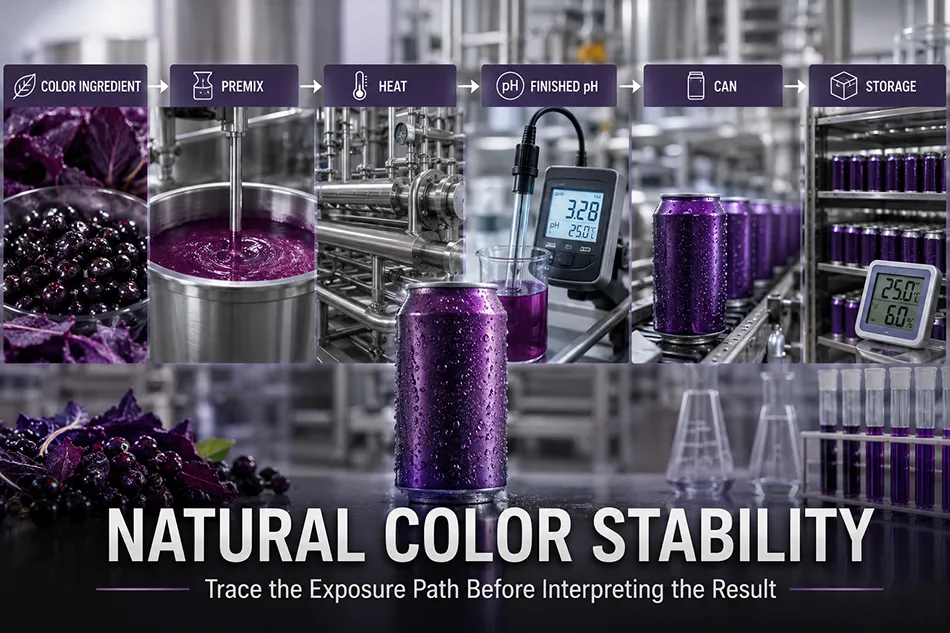
Natural Color Stability Starts With the Exposure Path
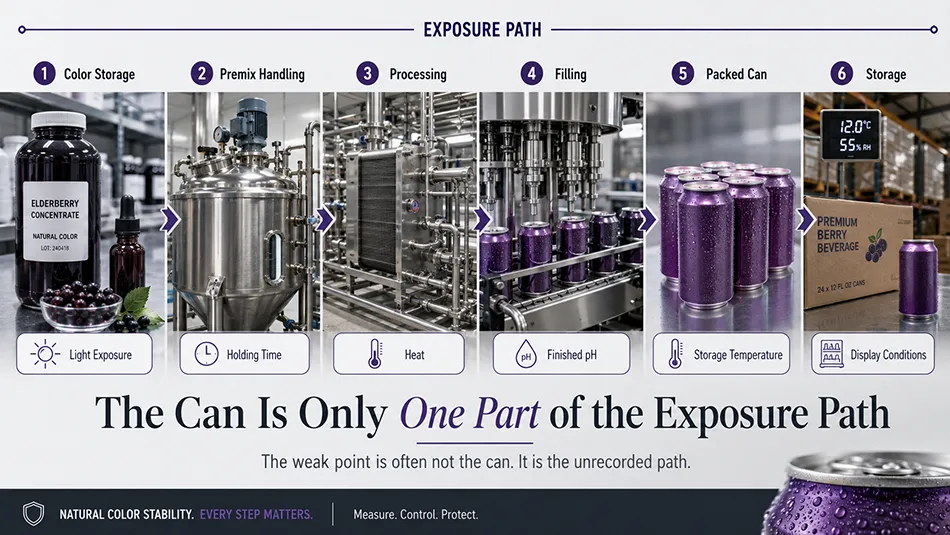
A can may block direct light after filling, yet the color system can still encounter light during ingredient storage or premix handling, heat during processing, a different pH in the finished formula, and storage conditions that are never named. If that path is unknown, a shade result is only an observation. It is not reliable release evidence.
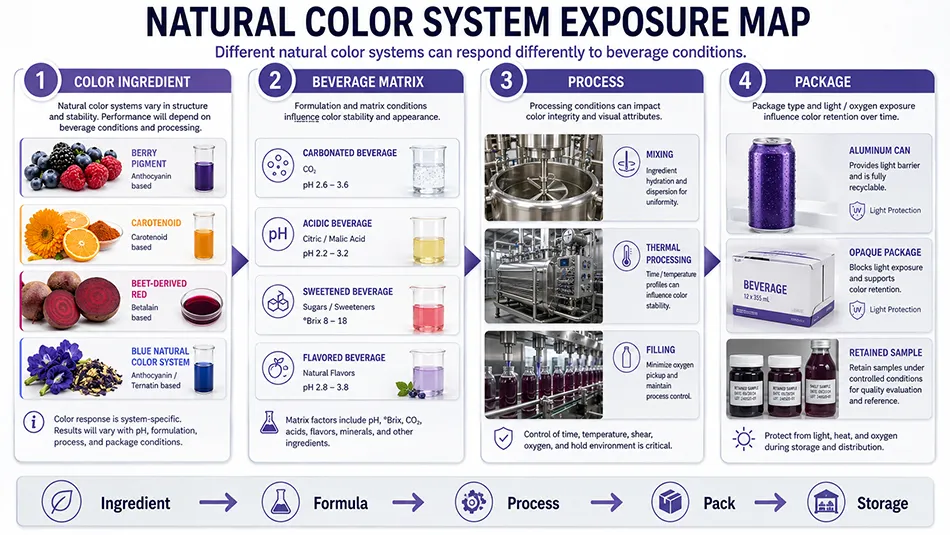
That distinction matters because “natural color” is a sourcing description, not a single technical behavior. A berry-derived purple, a carotenoid-based orange, a beet-derived red, and a blue system can respond differently to the beverage matrix. The useful question is therefore not, “Is this color stable in cans?” It is, “Which color system is in this drink, what stresses did it meet, and which packed condition does the test actually represent?”
Start with an exposure path: color lot and handling, premix and hold conditions, process heat, finished pH, pack format, and intended storage profile. This creates one shared record for R&D, quality, purchasing, and manufacturing. It also prevents a promising bench sample from being mistaken for a finished product result. The rule is deliberately narrow: the record does not prove a shelf life or approve a formula. It tells the team what must be true before a stability result can be interpreted.
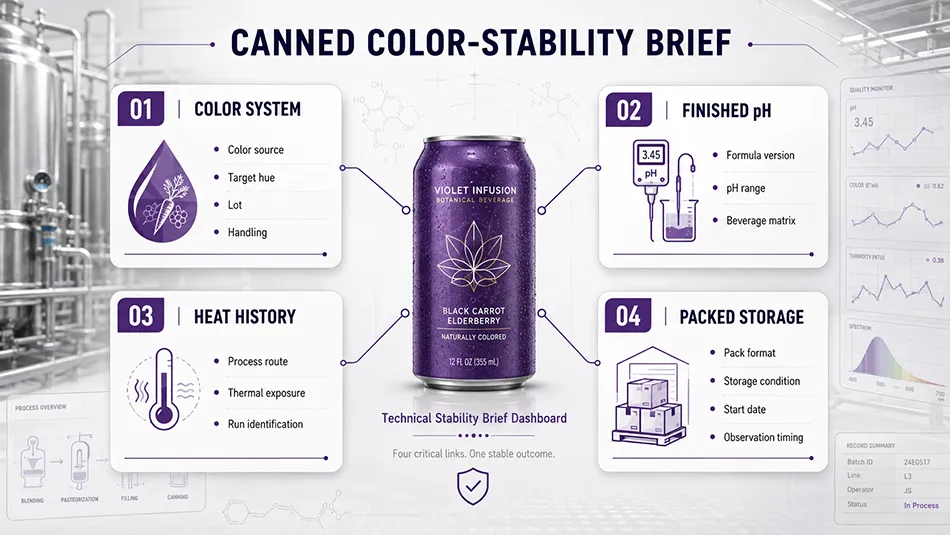
What a Canned Color-Stability Brief Must Resolve
A stability brief should name the color system, finished pH, heat history, and packed storage condition before release evidence is interpreted. These four links create a practical boundary between a development observation and a release decision. They are not a universal test protocol. They are the minimum context needed to ask the right next question.
- Name the color system. Record the supplied color, its target hue, the lot, and any handling instructions that matter to the project.
- Trace the exposure stages. Separate prefill light and handling from processing heat and post-fill storage. An opaque can is one control point, not the whole history.
- Measure the finished drink. The relevant pH, appearance, and sensory context belong to the formula that will be filled, not only to a concentrate or a water sample.
- Define what the retain represents. A packed sample should have a named storage condition, start date, formula version, and pack version before it is used to support a release conversation.
This approach changes the decision sequence. A single shade shift does not automatically demand a reformulation. First ask whether the observation came from a controlled, configuration-matched comparison. If it did not, the immediate task is to improve the evidence path. If it did, the team can investigate the color system, formula, processing, and storage variables with a clearer hypothesis.
Map the Color System Before You Map the Can
FDA distinguishes color additives subject to certification from many certification-exempt colors derived from plant, mineral, or animal sources. In U.S. context, the FDA’s color-additive overview makes that distinction. It is useful for regulatory scoping, but it is not a stability ranking. The same overview notes that color additives may be used to offset losses related to light, air, temperature, moisture, and storage. A natural source therefore does not remove the need to ask what conditions the actual drink will face.
Natural-color evaluation can include color retention and response to temperature, pH, and light exposure. A 2025 review of natural colorants identifies those as relevant evaluation parameters. Its value for a beverage team is not a single pass-or-fail rule. It is a reminder to test the stressors that belong to the selected color and food system. Read the review’s stability-assessment discussion as a planning prompt, not as a promise that every natural pigment will perform the same way.
An exposure map is simply a record of where the color system encounters light, heat, handling, and storage conditions. It should begin before the filler. Teams often record the selected can but omit whether the color ingredient sat in a brightly lit staging area, whether a premix waited between preparation and filling, or whether a packed sample was stored under a defined condition. Those gaps make it hard to decide whether a visible change is linked to the ingredient, the formula, the process, or the test itself.
For an early discussion with LZ Beverage, the map turns a shade request into clear product, process, pack, and storage variables. It remains a record for framing the question, not proof that the finished drink will meet a particular shelf-life outcome.
Use the exposure map to turn a color concern into a testable question.
| Exposure point |
What to record |
Question it answers |
Next action if unknown |
| Color ingredient and premix |
Lot, handling route, light and hold conditions |
Did the color enter the formula with an incomplete exposure history? |
Document handling and compare a controlled preparation. |
| Finished formula |
Target shade, pH range, matrix notes, formula version |
Was the color assessed in the drink that will be filled? |
Move from concentrate observation to finished-drink samples. |
| Process and filling |
Actual thermal history, run identification, pack version |
Can the observed result be connected to one process path? |
Record the current configuration before repeating the check. |
| Packed sample and distribution profile |
Named condition, start date, storage route, observation timing |
What commercial condition does the sample represent? |
Split matched samples across defined conditions. |
The table also prevents a common false shortcut. A can is usually opaque, so it may reduce direct light exposure after filling. That does not make light irrelevant. It moves the light question upstream to ingredient storage, preparation, or any transparent sample format used during development. It can also remain relevant where a project will use more than one format. The map tells the team where to look instead of forcing every color concern into a generic “shelf-light” explanation.
Test Heat and pH in the Finished Beverage
Natural food-colorant research describes pH and water conditions as relevant to hue for some color classes, while pH control agents are a distinct ingredient function. The FDA’s ingredient-function table lists color additives separately from pH control agents and acidulants. That separation is useful in a development brief: the color system has a target shade, while the formula has an acidity condition that can affect both appearance and wider product behavior. A finished pH record belongs beside the shade record, not below it as an afterthought.
Natural-color research also cautions against judging a pigment outside its food system. A review of natural food colorants notes that pH and water conditions can affect hue and stability for some color classes. The point is not that one number will make every natural color work. It is that an acceptable swatch in a supplier sample does not resolve performance in a carbonated, acidic, sweetened, or otherwise complex drink. Use the review’s discussion of natural-color stability to frame the test: assess the selected system in the finished beverage conditions that the project actually intends to fill.
Heat History Is More Useful Than a Generic Heat Claim
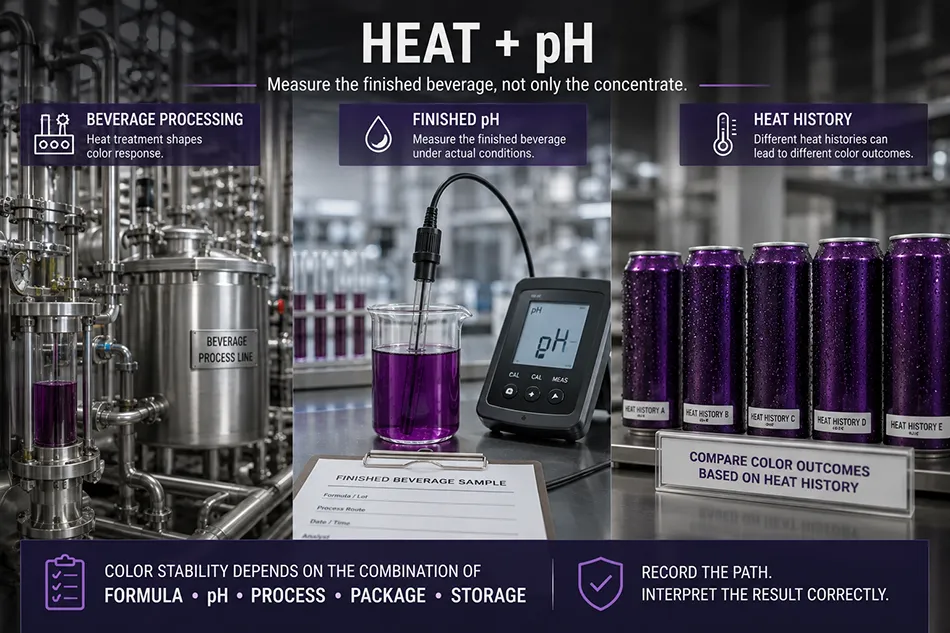
A recorded heat history is more useful for a canned-drink decision than a generic heat-stability label on a color ingredient. The relevant question is the recorded thermal history of the current drink: how the color was handled, what the finished formula experienced, what happened between processing and filling, and whether the retained cans came from the same defined run. This is not a request for a universal time or temperature. It is a way to preserve the cause-and-effect trail needed when a later shade trend appears.
A concise heat record can include the formula version, production or pilot run, intended process route, observed deviations, post-process hold assumptions, and the time at which retained samples entered storage. These entries are valuable even if every result looks acceptable. They make a later comparison meaningful. Without them, a team may change a color dose to solve a problem caused by a different exposure step, then lose the chance to learn which variable mattered.
For an RTD concept, the heat question should be discussed alongside product format and pack decisions, not after commercial artwork is fixed. Teams can review RTD beverage options while keeping the intended drink format explicit in the brief. The page does not replace technical review. It simply keeps the category decision visible while the formulation and process questions are still open.
pH Is a Formula Condition, Not a Shade Specification
Anthocyanin stability can be affected by pH, temperature, light, oxygen, and other factors, making it a useful but bounded pH-sensitive example. The anthocyanin stability review should not be used to prescribe a formula for every natural color. It does show why the final pH condition must be part of the evidence record when an anthocyanin-based or similarly pH-sensitive system is under consideration.
Write the finished pH target or range beside the formula version, then test the shade in that finished formula. If the project later changes acidulant system, sweetness balance, flavor load, or another matrix factor, the team should ask whether the previous color result still represents the new configuration. This is not an instruction to retest every minor adjustment automatically. It is a change-control question: did the adjustment alter a condition that the color result depended on?
Make Shelf-Life Evidence Look Like the Packed Drink
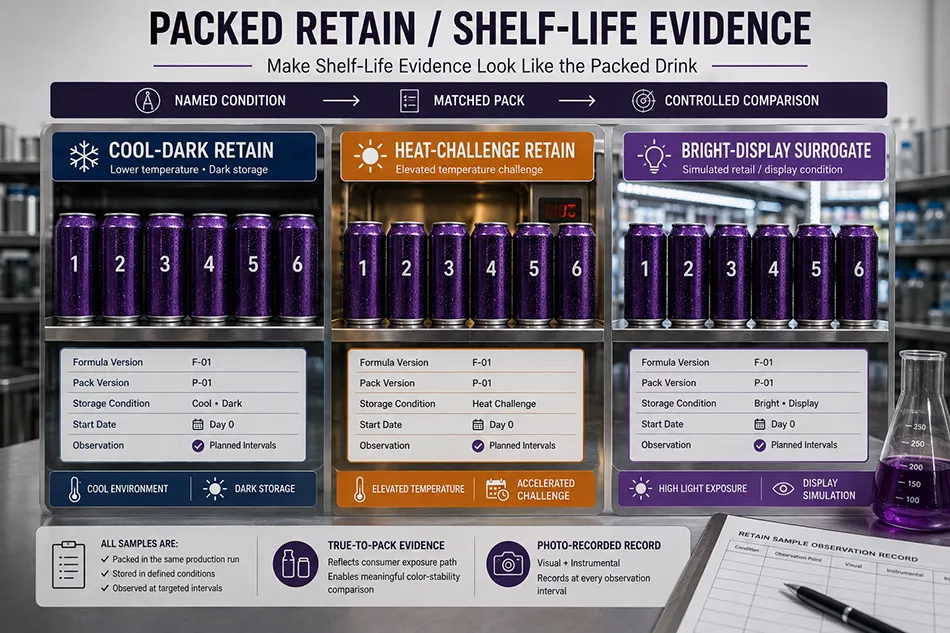
Anthocyanin stability research identifies pH, light, temperature, and storage conditions as interacting variables that should be named in a comparison. Shelf-life work becomes useful when it compares named conditions rather than creating a single stressed sample with no commercial meaning. Its light and thermal stability discussion supports the practical idea of defining exposures before comparing results. It does not convert any accelerated condition into a universal number of months on shelf.
A packed retain study should represent one named formula-pack-storage configuration before its result guides a release decision. A retained sample is a packed sample held under a named condition for planned evaluation. For a color-stability study, that definition is more useful than a shelf-life label on a spreadsheet. The retained can should identify the formula version, color lot where relevant, pack, run, storage condition, and observation schedule. When those details match, the result can answer a focused question. When they do not, it may still be a useful signal, but it should not be used as if it represented one commercial configuration.
A practical comparison can include a cool-dark retain, a heat-challenge retain, and a bright-display surrogate where the project’s exposure path makes that condition relevant. The names matter more than imitating somebody else’s exact settings. Each condition should have a reason tied to the intended product and channel. The study can then ask a cleaner question: does shade change follow a defined condition, or is the apparent trend present across conditions? If it follows a condition, the next review narrows. If it does not, the team may need to revisit formula, process, sampling, or measurement consistency.
The strongest release statement is therefore modest: the current formula-pack-storage configuration has been compared under named conditions, and the remaining decision is visible. It is not “the can solved the color problem.” For a broader portfolio discussion, teams can compare the beverage product range while documenting whether a future format would change the exposure map. A result from one pack should not silently become evidence for another.
This is also where LZ Beverage’s role can be scoped realistically. A conversation about custom formulation, filling, packaging, and export coordination is more productive when the project includes the color system, pH condition, pack, target market, and intended storage question. Those inputs do not guarantee a stability outcome. They allow the manufacturing discussion to start from a defined configuration rather than from a color name alone.
When a Repeat Shade Trend Changes the Release Decision
Repeated shade drift plus incomplete exposure records should trigger a controlled comparison before a release conclusion. The key word is repeated. One observation may come from a sample-handling difference, a measurement issue, or a real formula signal. Two directionally similar observations are enough to widen the question, but they are still not enough to name the cause. The decision changes from local adjustment to evidence escalation.
That escalation can stay proportionate. It does not require a team to declare the formula failed or to assume a full commercial lot is affected. It requires the team to hold the release decision at the point where evidence is incomplete, identify the current configuration, and create a comparison that can separate likely causes. The following disclosed scenario shows what that looks like in a canned pilot.
Illustrative Scenario: 18,000 Purple Cans and an Incomplete Exposure Record
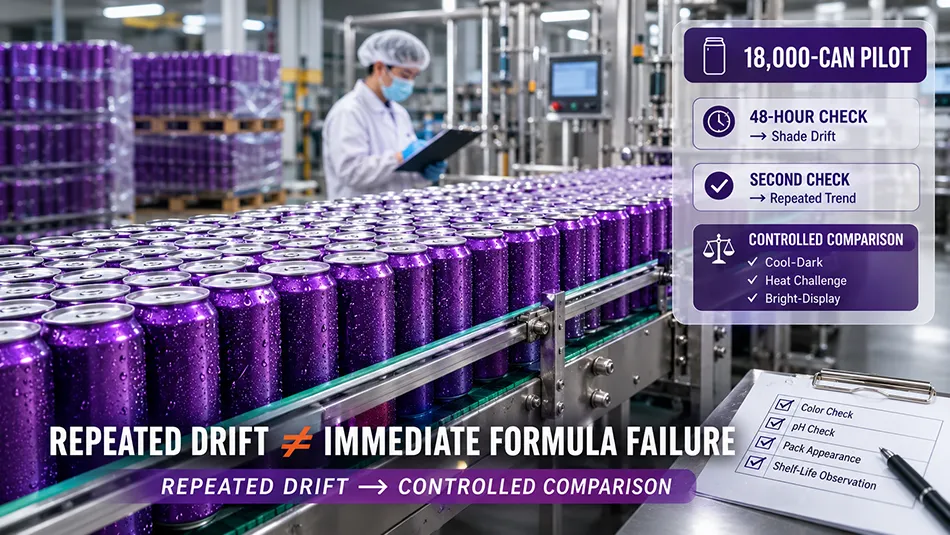
This is an illustrative development scenario, not a client project, production result, or shelf-life claim. In the disclosed scenario, repeated shade drift plus missing light history triggers a controlled comparison rather than a formula verdict. An R&D manager is preparing an 18,000-can pilot of a sparkling berry drink with a purple natural-color system. The formula and can size are recorded, and the team has a provisional process outline. However, the color ingredient’s prefill light-exposure history was never added to the file.
The buyer’s immediate question is whether a less-vivid retained sample calls for a color adjustment before the pilot. The business pressure is real: artwork, ingredient purchasing, and a production discussion are moving forward. Yet the relevant decision is still technical. Is the observation a property of the selected color system, or is it a result of a path that no one documented?
An 18,000-can illustrative pilot is planned after bench samples and a provisional canned pack review. At the first 48-hour check, one retained can appears less vivid than its control. At a second retained check, the shade moves in the same direction. The formula version and can size have not changed. The retained cans, however, were not assigned named storage conditions. Their record does not say whether the observation represents cool storage, a warm hold, a bright sample area, or a mixture of those situations.
The project is at pilot release review, not at a finished-product rejection. The repeated pattern raises the importance of the question, but it does not supply a root cause.
The first observation provides a signal. The second observation makes that signal harder to ignore. Neither observation tells the team whether light exposure occurred before filling, whether heat history differed, whether the finished pH was the recorded value, or whether the storage route was consistent.
Because those four links are incomplete, changing color dose would be a guess. It could hide the trend without explaining it, and it could make the next pilot harder to interpret.
The team treats the issue as trend escalation. It uses a tiered hold: the release decision pauses, while the current formula and can format remain the configuration under review. This is different from declaring all 18,000 cans unacceptable. The purpose is to prevent an ambiguous retained-sample pattern from becoming a claim about commercial shelf life.
The next step is a split-storage study. Matched cans are assigned to 3 named conditions: cool-dark retain, heat-challenge retain, and a bright-display surrogate. The team records the color lot, prefill handling, finished pH, process run, pack, storage start time, and observation schedule for each group.
This correction changes the quality of the next answer. If only one condition shows drift, the team has a focused hypothesis to test. If the pattern appears across all three, the next review can widen to formula, process, measurement, or color-system selection. In either case, the evidence is more useful than a retrospective explanation.
The release conversation resumes only when the controlled comparison and current formula-pack records describe the same configuration. The study does not promise a release result. It supplies the information needed to decide whether another adjustment, test, or escalation is warranted.
This example does not prescribe a colorant, a process setting, a pH target, a shelf-life duration, or a release decision. Its point is narrower: repeated drift plus an incomplete exposure record should create a better comparison before it creates a formula verdict.
Turn the Stability Question Into an OEM/ODM Brief
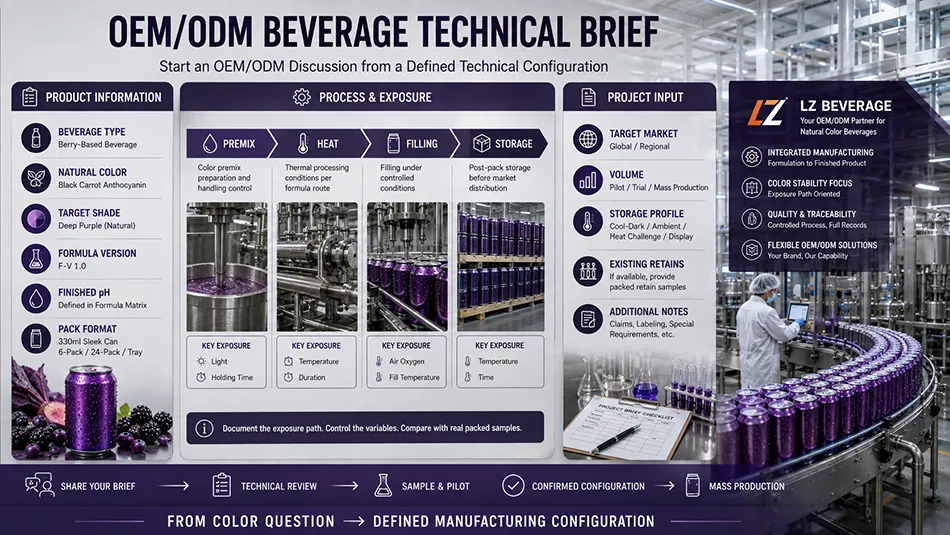
A scoped stability brief is suitable input for a discussion of custom formulation, filling, packaging, and export coordination. An OEM/ODM stability brief is a structured set of product, pack, exposure, and market details used to assess manufacturing feasibility. Before sharing a project, a team can review factory and company background and then prepare the information that makes an OEM/ODM assessment concrete. This is a feasibility conversation, not a promise that a selected color, process, or market claim will be approved.
Give the manufacturer a current, one-page view of the configuration: beverage type; carbonation or still format; target shade and color source; formula version; target pH or range; provisional process route; can and closure format; target market; expected storage and distribution profile; intended volume; and any existing retained-sample observations. Add what is unknown. A brief that openly marks its gaps is more useful than one that presents assumptions as facts.
Then state the decision the team needs. It may be, “Which variables should the first packed comparison hold constant?” It may be, “Does the planned color system require a different handling discussion?” Or it may be, “What documentation must be gathered before a pilot is scheduled?” Those questions let LZ Beverage connect the product-development request to its documented scope of custom formulation, filling, packaging, and export coordination without implying guaranteed color retention or market clearance.
Close the brief with an action path, not a generic request for a “stable natural color.” Share the color source and target shade, the finished pH target or range, the proposed pack, the storage question, the target market, and the expected volume. Teams that want more context before that discussion can review beverage manufacturing insights.
Common Questions
Natural-color stability questions need product-specific boundaries rather than universal targets. Product teams should review the formula, pack, storage conditions, and target market before advancing a formula.
Does an aluminum can protect natural colors from light?
An opaque aluminum can can reduce direct light exposure after filling, but it does not document light exposure before filling or replace a packed-product stability study. The relevant question is where light can enter the selected project’s exposure path. That may include color storage, premix handling, bench samples, or a second package format. Record those stages, then test the packed drink under conditions that represent the decision being made.
What pH should a naturally colored canned drink use?
There is no universal pH target. The appropriate range depends on the selected color system, beverage matrix, process route, sensory goal, and applicable market requirements. For a pH-sensitive color, the better practice is to record the finished pH condition and test the intended formula there. Do not choose a number solely because it appears in a general colorant article or supplier presentation.
Can accelerated testing prove the shelf life of a natural-color drink?
Accelerated testing can compare defined stresses and help prioritize follow-up, but it does not by itself prove a universal commercial shelf-life duration for every formula and pack. It is most valuable when the exposure condition, formula version, pack, and observation schedule are named. Treat the result as evidence for a particular comparison. Then decide what additional real-time, market-specific, or configuration-matched work is still needed.
What should a beverage team send to a manufacturer before a color-stability review?
Send the beverage type, color source and target shade, finished pH target or range, pack format, process assumptions, storage conditions, target market, and expected volume. Include the formula and pack versions used in any existing samples, plus what those samples were exposed to. That information lets the discussion start with a defined stability question rather than an unsupported request for a permanent color result.


