A request for a shorter ingredient list often arrives late: after a beverage has a sensory direction, a tentative pack, and an early production route. The difficult question is not how many names remain on the label. It is whether the finished drink still has a controlled way to perform every job that the removed ingredient performed.
That is the useful starting point for short ingredient list beverage formulation. A lower count can be commercially attractive, but it is not a stability method. One component can affect acidity, preservation, dispersion, texture, flavor protection, or processing tolerance at the same time. Removing it can be a sound design choice; treating its removal as proof of stability is not.
A Shorter List Is a Function Decision, Not a Word-Count Target
A shorter beverage ingredient list is defensible only when every removed function still has a named control path. An ingredient function is simply the job an ingredient performs in the finished drink. It is different from the ingredient’s marketing description, supplier name, or position in a development spreadsheet.
For example, a request to remove a familiar-sounding stabilizer should trigger a practical discussion: what was it doing in this exact beverage, in this pack, under this intended storage route? The answer may be that the function is no longer needed because the product design changed. It may be that another existing component already covers the role. Or it may be that the relevant protection now sits in a named formula setting, process condition, pack choice, or storage control. If none of those answers is clear, the request is not ready to be treated as a simple label edit.
This framing keeps the conversation useful for a product development manager. It avoids a false choice between a long list and an unstable product, while also avoiding promises that a particular ingredient, process, or claim will work in every market. The task is to make the control logic visible before a late commercial preference becomes a pilot decision.
What Must Stay Controlled When the Label Gets Shorter
Each proposed removal needs a named function-control path. Before approving a shorter list for a pilot, a team can use four concise checks:
- Name the job. Write the finished-drink function in plain language: for example, manage acidity, help keep an oil phase dispersed, protect a target flavor profile, or support a defined process route.
- Choose one of three paths. The function is eliminated by design, covered by an existing component, or transferred to a specified formula, process, pack, or storage control.
- Keep the configuration together. A pH record without the formula version, pack, and storage condition is not the same evidence as a matched finished-product configuration.
- Separate formulation from marketing language. A shorter statement does not automatically create a nutrition or other market-facing claim.
The rule is deliberately conservative. It does not prescribe a universal ingredient count, select a supplier, or replace shelf-life, safety, or market review. It gives the team a visible reason to hold an unassigned removal for comparison instead of assuming that fewer listed ingredients equals a lower technical burden.
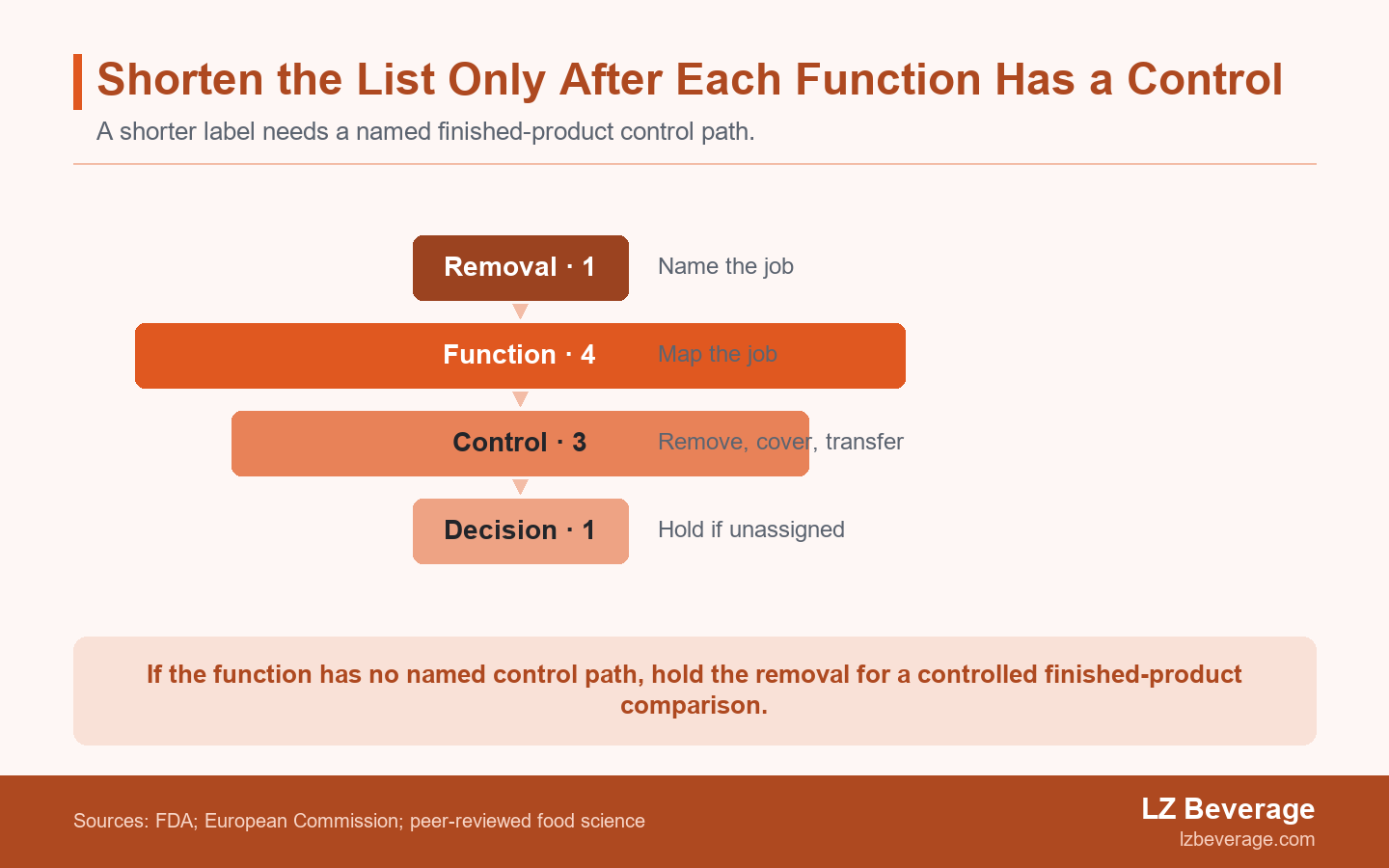
Map the Function Before You Remove the Ingredient
FDA identifies preservatives, stabilizers and thickeners, and pH control agents as distinct ingredient-function categories, including uses relevant to beverages. Its ingredient-function guidance is a useful reminder that a label name can signal a separate technical job; it is not a beverage formula template.
A control path is the named formula, process, pack, or storage measure that keeps a required function under review. The most productive map uses the function as the row and the evidence needed for the proposed change as the next column. Start with the actual finished drink, not a generic category label such as sparkling, juice, energy, or RTD.
| Question after a proposed removal |
What the team should name |
What not to assume |
| What job did the component perform? |
Acidity, preservation, dispersion, texture, flavor, color, or another finished-drink role |
That one ingredient has only one function |
| Where will that job be controlled now? |
Design change, existing component, formula setting, process, pack, or storage condition |
That a shorter label is the control itself |
| What configuration will be compared? |
Formula version, process route, pack, storage condition, and observation plan |
That bench appearance alone represents a finished product |
| What is the market boundary? |
Target destination, required label information, and claim question |
That an ingredient change creates a permitted claim |
For each proposed removal, the function must be eliminated, covered by an existing component, or transferred to a named formula, process, pack, or storage control. This three-path rule is a decision aid, not a declaration that the resulting drink is stable. It gives every stakeholder the same language for asking what changed and what remains to be observed.
For an early feasibility discussion, LZ Beverage can use this map as a shared working document: it helps turn a broad simplification request into specific questions about formulation, filling, packaging, and export coordination. The value is not a promise that every change can be made. It is a clearer starting point for identifying where a proposed change needs technical, market, or operational review.
The “eliminated” path is often overlooked. If a redesigned beverage no longer needs a particular cloud, texture, or flavor-protection outcome, that is a product-design decision and should be recorded as such. The “covered” path needs a clear explanation of which existing component now performs the job and why that is plausible in the finished formula. The “transferred” path needs the most discipline because the functional outcome is being carried by several conditions together. For a team comparing formats or evaluating later development work, it can be useful to review RTD beverage format options with those conditions in mind rather than assuming that one route transfers unchanged across products.
The fourth outcome is the one that protects the project: unassigned. An unassigned function is not a failure of the short-list ambition. It is a signal to pause the claim that the removal is ready, document the gap, and design a controlled comparison. That is usually cheaper and clearer than discovering after a pilot that the team cannot explain which difference drove an observation.
Move the Function Into a Named Control Path
A short list can still support a sophisticated beverage, but the relevant controls must be stated as a finished-product system. “We will use process” is too vague. A usable record names the formula version, the intended process route, the pack, the storage question, and what feature will be observed. That approach also keeps a change from being misread as a blanket preservation, claim, or compliance conclusion.
Research on clean-label preservation alternatives is active, yet an peer-reviewed preservation review does not establish one universal replacement route for beverages. A natural-sounding or shorter-listed option may deserve evaluation, but it does not remove the need to identify the function, product context, and evidence route.
European Union nutrition claims are permitted only when the listed conditions of use are met, so an ingredient change does not by itself establish a nutrition claim. The European Commission’s nutrition-claim conditions make that boundary explicit. Marketing language should therefore enter the brief as a question for the applicable product and destination, not as an assumed benefit of the shorter list.
When the product concept changes substantially, the team should not force a familiar control path onto a new format. It is more useful to compare beverage format options and ask which formula, filling, pack, and storage assumptions actually remain comparable.
Acidity and Process Are Controls, Not Label Shortcuts
For the FDA acidified-food category, finished equilibrium pH of 4.6 or below and water activity above 0.85 are part of the defined scope. The FDA’s acidified-food regulatory information is a scoped U.S. example, not a universal process instruction for every beverage.
The practical lesson is more important than the threshold by itself: acidity, water activity, heat treatment, package integrity, and storage can be linked in the control logic, but none of them is a generic label substitute. A buyer asking whether an acidulant, preservative, or processing statement can disappear should expect the answer to depend on the completed configuration and applicable requirements. The formulation brief should specify the intended route and record what is being compared, rather than attaching a universal meaning to one pH value or one processing word.
That distinction also improves communication across teams. Commercial, regulatory, and operations colleagues can discuss the same removal without assuming that a development observation is a market authorization or that a label preference determines a safe process. The record needs enough context for the right specialists to evaluate the relevant product and market.
Physical Stability Still Belongs to the Finished Drink
Food emulsions can destabilize through coalescence, Ostwald ripening, flocculation, and phase separation, and beverage systems respond to formulation and processing conditions. A food-science review of emulsion stability describes these mechanisms and the relevance of formulation and processing variables. This does not mean every beverage is an emulsion or will fail in the same way; it means a simple ingredient count cannot predict physical behavior.
For a beverage that contains a dispersed phase, cloud, protein system, pulp, or other texture-sensitive feature, the observation plan should remain tied to the finished formula. A bench sample may look acceptable and still leave unanswered questions about processing exposure, the actual pack, or storage behavior. A retained sample is a packed sample held under a named condition for planned evaluation. Retained samples are useful only when their formula version, pack, and condition can be related back to the decision being made.
Instead of asking whether a shorter list is “safe” in the abstract, ask what must remain uniform, what must remain sensorially acceptable, and what conditions could change those outcomes. The answers define a comparison plan. They do not promise a result before the appropriate finished-product work has been completed.
When a Late Simplification Creates a Separate Pilot Decision
The revised pilot group needs configuration-matched interpretation. A late change can be commercially sensible, but it changes the evidence question: the team is no longer reviewing one undifferentiated pilot. It is reviewing at least two configurations, each of which needs its own traceable record.
In the disclosed scenario, a late ingredient removal creates a changed pilot subset that must be compared as its own configuration. The example below is illustrative only; it does not describe a client project, a production result, a required process, or a shelf-life outcome.
Illustrative Scenario: A 12,000-Can Citrus Soda Pilot With a Late Ingredient Change
A product development manager is preparing a citrus sparkling beverage for two export markets and wants a shorter ingredient list before the first pilot. The buyer has a sensory direction and a can format in mind, but the request is not framed as a new formula from the beginning. It is framed as a late simplification of an ingredient statement.
For this illustrative example, a 12,000-can pilot is split into three 4,000-can groups after bench samples, pack review, and a provisional process outline. The purpose of the split is to preserve a clear comparison, not to prove that any group is commercially ready.
The formula is ready for pilot review, but it is not ready for a final market, claim, or shelf-life decision. The affected scope is 1 citrus sparkling formula, 1 can format, and 3 controlled pilot configurations.
The team removes one clouding-system component from the late formula revision because it complicates the ingredient statement. Before doing so, the group writes the affected finished-drink role in the function map rather than merely recording “remove ingredient.” That step makes the technical question visible: is the desired cloud or dispersion outcome being eliminated, covered elsewhere, or transferred into another named control?
Only the final 4,000-can group uses the revised component system. The other two groups retain the prior configuration and matched records. This does not make the two retained groups a universal control for every beverage; it simply preserves a traceable subset for this disclosed pilot design.
The change is not evidence that the new short list is better or worse. It creates a changed subset whose function, process record, pack, and storage comparison must be kept separate. Pooling observations across all three groups would blur the central question because one group no longer represents the same composition and control logic as the other two.
The team assigns a formula revision identifier to each group and records the pH observation, intended process route, can format, and planned storage conditions alongside it. It also states what it will observe in the finished drink, such as visual uniformity, settling, color, carbonation impression, or other product-specific features. A record with these elements does not validate the product; it makes later interpretation possible.
The three-path rule gives the team a disciplined next action. If the original function was removed from the product design, it records that decision. If an existing component covers it, the team names the component and why it is expected to cover the role. If the function now depends on a formula, process, pack, or storage control, that relationship is specified. If none of those statements is credible, the revised group remains an unassigned removal and should be held for a controlled finished-product comparison.
The revised group can inform the next formula decision only when a matched comparison identifies both the changed function and the named configuration. That gate prevents a promising early sample from being used as a broader label, process, or compliance conclusion. It also gives the OEM/ODM conversation a concrete packet: what changed, which group changed, what evidence is being sought, and what boundary remains open.
This example does not prescribe a clouding ingredient, process schedule, label claim, shelf-life duration, or release decision. Actual requirements depend on the finished product, target market, technical evaluation, and applicable review.
Give an OEM/ODM Partner a Function Map, Not a Vague Clean-Label Request
A function map is suitable input for a discussion of custom formulation, filling, packaging, and export coordination. It gives a prospective partner something more actionable than “make it clean label” or “remove this item.” For an OEM/ODM feasibility brief, include the beverage type, target markets, taste direction, proposed ingredient constraints, pack, storage question, expected volume, and the function-control map for each sensitive change.
For EU prepacked foods, the list of ingredients is one of several mandatory particulars that also include allergen information, date marking, storage information, and nutrition declaration. The European Commission’s mandatory-information overview is a useful reason to bring the destination and the whole brief into the discussion, rather than treating a shorter ingredient list as the only market-readiness task.
For LZ Beverage discussions, this information can support a focused conversation about custom formulation, filling, packaging, and export coordination. It does not guarantee feasibility, stability, market approval, or a particular label claim. Before sharing a technical request, buyers can review LZ Beverage manufacturing background and then assemble the decision record around the real product constraints.
Before an OEM/ODM conversation, convert the function map into a compact review sheet. State the finished beverage category and intended drinking experience. List the proposed deletions and their original jobs. For each one, mark whether the job disappears by design, remains covered by another component, or moves to a formula, process, pack, or storage condition. Then identify the exact question that should be answered by the next development stage.
Add the target markets rather than describing the project as “export-ready.” A country or region can change the information that must be prepared, the claim question that needs review, and the sequence in which commercial and technical colleagues need to work. Record the chosen pack in the same sheet. The container is not just a late purchasing detail when the development question involves carbonation, light exposure, oxygen management, headspace, transport, or storage. The aim is a truthful description of the configuration being discussed, not a generic promise that one can, bottle, or carton fits every short-list concept.
Finally, define the next evidence step in one sentence. It might be an initial feasibility discussion, a bench screen, a pilot comparison, a packaging review, or a market-specific label question. Naming the next step prevents the brief from silently claiming that all questions have been solved. It also allows the commercial team to distinguish a useful development conversation from a commitment about launch timing or final product performance.
A concise brief should finish with one open question that the development work must answer. For example: “After this component is removed, which named control path will support the intended finished-drink function in the selected can and storage route?” That question is more useful than a generic request for fewer ingredients. Teams that want more category context can review beverage manufacturing insights.
Common Questions
Short-list formulation questions need a finished-product boundary rather than a universal ingredient rule. The following answers are practical starting points, not a substitute for product-specific technical or market review.
Does a shorter ingredient list mean a beverage is clean label?
No, a shorter list may be easier to read, but it does not by itself define a clean-label position or prove finished-product stability. “Clean label” can mean different things to different buyers and markets. A useful project brief therefore describes the intended consumer-facing position separately from the function map, market requirements, and evidence needed for the finished product.
Can pasteurization replace a preservative in every beverage?
No, a thermal process is only one possible control, and its relevance depends on the finished formula, pack, storage route, and applicable requirements. It should not be treated as a universal label shortcut. When a preservation-related component is changed, the decision record should identify the product-specific process question and the comparison needed to assess the finished configuration.
Which changes need a new stability comparison?
A new comparison is warranted when a change alters a function that affects acidity, preservation, dispersion, texture, flavor, color, or the formula-pack-storage configuration. The trigger is functional, not merely editorial. If the team cannot state whether the function has been eliminated, covered, or transferred to a named control, the change is a strong candidate for a defined comparison rather than an assumption.
What should a buyer send before requesting an OEM sample?
Send the beverage type, target market, proposed ingredient constraints, desired taste, pack, storage question, expected volume, and any known function map. Also state what changed from the prior concept, which outcomes matter most, and what evidence the team wants from the next stage. That package helps an OEM/ODM partner discuss practical options without turning an early request into an unsupported promise.


