A yuzu drink needs separate decisions for aroma, acidity, sweetness, and carbonation. Treating all four as one "citrus flavor" decision is how a promising bench sample turns into a canned drink that is sharp but anonymous, fragrant but short-lived, or pleasant before carbonation and confused after it. The first formulation choice is therefore not a flavor house or an acid level. It is the sensory job yuzu must perform in the finished drink.
A Yuzu Drink Needs Four Decisions, Not One Citrus Note
Start by separating what the drink should smell like from what it should feel like on the tongue. Aroma architecture is the planned relationship among yuzu, companion notes, and the finish; it answers whether the drink reads as peel-like, floral, juicy, tea-lifted, or bright and dry. Acidity answers how the first sip arrives. Sweetness decides whether that tartness resolves cleanly or lingers as a blunt sour-sweet note. Carbonation changes the final sensory setting, so a sparkling concept cannot be approved from a still sample alone.
A workable development request names those roles before anyone proposes an ingredient list. For example: "yuzu-led peel aroma, green-tea middle, crisp acid entry, lightly sweet finish, medium sparkle in a slim can." That statement is not a recipe. It is a testable direction that helps a product team reject samples that are technically balanced yet no longer taste recognizably yuzu.
The Brief That Keeps Yuzu Distinct
A useful yuzu brief names the aroma role, acid entry, sweetness finish, and finished-pack condition. It should also state the drink base, the companion flavor's job, the intended market, and the decision that the first sample must answer. Those details keep a request for "fresh yuzu" from becoming a collection of unrelated interpretations.
- Define yuzu's role: lead aroma, bright top note, bridge between tea and citrus, or a dry peel finish.
- Give the companion flavor one job: add body, add warmth, lengthen the finish, or soften bitterness without taking the headline.
- Describe the sip in order: first-sip acid impression, middle flavor, and aftertaste.
- Name the finished condition: still or sparkling, pack type, serving expectation, and markets to be reviewed.
The distinction matters because a yuzu drink can be "balanced" by a general tasting score and still miss its commercial identity. A team that can point to the lost role—rather than merely saying the sample is "not bright enough"—can make a more useful revision request.
Start With the Job Yuzu Must Do
Yuzu juice research identifies limonene, beta-phellandrene, and gamma-terpinene among odor-active components associated with yuzu juices. In a study of yuzu juice volatiles, those components help show why yuzu should be treated as a distinct aromatic layer rather than as a generic lemon-like cue. That evidence does not prescribe a flavor source or dose; it does support giving yuzu an explicit aromatic target before acid and sweetness are tuned around it.
There are four common roles. A yuzu-led soda makes peel freshness the first recognition point. A tea-led drink uses yuzu to lift a leafy or roasted middle. A ginger pairing uses yuzu to sharpen the entry and keep warmth from becoming heavy. A light botanical direction uses yuzu as a clean connective note, so the finish does not become perfumed. Each can work; the error is allowing two lead flavors to compete for the same moment in the sip.
For an early conversation about a canned concept, LZ Beverage's review RTD beverage format options can help frame the intended format alongside the yuzu role. The format does not choose the flavor direction, but it affects which finished sample is relevant enough to judge.
Separate Aroma Identity From the Acid Spine
Aroma identity and acid intensity should be briefed separately because they answer different sensory questions. The yuzu aroma answers, "What fruit character does the drink present?" The acid spine is the sourness structure that shapes the first sip and carries the flavor forward; it answers, "How quickly and how firmly does the drink arrive?" A higher acid impression can make a drink seem brighter without making its yuzu aroma more recognizable.
This is especially important when a bench sample has a convincing fresh-citrus aroma but loses definition once it is cold, carbonated, or sweetened. Raising acidity may restore impact, but it can also push the drink toward a generic tart profile. Ask tasters to record aroma recognition before the sip, acid onset during the sip, and the character left after swallowing. Those observations identify whether the revision belongs in aroma, acid, or both.
Choose a Companion Flavor With a Defined Job
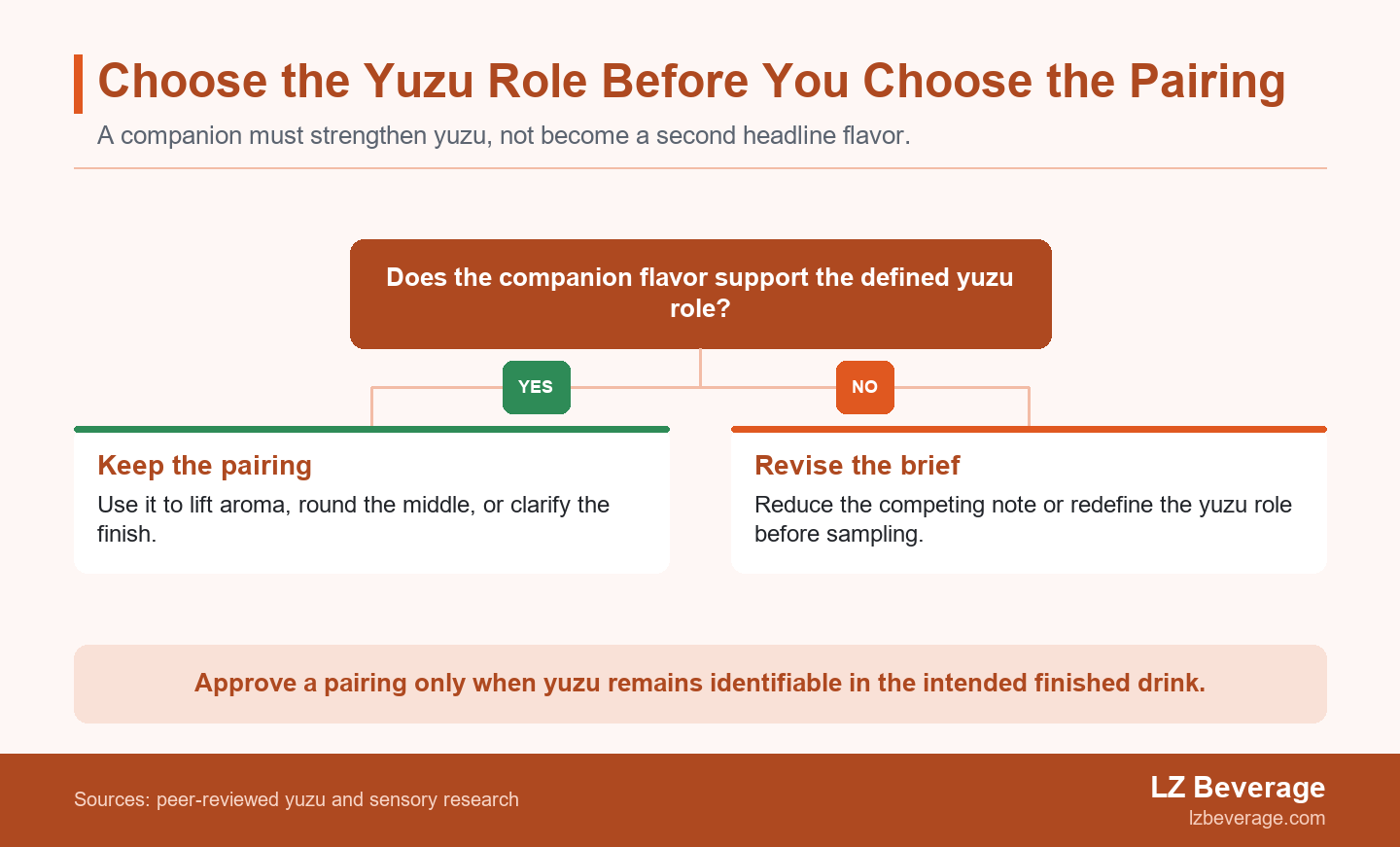
A peer-reviewed yuzu beverage-development study used sensory attributes in its formulation optimization. The Citrus junos beverage study is a useful reminder that sensory evaluation belongs in the formulation decision, not only at the end of it. A pairing should therefore begin with a sensory question: what does the companion note need to improve while yuzu remains identifiable?
A pairing is useful when it supports a named yuzu role rather than adding an unrelated second headline flavor. Green tea can provide a dry middle that makes the citrus aroma feel more composed. Ginger can give a warm lift and extend the finish, but it needs a clear rejection point: if the drink is first recognized as ginger, the yuzu role has been displaced. White peach or pear can add roundness in a softer direction, while herbs such as rosemary require careful restraint because they can make the peel note read medicinal.
| Companion direction |
Useful job |
What to check in the finished drink |
| Green tea |
Gives the middle a dry, structured feel |
Yuzu remains noticeable before the tea finish |
| Ginger |
Adds warmth and a longer finish |
Warmth does not become the lead identity |
| White peach or pear |
Rounds the middle and softens the edge |
The drink does not become a generic sweet fruit beverage |
| Light botanical note |
Adds lift or a clean finish |
Herbal character does not mask peel freshness |
Write the acceptance rule beside the pairing. "Yuzu is still identifiable on the first nose and after the swallow" is a better decision rule than "make it more premium." It gives the team a reason to keep, reduce, or replace the companion note during sampling.
Build Acidity and Sweetness as a Tasting Sequence
A consumer study of sucrose-citric acid mixtures found that sweetness suppressed sourness perception, with the degree varying by consumer cluster. The sweet-and-sour mixture research matters because a sweetness adjustment can change what a taster believes the acid is doing. It does not choose a sugar level for yuzu, but it is a reason to compare acid and sweetness changes as a controlled sequence rather than assume a sweeter version preserves the same citrus identity.
A yuzu beverage should be tuned as an entry, middle, and finish rather than by sweetness alone. First decide whether the opening should be crisp, rounded, or quietly tart. Then judge whether the middle still carries the yuzu and companion relationship. Finally, ask whether the finish is clean, slightly peel-bitter, warm, or cloying. A change is useful only if it improves the intended stage without damaging the others.
Set the Acid Entry Before You Soften the Finish
Start with the first-sip instruction. "Bright but not biting" is still vague; "clean, immediate acidity that clears before the tea note develops" gives tasters a sequence to assess. Compare a small acid adjustment against the same aroma system and ask a narrow question: does yuzu arrive sooner, or does the drink simply become more sour? If the latter is true, the acid change has not solved the aroma problem.
Hold the companion flavor constant for this comparison. A warm ginger note can make acid seem more pronounced, and a rounded fruit note can make the same acid feel softer. Changing both at once creates a result that may taste acceptable but cannot tell the team which lever created the improvement. Keep the sample record focused on the first-sip impression, the point at which yuzu is recognized, and any bitterness that appears after the acid drops away.
Use Sweetness to Resolve, Not Erase, the Finish
Sweetness is most useful when it settles the finish after the acid has done its job. In a yuzu drink, it can support juiciness, take the hard edge off peel bitterness, or give a tea-led concept enough body to avoid feeling watery. It cannot reliably substitute for a missing aroma or a poorly defined acid entry.
Run a lower-sweetness and a reference-sweetness sample in the intended beverage base. Look for four outcomes: yuzu clarity, bitterness, length of finish, and the point at which the drink begins to feel thin. If the lower-sweetness sample loses only body, a middle-note or texture decision may be needed. If it loses yuzu recognition, revisit the aroma and acid relationship before adding more sweetness.
Treat Carbonation as Part of the Flavor System
Carbonation research reports that carbonation level can modulate sweetness perception, aroma, and overall liking. A recent sensory study of carbonated beverages gives a practical reason to make the decisive comparison under the intended carbonation condition. It does not set a carbon dioxide target for yuzu, but it makes a still-bench approval an incomplete signal for a sparkling can.
Use a finished-pack comparison: a comparison of samples in their intended formula, container, and serving condition. Taste cold cans with the proposed headspace and carbonation, then compare them with the same flavor direction under any alternate sparkle level being considered. Listen for a change in aroma lift when the can opens, but judge the drink after the first sip as well. A highly sparkling sample may feel exciting at opening yet compress sweetness or shorten the fruit impression in the mouth.
For a sparkling yuzu drink, record whether carbonation improves the peel top note, makes the acid too aggressive, or causes the companion flavor to disappear. That record gives a product team a concrete reason to adjust the flavor system or the carbonation condition before treating the formula as ready for a wider pilot.
Scale-Up Needs Formula Identity, Not Just Matching Numbers
The mixed pallet groups need population reconstruction before the team can interpret a pairing result. That is an identity problem, not a Brix or pH problem: values may match across cans while the yuzu aroma system inside them does not. When one finished group may contain more than one pairing configuration, pooled sensory notes and stability observations no longer answer a clean formulation question.
A pilot needs traceable formula identity because matching Brix and pH records cannot prove which yuzu sensory system reached a finished can. Before a pilot, link each flavor configuration to a defined blend record, a finished-can or pallet identifier, and retained samples from that configuration. Teams comparing beverage categories or pack formats can compare beverage categories and formats while keeping that identity requirement intact.
Illustrative Scenario: A Shared Blend Tank Creates Two Yuzu Identities
This is an illustrative development scenario, not a client project or production result. A product development manager is preparing a sparkling yuzu drink for two markets and wants to compare a tea-led pairing with a ginger-led pairing before a wider launch. Both directions passed a bench review because each had a clear yuzu role: tea was meant to create a dry middle, while ginger was meant to add a restrained warm finish.
The pilot covers 18,000 cans in three 6,000-can runs. Its scope is 2 yuzu pairing systems, 1 shared blend tank, 1 slim can format, and 2 mixed pallet groups. The scale is large enough for the team to want meaningful finished-can observations, but it is still a development pilot rather than evidence of market, process, shelf-life, or label approval.
The product is ready to compare two sensory directions in finished cans. It is not ready for a commercial release decision, because the desired outcome is narrower: determine which pairing holds the yuzu identity more clearly under the intended sparkling condition.
The tea-led and ginger-led variants are cleared as bench directions, but the final blend record does not show where the switch between aroma systems occurred. The first 6,000-can run is known to be tea-led. After that, the team knows that the shared tank was changed over, yet the record does not connect a specific change point to the remaining finished cans.
Two pallet groups carry the same can code. Retained samples identify the intended pairing only for the first 6,000-can run. A cold tasting suggests that one of the mixed groups has more warmth and another feels drier, but those sensory impressions cannot establish which exact cans represent the ginger-led or tea-led configuration.
Brix and pH records may still look consistent, but they cannot reconstruct the intended yuzu identity. The concern is not that either pairing is automatically unsafe or unacceptable. The concern is that the finished population cannot be tied reliably to the sensory direction being evaluated, so a pooled score would blend two different questions: whether tea supports yuzu and whether ginger supports yuzu.
The team holds the two mixed pallet groups as development material, keeps the known first run as a separate tea-led reference, and does not pool tasting or stability observations across unidentified configurations. This loses some pilot time, but it avoids selecting a pairing based on results that cannot be assigned to one formula identity.
For the next pilot, the team records the aroma-system changeover, assigns distinct finished-can or pallet identifiers to each pairing, and matches retained samples to those identifiers. The sample plan then records the same serving condition for each configuration, so carbonation and temperature do not become a second source of uncertainty.
The next comparison can inform a formula choice only when each can group can be traced to one yuzu pairing, one finished-pack condition, and the planned sensory review. At that point, a lower score for the ginger direction would mean something actionable: revise its role, reduce its prominence, or retain the tea-led direction for the next development decision.
The example does not prescribe an ingredient, process schedule, label statement, or commercial release decision. It shows why a pilot needs an identifiable formula configuration before the team treats finished-can observations as evidence for a yuzu pairing choice.
Keep Market Review Separate From the Flavor Brief
FDA defines acidified foods within a specific scope that includes finished equilibrium pH of 4.6 or below and water activity above 0.85. Its acidified and low-acid canned foods information is a boundary, not a recipe for a yuzu beverage. The finished formula, water activity, process, container, and destination market determine what review is needed; a sensory target should never be mistaken for a process or regulatory conclusion.
European Commission guidance describes specific safety, approval, and labelling requirements for flavourings, including use of the term natural. The EU rules on flavourings make the same practical point for an EU destination: a yuzu concept and its label wording need to be reviewed against the finished formulation and the market rule, not inferred from the presence of a citrus ingredient. Confirm the applicable requirements with the responsible regulatory and technical parties before commercial use.
Build market review into the request from the start. State the destination countries, proposed product name and any flavor wording, the can format, and whether the drink is still or carbonated. Those details help separate a sensory-development discussion from the distinct work of evaluating a finished product for a specific market.
Give an OEM/ODM Team a Yuzu Brief They Can Evaluate
A scoped yuzu brief is suitable input for a discussion of custom formulation, filling, packaging, and export coordination. An OEM/ODM feasibility brief is a concise product, market, pack, and sensory summary used to assess manufacturing feasibility. It is not a promise that a formula, shelf life, claim, or market clearance has been approved; it gives the manufacturing conversation a defined product to evaluate.
- Product: beverage base, still or sparkling status, yuzu's role, companion flavor, and the required sensory sequence.
- Pack: can type and size, expected serving condition, and any packaging constraints already known.
- Market: intended country or countries, proposed flavor wording, and questions that require market-specific review.
- Sample decision: the one comparison the sample must resolve, such as tea-led versus ginger-led yuzu in a cold sparkling can.
- Commercial context: expected volume, timing, and whether the request is for formulation exploration, a pilot, or a finished-pack comparison.
That level of specificity lets a manufacturer respond to the actual development question instead of guessing what "premium yuzu" means. For a yuzu concept within LZ Beverage's stated scope, the same brief can support a bounded discussion of custom formulation, filling, packaging, and export coordination. Before sharing a technical brief with a prospective partner, buyers can review LZ Beverage manufacturing background.
When the sensory target and market context are still moving, list the open decisions rather than hide them. Identify whether a sample is meant to compare tea and ginger, reveal a lower-sugar boundary, or show how carbonation changes the chosen yuzu role. That gives the next sample a single job and prevents a collection of attractive but incomparable cans.
Keep the feasibility request honest about what is not yet known. A product team may know the desired profile while still needing to decide the final flavor source, sweetness system, carbonation condition, or market wording. Record those points as questions for evaluation. Separating known requirements from open questions is more useful than presenting a preliminary direction as a finished specification.
The commercial context also affects the kind of response a team needs. Expected volume, target launch timing, can format, and destination countries can change which sample path is practical. Include them alongside the sensory sequence, but do not turn them into assumptions about feasibility. The purpose of the first exchange is to establish whether the defined product direction can be assessed within the relevant manufacturing and market constraints.
Use the same discipline when comparing feedback from different functions. Product development may be deciding whether the yuzu aroma is clear enough, operations may need to understand the requested can format, and regulatory reviewers may need the intended wording and destination market. Those are connected questions, but they should remain separately visible in the request so a response to one is not mistaken for a completed answer to another.
For additional product-development context, review beverage development insights before sampling.
Common Questions
Residual yuzu formulation questions need a finished-product and market-specific boundary. The answers below help narrow a flavor-development choice; they do not set universal ingredient levels, process conditions, or label terms for every canned yuzu drink.
Is yuzu better as the lead flavor or a supporting note?
Yuzu works best as the lead flavor when its aroma remains identifiable after the intended acid, sweetness, and carbonation choices are set. Use it as a supporting note when another flavor genuinely owns the product identity and yuzu's job is to add lift, peel freshness, or a cleaner finish. The decision should come from a finished-can comparison: if yuzu is present only in the concept name but not in the sip, it is neither a useful lead nor a useful support note.
Can a yuzu drink use less sugar without tasting thin?
Yes, but the lower-sugar version must be compared for acid entry, aroma clarity, bitterness, and finish in the intended finished beverage. Less sweetness may reveal yuzu peel character more clearly, but it can also expose harsh acid or leave a tea-led drink without enough middle. Test a reference and a reduced-sugar sample under the same carbonation and temperature. If the difference is mainly body, revisit the middle and finish before assuming more sweetness is the only solution.
Should carbonation be decided before flavor sampling?
For a sparkling concept, carbonation should be represented in the decisive sample stage because it can change how sweetness, aroma, and overall balance are perceived. Early still samples can be useful for narrowing broad flavor directions, but the choice between close yuzu pairings should be made in a cold, finished-pack condition. Otherwise the selected aroma and acid balance may not be the one that performs best once the can is opened and served.
What should be confirmed before requesting a yuzu OEM sample?
Confirm the beverage base, yuzu role, pairing direction, target market, pack, sweetness target, expected volume, and the finished-product question the sample must answer. Add whether the drink is still or sparkling and describe the desired first sip, middle, and finish. This gives the sample a purpose: it might compare two companion directions, test whether a lower-sugar version still carries yuzu, or show how a cold carbonated can changes the intended aroma.


