The profile should use separate fruit and aromatic roles before intensity is tuned. The strongest kumquat kaffir lime beverage concepts do not treat the two citrus notes as a single flavor. Let kumquat establish the fruit body that a drinker can recognise, then let Citrus hystrix provide a deliberate aromatic lift: the high, fresh smell that arrives before the fruit body. When those roles, acidity, sweetness, and sparkle are all changed together, the team cannot learn what made a sample better or worse. A useful brief separates the jobs first and tests the finished drink second.
A Kumquat and Kaffir Lime Drink Needs Two Roles, Not One Citrus Note
A regional citrus cue can be commercially appealing yet still be too vague for product development. “Kumquat and lime” leaves open whether the drink should smell leafy, taste peel-forward, finish dry, feel soft and rounded, or deliver a sharp sparkling first sip. Each answer points to a different sample conversation. The working rule is simple: name the fruit identity, name the aromatic lift, and state what must remain recognisable when the can is cold and carbonated.
This is not a call to make either note louder. It is a way to preserve diagnostic value. If kumquat disappears after a leaf-like top note is adjusted, the product team can decide whether to reduce that lift, reframe the fruit role, or change the base. If the two notes were only recorded as “citrus,” the same change becomes a matter of opinion instead of a decision with a visible cause.
What Must Be Decided Before You Ask for a Sample
A useful first brief names fruit role, aromatic role, acid, sweetness, sparkle, format, market, and sample decision. It does not need a universal recipe. It needs a shared definition of what the team is trying to protect and what it is willing to trade away.
- Keep kumquat recognisable through the middle of the drink.
- State the exact job of the Citrus hystrix note.
- Judge the decisive versions cold and carbonated when the product is sparkling.
- Name the market and the decision the first sample must make possible.
| Brief element |
Decision to record |
What it prevents |
| Kumquat role |
Fruit-led, peel-bright, or a rounded middle note |
A generic citrus base that no one can recognise later |
| Citrus hystrix role |
Leaf-like lift, peel-like edge, or a short aromatic finish |
An undefined “lime” note that overtakes the fruit |
| Acid and sweetness |
First-sip sharpness and finish direction |
Using extra sweetness as the only correction for a sour or bitter sample |
| Sparkle and serve |
Still or sparkling, plus the intended cold serving state |
Approving a bench sample that does not resemble the drink in market |
| Sample decision |
What the tasting must prove or eliminate |
Collecting versions that cannot guide a next step |
For example, “a bright Southeast Asian citrus drink” is a concept description. “A sparkling, kumquat-led drink with a clean leaf-like lift, a dry finish, and a test of whether fruit identity remains clear in the final can” is a sample decision. The second statement gives formulation, packaging, and commercial teams a common question to answer.
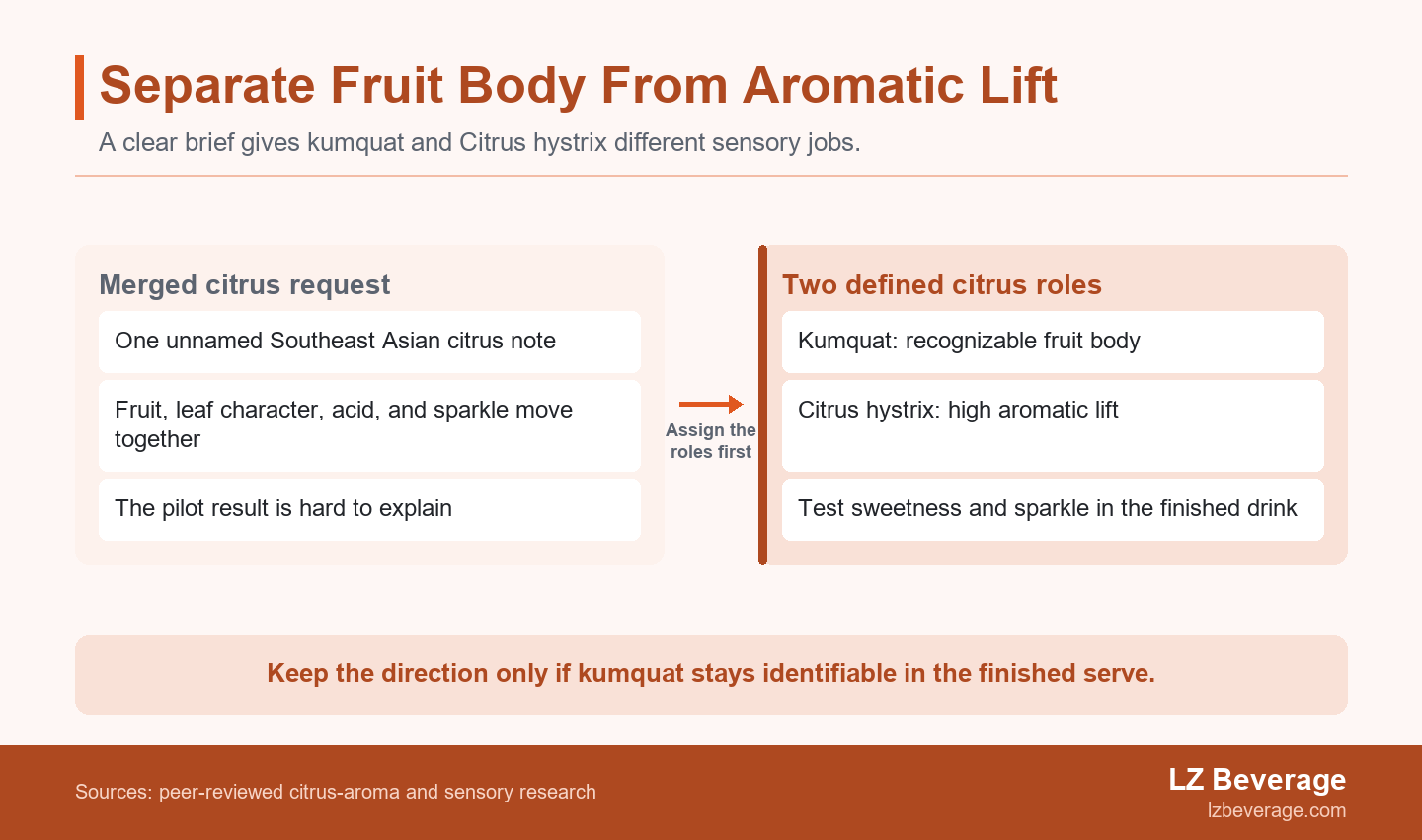
Give the Two Citrus Notes Different Jobs
Separating kumquat fruit body from Citrus hystrix aromatic lift makes later sensory changes diagnosable. Kumquat fruit body means the rounded, recognisable citrus impression that should stay present through the middle of the drink. The second role is the high, fresh smell that arrives before the fruit body and makes the profile feel more open. The two roles may be complementary, but they should not be written as one control.
Start by asking a binary question: if a taster notices only one named citrus after a cold sip, which one must it be? If the answer is kumquat, the Citrus hystrix direction is supporting lift. If the answer is an herbal, leaf-like lime character, the team may be developing a different product and should say so. This avoids a common sample loop in which more aroma is added to solve a weak fruit middle, then more sweetness is added to soften the result.
The role split also creates a clean rejection criterion. A candidate is not accepted merely because it is vivid. It is accepted when the drink still has a named fruit identity and the aromatic lift does one specific job: open the nose, sharpen the transition into the sip, or clean up the finish. If it becomes a second headline flavor, return to the brief instead of masking the conflict with a sweeter base.
Let Kumquat Carry the Fruit Identity
A peer-reviewed kumquat peel essential-oil study reports a distinct chemical profile with limonene among the dominant components, supporting a named fruit-aroma role. The cited research record does not prescribe an ingredient level or guarantee a finished beverage flavor. It gives a sound reason not to treat kumquat as a generic citrus substitute when writing the sensory target.
In the brief, describe the job in drink language rather than compound language. The team may want an immediate whole-fruit recognition, a slightly warmer peel impression through the middle, or a fruit note that remains visible after carbonation. It may also decide that a pronounced peel edge is not wanted. Those are useful choices because they tell the sampler what to listen for, and they keep “more kumquat” from becoming the only available response.
A practical test is to remove the supporting lift from one comparison sample without otherwise changing the target serving state. If the remaining drink has no clear fruit identity, the kumquat role has not yet been defined strongly enough. If it remains recognisable but dull, the support note has a legitimate job. This is a decision aid, not a demand that every development round use the same protocol.
Use Citrus hystrix as Lift Rather Than a Substitute for the Whole Profile
Citrus hystrix evidence supports treating leaf-like aroma separately from juice acidity and fruit body. A study of its aroma and juice describes the leaves as the main aromatic part used in food, while describing the juice as extremely tart and often bitter. The formulation implication is bounded: write the leaf-like aromatic direction separately from the fruit-body and acid decisions. The study does not select a beverage ingredient form, dose, or final formula.
That distinction matters because “lime” can hide three different requests: an aromatic green note, a peel edge, or a sharp acid impression. A sample may be technically coherent and still fail the intended profile if the team expected the first while receiving the third. Put the preferred language into the brief: for example, “leaf-like lift above kumquat fruit body” or “short peel-like lift with no lingering green bitterness.” The wording should be sensory and observable, not a list of assumed raw materials.
Choose the finish rule as carefully as the opening aroma. An aromatic lift can make the first nose more expressive but leave the fruit feeling thin if it persists too long. A short, clean finish may serve a sparkling refreshment concept; a longer leaf-like finish may belong in a more adult, culinary direction. Neither is inherently better. The relevant question is whether it supports the kumquat role the brief already named.
Taste Sweetness, Sourness, and Sparkle as One Finished Decision
Sweetness can suppress sourness ratings, while market background can affect aspects of sourness response. A cross-cultural sweet-sour perception study found that sucrose suppressed sourness ratings and that cultural background influenced aspects of sourness response. This does not tell a team which version will win in Southeast Asia or an export market. It does mean that a lower-sugar and a higher-sugar direction should be compared with the intended audience and not assumed to deliver the same citrus balance.
Set the sensory sequence before discussing correction. First, decide the desired acid entry: sharp and immediate, softer and rounded, or restrained. Next, decide what should happen after the first sip: should the kumquat stay visible, should the lift clear the palate, or should a dry peel edge remain? Only then compare sweetness directions. If a sweeter version is less harsh but also makes the fruit harder to name, it has solved one problem by creating another.
Carbonation can alter sweetness perception, aroma, and overall liking, so sparkling samples need finished-condition comparison. Research on carbonated beverage perception describes interactions among carbonation, sweetness, flavor, aroma, and overall liking. A still bench sample can be useful for early direction, but it should not settle a sparkling product decision. The decisive comparison belongs in the finished condition: the same cold, carbonated serving state in which the drink will be judged.
That is also where format enters naturally. A team evaluating a sparkling citrus concept with LZ Beverage can review ready-to-drink beverage formats alongside the sensory brief, then decide whether the intended format can carry the desired first-sip and finish behavior. This is a format-scoping step, not a promise that any particular profile will transfer unchanged.
The comparison plan can be kept simple. Two aroma-role options multiplied by two sweetness directions and two carbonation conditions make eight possible configurations. That is an illustrative planning map, not an instruction to make eight samples at once. Lock two variables in a round and compare the remaining two candidates under the same serving condition. The result is more useful because the team can say whether the preferred version won on fruit clarity, aromatic lift, acid entry, or finish rather than on an untraceable combination of changes.
Treat Aroma Variation as a Brief-Control Issue
Citrus hystrix leaf-oil variation by growing location supports recording aromatic-system versions for sensory interpretation. A study of Citrus hystrix leaf essential oil found that growing location affected oil yield and citronellal concentration in the examined oils. It does not prove that a finished beverage will shift by the same amount. It does support a more careful sampling habit: record which aromatic system and version reached the sample instead of assuming one product name is enough to explain a sensory result.
Call that record the formula identity: the information that shows exactly which aroma system and version reached a given sample. A useful record can be concise. It can identify the fruit direction, the aromatic lift direction, the base version, the intended serving state, and the sample date. Its purpose is not to create a laboratory-style report for every tasting. Its purpose is to make a later choice explainable when two cans with the same concept name do not smell or finish the same way.
For a team considering a manufacturing discussion, partner background matters alongside the brief itself. The product packet should still be checked against the actual market, packaging, and product requirements; the brief remains the source of truth for the sensory decision. Before sharing it, the buyer can review LZ Beverage's stated company scope.
When the Bench Sample and the Pilot Stop Being Comparable
The following is an illustrative development scenario, not a client case, production result, or shelf-life claim. It shows why a pilot with unmatched aroma-system records and a different tasting condition is not direct proof of bench-sample transfer.
An innovation manager is preparing a non-alcoholic sparkling drink for a regional launch and a later export discussion. The approved bench direction is kumquat-led, with a short Citrus hystrix lift that should be noticeable on the nose but should not replace the fruit through the middle of the sip.
The commercial-style pilot is 24,000 cans in four 6,000-can runs, using one 330 mL sparkling-can format. This number is only the scope of the example. It is included to show that a sample-record gap can affect more than one tasting cup once a concept moves beyond bench work.
The bench team has a kumquat-led reference sample, but it has not agreed a final-can comparison protocol. The product is not yet ready for market, process, shelf-life, or label approval; it is ready only for a controlled flavor-transfer question.
First, the bench notes were taken from open samples, while the pilot was assessed from cold cans one day later. This changes the sensory condition being compared.
Second, the pilot record identifies the base formula but does not show which Citrus hystrix aroma-system variant reached each 6,000-can run. Neither observation proves that the drink is unacceptable, but together they prevent a clean claim that the approved bench character transferred to the finished can.
Matching base-formula readings cannot reconstruct the intended aromatic balance, and the change in tasting condition means the two scores answer different questions. The problem is not simply that a leaf-like note may be stronger or weaker. The problem is that the team cannot attribute the sensory difference to a named version under a matched comparison. Pooling all four runs would turn uncertainty into a false average.
The team does not call the pilot a confirmed transfer of the approved sample. It treats the pilot as a reset comparison and holds the next flavor-selection decision until the reference and finished-can conditions are matched. That is a conditional development decision, not a commercial release hold or a statement about the product's regulatory status.
For the next round, the team retains a labelled reference for the approved aromatic system, records the variant against each pilot run, and compares the reference and cold finished can with the same sensory questions: Is kumquat still identifiable? Does the lift arrive before, rather than replace, the fruit body? Does the finish remain within the intended direction?
The flavor decision can move forward only when the record identifies the aromatic system, tasting condition, and assessed run, and the named kumquat-first profile remains identifiable in the finished serve. The verification is about comparability, not a substitute for destination-market, process, or shelf-life review.
The example does not establish an ingredient dose, processing parameter, commercial capability, legal status, or finished-product outcome. It is a decision pattern for avoiding an unsupported “the pilot matched the sample” conclusion.
Keep the Flavor Brief Separate From Market Release Review
FDA describes a defined scope for acidified and low-acid canned foods, including pH, water activity, registration, and scheduled-process considerations for covered U.S. products. A sensory target is not a market classification. For products within its scope, the FDA guidance page uses finished equilibrium pH, water activity, establishment registration, and scheduled-process filing considerations. The page does not classify a proposed kumquat drink. It is a reminder to establish whether the actual formula, container, processing method, and U.S. market route fall within the relevant scope.
EU flavouring rules include general requirements, definitions, and specific labelling provisions, including rules around natural terminology. For an EU destination, the European Commission's flavouring rules overview describes those boundaries. The practical distinction is important: a team may prefer a particular aromatic direction while still needing a separate review of the finished formula and wording for the destination market. Neither flavor preference nor a research citation is market clearance.
Keep the handoff orderly. The development brief should state the intended market early, but it should not invent a compliance conclusion. The partner and the responsible regulatory reviewers need the actual ingredient documentation, final label language, pack details, and product context before a release decision. That boundary protects both the product concept and the buyer from treating an early sample as a finished-market promise.
Send an OEM/ODM Partner a Brief They Can Act On
LZ Beverage's documented scope makes a detailed citrus brief relevant to conversations about custom formulation, filling, packaging, and export coordination. A useful enquiry says what the drink should do and what the next sample must prove; it does not ask a partner to infer a complete product from “kumquat and kaffir lime.”
Start with the beverage base and intended format. Then name kumquat's job, the desired Citrus hystrix direction, the target market, the preferred sweetness and acid impression, the expected serving state, and the decision owner for the first sample. Add the expected volume only when it is known, and state the real sample question: for example, whether the kumquat remains recognisable after sparkling delivery or whether the leaf-like lift is too dominant in the finish. The same packet helps the team compare beverage categories and formats without assuming that one presentation suits every intended route.
That packet creates a more useful first feasibility conversation than a flavor name alone. Keep any packaging, ingredient, market, and label decision in the packet as a requirement to be checked, not as a completed approval. A formulation conversation becomes more efficient when the buyer distinguishes a sensory preference from a confirmed production requirement, and when the commercial team knows which question the next version must answer.
Before sending the brief, make sure the team can answer five practical questions:
- Which citrus must a taster be able to name after the first cold sip?
- What aromatic lift is wanted: leaf-like, peel-like, or another clearly described direction?
- What must remain fixed when sweetness or carbonation is compared?
- Which market and pack are in scope for the first discussion?
- What decision will the sample make possible: choose a direction, revise it, or stop it?
Those answers give custom formulation and packaging conversations a usable starting point while leaving production feasibility and market review where they belong: with the actual formula and documented requirements. They also make it easier to compare sensory feedback across departments, because the commercial team, product team, and partner are responding to the same named fruit role, aromatic role, market context, and finished serving state. When the packet is complete, the buyer can request a beverage development discussion.
Common Questions
The FAQ gives short bounded answers without adding a new formula, approval, or process claim. The remaining questions use the same boundary as the brief: choose sensory roles and comparison conditions first, then treat formula, process, and market release as separate product-specific decisions.
Should kumquat or Citrus hystrix lead the profile?
Let kumquat lead when the drink needs fruit recognition, and use Citrus hystrix as a controlled aromatic lift. Reverse that relationship only when the intended product is explicitly leaf-like or aromatic-led rather than fruit-led. The key is not which ingredient is more fashionable; it is whether the brief names the flavor a taster must recognise and the role the other note is allowed to play.
Can a lower-sugar kumquat drink still taste recognisably citrusy?
Yes, but the lower-sugar version needs a finished-condition comparison because it can change perceived sourness and expose peel-like notes. Compare it against the target sparkling serve, not only an open bench sample. If the kumquat is still clear and the finish matches the intended direction, a lower-sugar route may be viable for further work. If the fruit disappears, revise the role balance rather than assuming more sweetness is the only answer.
Are Citrus hystrix leaf and peel directions interchangeable?
No, they are not interchangeable. Write the requested aromatic direction into the brief instead of treating leaf and peel as one unnamed lime note. The difference matters because the buyer may be seeking a high, green aromatic lift, a sharper peel edge, or a short clean finish. A partner can evaluate a named sensory direction far more accurately than a broad ingredient label, and the result can be assessed against a clear acceptance or revision rule.
What should be in the first OEM sample request?
Include the product format, named citrus roles, sensory target, market, comparison condition, and the decision needed from the sample. Add any known pack preference, expected volume, and constraints without presenting them as final approval. For a kumquat kaffir lime beverage, the most useful first request says which note must lead, how the support note should behave, and how the finished drink will be judged when cold and sparkling.


