Treat color, acidity, and pairing as separate controls before requesting a hibiscus sample. Hibiscus color can be a powerful first signal, but a vivid red bench pour does not tell a product team whether the intended tartness, companion flavor, and finished serving condition will still express the same product idea. A useful brief gives each control a job, then asks the next sample to answer one defined question.
A Hibiscus Drink Needs Three Separate Controls
Start with a simple distinction. Color is the appearance the product must carry. Acidity is the tartness direction the drink should deliver. Pairing is the supporting flavor direction that gives the hibiscus a recognizable commercial identity. They influence one another, but they are not interchangeable. If all three move in the same sample round, a team may know that it likes one version more than another without knowing why.
This matters most when the brief will travel from a bench sample to a packaged drink. A berry-led hibiscus concept can be attractive because it reinforces red-fruit character. A citrus-led concept can feel brighter and more lifted. A tea or spice direction can make the profile feel drier or more structured. Those are different decisions from whether the red appearance remains on target or whether the tartness is appropriate for the intended market and serve.
For the first sample, write the decision in this order: what the drink should look like, how tart it should feel, and what the companion flavor is meant to contribute. Then state how it will be tasted. That sequence gives formulation, sourcing, and commercial teams a shared basis for deciding whether the next version is a refinement or a new direction.
The Brief Must Name What Each Control Is Supposed to Do
A useful first brief names color direction, acid direction, pairing role, finished condition, pack, market, and sample decision. It does not need to prescribe a recipe. It needs to make the next comparison intelligible to everyone who will judge it.
- Color direction: describe the intended red appearance and when it will be judged, not only the look of a freshly prepared bench sample.
- Acid direction: state the desired tartness in reader language, such as clean, rounded, sharp, or restrained, without presenting a universal pH target.
- Pairing role: name the sensory job of the companion note: berry reinforcement, citrus lift, or tea-and-spice structure.
- Finished condition: specify the intended beverage base, still or sparkling state, pack, serving temperature, target market, and the decision required from the sample.
The last point is easy to miss. “Finished condition” means the same packaged and served state in which the drink will actually be judged. A still open pour and a cold carbonated can are not automatically the same sensory question. The more clearly the brief distinguishes them, the less likely the team is to interpret a change in serving state as a change in hibiscus quality.
Set a Color Trajectory Rather Than a Single Bench Color
Hibiscus anthocyanin behavior is affected by pH and several handling conditions. Roselle is rich in anthocyanins and has long been used to make bright red beverages; a peer-reviewed study specifically examines the stability of those pigments under heat and pH conditions. A separate review of anthocyanins in beverage systems also discusses light, pH, and heat as relevant environmental conditions. Read the evidence as a reason to set a bounded expectation, not as a promise that one color choice will be stable in every formula or pack. Roselle anthocyanin research and a beverage-systems review provide that context.
A color trajectory is the intended appearance from an early sample through the finished serve. It is more useful than a single phrase such as “deep ruby.” For example, the brief can state that the drink should present a clear red identity when poured cold from its intended pack, without requiring a particular recipe or making a shelf-life claim. The team then knows what visual result it is trying to protect when it compares ingredients, acid direction, pack, and handling conditions.
The source examines Hibiscus sabdariffa processing from powder production to reconstitution. Processing and preparation conditions need a record as well. That scope is a reminder that “hibiscus” is not a complete description of the material in a sample. Record the source form and preparation route before treating an early sample and a later run as direct equivalents. The processing and reconstitution study is useful here because it keeps the discussion tied to the condition actually examined.
That record does not make a color decision by itself. It simply prevents an avoidable mistake: approving a red appearance from one preparation route, then assuming that the same visual result must follow from a different route. The manufacturer brief should therefore pair the visual direction with the material description, the intended pack, and the point at which the color will be judged.
Use Acidity as a Sensory Direction, Not a Standalone Number
Acidity should be specified as a sensory direction and tested in the finished drink. Hibiscus can carry tart, astringent, floral, and fruit-associated impressions at the same time, so a request for “more acid” is too broad to guide a useful sample. It may mean a cleaner opening, a sharper finish, less perceived sweetness, or a stronger contrast with a companion flavor.
Write the intended result in a sentence that a tasting panel and a production partner can use: “a clean, tart hibiscus opening with a rounded finish,” for example, or “a restrained tartness that leaves room for a tea-like finish.” The point is not the wording itself. The point is that the team can compare the sample against a sensory intent rather than against an isolated number.
Acidity also belongs in the color conversation, but it should not be used as a shortcut to a technical decision. The research above supports condition sensitivity; it does not supply a universal target for a commercial drink. Keep the sensory decision, the product conditions, and the required process review distinct. This makes room to test a pairing fairly: a citrus note can seem brighter in a sharper version, while a berry note can appear fuller in a more rounded version, even when neither companion flavor has changed.
For a first sample round, decide the acid direction before choosing which pairing contrast to test. That order reduces the chance that a change in tartness will be mistaken for a change in the quality of the berry, citrus, tea, or spice note.
Give Every Flavor Pairing a Job
The trained-panel study reported acid, astringent, floral, red-berry, herbal, and caramel attributes across hibiscus beverage materials. That range does not tell a buyer which formula will win. It does show why a hibiscus brief needs a defined pairing role rather than a long list of attractive ingredients. The sensory and volatile-compound study is especially helpful for keeping the role of the added flavor separate from the natural range already present in hibiscus.
Write berry, citrus, tea, or spice as a sensory role, not a shopping list. A pairing role is the specific sensory job a companion flavor is meant to perform. It makes the sample decision clearer because the team can ask whether the added note performs that job without obscuring the hibiscus base.
| First pairing direction |
Sensory job |
What to protect in the sample |
| Berry |
Reinforce a red-fruit impression and add familiar fruit body. |
Keep hibiscus recognizable; do not let the companion note turn the drink into a generic berry beverage. |
| Citrus |
Add aromatic lift and a fresher opening. |
Hold the acid direction steady so a sharper finish is not automatically credited to the citrus note. |
| Tea or spice |
Add dryness, structure, or a more adult finish. |
Watch whether astringency or herbal character becomes the dominant impression. |
Choose one of these routes for the first contrast, not all three. For a tea-base concept, review tea beverage formats alongside botanical pairing choices; the article decision remains the same: name the job before deciding intensity. The next sample should be able to say whether the pairing improved the intended role while the color direction and acid direction remained recognizable.
Test One Contrast at a Time in the Finished Condition
Hold two controls steady and compare one named contrast at a time. This is a practical development rule, not a claim that a single tasting replaces broader validation. It simply gives the result a meaning. If a team changes the hibiscus input, acid direction, berry level, and carbonation state together, the preferred version may be useful as inspiration but it cannot explain which decision should transfer to the next round.
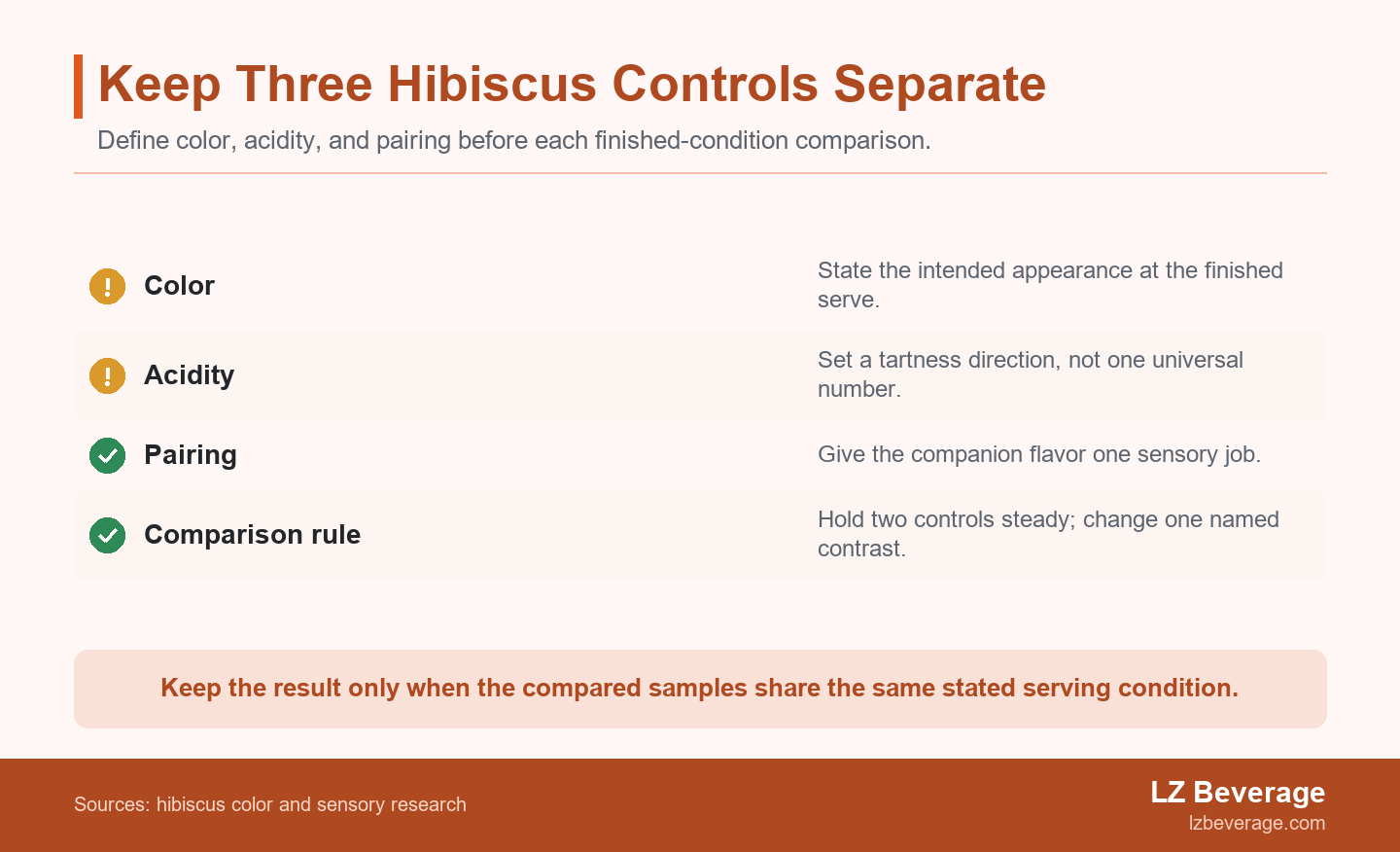
Use a short comparison card for every sample: the color trajectory being protected; the acid direction being held; the pairing role being compared; and the finished condition in which the drink will be tasted. If the pairing is the only intended contrast, keep the other three entries unchanged. If the team wants to explore a sharper acid direction, keep the pairing role and the color target unchanged. The same logic applies to a still versus sparkling concept.
For a packaged concept, define the finished condition before collecting preference notes. That means the same beverage state, pack, serving temperature, and sensory prompt. If the intended product is ready to drink, it is useful to review ready-to-drink beverage formats while the team decides how the sample should be served. LZ Beverage can then use the stated condition as part of a conversation about custom formulation, filling, packaging, and export coordination, rather than treating a bench pour as a complete product definition.
The output of this round should be a decision sentence, not a vague preference. For example: “Keep the berry-led direction because it reinforces red-fruit identity in the cold finished serve while the chosen tartness remains clean.” The sentence tells the next team what has been decided and what must be kept constant in the next comparison.
The study investigates roselle anthocyanin recovery and stabilization under stated conditions. The useful development lesson is modest: when a team relies on color or stability evidence, it should keep the stated input and handling conditions with the sample record. A roselle stabilization study examines recovery and degradation under defined conditions, which is a better basis for disciplined comparison than a generic ingredient name.
Record the input and preparation route with the sample version. At minimum, the record should identify the hibiscus source form, the preparation route, the pairing direction, the acid direction, the pack or open-pour state, the serving condition, and the version name. This is not bureaucracy for its own sake. It allows a later pilot to answer whether the same sensory question was tested, rather than merely whether the product still has a red color and a hibiscus label.
Where a sample differs from a prior reference, state that difference plainly. “New source form,” “new preparation route,” or “new serving condition” are better decision labels than “improved” or “more premium.” They keep the team from treating an untracked input shift as evidence that a companion flavor, package, or manufacturing step caused the change.
When a Pilot Is a New Question Rather Than a Confirmation
A pilot that changes an unheld control is a new question rather than confirmation. The following is an illustrative development scenario, not a client case or a production result.
An innovation manager is developing a non-alcoholic sparkling hibiscus drink for an export-market discussion. The product idea is berry-led, with a clean tartness and a red appearance that should remain recognizable in a cold can serve.
The first commercial-style pilot is 18,000 cans in three 6,000-can runs; the intended format is a 330 mL sparkling can. The number of runs is simply the scenario's scale, not a recommended minimum order or a claim about plant capability.
The team has approved a bench reference with a berry-led pairing, but the completed pilot comparison protocol has not been aligned. The reference was intended to guide a sensory decision, not to stand in for every later condition.
The bench sample was judged as a still open pour, while the pilot was assessed from cold carbonated cans. The serving conditions therefore changed at the same time as the format.
One pilot run used a different recorded hibiscus input preparation route from the bench reference. The run may be useful, but it no longer answers the same tightly framed question.
The changed serving condition and preparation record make the pilot a different sensory question, so the result cannot confirm transfer of the original preference. Calling it a confirmation would hide two unheld controls behind one pilot outcome.
Do not approve the pilot as a confirmed transfer. Reset the comparison with matched input records and the same finished-condition tasting protocol, then decide whether the berry-led direction still performs its intended job.
Retain the approved reference, record hibiscus source form and preparation route against each run, and compare matched cold finished cans using the same sensory questions. If the team wants to explore carbonation as a new variable, name that as a separate contrast.
Proceed only when the matched samples have the same stated serving condition, input record, and named comparison contrast. The verification is a decision gate for this scenario, not a release or compliance decision.
The example does not establish a formula, process parameter, shelf-life result, regulatory status, or manufacturing capability.
Keep the Flavor Decision Separate From Market Review
FDA provides regulatory information on acidified and low-acid canned foods for covered U.S. products. That framework uses product-specific conditions and obligations; it is not a sensory target for a hibiscus drink. A team considering U.S. sale should confirm whether and how its finished product falls within the relevant scope with responsible regulatory and process owners. FDA's acidified and low-acid canned-food information is the appropriate starting point for that boundary.
The European Commission describes EU flavouring rules as including definitions and specific labelling provisions. A desired berry, citrus, tea, or spice direction therefore does not determine destination-market wording by itself. Confirm the actual flavoring system, label language, and destination-market conditions with the responsible reviewers. The European Commission's flavourings rules set out that separate framework.
For Middle East and African markets, the same principle applies even though the applicable requirements may differ: identify the intended destination early, keep the sensory brief intact, and make market review a separate workstream. This protects the development conversation from two opposite errors: treating a flavor preference as a compliance decision, or letting a compliance question erase the sensory choice that made the product worth developing.
Send an OEM/ODM Partner a Brief They Can Act On
A usable manufacturer brief names the input, controls, finished condition, pack, market, volume, and sample decision. For a hibiscus concept, that can be a concise one-page request rather than a long ingredient list.
- Product intent: beverage base, still or sparkling state, and the market the sample is intended to inform.
- Hibiscus input: source form and preparation route to be recorded with each version.
- Three controls: color trajectory, desired acid direction, and the named pairing role.
- Finished condition: pack, serving temperature, and the way the sample will be judged.
- Decision needed: the single contrast to compare, the expected volume range, and who will approve the next step.
This level of definition is enough to make an OEM/ODM conversation concrete without pretending that the article has solved the formula. Buyers who want to understand the company context before sharing a brief can review LZ Beverage's stated company scope. LZ Beverage's documented role covers custom formulation, filling, packaging, and export coordination; the final feasibility decision still depends on the specific beverage, pack, market, and evidence supplied for the request.
When the brief is ready, use it to start a beverage development discussion. Bring the named controls, the intended finished condition, and the next sample decision. That gives the conversation a useful starting point: not “make a hibiscus drink,” but “compare this defined hibiscus direction under this stated condition and tell us what evidence is needed next.”
Hibiscus Formulation Questions Buyers Ask Next
The FAQ resolves residual questions without a universal formula. Each answer stays within the same three-control framework used above.
What gives a hibiscus drink its red color?
Hibiscus color comes largely from anthocyanins, whose visible behavior depends on the product conditions around them. In a beverage brief, describe the red appearance you want in the finished serve and record the input and handling context behind the sample. Do not assume that a vivid bench color alone proves how another preparation route, pack, or serving state will look. Use the visual target as a comparison point, then ask whether the finished drink still expresses that target after the stated sample conditions are applied.
Should acidity be adjusted before flavor pairing?
Set the intended acid direction before judging a pairing, because perceived tartness can change how the companion flavor reads. The first round does not need a universal numeric target. It needs a clear sensory statement, such as clean and tart or rounded and restrained, so the team can tell whether a berry, citrus, tea, or spice pairing is adding the intended value. Once the direction is chosen, hold it steady while comparing the companion note in the same finished serving condition.
Which hibiscus pairing direction should be tested first?
Test the direction that best expresses the intended product identity: berry for fruit reinforcement, citrus for lift, or tea and spice for structure. Choose one role for the first contrast and protect the hibiscus base. If several pairings are under consideration, make them separate samples rather than mixing them into one version that cannot explain its own result. The first winner should be the direction that gives the clearest intended identity while leaving color and tartness understandable to the tasting team.
What should be held constant in a hibiscus pilot?
Hold the approved controls, serving condition, and input record constant when the pilot is meant to confirm rather than explore a new question. If the pilot changes the hibiscus preparation route, pack state, carbonation, acidity direction, or pairing role, label it as a new comparison. That makes the next decision more defensible and prevents a promising but unmatched pilot from being overinterpreted. The record should make it easy to identify which run, input, serve, and contrast were actually judged before the team carries a choice forward.


