Separate heat, sediment, and positioning before requesting a ginger sample. A product team gets a more useful first prototype when it treats these as different decisions: the sensory intensity to pursue, the appearance the drink may show, and the consumer cue that makes the combination coherent.
That separation matters because a request for “more ginger” can conceal several different aims. It might mean a cleaner aromatic lift, a warmer bite, a more rustic fresh-pressed appearance, or an adult sparkling refreshment cue. Those aims do not necessarily call for the same input route, sample format, or tasting question.
Use these distinctions to frame a product conversation: describe the desired ginger experience, choose an intentional appearance stance, set a consumer-facing boundary, and compare samples without confusing one change for another. A first brief can guide development without becoming a universal recipe, a shelf-life claim, or a regulatory conclusion.
Make the First Ginger Sample Answer One Clear Question
A useful ginger beverage brief is a short decision document, not a longer ingredient list. Before a supplier is asked to make a sample, the team should be able to say which of these three jobs the first sample must do:
- Heat direction: background warmth, a defined ginger bite, or an assertive, adult-facing sharpness.
- Appearance stance: clear or nearly clear, controlled cloud, or intentionally visible material.
- Consumer cue: for example, crisp refreshment, botanical complexity, or a fresh-pressed signal.
These choices influence one another, but they should not be collapsed. A clear sparkling drink with a defined bite answers a different brief from a gently spicy, cloud-accepted drink, even when both use ginger and citrus. Naming the difference makes feedback useful: tasters can react to a stated direction instead of trying to evaluate every possible interpretation at once.
Write the intended serving context beside the three choices. Still or sparkling, cold or ambient, can or bottle, and shake or no-shake are not production instructions here; they are the conditions under which the first sample will be judged. That keeps the tasting brief connected to the product the buyer actually hopes to launch.
Write the First Ginger Brief in Three Lines
A first ginger brief should name heat, sediment stance, positioning cue, finished condition, pack, market, and sample decision. Here, finished condition means the planned pack, storage, temperature, and serving context in which the product is judged—not a bench glass viewed at a different moment.
Three lines are usually enough to make the first conversation concrete. They also expose missing decisions early, while a team can still refine the question rather than reinterpret a finished sample.
| Brief line |
What to state |
What the first sample should answer |
| Heat |
Background, defined, or assertive; plus the intended serve. |
Does the ginger signal feel appropriate in the finished beverage context? |
| Appearance |
Clear, controlled cloud, or visible particles; plus the viewing or settling condition. |
Does the product look intentional before and after the agreed hold? |
| Position |
One primary cue, such as crisp refreshment or botanical depth. |
Do heat and appearance support the same consumer expectation? |
Add the intended pack, destination market, expected volume range, and a single decision for the sample round. “Choose between a clear, defined-heat sparkling direction and a light-cloud, gentler direction” is actionable. “Make a premium ginger drink” is not, because it leaves the tasting result open to incompatible interpretations.
Choose a Heat Direction Before Choosing a Ginger Delivery Route
Published research reports that heat treatment can induce conversion of gingerols to shogaols, with results dependent on stated conditions. A peer-reviewed ginger-processing study describes outcomes that varied with heat type, sample type, temperature, and time. That is a reason to avoid treating a ginger name or a single ingredient form as a complete sensory instruction.
For a brief, pungency is the warming, biting, or sharp sensory intensity associated with ginger. Describe it in the words a tasting group can use: background warmth, defined bite, or assertive heat. Then specify when it is judged. A cold, carbonated drink can make the same underlying ginger direction feel different from a still bench pour; the team should not assume the earlier observation transfers unchanged.
A separate sensory study of ginger beverages associated higher tested ginger-extract levels with stronger aftertaste and pungency within its own study conditions. It does not prescribe a commercial level. It does support the more useful question: what degree and style of heat should this finished drink deliver?
Describe ginger heat as a target experience before selecting a delivery route. Once that target is stated, a development discussion can ask whether the input route preserves the desired aroma, changes the bite, or creates an appearance trade-off. Teams exploring a botanical base alongside ginger can review tea beverage formats for a ginger-led brief without turning the article into a claim about a specific formula.
Treat Sediment as a Product Choice, Not a Surprise
Beverage research examines processing, particle behaviour, turbidity, and precipitation together, indicating that visible solids need a physical-system decision. In a different plant-based beverage system, a peer-reviewed physical-stability study assessed processing, particle size, turbidity, precipitation, and sensory properties together. It does not establish ginger stability, but it is a useful boundary: appearance cannot be judged independently of the beverage system.
Sediment is material that settles or remains visibly dispersed in a drink. A cloud is a deliberately non-clear appearance caused by dispersed material. These are reader-facing descriptions, not shortcuts for process approval. The first brief should say whether a clear-to-nearly-clear result is required, whether a light cloud is welcome, or whether visible particles are part of the intended experience.
A brief should state whether clarity, controlled cloud, or visible particles are intentional and how the finished product will be judged. Add the observation point: just after filling, after an agreed rest, after inversion, or when poured cold. That prevents a team from treating a normal change in appearance as either a failure or a promise before the product expectation has been set.
For a packed-drink discussion, the visual decision belongs with the final format. A team can review ready-to-drink beverage formats when it is ready to relate a clear or cloud-accepted direction to a real finished-beverage context. The link is a category path, not evidence that any ginger system will remain stable.
Let Consumer Positioning Limit the Formula
Consumer carbonation research includes bite and fizziness among relevant descriptors, so carbonation belongs in the sensory context for a sparkling ginger sample. A consumer-perception study of carbonated beverages identifies bite, cooling, carbonation, and fizziness among relevant terms. It does not predict demand for a ginger drink, but it explains why a sparkling and still sample should not be treated as interchangeable sensory contexts.
Positioning should narrow the brief. If the lead cue is crisp refreshment, the sample should test whether the ginger signal stays clean and readable in that role. If the cue is botanical complexity, the question may be whether the ginger holds the profile together without becoming a generic burn. If the cue is fresh-pressed character, the team may accept more visible body but should state that choice explicitly.
Use one primary consumer cue to limit the formulation brief rather than collecting incompatible positioning words. Piling “clean,” “bold,” “fresh,” “premium,” and “functional” into one request does not create a position; it creates an unclear tasting scorecard. One lead cue tells the panel what must be protected when heat, carbonation, and appearance create trade-offs.
When the brief moves from taste development into supplier evaluation, buyers can also review LZ Beverage's company background to understand the organization they may ask to scope a development conversation. The next step remains a product-specific discussion, not an implied promise about a final formula.
Run Samples as One-Contrast Comparisons
A matched sample comparison should change one named variable so a preference result can inform the next decision. The comparison does not need to be complicated: state which condition is held constant, state the single contrast, and write the decision that the tasting should unlock.
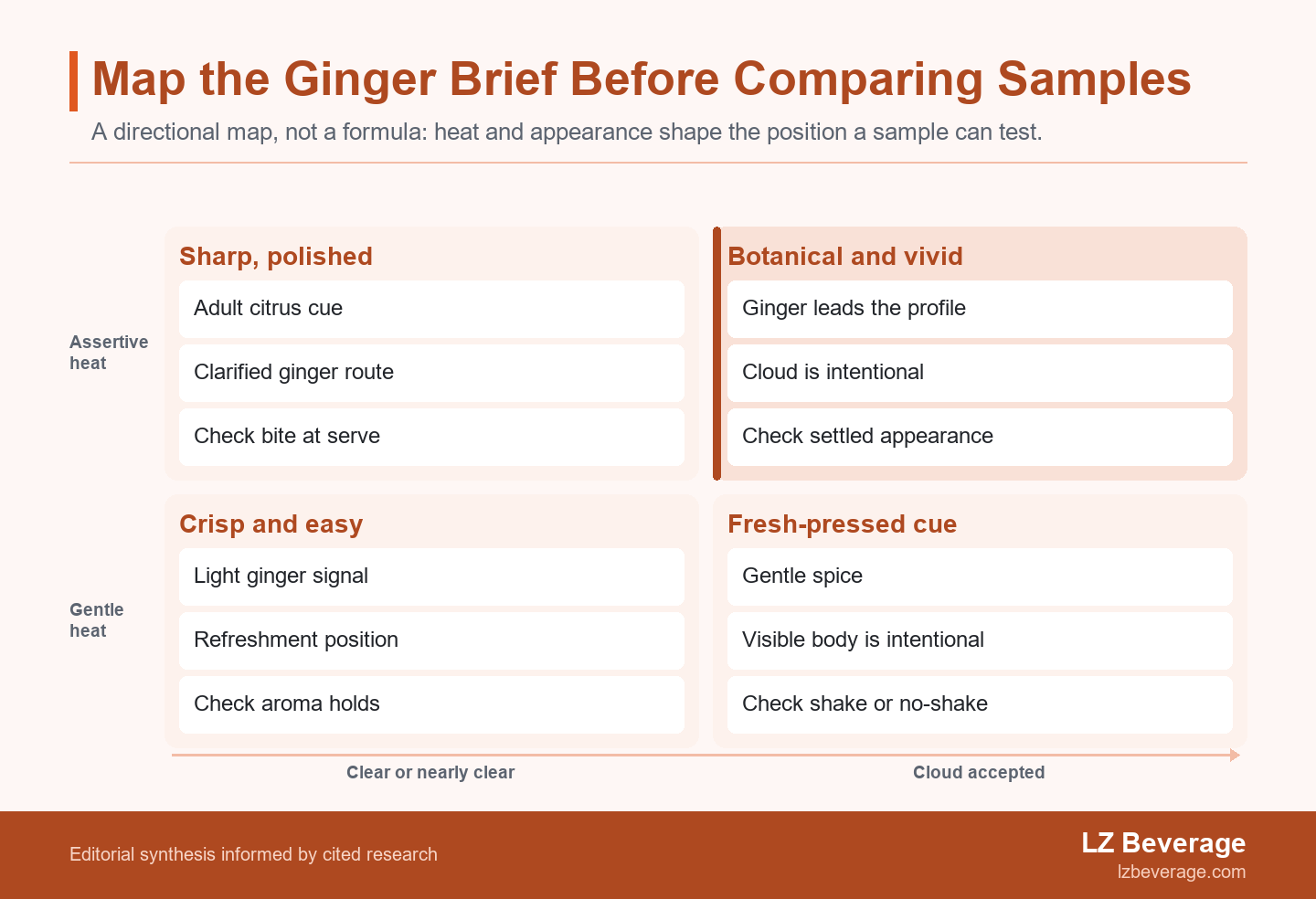
For example, a first round might hold the intended carbonation, serving temperature, citrus direction, pack concept, and light-cloud stance constant while comparing a gentle versus defined heat direction. A later round might hold the selected heat direction constant while comparing clear and controlled-cloud appearance. The sequence is deliberate: each result becomes evidence for the next question instead of a vote on an undefined beverage.
Use the heat-and-appearance map below as a briefing device. Its four positions are not consumer segments or recipe targets. They are prompts for choosing one testable direction before the sampling conversation expands.
Record the ginger input route and finished condition with each sample result. A product name such as “ginger citrus” does not identify the material, the appearance stance, or the way a panel experienced the drink.
A compact record can include the sample version, ginger input form, stated heat direction, sediment stance, carbonation state, serving temperature, pack concept, and the exact question put to tasters. It should also record the decision: continue, compare one new contrast, or stop pursuing that direction. This is a traceability habit for development conversations, not a claim that the record replaces analytical, process, or shelf-life validation.
| Record item |
Why it belongs with the feedback |
| Input route and sample version |
Shows what the taster actually received. |
| Heat, appearance, and consumer cue |
Keeps the result tied to the written brief. |
| Finished condition |
States the pack, temperature, carbonation, and serving context. |
| Next decision |
Prevents a preference comment from becoming an undocumented instruction. |
When a Pilot Is Answering a Different Question
An unmatched pilot is a new sensory question, not proof that a benchtop brief transferred. The key test is simple: can the team point to one comparable record and one named contrast between the bench reference and the pilot?
When the answer is no, a reset is more informative than a forced conclusion. The team can preserve what it learned—perhaps that the pilot feels sharper or looks more substantial—while admitting that the result cannot yet be allocated to heat, input route, appearance, or serving condition. The following composite is illustrative, not a client case or a production recommendation.
Illustrative Scenario: Reset the Pilot Before Selecting a Direction
Hold the selection decision when the bench record and pilot condition describe different ginger samples. The hold applies to choosing a direction from this comparison; it does not assert a manufacturing hold, release decision, or approval outcome.
A beverage brand is developing a 330 mL sparkling ginger-citrus drink for an adult-refreshment positioning discussion.
The illustrative plan covers 24,000 bottles across three 8,000-bottle pilot runs, with one 330 mL sparkling SKU under review.
A bench reference exists, but the first pilot cannot yet be used to confirm that the written ginger brief transferred into its intended serving condition.
The benchtop sample used a clarified ginger input and was judged cold in still tasting cups.
The first pilot used a more particulate ginger preparation and was judged carbonated after chilled storage.
The pilot changed both the ginger delivery route and the serve condition. A stronger or different result cannot be attributed to heat alone, sediment alone, or carbonation alone.
Hold the selection decision for all three pilot runs until the bench record and pilot conditions describe one comparable question. Reset the comparison with one named contrast while keeping carbonation, temperature, citrus direction, and sediment stance explicit.
Create matched pilot samples that retain the same intended serve and document whether the comparison is clarified versus light-cloud, or gentle versus defined heat, rather than changing both together.
Before selecting a direction for the next 8,000-bottle run, record the sample version, ginger input form, appearance after the agreed hold, serving condition, and panel decision in one matched record.
The bottle count is illustrative. It does not establish an MOQ, capacity, shelf life, process, or market approval requirement.
Keep Market and Process Review Separate From Preference
FDA provides regulatory information for covered acidified and low-acid canned foods, so a sensory preference cannot determine U.S. regulatory treatment by itself. The FDA's guidance and regulatory-information page is a useful starting point for the relevant U.S. categories, but it cannot decide whether a specific ginger product is covered.
The European Commission identifies mandatory food-information requirements for prepacked foods, so a consumer-facing ginger proposition needs market-specific review. Its mandatory food-information overview describes an EU-level regulatory context; the appropriate treatment of a specific product depends on its ingredients, pack, market, and other product details.
The practical boundary is to keep two tracks visible. The sensory track asks whether the stated ginger direction, appearance, and consumer cue work together. The market-and-process track asks the responsible owners to assess the destination market, ingredients, pack, processing route, labeling, and any product-specific requirements. A favorable tasting result can advance the first track without completing the second.
Give an OEM/ODM Partner a Brief They Can Act On
A practical OEM/ODM request names product type, target consumer, heat, sediment, pack, market, volume, and the sample decision. Here, OEM/ODM means a manufacturing and development partnership that turns a defined beverage brief into a scoped production conversation.
Before asking for a feasibility discussion, collect the answer to each item in one place: still or sparkling beverage type; lead consumer cue; desired heat direction; clear, cloud, or particle-forward appearance; relevant flavour companions; intended pack; destination market; expected volume range; and the one decision the first sample must answer. This gives a development partner enough context to identify questions without pretending that the brief has already resolved process or market requirements.
LZ Beverage's documented scope includes custom formulation, filling, packaging, and export coordination. That makes the handoff most useful when the buyer is ready to connect the brief to a specific product discussion. Readers can review beverage categories for an OEM/ODM feasibility brief, then bring the completed decision record rather than a generic request for a stronger ginger drink.
The most productive first conversation is bounded. It asks whether the chosen product direction can be explored in the stated format and market context, identifies the next sample comparison, and keeps any market, labeling, process, or shelf-life work in its proper review path.
Ginger Formulation Questions Buyers Ask Next
How should I define ginger heat for a first sample?
Define ginger heat as a tasting direction, name the intended serving condition, and ask the panel to judge that same condition across samples. Use words such as background, defined, or assertive, then add the intended carbonation and temperature. This does not set an ingredient level. It gives the tasting group a shared sensory question and makes the next comparison easier to interpret.
Can a ginger beverage contain visible sediment intentionally?
Yes, but visible particles should be a deliberate part of the product experience, described in the brief and evaluated in the intended pack and serving condition. State whether a shake is expected, what the drink should look like after an agreed hold, and whether the visible material supports the consumer cue. Do not use the intended appearance to assume a stability or process outcome.
Does carbonation make a ginger drink taste hotter?
Carbonation can contribute bite and related sensations, so it may change how a ginger direction is perceived even when the ginger input is held constant. It is more precise to say that carbonation changes the sensory context than to claim that it universally increases ginger heat. Compare still and sparkling samples only when the question is specifically about that change.
What should an OEM receive before quoting a ginger beverage?
An OEM needs the beverage type, target consumer, heat direction, sediment stance, pack, target market, expected volume, and the decision the first sample must answer. Include the finished condition for tasting and any flavor companions that are essential to the position. This supports a scoped feasibility conversation; it does not replace product-specific process, market, or compliance review.


