A clean cucumber-mint profile is lost when a team tries to solve every decision with “more freshness.” The stronger route is to protect a recognizable cucumber cue first, use mint as a chosen modifier, judge the drink in its finished serve condition, and define any functional ingredient by its product role before discussing market-facing language.
A Clean Profile Is a Set of Decisions, Not a Color Palette
Clean is a stack of decisions, not an adjective. Cucumber recognition is the sensory foundation; mint has a selected character; carbonation, sweetness, temperature, and pack define the serve; and function has a specific job that is reviewed separately from a claim. Treating these as one “fresh” instruction produces samples that may be pleasant yet impossible to compare.
- Write the cucumber cue in sensory language, including what must remain recognizable.
- Choose the mint direction before changing its intensity.
- Set the intended serve before tasting refreshment or dryness.
- Give an added ingredient a product role, then review claims for each destination market.
Build the Brief From the Bottom Up
The drink must be briefed as a finished sensory system, not an ingredient list. Research on volatile organic compounds and multisensory flavor perception shows why aroma is only one part of what a consumer experiences. A cucumber note that seems clear in a bench glass can read differently once sweetness, bubbles, temperature, and visual expectation are present. The brief therefore needs a sequence: cucumber cue, mint direction, finished serve, then ingredient purpose.
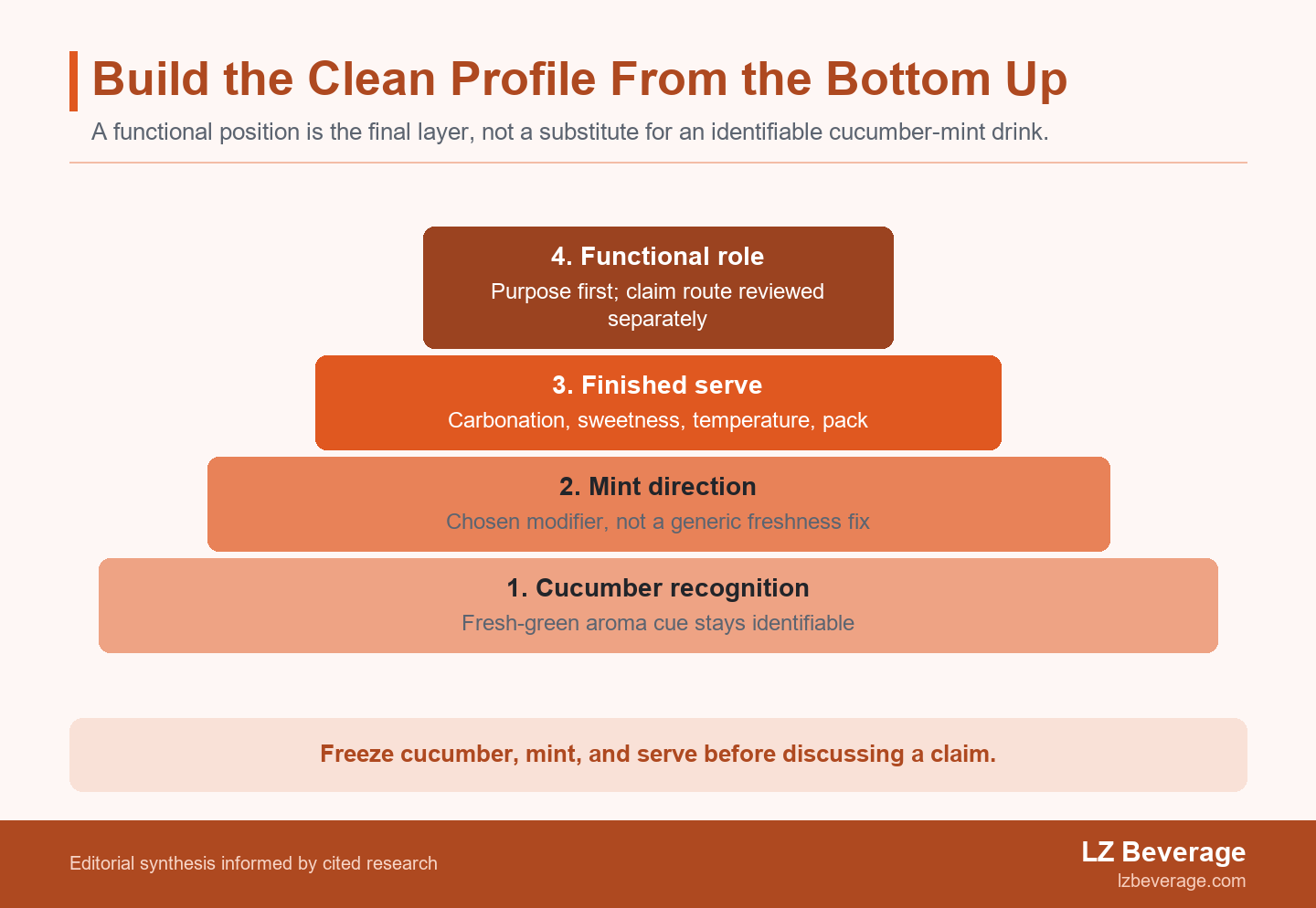
That order prevents a common shortcut: using mint, a pale-green appearance, or functional language to compensate for an undefined base. It also gives the development team a testable question. Instead of asking whether the drink is “fresh enough,” ask whether the first nose still signals cucumber, whether the mint arrives as a light herbal lift or a cooling finish, and whether the same description holds at the intended serve.
Protect the Cucumber Cue Before Adding Freshness Modifiers
Cucumber recognition should be written as an aroma cue, not a color instruction. In food science, volatile compounds are aroma compounds that readily move into the air and shape the smell of a drink. Cucumber-aroma research links fresh green and characteristic cucumber notes to the balance of C6 and C9 volatiles. That does not prescribe a beverage formula, but it gives the brief a better target than “light green and refreshing.”
Start with two descriptions: the cue you want at first smell and the failure mode you want to avoid. For example, “fresh green cucumber, identifiable before mint” is more useful than “cool spa water.” The failure note might be “watery,” “melon-like,” or “covered by herbal cooling.” These are not supplier instructions by themselves; they are decision boundaries for comparing samples.
Keep the cucumber base stable while the team explores modifiers. If the base changes together with sweetness, mint, and carbonation, a panel cannot tell whether a weaker cucumber impression comes from aroma balance or from the served product context.
Choose a Mint Direction, Not Just More Mint
Choose a mint character, not just more mint. A Food Chemistry study of mint species found distinct sensory descriptions and odor-active markers across the materials examined. For a cucumber-led drink, the practical implication is to name the intended direction—soft leafy, sweet herbal, crisp, or more cooling—before asking for higher intensity. Teams can also review tea beverage directions for a botanical brief when a wider plant-note route is under consideration.
Mint should modify the cucumber cue rather than announce itself first. A modest herbal lift may support a fresh-green profile; a sharper cooling route can quickly move the association toward confectionery or oral-care territory. Ask tasters to answer one narrow question: after the first sip, can they still identify cucumber without being prompted?
The aim is not to build a long flavor list. It is to make the modifier legible enough that a tasting result can guide the next sample instead of producing a new round of vague freshness requests.
Set the Intended Serve Before Judging Refreshment
Test the profile at the intended serve, not only as a still base. A study of mint-flavored carbonated beverages found that carbon dioxide and sugar can change aroma release and perceived intensity. Aroma release means how aroma compounds move from the drink to the nose during consumption. That makes carbonation, sweetness, and temperature part of the sensory brief—not later packaging details.
Define the tasting condition in advance: chilled or ambient, sparkling or still, glass or can pour, and any settling time after opening. Hold those conditions steady while comparing the first two directions. A thin profile may need a different cucumber cue, while a profile that seems too minty may simply be judged warmer or more carbonated than intended.
Pack format shapes the conversation as well. Teams that need to compare the intended finish with format options can review ready-to-drink beverage formats before treating a bench sample as a final consumer experience. In practical terms, LZ Beverage can receive a sensory question tied to a finished format rather than a request for a generic “cucumber-mint sample.”
Give Function a Product Role Before It Becomes a Claim
Function needs a product job before it becomes label wording. Define functional role as the product job an added ingredient is intended to perform before a claim is considered. State that purpose—such as support for a botanical positioning or a specified ingredient story—without assuming the finished beverage can make a health-oriented promise. The FDA’s labeling information for foods and dietary supplements separates categories of label claims; an ingredient statement or presence level does not automatically authorize a nutrient-content or health claim.
A functional direction is not an automatic EU claim route. The European Commission’s overview of nutrition and health claims emphasizes that claims must be clear, accurate, and grounded in scientific evidence. This is a market-specific regulatory boundary, not legal advice: keep the product role, ingredient evidence, and proposed claim wording as separate workstreams until the target market is confirmed.
That separation keeps early sensory work honest. A functional ingredient can change taste, haze, aroma, or sweetness perception, so it deserves its own sample question. First decide whether it fits the cucumber-mint experience. Then ask what evidence, wording, and local review would be needed if a commercial claim is contemplated.
Run the First Pilot as a One-Contrast Comparison
Change one named contrast so the next decision has a clear cause. For a first cucumber-mint pilot, keep the cucumber cue, serve condition, pack assumption, and functional role constant. Change only one variable—such as the mint direction—and write the question before the samples are poured. This is an editorial decision rule, not a substitute for technical validation, shelf-life work, or compliance review.
| Sample field |
Hold constant |
Single contrast |
Decision record |
| 330 mL sparkling format |
Cucumber cue, pack, chill condition |
Mint direction |
Does cucumber remain identifiable after the first sip? |
| Defined sweetness and carbonation |
Base and tasting method |
One botanical route, if tested later |
Does it support the intended profile without changing the cue? |
Record the finished drink and the question together. A useful sample note captures the aroma description, serve temperature, carbonation condition, relevant pack assumption, panel prompt, and the decision threshold. “Liked better” is not enough; the next team needs to know what changed and whether the named cucumber cue survived.
When a Pilot Is Testing Too Many Identities
Split a late mint change from the defined base before choosing the direction. When cucumber flavor, mint level, sweetness, carbonation, and a functional ingredient all move at once, the tasting result cannot identify the cause. The right recovery is a clean comparison, not a stronger preference vote.
Reset the pilot before selecting the direction. The following composite illustrates how a team can regain an interpretable decision without presenting a formula, production record, or customer outcome.
Illustrative Scenario: Reset the Cucumber-Mint Pilot
A beverage brand is developing a 330 mL cucumber-mint sparkling drink for a warm-weather functional-positioning discussion.
The illustrative plan covers 18,000 cans across two 9,000-can pilot conditions, with one 330 mL sparkling SKU under review.
A common cucumber base has been described, but a late mint-delivery change was introduced before the first pilot direction had been compared at the intended serve.
The first two bench directions changed cucumber flavor, mint level, sweetness, carbonation, and a botanical functional ingredient together.
Tasters described one version as toothpaste-like and another as flavored sparkling water, but neither result isolated the cause.
The pilot was testing several identities at once. The team could not tell whether weaker cucumber recognition came from the mint direction, perceived dryness, carbonation, or the added ingredient system.
Reset the plan into two 9,000-can pilot conditions after a common base is agreed: keep the cucumber cue, intended pack, serve temperature, carbonation target, and functional role fixed; change only the mint direction in the first contrast.
Record the sensory question, mint route, finished serving condition, and decision threshold with each pilot sample before introducing a new functional or claim variable.
Advance only the direction that preserves cucumber recognition and gives the panel a repeatable description at the intended serve condition; then separately review the functional ingredient and market claim path.
This is an illustrative planning scenario, not an LZ Beverage customer case, production formula, or proof of regulatory suitability.
Hand an OEM/ODM Partner a Brief They Can Test
Give the manufacturer a product question they can test. A useful cucumber-mint brief states the beverage format, target consumer, required cucumber cue, chosen mint direction, intended serve, ingredient’s product role, pack, target market, and expected volume. It also names the first contrast and the decision threshold; that is more useful than asking a partner to make a drink that is merely “clean and functional.” For a view of the partner context, review LZ Beverage's manufacturing background.
- Sensory target: first-nose cucumber cue, mint character, and the failure notes to avoid.
- Finished condition: still or sparkling, intended temperature, sweetness direction, and pack assumption.
- Functional boundary: ingredient purpose, any planned evidence review, and no unapproved claim wording.
- Commercial context: destination market, 330 mL or other pack requirement, pilot scope, and volume expectation.
Manufacturing feasibility also depends on the finished product and process route. In the United States, FDA guidance on acidified and low-acid canned foods defines an acidified food as having finished equilibrium pH of 4.6 or below and water activity above 0.85. This illustrates why product classification and process requirements must be reviewed with the actual beverage specification rather than inferred from a flavor description; it does not classify this concept. A flavor name alone does not establish the processing conditions, stability work, or labeling route that a finished product may require.
For the first feasibility call, provide one document rather than a collection of separate tasting comments. Put the sensory target at the top, followed by the served format and the question that the first comparison must answer. Place the functional ingredient purpose and the proposed market in their own fields, so they do not get mistaken for approved front-of-pack language. If the team has not chosen a pack or expected volume, say that clearly; an honest open point is more useful than a false specification.
Also record which decisions are already fixed and which are still exploratory. The partner can then distinguish a request to protect a cucumber aroma cue from a request to investigate a new mint route, or a request to assess whether an ingredient changes the final drinking experience. This avoids making a technical or commercial commitment from a tasting note alone, and it leaves room for formulation, process, and market review to proceed on their own evidence.
When all inputs are settled, share a cucumber-mint brief for an OEM/ODM feasibility review.
Cucumber-Mint Functional Drink Questions Buyers Ask Next
FAQ resolves narrow buyer questions without replacing the core brief. Use the answers below to clarify the first sample and handoff, while keeping formulation, process, and market review as separate decisions.
How should a first cucumber-mint sample be described?
Describe the cucumber cue, mint character, serving condition, functional role, and the single decision the sample must answer. Add two or three failure notes, such as “watery,” “toothpaste-like,” or “cucumber not identifiable.” This gives the tasting panel a shared language and prevents generic preference comments from driving the next formulation change. The note should also state whether the panel is judging aroma before sip, flavor after sip, or the finish, because those are different moments in the experience.
Can cucumber and mint work in a carbonated functional drink?
Yes, provided the first samples are judged at the intended carbonation and temperature rather than as a still base. Keep the cucumber cue and serve condition fixed while testing the mint route. If a functional ingredient is introduced, give it a separate comparison after the core sensory direction is understood. A sparkling direction is not automatically fresher; the useful test is whether the chosen bubbles, sweetness, and chill level preserve the profile the brief actually names.
Does a functional ingredient justify a health claim?
No, an ingredient’s intended role does not by itself establish that a finished product may use a particular health claim. The permitted route depends on the target market, the evidence, the finished product, and the exact wording. Keep claim review separate from the early decision about whether the ingredient belongs in the sensory profile. A development sample can therefore be useful even when its commercial language has not been chosen, because it answers a product question rather than a legal one.
What should an OEM receive before quoting this concept?
An OEM needs the beverage format, target consumer, cucumber and mint direction, functional role, pack, market, and expected volume before a useful feasibility discussion can begin. Include the intended serve and the first sample contrast as well. That lets the partner assess a concrete development question rather than infer a product from a broad flavor trend. If the project is still exploratory, identify which input is a working assumption so quotation and sample discussions do not turn it into an unintended requirement.


