A first can can be useful, but it should not be asked to do five jobs at once. It can help a buyer compare a flavour direction, sweetness balance, coffee character, or serving experience. It cannot, by itself, establish the commercial process, package performance, destination-market label path, importer obligations, or repeatability at scale. The practical task is to make the sample answer one stated question while the remaining evidence follows its own review path.
Private Label Canned Coffee Manufacturer: What Buyers Should Ask Before Sampling
A canned coffee sample is not supplier qualification. Treat it as a controlled comparison once the buyer has defined the product it represents, the decision it must support, and the evidence that still needs to be reviewed separately. That distinction protects both sides: the buyer does not infer a full manufacturing outcome from a pleasant taste, and the manufacturer receives a question that can be answered rather than a vague request for “premium canned coffee.”
Before sending an enquiry, write a one-sentence decision statement. For example: “For a 250 mL chilled black coffee for the United States, which of two agreed sweetness directions best supports a clean coffee finish?” This gives the tasting a boundary. The finished-drink description, process evidence, packaging, labelling, import ownership, and commercial scale remain separate workstreams until they are confirmed for the actual brief.
- Fix the comparison: one intended SKU, market, and tasting question.
- Separate the proof: taste does not replace process, pack, or market evidence.
- Assign the owners: name who will resolve label, importer, and supply-chain questions.
- Rank later: compare manufacturers only after each responds to the same brief.
A Sample Is Useful Only When the Brief Is Fixed
A sample needs a fixed brief before it can be useful evidence. Start with one intended SKU, one target market, one sensory or product question, and a short list of evidence you want to discuss apart from the tasting. A sample brief does not need to be a final specification; it needs to identify what is fixed, what is exploratory, and what the buyer will decide after the sample is reviewed.
A useful request distinguishes three lines. The sample question might be whether the coffee character remains clear at the intended chill condition. The finished-drink description records the intended coffee style, ingredient system, pack, and serving expectation. The evidence request lists the items that will require a separate conversation: relevant controls and records, pack and storage assumptions, destination-market label review, and ownership of import tasks.
- Define: black coffee, milk coffee, flavoured coffee, or another intended finished route.
- Limit: one pack format, one market, and one comparison question for the first round.
- Record: what a preferred taste can decide and what it cannot decide.
- Request: a named next owner for each open technical, market, and commercial question.
This keeps an early sample from turning into a disguised approval. It also makes supplier responses comparable: each manufacturer is responding to the same buyer-owned brief, not inventing a different interpretation of “iced coffee” or “premium.”
Ask Which Coffee Product Route You Are Sampling
Name one intended SKU before comparing suppliers. A product route is the defined path for the finished drink: coffee style, ingredient system, production process, pack, storage expectation, and target-market context. It is not a finished formula and it does not assign a process classification. It prevents several unlike products from being judged as though they are interchangeable samples.
“Canned coffee” can point to very different buying questions. A sweetened black coffee, a milk coffee, a flavoured latte-style drink, and a coffee drink with an additional functional ingredient may each involve different sensory, ingredient, pack, and market questions. The buyer should tell the manufacturer which route is being explored, which elements are fixed, and which single contrast is still open. If the broad category has not been narrowed yet, use the first conversation to define the route rather than to request a final-looking can.
For category context while preparing that brief, buyers can review LZ Beverage's canned coffee options. The point is not to choose a stock answer from a gallery. It is to give the supplier a clearer starting frame: intended coffee direction, dairy or non-dairy question where relevant, sweetness direction, format, serving condition, and destination market.
Ask a direct question such as: “Which finished product route does this sample represent, and which assumptions should remain open until feasibility review?” That wording is more useful than asking whether a manufacturer “can make canned coffee,” because it ties the sample to a specific buyer decision.
Ask for the Process Evidence Behind the Can
A tasting result cannot stand in for controls, records, and verification. For the proposed route, ask the manufacturer how it would identify relevant hazards, controls, monitoring, corrective actions, verification activities, and records for discussion. The U.S. Food and Drug Administration’s Preventive Controls for Human Food rule overview describes a food-safety-plan framework that includes hazard analysis, preventive controls, monitoring, corrective actions, verification, and records. It is useful context for the buyer’s questions, not a determination that a particular product or facility meets a requirement.
Where a manufacturer uses the term scheduled process, ask for it in plain language: a documented process selected as adequate for a specified product and container under stated manufacturing conditions. The term belongs to a product-specific technical discussion, not to a tasting verdict. The buyer’s task is to understand whether that discussion is needed for the intended drink and who would own the next step.
A can is not a process classification. FDA information on acidified and low-acid canned foods is product- and process-specific. Do not decide that an unspecified canned coffee formula belongs in a particular category simply because it is packed in a can. Instead, ask how the proposed finished route would be assessed and what product-specific work would remain before a commercial decision.
The buyer’s question is not “show a certificate.” It is “for this proposed route, what would you need to establish, monitor, document, or verify, and who owns the next decision?” A concise answer can expose a meaningful difference between a sensory sample and a commercially reviewed route without forcing either party to make a premature compliance claim.
Keep Pack and Shelf-Life Questions Separate From Taste
Taste approval is not pack or shelf-life proof. A sample that pours well and tastes right at a tasting table can still leave open questions about the proposed pack, storage conditions, distribution route, and product-specific validation. Record those questions alongside the sensory result rather than allowing a preferred flavour direction to become a proxy for commercial readiness.
Ask what pack the sample represents, whether it is intended to be judged chilled or at another condition, and which assumptions would need to be confirmed before a commercial route is discussed. A 250 mL sample can be a useful pack reference, but it does not prove a final shelf-life outcome, transportation result, or stability path. The right outcome from the first round may be “sensory direction selected; pack and shelf-life evidence still open.”
For U.S.-bound packs, fix the intended serving assumption in the brief before the label inputs are assembled. The FDA explains that Nutrition Facts information is generally based on one serving, while some containers may also display information per package. That is a label-input boundary, not proof of a final commercial pack.
Buyers who need to align a serving route with a ready-to-drink format discussion can review ready-to-drink beverage formats. This is a practical bridge between product intent and a feasibility conversation, not evidence that any specific finished product has been validated. Keep the fields separate in the brief: target format, intended storage or serving assumptions, and the evidence needed before commercial release.
Assign the Market File Before You Approve Artwork
A sample can is not a market-ready label file. The final label and related import documentation must be reviewed against the destination market, because food-information and language responsibilities are market-specific. The European Commission’s guidance on mandatory food information and its overview of language and presentation show why a buyer should not treat an attractive sample label as final market evidence. The actual requirements depend on the product and destination market.
Importer verification is a separate evidence stream. For U.S. imports subject to the Foreign Supplier Verification Program, FDA guidance describes the importer’s food-safety verification responsibilities. Buyers can use the FDA FSVP guidance to frame an ownership discussion, while confirming applicability for the specific transaction with appropriate professional advice.
Traceability is a record path, not a badge. In plain language, it means being able to identify where relevant food or inputs came from and where they went in the supply chain. Regulation (EC) No 178/2002 provides EU food-law context for traceability. A practical buyer question is: “Which records and named parties would let us follow this product and its relevant inputs through the intended supply chain?”
Put an owner beside each market task: label review, language review where relevant, importer responsibilities, and traceability documentation. Do this before artwork is treated as final. It avoids a common rework cycle in which a team chooses a can design and then discovers that the target-market file has not been assigned.
Use a Five-Gate Sample Scorecard
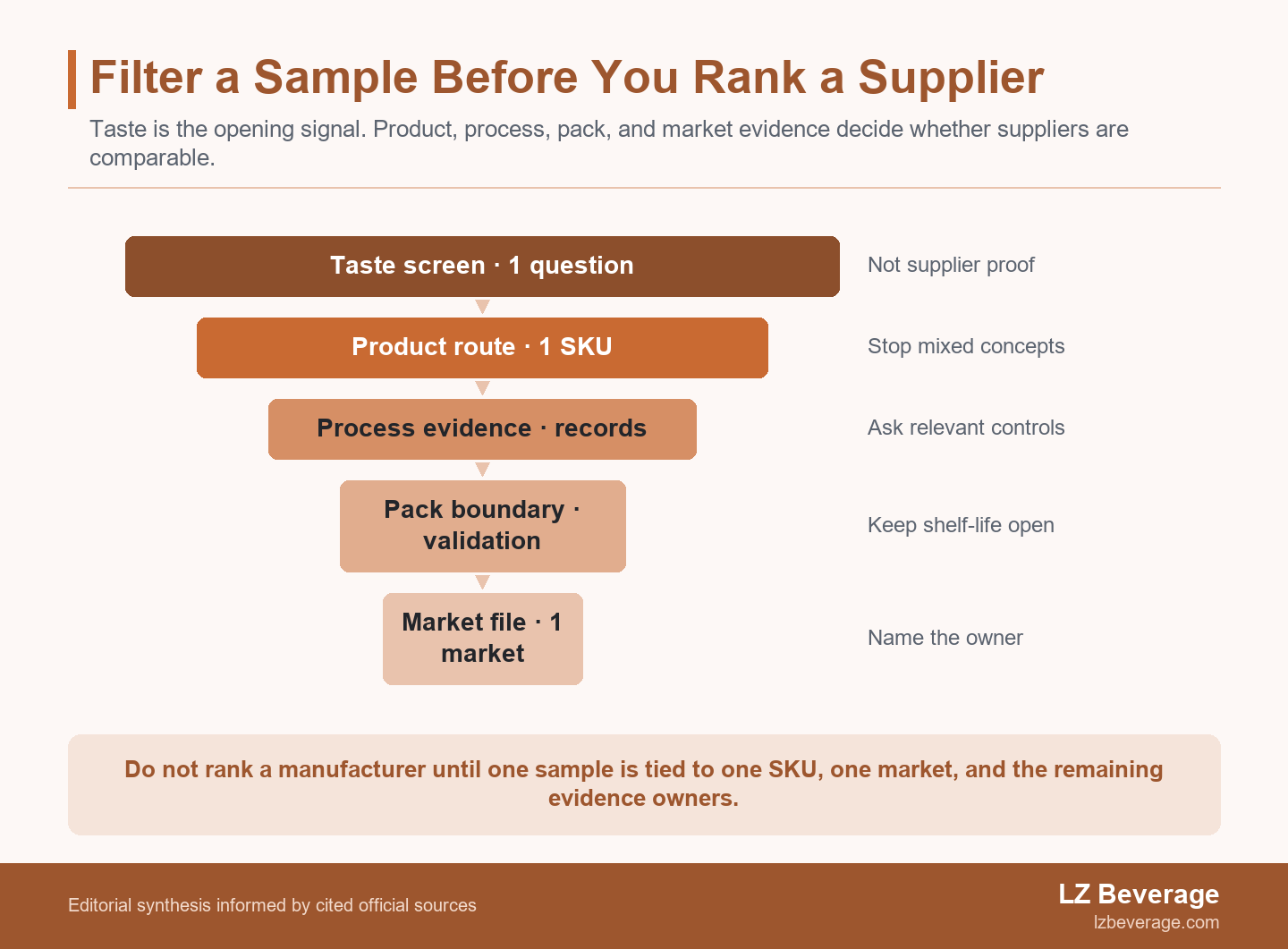
Score five gates separately before ranking a supplier. The scorecard below is an editorial procurement model: it does not audit a manufacturer or certify a product. Its purpose is to stop a strong sensory result from hiding an unanswered process, pack, market, or scale question.
| Gate |
What the sample or discussion can clarify |
Decision record |
| 1. Sensory fit |
Does the can answer the stated coffee, sweetness, or serving question? |
Pass, revise, or compare one named contrast. |
| 2. Product route |
Does every supplier understand the same intended SKU and pack context? |
Fix the shared route before ranking. |
| 3. Process evidence |
Which controls, records, and verification topics are relevant to the proposed route? |
Name the evidence request and its owner. |
| 4. Pack boundary |
Which pack, storage, and validation questions remain? |
Keep commercial validation open. |
| 5. Market file |
Who owns label, importer, and traceability review for the target market? |
Assign owners before final artwork. |
Use simple statuses—answered, open, or not applicable yet—rather than inventing a supplier score. A manufacturer can be the preferred sensory direction and still have open gates. The next action is then visible: request evidence, clarify ownership, revise the brief, or postpone ranking until the suppliers are being compared on like-for-like terms.
When Three Good Samples Still Do Not Support a Decision
Reissue the sample contract before ranking the suppliers. When samples represent different product routes and no common evidence request exists, a buyer can like all three cans and still have no defensible supplier decision, because the cans may answer different questions.
Illustrative Scenario: Reissue the Sample Contract
Reissue one comparable sample contract before ranking suppliers. This illustrative composite is not a customer case or production recommendation.
An importer is assessing a private label 250 mL canned coffee for two retail markets and asks two manufacturers for samples before finalising the brief.
The illustrative launch estimate is 24,000 cans across an initial commercial order, with a single 250 mL SKU under consideration.
The request says only “premium iced coffee” and gives no target product route, market ownership, pack evidence, or acceptance question.
One sample is sweetened black coffee, one is a milk coffee, and one includes a flavoured profile, so they are not substitutes for the same SKU.
The tasting sheet records preference but does not request a product-route explanation, pack assumption, market label review path, or evidence record set.
The buyer is comparing three product concepts while trying to make one supplier decision. A tasting result can choose a preferred direction, but it cannot resolve which route, documentation set, or scale assumption sits behind that preference.
Pause the ranking and issue one revised request: a defined 250 mL SKU, one target market, a named sensory question, the intended pack route, and a list of process, label, and traceability evidence to discuss separately.
Ask each manufacturer to return the same sample brief and identify what remains to be validated before a commercial order, rather than presenting an unqualified sample as a finished approval.
Advance only when the preferred sample is tied to a consistent product route and the buyer has a documented next owner for process, market, and commercial-scale questions.
This is an illustrative procurement scenario, not a LZ Beverage customer case, confirmed process, market approval, or shelf-life result.
Hand an OEM/ODM Partner a Sample-Ready Brief
Give the manufacturer a sample-ready product question. An OEM/ODM feasibility handoff should state the beverage type, target consumer, flavour direction, function if any, pack format, target market, expected volume, and the decision the first sample must support. It should also distinguish fixed choices from working assumptions, so a conversation about feasibility does not become an implied commitment on formula, shelf life, compliance, price, or capacity.
- Product: intended coffee route, target consumer, flavour direction, and any functional role.
- Format: pack format, serving or storage assumptions, and the specific comparison to make first.
- Market: destination market, named label or import review owner, and known language or traceability questions.
- Commercial context: expected volume, timing assumptions, and the decision that will follow the sample.
As part of a broader partner assessment, a buyer can review LZ Beverage's manufacturing background.
Keep a short decision log with the brief. For each open point, write the owner, the information needed, and the condition that will close it. That simple record prevents a preference note from becoming a product specification and makes it easier to see whether two manufacturers are answering the same request. A feasibility discussion is most productive when its open points are explicit rather than hidden in a long email chain.
Ready to move from a broad enquiry to a defined comparison? Share a canned coffee brief for an OEM/ODM feasibility review with the beverage type, target consumer, flavour direction, function, pack format, target market, expected volume, and the decision the first sample must support.
Common Questions
What should a private label canned coffee sample request include?
Name the SKU, market, sample question, pack, volume, and separate evidence request. State what the buyer wants to compare—such as coffee character or sweetness direction—and list the process, pack, label, importer, and traceability questions that must not be inferred from taste. This makes supplier responses comparable even while parts of the final specification are still open. Also state which inputs are working assumptions. A supplier can then respond with a useful next question instead of silently treating an exploratory preference as a fixed requirement.
Can a first sample prove a canned coffee shelf life?
A first sample does not prove commercial shelf life. It can support a sensory decision, but pack performance, process conditions, storage, distribution, and product-specific validation remain separate questions. Record those open points beside the tasting result so a preferred can is not mistaken for commercial release evidence. The practical decision after a positive tasting is usually “continue with this sensory direction,” not “approve the finished commercial product.” That distinction makes the next technical conversation clearer.
Who should review a canned coffee label for export?
Confirm destination-market requirements before final artwork. The responsible buyer should assign the relevant label, language, importer, and traceability reviewers for the target market. The manufacturer can contribute product and packaging information, but the ownership and exact review path should be clear before artwork is treated as final. The European Commission’s mandatory-information guidance and language guidance are useful starting points for an EU-bound review, while the exact path depends on the product and market.
When is an OEM/ODM feasibility review ready to start?
A feasibility review starts with a defined beverage brief and sample decision. The buyer does not need every answer in advance, but should be able to state the intended beverage, consumer, flavour direction, function if any, pack, market, expected volume, and the question the first sample must answer. Clear open items are welcome; unclear product identity is what makes a sample round difficult to interpret. Attach one concise note of what has already been tasted, what result was preferred, and what has not yet been evaluated. That gives the OEM/ODM team a factual starting point without turning the first conversation into a promise of approval.


