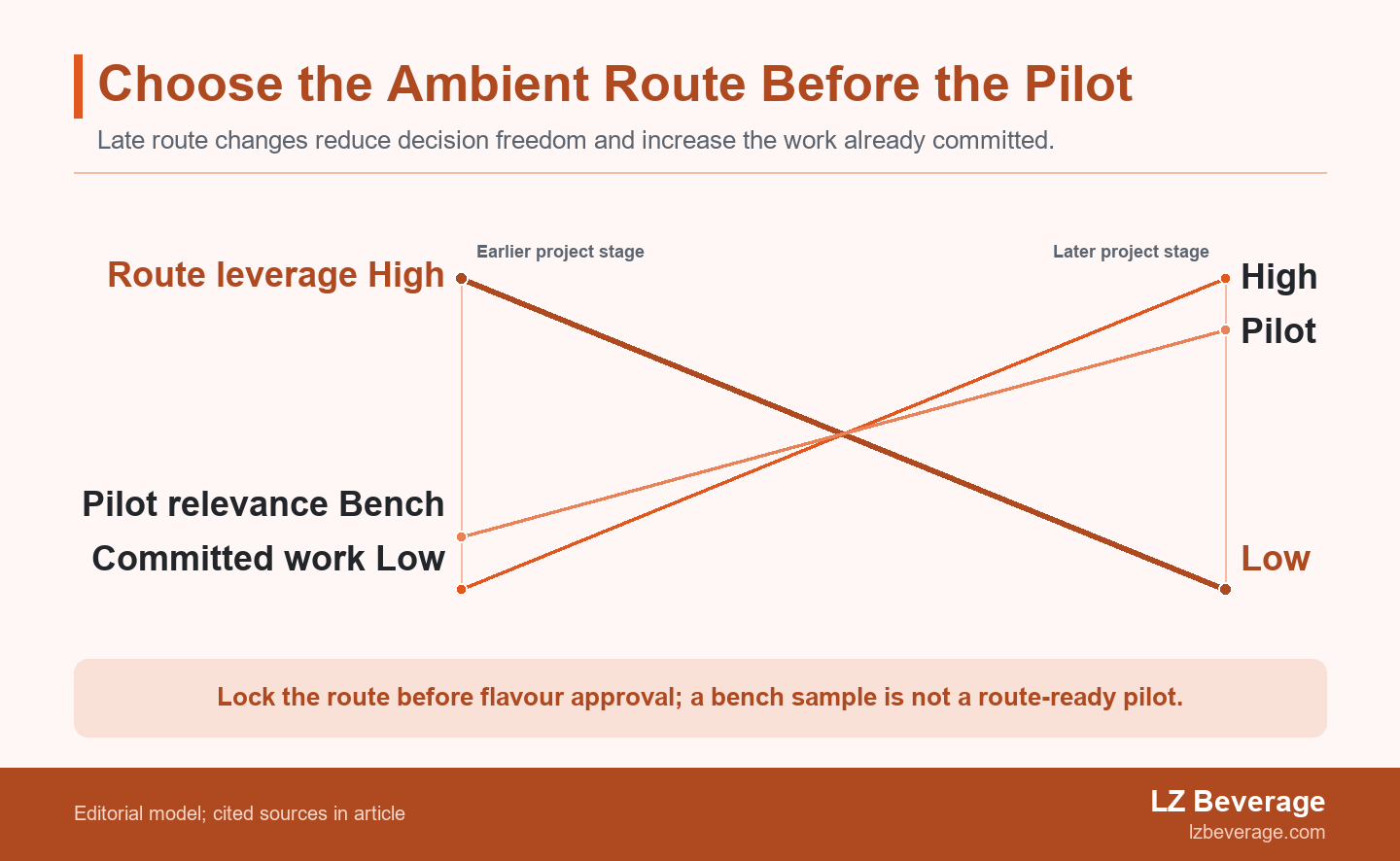
Cold brew tells you how coffee was extracted. It does not, by itself, tell you how a finished drink can travel, how long it can be stored, or which process-and-package system should be evaluated. For a product-development manager, that distinction changes the order of work: choose the intended commercial route first, then assess flavour on a sample that represents that route.
Choose the Route Before You Approve the Flavor
Cold-brew extraction is not a shelf-stable manufacturing route. A bench brew can be useful for deciding whether a roast, extraction profile, sweetness level, or dairy direction is worth pursuing. It cannot by itself demonstrate what the product will taste like after the intended commercial treatment, in the intended pack, or after the intended distribution conditions.
That is why a productive canned cold brew manufacturing brief starts with four decisions: the finished product condition, the route family, the pack, and the target market. Once those are named, a team can decide which sensory question a pilot should answer and which questions remain with qualified process and market reviewers.
- Classify the finished product before treating equipment as the answer.
- Compare sealed-can thermal, aseptic-system, and refrigerated paths as different commercial propositions.
- Judge flavour after the planned processing and pack conditions are represented.
- Open the destination-market file before artwork becomes difficult to change.
Start With the Finished Product Boundary
Start with the finished-product boundary. The first technical question is not “Which machine makes cold brew shelf stable?” It is “What finished product are we actually developing?” In the United States, FDA definitions for low-acid canned food and acidified food use finished equilibrium pH and water activity conditions; qualifying shelf-stable products in hermetically sealed containers also sit within a product- and process-specific framework. See the FDA acidified and low-acid canned-food guidance.
This does not mean a coffee developer should classify a concept from a spreadsheet. It means acidification, sweetener system, dairy or plant-base choice, water activity, intended pack, and final product condition must be treated as route inputs. “Cold brew” is not a regulatory category, and a can is not a process classification. A qualified processing authority should assess the actual formula and intended route where that review is required.
Write the product brief in finished-product language: black or milk-based, still or carbonated if relevant, target sweetness, acidity direction, pack size, ambient or refrigerated distribution, and destination market. That gives a manufacturer something more actionable than “smooth cold brew in a can.” It also makes it easier to review LZ Beverage coffee formats in the context of a defined product direction.
Compare Three Commercial Routes, Not Three Buzzwords
Compare route families as product-and-process systems. A route comparison should ask what each option changes in the product, process, pack, and evidence set. Cold-brew research itself treats sensory and microbiological questions as distinct parts of development; a preferred extraction profile is therefore one input, not the complete manufacturing decision. The cold-brew pilot study is useful context for keeping those questions separate.
| Route family |
What the buyer is choosing |
What the pilot must represent |
What it does not settle |
| Sealed-can thermal route |
The finished formula, the can, and the applicable in-container process as one system. |
Post-process flavour, appearance, pack condition, and the route-specific record path. |
A generic “retort capable” statement or a pre-process cup tasting. |
| Sterile process-and-fill route |
A product, sterile filling system, and package route that work together. |
The actual product-package combination and the intended system controls. |
A universal claim that one route will preserve every coffee profile better. |
| Refrigerated cold chain |
A different storage and distribution promise rather than an ambient workaround. |
Refrigerated sensory and distribution checks under the intended conditions. |
Ambient shelf-stability evidence. |
Choose one route family for the first commercial pilot. For an applicable shelf-stable food, commercial sterility refers to the process outcome the route is designed to establish for that intended food system. If the product direction or pack changes the route question, call that a new development decision instead of treating it as a minor sample revision. Teams comparing ready-to-drink concepts can also explore ready-to-drink format options once the route question is stated clearly.
Retort: Treat the Sealed Can as Part of the Process
Treat the sealed can as part of the process. For an applicable in-container canned route, the liquid is not evaluated in isolation from its container. FDA inspection guidance describes filing information that can include processing method, equipment, minimum initial temperature, processing time and temperature, evidence of adequacy, critical heat-penetration factors, and the source of the process. Those are route-specific evidence categories, not a heat setting to copy into a product brief. See FDA’s Guide to Inspections of Low-Acid Canned Food.
In plain language, a scheduled process is the documented set of operating conditions for one formula and container. The right supplier conversation is therefore not “Can you retort cold brew?” It is “For this proposed formula and can, what must be established before we can judge the processed pilot?” That keeps any sensory discussion anchored to the finished, sealed product rather than to an unprocessed extraction.
Flavour impact belongs in the pilot decision, but avoid turning it into a universal rule. Processing can change perceived roast, bitterness, sweetness balance, dairy integration, aroma, or colour depending on the actual product system. Set a short, explicit sensory scorecard for the post-process sample: aroma, first sip, mid-palate, finish, visual condition, and comparison against the target direction. If the score changes materially, revisit the route or formula rather than silently accepting a bench-sample-to-can gap.
Aseptic: Validate the System, Not Just the Liquid
Validate the system, not just the liquid. Aseptic processing is a route in which the product, relevant equipment, and package must be managed together during filling. It is not a marketing shorthand for “less heat,” and it is not an automatic claim for an unspecified package. For the buyer, the practical effect is simple: discuss product, sterile system, filling conditions, package suitability, and finished sensory result together.
Ask for a pilot plan that names the proposed format, the version being evaluated, the decision owner, and the sensory question that follows processing. This keeps the team from changing formula, pack, and route at once and then losing the ability to interpret why the finished result changed. FDA’s recordkeeping context is useful here: the FDA low-acid canned-food records guidance distinguishes retort and aseptic processing and packaging systems.
Cold Chain Is a Different Product Promise
Cold chain is a different product promise. Refrigeration can be a deliberate product route when the desired profile, distribution model, and operating economics support it. It should not be described as evidence for ambient shelf stability. A 2024 study of cold- and hot-brewed coffee evaluated chemical, microbial, and sensory changes over 42 days of refrigerated storage; its storage scope was refrigerated, and sensory deterioration limited the observed shelf life in that study. Read the refrigerated cold-brew storage study.
Sensory deterioration limited the observed refrigerated shelf life. That finding is valuable because it makes sensory stability a planned test, not because it supplies an ambient claim. If a shelf-stable pilot moves too far from the desired profile, the decision may be to reformulate, evaluate a different permitted route, or deliberately keep the product refrigerated. Those are distinct commercial choices. Do not use a refrigerated result to fill an ambient evidence gap.
Make the Pilot a Post-Process Sensory Test
Make the pilot a post-process sensory test. The most useful first commercial pilot is not the prettiest bench sample. It is the sample that tests one defined route against one defined sensory target. Before production, write down the formula version, the intended route family, pack format and size, storage proposition, market, planned sensory panel, decision owner, and which open questions are deliberately outside the tasting decision.
Process records and sensory acceptance answer different questions. Keep two records side by side. The sensory record should say whether the processed product is acceptable for the target direction. The route record should identify the product, code, date, system or equipment context, container, and the applicable processing information discussed for that route. FDA’s inspection guide describes batch-record context for applicable systems. A sensory score does not replace the second record, and the second record does not decide whether the target flavour is commercially right.
- Before the pilot: freeze the product version and state the specific sensory question.
- After processing: compare the finished product, not a memory of the bench brew, against the agreed target.
- Before scale discussion: list what remains to be validated for the route, pack, distribution, and market file.
This separation also improves partner comparison. The pilot brief should remain specific enough that every proposed route is being evaluated against the same question. A buyer who wants to understand the company context before a detailed discussion can see LZ Beverage's manufacturing background.
Open the Market File Before Artwork Freezes
Open the market file before artwork freezes. A technically promising can can still be market-incomplete. For prepacked food in the EU, food-information rules cover mandatory particulars and responsibilities; mandatory information must be presented in a language consumers can understand in the Member State where the food is marketed, subject to that market’s requirements. The European Commission explains the mandatory food-information framework, its language-and-presentation context, and nutrition-labelling guidance.
Put the target market, responsible reviewer, pack volume, nutrition input, ingredient and allergen questions, and artwork decision date in the same working file as the pilot. For EU prepacked foods, nutrition declaration presentation is generally expressed per 100 g or 100 ml. These sources define a market-specific context, not a substitute for product-specific legal or regulatory review.
When a Good Bench Sample Still Cannot Be Ranked
Reissue one common route-anchored pilot brief. A route-anchored brief prevents a team from ranking samples that answer different commercial questions. The following example is illustrative, not a customer case, process determination, market approval, or shelf-life result.
A good bench sample still cannot be ranked. A product-development manager has a preferred cold-brew direction for a 250 mL can and expects an initial order of 36,000 cans across two retail markets. Two bench samples taste close to the target. One proposal, however, is framed around a sealed-can thermal route and the other around a different package-and-system assumption. Neither sample is yet a like-for-like commercial comparison.
Illustrative Scenario: Reissue the Pilot Brief
The buyer is preparing a cold-brew coffee launch for two intended retail markets and needs one decision-ready pilot comparison.
The working assumption is one 250 mL canned SKU and an expected first order of 36,000 cans.
A preferred bench flavour exists, but the route family and final market file have not been fixed.
The samples are close in pre-process sensory terms.
They do not share the same container and evidence assumptions.
The samples answer a flavour question, not whether one formula, one pack, and one route can be compared commercially.
Pause supplier ranking and reset the pilot as a route-anchored test.
Issue one brief that names the product condition, markets, 250 mL can, route family, post-process sensory question, and open validation owners.
Advance only when the preferred finished sample, its route-specific records, pack context, and market-file owner point to the same next decision.
This is an illustrative planning model. Qualified processing and market reviewers determine the requirements for the actual product.
Hand an OEM/ODM Partner a Route-Ready Brief
Hand an OEM/ODM partner a route-ready brief. An OEM/ODM feasibility conversation becomes more useful when it begins with a defined decision instead of an unscoped request for “shelf-stable cold brew.” State the beverage type, target consumer, flavour direction, any functional role, pack format, route question, destination market, expected volume, and the sensory decision the pilot needs to answer. Then identify what still needs qualified technical or market review.
For LZ Beverage, that structure creates a practical way to discuss a coffee concept without implying that a formula, process, shelf life, label, price, or capacity has already been approved. It also lets both sides distinguish a bench-sample request from a commercial pilot request. Share the beverage type, target consumer, flavor direction, function, pack format, target market, and expected volume for an OEM/ODM feasibility review. To begin, start an OEM/ODM feasibility review with LZ Beverage.
Common Questions
Can a cold-brew coffee can use a retort route?
A retort route must be evaluated with the actual formula and can for the proposed beverage before a pilot can be compared. The useful next step is to define the finished product and ask which route-specific evidence must be established before sensory approval is treated as a commercial decision. Do not transfer a schedule or a result from another product into an unspecified coffee concept.
Is aseptic processing always better for cold-brew flavor?
No filling route is automatically better for flavor, because the finished result still depends on the intended product and package. It may be one route to evaluate, but it is not a universal sensory ranking. Compare the processed finished sample with the agreed target, and keep product, filling-system, package, and route-specific evidence questions visible in the same pilot brief.
Can refrigerated cold-brew testing prove ambient shelf life?
Refrigerated testing cannot prove ambient shelf life, because storage temperature, distribution, pack, and route must match the question being evaluated. If the cold chain is the chosen route, specify it deliberately and design its sensory and distribution checks around that promise. Record the intended temperature range and who owns each distribution assumption before the next pilot is evaluated.
What should an OEM cold-brew feasibility brief include?
A useful brief names beverage, pack, markets, route question, and expected volume before an OEM/ODM partner can frame a pilot discussion. It should also identify the target consumer, flavour direction, functional role, pilot decision, and which items remain open for qualified process or market review. That gives an OEM/ODM partner enough context to discuss practical next steps without presenting a bench sample as a finished commercial answer.


