A sugar-free canned coffee rarely fails because a team chose the “wrong” sweetener in isolation. It fails when claim wording, coffee finish, dairy-free base, flavor, and the intended canning route are approved as separate decisions. A better sugar free canned coffee formulation treats them as one system: decide what the finished product must be allowed to say, screen sweetness in the coffee it will become, then carry one selected system into a route-representative pilot.
Build the Product System Before You Choose the Sweetener
Build the claim route, sweetener route, dairy-free base, and process-matched sensory test as one product system. The useful question is not “Which sweetener tastes closest to sugar?” It is “Which sweetener-base-flavor system can meet the target market, survive the intended product route, and still give the desired coffee finish?” That framing prevents a promising bench cup from becoming a costly dead end once the base, process, or label wording changes.
- Lock the market claim boundary first. “Sugar-free,” “no added sugars,” and “reduced sugars” are not interchangeable project labels.
- Test the finish, not just sweetness onset. Coffee bitterness can expose a side taste that was not obvious in water or a quick bench sip.
- Treat dairy-free as a physical system. A creamy target depends on the behavior of protein, fat, water, coffee, and the intended process together.
- Approve flavor after the selected base and sweetener are stable. Then ask a pilot to prove the remaining product-and-process questions.
Start With the Claim and Finished-Product Boundary
Sugar-free, no added sugars, and reduced-sugars wording should be selected against the destination market and finished formulation before sensory sign-off. A nutrient content claim is a label statement that is allowed only when the finished food meets the applicable legal conditions. In the United States, FDA guidance states that a food using a sugar-free claim must contain less than 0.5 g of sugars per reference amount customarily consumed and per labeled serving; the same guidance also describes situations that need an accompanying disclosure. FDA’s sugar-free claim guidance is the right starting point for a US brief, but it is not a formula approval. For liquids, the European Commission sets a separate sugars-free condition of no more than 0.5 g of sugars per 100 ml and lists distinct conditions for related wording. The Commission’s nutrition-claim conditions show why one claim route cannot be assumed to fit every destination.
Do not use a “0 g total sugars” line as a shortcut for the sugar-free decision. FDA distinguishes the amount-statement rules from the conditions for specified sugar-content claims. Once the commercial team has written the target claim, serving, market, coffee direction, and pack into one brief, it is easier to review LZ Beverage coffee format options in the context of a real finished-product question rather than a generic “no sugar” request.
Choose a Sweetener Route by Its Coffee Finish
Screen a sweetener route for the coffee finish it creates after the intended process, not only for first-sip sweetness. A high-intensity sweetener delivers strong sweetness at a much smaller amount than sucrose. That tells an R&D team something about use level, but not whether the product will have a clean coffee finish. A temporal sensory study of nutritive and nonnutritive sweeteners found that sweetness and bitterness appeared earlier in its 60-second evaluation, while metallic, cooling, and drying perceptions followed later. The study’s temporal check-all-that-apply results do not predict a canned coffee outcome, yet they give a sound reason to score the finish over time rather than to rank samples by first sip alone. FDA also notes that sweeteners used in sugar-free or diet foods must be safe for their intended use; FDA’s overview of sweeteners makes intended use a brief input alongside sensory performance.
Start with two feasible directions, not a long ingredient list. One direction may prioritize a clean, direct sweetness profile; another may use a different sweetness system to build body or soften a particular finish. Keep coffee concentrate, target sweetness range, serving temperature, and test protocol fixed while comparing them.
| Screening question |
What to compare |
What a pass looks like |
What it does not prove |
| Sweetness onset |
Perceived sweetness at the planned serving temperature |
The coffee is recognizably sweet enough for its target consumer |
That the finish will stay balanced |
| Coffee finish |
Bitterness, metallic notes, drying, and lingering sweetness after swallowing |
Side tastes remain acceptable against the intended coffee profile |
That a dairy-free base or process will not change the result |
| System fit |
Selected sweetener with the intended base and flavor direction |
The route gives a repeatable sensory target worth taking to pilot |
Legal claim eligibility or commercial process validation |
The decision rule is simple: choose a sweetener route only after it has answered a coffee-specific finish question. Then preserve that route long enough to learn whether the dairy-free base changes it. If flavor is optimized after every sweetener swap, the team loses the ability to tell which variable created the improvement.
Treat Dairy-Free as a Product System, Not a Flavor Note
A dairy-free coffee base should be evaluated as a protein-fat-water system under the product's intended conditions. A dairy-free coffee is not simply black coffee plus a creamy flavor. An emulsion keeps oil droplets dispersed through a water-based beverage rather than separating into layers. Research on coffee mixed with soymilk found that concentration, temperature, and pH affected whether the studied mixture appeared as one phase or two. The coffee-soy study is not a specification for oat, pea, coconut, or any other plant base. A separate beverage-emulsion study examined one acid-soluble pea-protein system at pH 2.0 over 28 days and included heat treatment at 90 °C for 30 minutes. That emulsion research supports testing under the intended product conditions instead of assuming a base is stable because it looked good at the bench.
Dairy-free positioning does not itself resolve the applicable allergen declaration for the actual ingredients and production context. In the US context, FDA explains that applicable labels identify the food source of major allergens through the ingredient list or a Contains statement. FDA’s food-allergy guidance is a reminder to review the actual ingredients and manufacturing context, not to infer a labeling conclusion from “dairy-free” alone. For teams assessing who will make and test that system, it can be useful to see LZ Beverage's manufacturing background.
Approve Flavor Only After the Intended Process
Approve a flavor direction only after the selected base-sweetener system has been tasted after the intended process. Flavor should express the selected coffee system, not compensate for an unresolved one. A vanilla, caramel, mocha, or roasted profile may soften a perceived edge in a bench sample, yet it can also make the team overlook lingering sweetness, bitterness, or base instability.
Write acceptance criteria that a tasting panel can use consistently: first-sip sweetness, coffee aroma, mid-palate body, finish at a defined time point, visible appearance, and any physical observation relevant to the base. This is not a universal sensory scorecard. It is a way to make the flavor decision falsifiable. If the coffee finish is outside the agreed range, return to the sweetener-base system before adding another flavor note.
When a Good Bench Sample Fails the Canned Test
The four-cell screen holds coffee concentrate, pack, target process, and flavor direction constant while two sweetener directions are tested across two dairy-free base directions. Consider an illustrative composite scenario. An R&D manager reserves an initial 60,000-can pilot for a 250 mL sugar-free coffee intended for two retail markets. The team likes a vanilla bench sample, but the first processed version changes the sweetener, an oat-style base, and the flavor at the same time. It has an acceptable first sip, followed by a lingering finish and visible instability. The result is not a verdict on any one ingredient; it is an attribution failure.
A two-by-two sweetener-base screen can turn an uninterpretable failed sample into four comparable prototypes. The corrective move is to stop broad reformulation and reissue the screen. Hold coffee concentrate, pack, planned process, and flavor direction constant. Test two sweetener directions across two dairy-free base directions. Four cells are not a claim of commercial readiness, but they can show whether the next decision belongs to the sweetener, the base, or the interaction between them.
Illustrative Scenario: Reissue the Formulation Screen
The buyer is an R&D manager developing a 250 mL sugar-free canned coffee for two intended retail markets, with an early pilot volume of 60,000 cans.
One coffee concentrate and two possible flavor directions are available, but the first pilot should resolve the core sweetener-base system before a market-specific flavor range is widened.
A vanilla coffee bench sample is promising, yet the sweetener route and dairy-free base remain open decisions rather than approved product specifications.
The first processed sample introduces a new sweetener, a new oat-style base, and a new flavor in the same run.
The first sip remains acceptable, but the finish lingers and the beverage shows visible instability after the planned processing sequence.
Because three variables moved together, the team cannot tell whether the finish comes from sweetness timing, the base behavior, the flavor, or their interaction.
The team should not approve the flavor or scale the sample. It should return to a controlled two-by-two sweetener-base screen.
Keep the coffee concentrate, can, target process, and flavor direction fixed. Compare two sweetener directions across two base routes, using the same observation sheet for sensory finish and physical appearance.
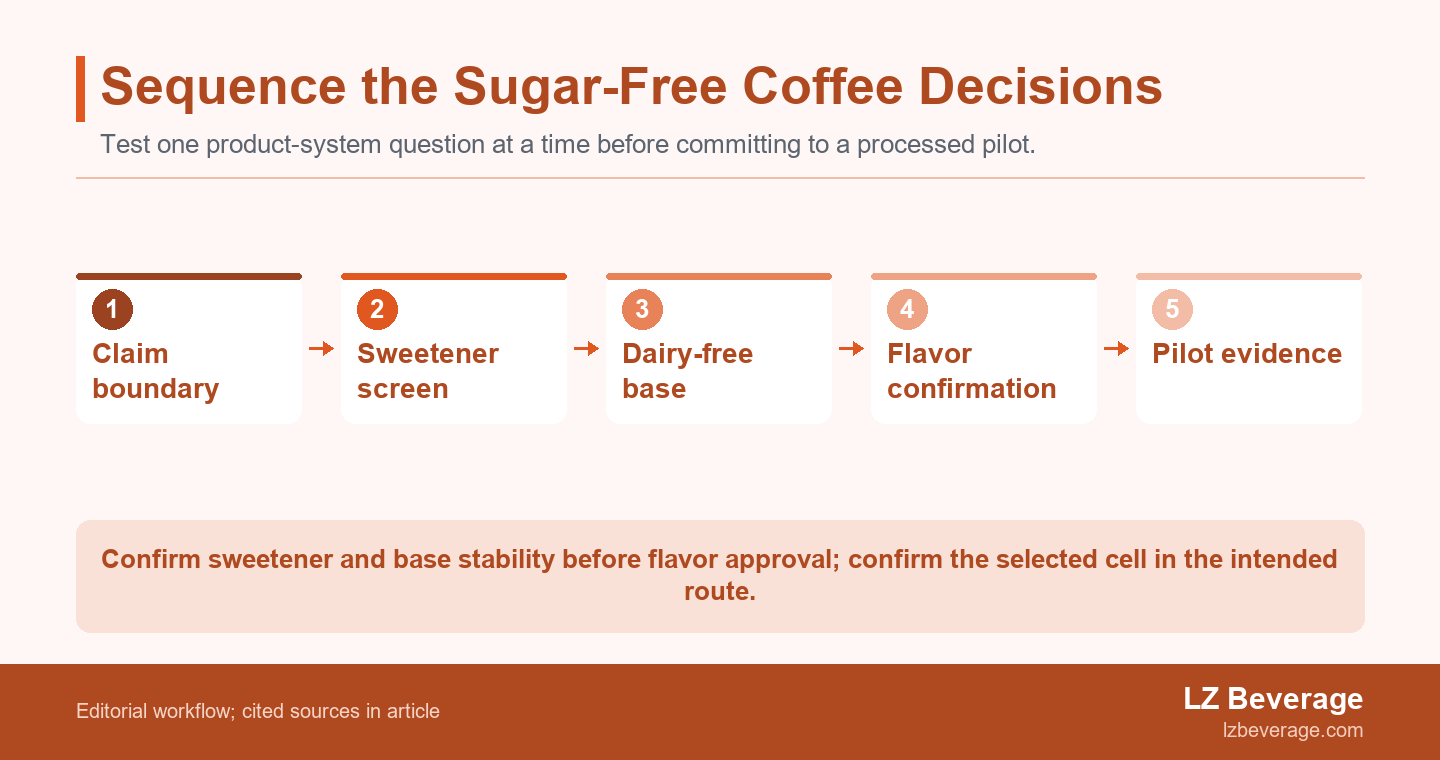
Select one cell only after post-process sensory and physical observations are reviewed against the target-market claim route; then carry that one system forward.
This composite scenario is a formulation-planning model. It does not validate shelf life, a commercial process, legal claim use, or a result for any particular ingredient supplier.
Make the Pilot Prove the Right Thing
For an applicable ambient canned route, sensory selection is separate from the product- and process-specific evidence needed for the intended food system. A selected sensory cell is a reason to run a better pilot, not evidence that an ambient canned product is ready. FDA identifies low-acid canned foods as having a finished equilibrium pH greater than 4.6 and water activity greater than 0.85 within its applicable framework. FDA’s canned-food guidance is relevant because formula, processing route, container, and market cannot be replaced by a successful sensory tasting.
A route-representative pilot should therefore answer two different questions. First, does the selected sweetener-base-flavor system still deliver the target coffee experience after the intended route? Second, what product- and process-specific work remains for the pack and market under consideration? Keep those questions separate in the pilot brief. The tasting protocol should retain the accepted finish criteria, the base appearance check, the can and distribution assumptions, and the market wording that framed the project. It should also identify whether the trial is intended to resolve product fit, process fit, pack fit, or a remaining label review. A result that improves only first-sip sweetness is not enough if it leaves the visible base behavior or the planned claim unresolved. This protects the team from treating a pleasant cup as a shelf-life, labeling, or safety conclusion.
Before scheduling that pilot, assign an owner to each observation and decision. Product development owns the target sensory profile and the formulation variables. Packaging and operations own the assumptions that must match the selected can route. Regulatory review owns the destination-market wording and any label questions that remain open. The pilot record should show which variables were fixed, which were intentionally changed, the result for each observation, and the condition for moving forward. That record gives the next team a usable comparison instead of a memory of which sample seemed most pleasant in a short tasting.
With those parameters in place, the team can explore ready-to-drink format options around a named pilot objective, pack, and product system rather than a broad request for canned coffee.
Hand an OEM/ODM Partner a Formulation-Ready Brief
A feasibility discussion becomes useful when it contains the market claim, base, sweetener route, pack, process question, and sensory target. An OEM/ODM feasibility conversation becomes useful when it starts with decisions already made and uncertainties named plainly. Share the beverage type, target consumer, flavor direction, function, pack format, target market, and expected volume for an OEM/ODM feasibility review. Add the preferred sugar-related wording, coffee direction, sweetener-base screen, intended distribution, and the one question the pilot must answer.
That handoff does not guarantee a formula, claim, process, or timeline. It gives the manufacturing conversation a clear starting point: one defined product system, one market boundary, and one next validation decision. When those inputs are ready, start an OEM/ODM feasibility review with LZ Beverage.
Frequently Asked Questions
Short answers about sweetness, sugar wording, dairy-free labeling, and OEM briefs should preserve the product-system boundaries established in the guide. The following questions keep the same sequence: first define the market claim, then select a coffee system, then ask a matched pilot to confirm what remains.
Can a canned coffee be sugar-free and still taste sweet?
Yes, but the useful question is whether the selected sweetener produces an acceptable coffee finish after the intended process, not whether it tastes sweet in isolation. A viable route is usually screened for sweetness onset, bitterness, lingering sweetness, drying or metallic notes, and compatibility with the selected base. The product can taste sweet and still fail its coffee target if the finish is out of range. Ask the panel to name the change and its timing, then compare that observation with the target profile before changing flavor.
Is sugar-free the same as no added sugars?
No. The terms can have different legal conditions, so the selected wording should be checked against the rules of the destination market and the finished formulation. “No added sugars” can still involve naturally occurring sugars, while a sugar-free claim has its own defined conditions. Record the wording and market in the formulation brief before packaging or flavor approval makes a change harder. If distribution spans more than one market, ask for separate label review rather than treating one wording decision as portable.
Does dairy-free automatically mean allergen-free?
No. A dairy-free positioning choice does not remove the need to identify applicable allergens from the actual ingredients and production context. The base may introduce its own ingredients and the final label review depends on the destination market. Treat dairy-free as both a sensory-and-stability choice and a labeling-review trigger, rather than as a complete allergen statement. The pilot brief should state the actual base and intended label market so this review does not get deferred to an artwork deadline.
What details should an OEM pilot brief include for sugar-free coffee?
Include the target market and claim wording, coffee direction, sweetener route, dairy-free base if relevant, pack, intended distribution, expected volume, and the post-process sensory question. State what is fixed and what remains open. That lets a partner assess a defined product system instead of guessing whether the next prototype should solve sweetness, base stability, flavor, pack compatibility, or a market-label question. It also gives the team a clear rule for deciding whether the next round should be a formulation screen or a route-representative pilot.


