An RTD coffee scale-up is a new evidence system because the matrix, package, process, and storage history can change aroma, sediment, and oxidation together. A bench sample can be useful for choosing a coffee direction, but it cannot prove that a sealed, processed product will keep the same aroma, remain physically stable, or behave the same way through its intended storage route. The practical job is to make the next pilot answer one linked question: what changed, what evidence identifies it, and what condition can safely move forward?
Scale-Up Changes the Evidence, Not Just the Batch Size
An RTD coffee scale-up is a new evidence system because the matrix, package, process, and storage history can change aroma, sediment, and oxidation together. The most useful brief therefore does not list three defects and three remedies. It locks the coffee matrix, intended package, process question, storage exposure, and release observation into one comparison set. A result then has a context: it belongs to a specified product condition rather than to “coffee” in general.
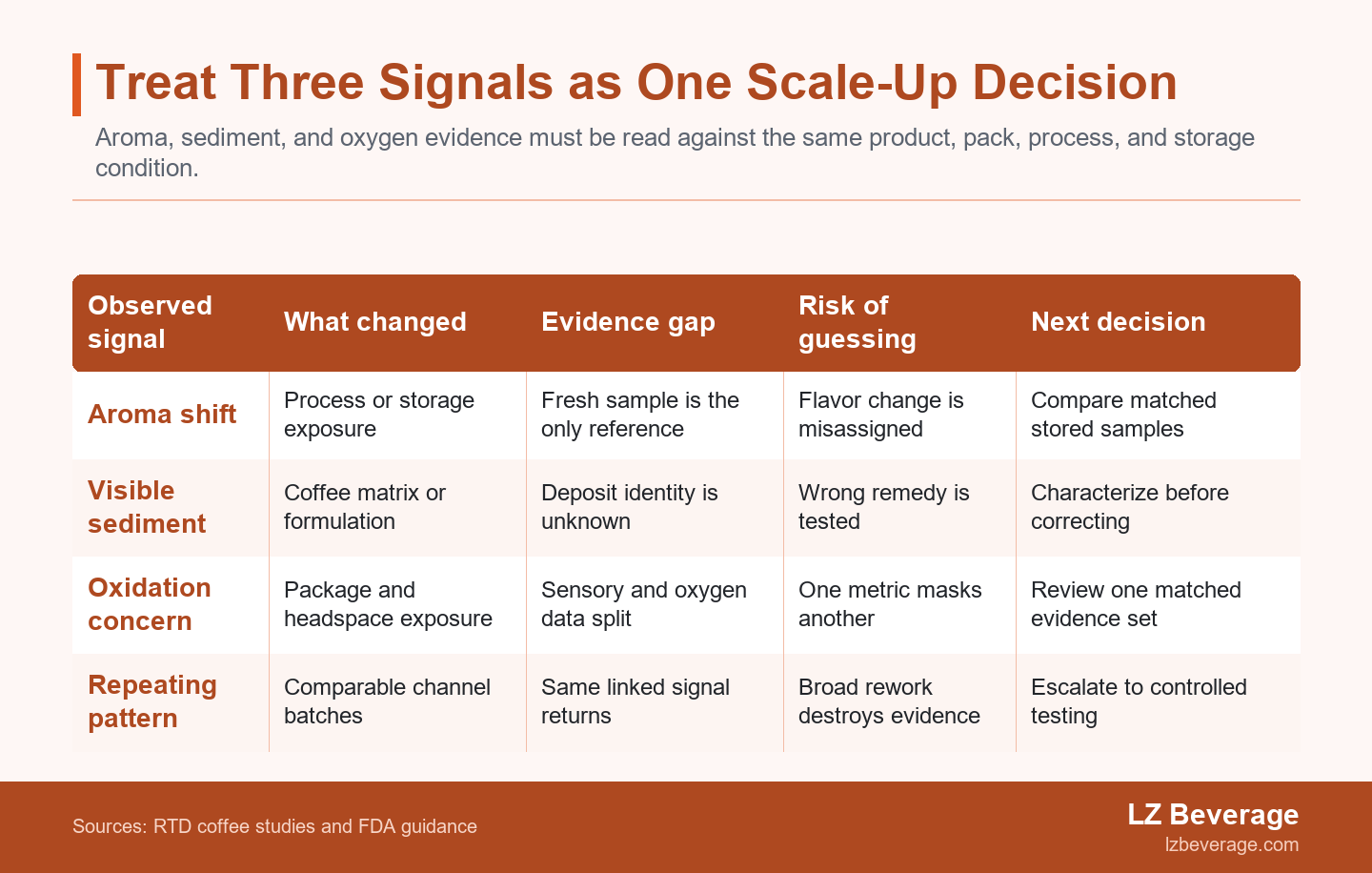
- Approve a condition, not a fresh sample. Aroma, appearance, and oxygen observations need the same process-representative reference.
- Identify a deposit before correcting it. A visible layer is evidence of a physical change, not proof of its cause.
- Escalate a repeating pattern. If a comparable batch shows the same linked change again, preserve the evidence before adding more variables.
This framing changes the role of the manufacturing discussion. Instead of asking for a larger version of a preferred laboratory cup, a buyer can review RTD coffee format options with LZ Beverage after defining which formula, pack, and technical question the pilot must test. That makes a coffee category conversation more specific without claiming that a particular formula or shelf life has already been validated.
Treat Aroma and Oxygen as One Storage Question
Published coffee studies show that storage conditions can change volatile profiles and sensory outcomes, so RTD aroma should be reviewed under defined storage exposure. In one RTD coffee study, all aged samples were significantly different from non-aged samples in degree-of-difference sensory testing. That result does not supply a commercial shelf-life target, but it does rule out a common shortcut: treating a pleasing fresh aroma as sufficient evidence for a stored product.
A second study compared coffee held at 5 degrees C and 20 degrees C for one month. Its researchers reported that lower-temperature storage slowed changes in coffee volatile compounds and helped preserve desired aroma and flavour characteristics. The useful lesson for an RTD project is not to copy those temperatures into a production specification. It is to decide, before the pilot, which storage condition, sensory attributes, and elapsed time will make an aroma comparison meaningful for the intended distribution route.
Measure oxygen-related observations alongside process-matched sensory samples because they belong to the same storage decision, not because one metric can replace the other. Headspace is the gas space inside a sealed package above beverage. It belongs in the comparison record with the package, fill condition, processing route, and storage checkpoint. A lower reading, a cleaner first sip, or a better retained roast note is not a stand-alone verdict. The development team still needs to ask whether those observations came from the same representative condition and whether any changed factor has been isolated.
A practical aroma record can be short: name the desired opening note and finish, retain a process-matched reference, set the storage checkpoint, and record the package and oxygen observations next to the sensory result. This avoids a late-stage argument in which the flavor team, packaging team, and process team are comparing different samples while using the same word, “oxidation,” for different concerns.
When that record is ready for a process-representative conversation, the prospective partner’s operating context belongs in the evaluation. Decide first whether the next discussion is a feasibility review, an analytical question, or a pilot request; then see LZ Beverage's manufacturing background.
Identify Sediment Before You Try to Remove It
A 2024 peer-reviewed article assessed the physical stability of cold-brew coffee in retorted beverage systems, underscoring that physical stability is a distinct RTD coffee question. That scope matters. A deposit that appears only after a process or storage condition may not be visible in a retained bench bottle, so an appearance-only decision can send the next trial in the wrong direction.
RTD coffee sedimentation research reported galactomannan crystallization and protein-polyphenol interactions as two distinct mechanisms. A precipitate is material that comes out of the beverage system and collects as a visible deposit or haze. The source does not mean every black coffee and every latte follows the same route; it means that the observed material, extraction context, and formula type matter before a team assumes that more filtration, a stabilizer, or a broad ingredient change is the answer.
Start by preserving samples from the relevant conditions and recording where the material appears: immediately after processing, after a defined storage point, or only in one pack condition. Then separate the observation from the hypothesis. “There is a deposit” is an observation. “It is a particle-size problem” or “it is a protein interaction” is a hypothesis that needs a comparison. This distinction protects the next pilot from becoming a stack of untraceable changes.
Choose the Next Test by the Evidence Gap
Choose the next trial to distinguish one evidence gap, such as particle origin, aggregation pathway, or process exposure, rather than to test several remedies at once. The table is a development rule, not a prescribed laboratory protocol. Its purpose is to make the next comparison capable of ruling something in or out.
| Observed condition |
Evidence gap |
Keep fixed |
Next useful comparison |
| Deposit appears after storage |
Material has not been characterized |
Pack format, sensory checkpoint, storage exposure |
Preserve and characterize the deposit before changing several formula variables |
| Haze appears after a process change |
Process exposure is confounded with ingredient changes |
Coffee style and base formula |
Compare one process-representative condition against its matched reference |
| Only one formula family shows instability |
Interaction is not yet isolated |
Storage point and package direction |
Vary one matrix or extraction factor at a time |
Based on this comparison, the best next test is the one that removes the largest unknown while leaving the remaining evidence interpretable. A trial that changes filtration, extraction, base ingredients, and pack conditions together may look productive, yet it can leave the team unable to explain why the result improved or worsened.
Illustrative Scenario: Escalate a Repeating Failure
When the same sediment and aroma pattern repeats across comparable channel batches, preserve the evidence and escalate to a controlled comparison rather than broad reformulation. The trigger is repetition under comparable conditions, not a predetermined number of weeks or a particular amount of sediment. That keeps the escalation tied to what the pilot has actually shown.
Illustrative Scenario: Preserve the Evidence Before Reformulating
Keep the sensory panel, package format, and storage checkpoint fixed while one factor at a time is compared and the recurring deposit is characterized. The following is an illustrative composite example, not a client case.
An R&D manager is moving a black RTD coffee from bench bottles to 250 mL cans for an ambient-distribution feasibility study.
The initial pilot reservation is 48,000 cans split across two channel batches and one intended coffee style.
The first processed cans have a clean opening aroma, but a light deposit and flatter finish appear after storage in both channel batches.
The deposit is not present in the retained bench bottle, so a bench-only filter test cannot identify its cause.
The second channel batch shows the same deposit pattern and a weaker roast note at the same planned storage checkpoint.
Because the pattern repeats across two channel batches, another broad recipe adjustment would confound the product, process, and storage evidence. The decision should move from local correction to a mechanism-specific escalation.
Do not approve the next 48,000-can condition as a routine repeat; preserve samples and escalate to a comparison that isolates coffee extraction, pack oxygen exposure, and precipitate identity.
Run a matched set with one controlled factor per comparison, characterize the deposit, and keep the sensory panel, package format, and storage checkpoint fixed.
Advance only when the recurring pattern is absent or its mechanism is understood and the selected correction is verified under the same process-representative conditions.
This example does not validate a commercial process, establish shelf life, or represent LZ Beverage production data.
Turn the Pilot Into a Process-Representative Release Question
For products that fall within the applicable US shelf-stable acidified-food or low-acid canned-food scope, FDA materials make the product, container, and process basis part of the commercial decision. FDA states that commercial processors of shelf-stable acidified foods and low-acid canned foods in hermetically sealed containers sold in the United States must register establishments and file scheduled processes. The cited requirement concerns a documented, product-specific, package-specific process basis rather than a generic manufacturing assumption. Applicability depends on the actual product and route; a technical guide cannot determine that scope for an individual formula or market.
The same boundary explains why a pilot should be designed around the intended product condition. In the FDA inspection guidance, changing product formulation, the container, or another condition basic to process adequacy requires prior confirmation of process adequacy in the described scope. That is not a universal instruction for every country or RTD route. It is a clear reminder that a formula, pack, or process change may alter more than sensory evidence when a product enters an applicable shelf-stable regulatory path.
For project planning, treat the chosen product condition as a release question: what does this pilot need to prove for this coffee matrix, this package direction, this intended process, and this distribution plan? If the commercial route is still open, the buyer can compare beverage product categories for the pilot route before freezing an assumption into the formula brief.
Hand Over a Brief That Can Be Tested
A useful scale-up brief names the coffee style, matrix, target market, package direction, intended distribution, volume, and the exact aroma, sediment, or oxidation question that the pilot must resolve. Add the reference sample, the proposed storage checkpoint, and the known boundary: for example, whether the team is comparing a retained bench sample with a processed can, or whether it is trying to identify a recurring deposit. These inputs let an OEM/ODM partner discuss feasibility without pretending that a formula or process outcome is already known.
For the applicable FDA process context, critical factors specified in a scheduled process must be measured and recorded at sufficient frequency. That is a scoped US process-record point, not a formula, shelf-life, or market-approval determination. It does show why a pilot brief should name the process factors that are still open instead of treating them as settled manufacturing assumptions.
Before a feasibility conversation, turn that list into a one-page comparison record. Give each trial a condition name; list what stayed fixed; identify the one factor under review; and note how the sensory, visual, and package observations will be compared. Include any non-negotiable commercial boundary, such as an intended market, pack direction, distribution assumption, or pilot-volume range. If a process or regulatory question remains open, label it as a question rather than filling the gap with a desired answer. This record does not replace technical validation, but it makes the first manufacturing discussion more likely to end with a defined next test instead of a broad request for improvement.
For LZ Beverage, the productive starting point is a request that describes the beverage type, target consumer, flavor direction, function if relevant, pack format, target market, expected volume, and the open technical question. A buyer with that packet can review ready-to-drink feasibility with a defined scale-up brief.
FAQs
Short scale-up answers should preserve the product-system, evidence, and market-specific process boundaries established in the main article. They are useful for narrowing a next decision, but they cannot replace product-specific technical, regulatory, or shelf-life review.
What should be fixed before an RTD coffee pilot?
Fix the coffee style, matrix, package direction, intended process question, and storage comparison before judging whether a pilot has produced usable evidence. The team can still investigate one controlled variable, but it should keep the reference condition, sensory checkpoint, and observation method stable. Name the decision that the run is meant to inform and the evidence that would prevent a release. If the purpose of the run keeps changing, the result may be interesting without being usable for a commercial decision.
Is sediment always a filtration problem in RTD coffee?
No, visible sediment can reflect different material and process pathways, so the deposit should be identified before filtration or a formula change is chosen. A filter trial may be relevant after the team knows what it is trying to distinguish. Retain and label representative samples, record when the material appears, and compare only one controlled factor where possible. It is a weak first response when the product, process exposure, and storage condition have all changed at the same time.
How should a team evaluate oxidation without masking aroma loss?
Compare matched processed samples at defined storage points and record both sensory change and oxygen-related observations, rather than approving a fresh aroma sample on its own. The comparison should name the package and condition under review. Use the same sensory reference, panel instructions, and checkpoint for the samples being compared. This keeps the team from treating an oxygen observation as a substitute for tasting, or a positive tasting note as proof that every storage-related risk has been resolved.
When should an RTD coffee pilot be escalated?
Escalate the pilot when a comparable batch pattern repeats and the team cannot attribute the result to one controlled factor, because another broad adjustment would weaken the evidence further. Preserve the relevant samples, state the evidence gap, and choose the next comparison to distinguish one plausible mechanism. Record why the batch conditions are comparable and what result would close the open question. That is often a better use of the next pilot than changing the coffee, process, package, and storage plan all at once.


