A coffee energy drink succeeds when its energy promise and coffee experience reinforce each other in the same can. The first decision is not which flavor to add or which functional cue to emphasize. It is whether the declared serving, total caffeine, coffee identity, package route, and target market can all be explained as one product. That framing gives an innovation manager a cleaner prototype brief and gives an OEM/ODM discussion a real question to resolve.
What Has to Agree Before a Coffee-Energy Concept Moves Forward?
- One declared-serving number: coffee-derived and added caffeine belong in one total-caffeine position.
- One coffee architecture: the base, matrix, aroma target, and functional flavor boundary should be defined together.
- One packaged evidence set: sensory approval has to reflect the intended pack, process question, storage checkpoint, and target market.
Start With One Total-Caffeine Position
A coffee energy drink needs one total-caffeine position per declared serving, because coffee-derived and added caffeine contribute to the same consumer exposure . FDA consumer guidance treats caffeine as something people encounter across coffee, energy drinks, and other foods and beverages. The formulation brief should therefore record every caffeine input against the same declared serving before the team decides what the product promises.
A ready-to-drink (RTD) beverage is sold ready for the consumer to drink. That definition is why the serving statement, coffee system, and packaged route need to be considered together instead of as separate ingredient decisions.
Make the Serving the Reference Point
Start with the package the consumer will actually buy, not a bench cup or a raw-material specification. Record the intended serving size, the caffeine contribution expected from the coffee component, any added caffeine source, and whether a botanical or other ingredient could change the way the product is presented. This is a product-position ledger, not a health recommendation. It does not tell a brand which amount to choose; it makes clear which amount the product is asking the consumer to understand.
Fixing total caffeine and serving definition first makes later coffee flavor trade-offs easier to interpret. When the total changes during development without being recorded, a richer coffee base can look like a sensory improvement while quietly changing the product's consumer-facing position. Assign one owner to the ledger and keep the target market beside it, because label treatment and permitted presentation are not the same in every route.
Separate Positioning From a Performance Claim
“Coffee energy” can describe a category concept, but it should not become a shortcut to unsupported promises about alertness, endurance, or health. A practical brief uses plain commercial language: who the intended adult consumer is, when they might drink it, what coffee experience they expect, and what functional role the brand wants the product to signal. That keeps marketing language from deciding the formula before the technical and market review has happened. It also gives reviewers one fixed product description to compare clearly with the eventual label and sales materials.
Define the Coffee Experience Before Adding Energy Cues
In formulated coffee beverages, coffee level and fat level can influence aroma acceptance, showing why a coffee-energy concept needs a defined matrix . In one consumer study of nine coffee-flavored dairy formulations, researchers varied coffee and fat levels and evaluated aroma acceptance with regular coffee consumers. The point is not to borrow a recipe from that study. It is to recognize that a coffee note is interpreted through the rest of the beverage system.
Give Coffee a Job in the First Sip
Decide whether the product should open as roasted and dark, smooth and creamy, bright and cold-brew-like, or lightly coffee-forward with another leading flavor. Then name the coffee base or extract direction, roast expectation, sweetness boundary, acid balance, and matrix. “Coffee flavor” alone is not a workable sensory instruction. It leaves the formulator unable to tell whether a later change is correcting the coffee experience or merely covering it.
A coffee architecture should specify the coffee base, roast direction, matrix, aroma target, and functional flavor boundary before a prototype is judged. For a black RTD direction, the brief may prioritize roast clarity and finish. For a dairy or plant-based direction, it should explicitly ask how the matrix carries aroma and texture. The answer can differ, but the question must be stable across prototypes.
Use Energy Cues as a Boundary, Not a Mask
Functional flavor cues can make a concept feel fresher, sharper, or more energetic. They become a problem when they conceal a thin, harsh, or inconsistent coffee foundation. A useful sensory panel question is therefore not simply “Do you like it?” Ask whether the coffee identity is still recognizable, whether the energy cue changes the finish, and whether the result matches the intended consumer occasion. This makes sensory feedback diagnostic rather than a vote on a vague concept. It also reveals whether the coffee system is carrying its own sensory job.
Validate the Combined RTD System
RTD coffee storage can alter sensory outcomes, so a fresh bench sample cannot by itself validate a packaged coffee-energy system . A study of canned RTD coffee found that aged samples differed from non-aged samples in sensory testing after controlled storage; its authors compared air and nitrogen processing conditions as part of the work. Read the RTD coffee storage study for the experimental context. That does not establish a shelf life for a new product, but it does explain why a fresh tasting cannot close the development question.
Storage conditions also change coffee more broadly. A later coffee volatile-profile study reported different sensory and volatile changes at different storage temperatures. Treat that as a reason to define the actual checkpoint that matters to the intended route, rather than as a universal storage prescription.
Compare the Same Product Question
The right comparison keeps the declared serving, coffee architecture, package direction, and intended storage checkpoint visible in one evidence set. Record what changed between candidates, what stayed fixed, and which observation would make the next decision clearer. In a sealed package, headspace means the gas space inside the sealed package above the beverage. It belongs in the development record when package exposure is part of the question, but it should not be used as a stand-alone explanation for every flavor change.
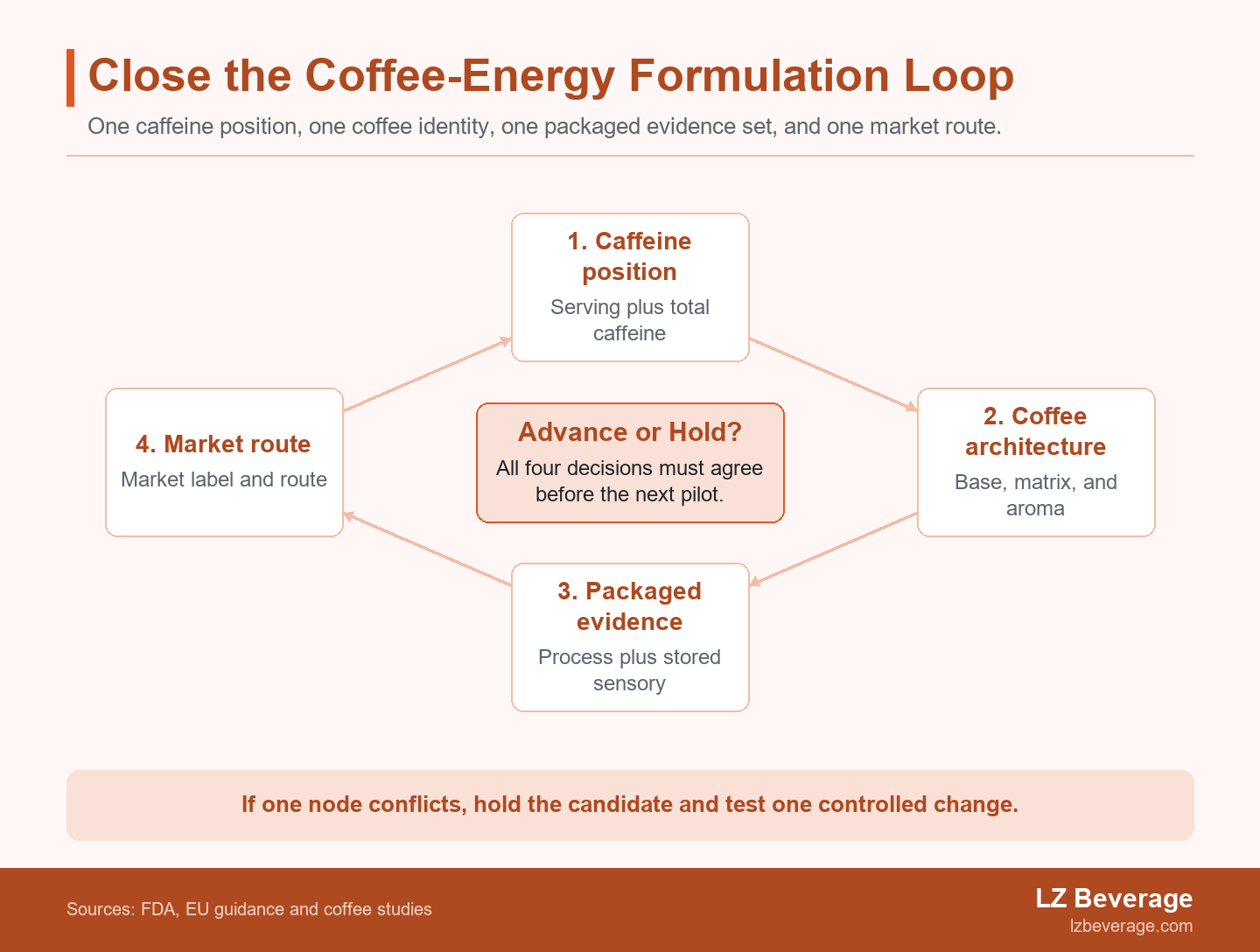
This is where the project changes from ingredient selection to RTD development. The target pack, process route, distribution assumption, sensory protocol, and label brief should travel with the same prototype code. For category context after that system has been defined, buyers can review the RTD beverage range.
Bring Market and Process Boundaries Into the Brief
For an EU route, Regulation (EU) No 1169/2011 contains a high-caffeine beverage information framework at more than 150 mg/L, subject to its stated exceptions . The consolidated EUR-Lex text is the right place to verify that limited statement and its exceptions. It is not a substitute for qualified review of the finished product, but it is enough to show why the target market should appear in the first concept brief.
Do Not Treat a Can as a Process-Neutral Container
For products within the FDA's stated US shelf-stable acidified or low-acid canned-food scope, product, container, and process details can affect registration and scheduled-process filing obligations . In this context, a scheduled process is a process basis established for the specific product and package within the applicable scope. The FDA's guidance page on acidified and low-acid canned foods defines that scope and its filing context. Not every coffee energy drink belongs in it. The practical lesson is that product, pack, and intended process cannot be separated once the route is being evaluated.
Where the applicable route calls for a documented process basis, ask early which technical authority, market reviewer, and manufacturer records need to align. Keep the decision tied to the actual product and pack rather than to a generic line setting copied from another drink. A buyer who needs provider context can also see the LZ Beverage factory background.
Illustrative Example: Keep Two Candidates Testable
When two candidates conflict on sensory preference and system evidence, holding the ambiguous candidate preserves a controlled comparison. This example is illustrative, not an LZ Beverage customer case and not a formula specification. An innovation manager has 2 candidate formulas in 250 mL cans for 2 intended markets and a 12,000-can pre-pilot reservation. Both candidates share the same declared serving and intended total-caffeine position. Candidate A has a darker roasted profile. Candidate B wins a fresh bench aroma preference.
Hold One Variable Still
Keep the serving, coffee base, pack direction, and target market fixed while one flavor-architecture change is compared.
The buyer needs a concise comparison for an initial cross-market feasibility discussion, not a declaration that either candidate is commercially ready.
The 12,000-can reservation is divided between 2 candidate formulas in 250 mL cans for 2 intended markets, creating enough structure to compare rather than blend the options.
Both candidates have coffee briefs, yet neither has a processed and stored sensory record tied to its market review path.
Candidate B has the stronger fresh aroma preference, while its information review for the coffee-plus-added-caffeine description remains open.
Candidate A has the clearer roasted cue, while its planned package and storage checkpoint have not yet been compared with the bench sample.
A combined adjustment would make it impossible to know whether the next result came from the coffee system, the functional cue, the package exposure, or the changed market brief. The two candidates need to remain traceable.
Hold the ambiguous candidate. Advance only the path whose declared serving, market review, and process-matched sensory evidence can be made consistent.
Run one controlled comparison that changes only the documented flavor architecture while the coffee base, serving, pack direction, and target market remain fixed.
Review the serving ledger, qualified label assessment, and matched sensory evidence after the intended process and storage checkpoint before choosing the next pilot.
This example does not validate shelf life, establish a commercial process, or predict a formula outcome. Qualified teams must define the actual conditions.
Hand an OEM/ODM Partner a Feasibility-Ready Brief
An OEM/ODM feasibility brief becomes useful when it names the beverage type, target consumer, flavor direction, function, pack format, target market, expected volume, and open pilot question. Those inputs turn “coffee energy drink” from a category label into a development conversation. For the coffee component, a buyer can compare coffee product directions after deciding what the coffee experience must do in the finished concept.
Send the Question, Not Only the Wish List
- Beverage type and target consumer: state the intended adult use context without making an unreviewed performance claim.
- Flavor direction and function: name the coffee architecture, the energy cue, and which one must lead the first sip and finish.
- Pack format and target market: identify the intended can or other pack direction, market route, and any route-specific question already known.
- Expected volume and pilot uncertainty: state the scale being explored and the single question that testing must answer, such as coffee identity after processing or the clarity of the caffeine presentation.
In an initial feasibility call, separate requirements from assumptions. A requirement is the declared serving, the target market, or the pack direction that cannot move without resetting the brief. An assumption is a coffee note, energy cue, or processing checkpoint that needs comparison. Naming that difference keeps the first discussion focused on what must be held constant, what can be tested, and which result will consistently change the next decision. It also prevents a plausible sample from being mistaken for a confirmed route-to-market answer.
A feasibility review should identify what the pilot needs to resolve instead of treating a flavor name as a complete manufacturing brief. LZ Beverage can use the beverage type, target consumer, flavor direction, function, pack format, target market, and expected volume to frame an OEM/ODM discussion. When those inputs are ready, request an energy drink feasibility review.
FAQs
Should coffee caffeine and added caffeine be counted together?
Yes, the formulation brief should count coffee-derived and added caffeine together against the declared serving so the product has one defensible caffeine position. That does not set a universal target amount. It simply keeps the consumer-facing exposure, formulation ledger, and market review from being split into separate stories within one documented product position.
Can a coffee flavor prove that a drink will taste like coffee?
No, a coffee flavor name cannot prove the finished experience because the coffee base, matrix, processing exposure, and storage all shape how the aroma is perceived. Use the flavor name as a starting direction, then confirm the coffee identity with a packaged comparison that reflects the intended product route rather than a bench-only impression.
When should market labeling be checked for a coffee energy drink?
Check the target market before the formula is treated as final, because caffeine disclosures, warning language, and permitted claims can change the design brief itself. The right timing is when the declared serving, caffeine sources, pack direction, and intended route are clear enough for qualified market-specific review before artwork or selling language is finalized.
What should an OEM or ODM feasibility request include?
Include the beverage type, target consumer, flavor direction, function, pack format, target market, expected volume, and the exact uncertainty you want the pilot to resolve. That lets the manufacturer discuss realistic development questions while leaving final formula decisions and market conclusions to qualified teams with the complete product and route information.


