A fruit drink brief becomes risky when juice content, sweetness, and shelf life are approved as separate choices. A percentage on a concept sheet, a preferred tasting sample, and a quoted shelf-life target can still describe different commercial products. A better manufacturer comparison starts with one connected brief: fruit base, sensory target, process-and-pack route, and the evidence still needed for the destination market.
Private Label Fruit Drink Manufacturer: Start With One Connected Brief
A fruit drink brief becomes risky when its core attributes are approved separately. The fruit base affects texture, flavour release, and the questions a technical team must resolve. Sweetness changes with acid, aroma, and serving experience. Shelf life depends on a defined product, process, package, storage assumption, and validation plan. If one of those pieces changes without the others, two manufacturers may appear to quote the same SKU while answering different technical questions.
Before requesting samples, name the commercial decision you need to make. Is the sample meant to select a mango profile, confirm a juice-base direction, compare two packs, or begin a feasibility discussion for one target market? That sentence keeps a tasting exercise from being mistaken for product approval. It also gives each supplier permission to mark an open issue rather than hiding it behind a broad promise.
What a Comparable Manufacturer Response Must Show
A comparable response states the product, sensory, process-pack, and evidence assumptions together. Use the four gates below to judge whether a quotation or sample can move forward. A blank gate is not necessarily a rejection; it is a reason to keep the request in concept screening until the missing question has an owner.
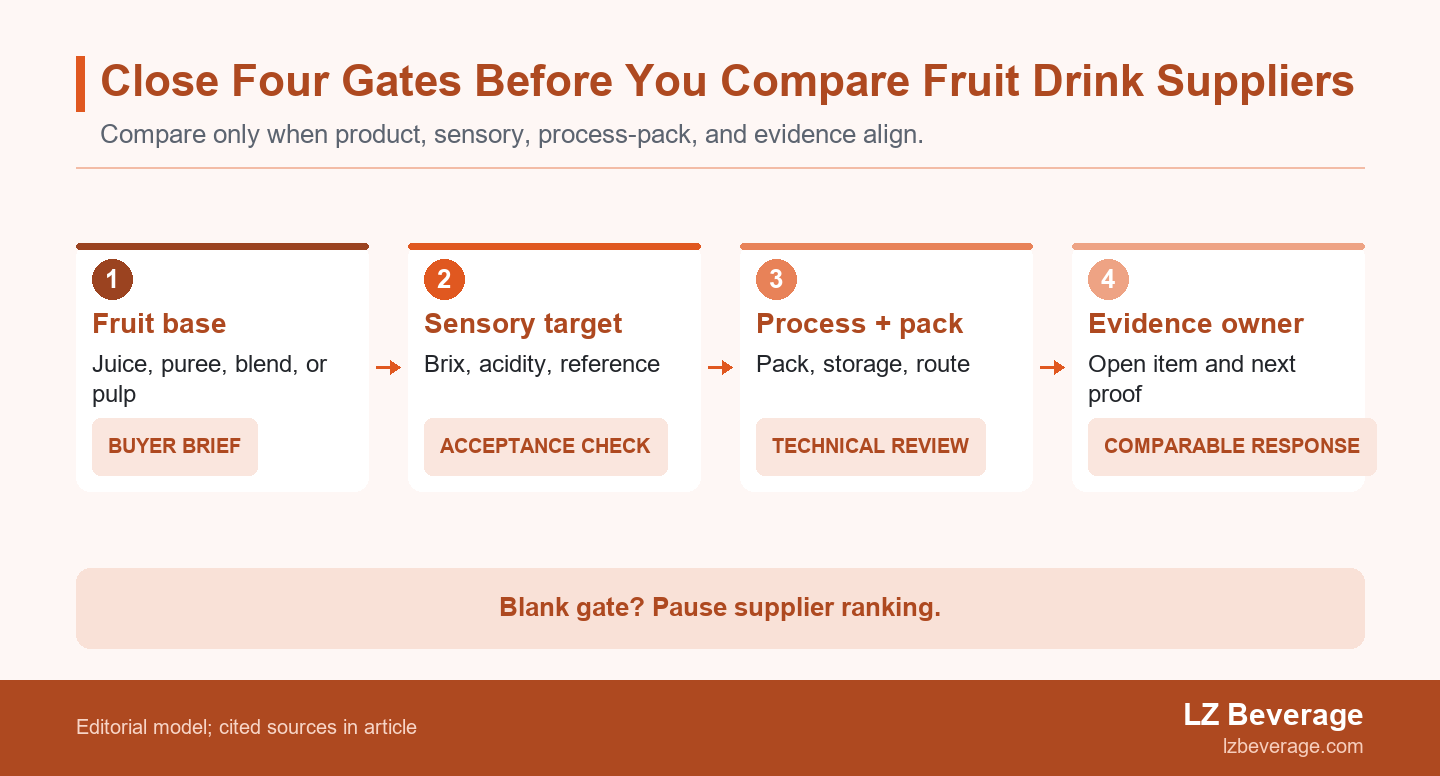
- Product gate: name the fruit-base form, intended fruit expression, finished drink format, and target market.
- Sensory gate: describe the acceptance question, sweetness direction, acidity character, and a reference sample or panel method.
- Process-and-pack gate: state the proposed pack, distribution conditions, and what technical route is being considered.
- Evidence gate: identify what is already known, what still needs validation, and who will resolve each open item.
This is a buyer decision rule, not a product certificate. Its value is simple: it prevents price, lead time, and flavour preference from carrying more certainty than the brief actually supports.
Put Juice Content in a Product Brief, Not an Adjective
A stated fruit percentage is insufficient unless the buyer also names the fruit-base form, finished product route, and target-market labelling context. “Mango fruit drink with 20% fruit” can still leave unanswered whether the intended base is juice, concentrate, puree, a blend, or another declared fruit ingredient; whether pulp is expected; and whether the sample is for ambient retail, chilled distribution, or another route.
Those questions matter before a manufacturer begins to optimise flavour. In the United States, FDA juice-HACCP guidance explains its stated scope for juice sold as juice or used as an ingredient in beverages. That is not a global labelling rule, but it illustrates why a buyer should define the product route and market rather than rely on a front-of-pack phrase alone.
Write the request in observable terms: fruit-base form, target fruit expression, expected clarity or pulp character, pack size, and the market where the product will be sold. When the commercial direction is still broad, buyers can review LZ Beverage's beverage categories to narrow the category discussion before asking for a like-for-like sample. The useful outcome is not a longer brief; it is one product description that every supplier can read the same way.
Specify Sweetness as a Sensory Relationship
Sweetness should be requested as a sensory target linked to soluble solids and acid balance, not as an isolated sweetness word. Terms such as “low sugar,” “less sweet,” or “premium sweetness” do not tell a supplier what the buyer wants a panel to notice first. A practical brief instead names a comparison reference, the desired fruit intensity, the preferred tartness, and the question the first sample should answer.
For example, a buyer can ask whether a proposed sample should taste closer to a bright, tart fruit profile or a rounder, dessert-like profile at the intended serving temperature. Ask the supplier to record the test order: which attribute is being changed first, which reference is being used, who will taste it, and what result would keep the concept moving. Also state whether the trial is intended to choose a flavour direction, compare sweetener systems, or assess a fruit base. The answer determines which change should be isolated in the next round. That makes the next sample testable without pretending that a single sensory word is a formula. For related category-development reading after that first reference is defined, explore LZ Beverage's beverage-development insights.
Use Brix as a Measured Input, Not the Entire Taste Brief
Soluble solids can inform a target, but sensory acceptance still requires a defined product context. Brix is a measure of soluble solids commonly used as one input to beverage sweetness development. It can give a supplier a measurable starting point, but it does not determine the finished taste by itself. Fruit type, acidity, aroma, texture, carbonation where relevant, and serving condition can change how the same measured value is received.
Ask the manufacturer to state the proposed measured range and the sensory reference used to judge it. Then ask what changes they expect if the fruit base, acid direction, or sweetener system changes. This keeps Brix in its proper role: a shared measurement for development, not a shortcut for approving flavour across every fruit drink.
Then Test How Acidity Changes the Same Sweetness Target
In the cited study, sensory sweetness is close to measured Brix and sensory acidity corresponds to measured acidity in analysed orange juice samples. The peer-reviewed study of pasteurised orange juice does not supply a universal fruit-drink recipe. It does support the narrower buying point: a sugar target should not be treated as a complete sensory brief.
Ask for an acid-and-sensory check alongside the preferred sweetness direction. The supplier response should say whether the next sample changes fruit base, soluble solids, acid profile, or more than one of those factors. Without that record, a buyer can prefer Sample B without knowing what actually made it more acceptable or whether the same change affects the proposed commercial route.
Make Shelf Life a Process-and-Pack Question
Shelf life should be discussed with the intended product, process, package, storage condition, and validation evidence. A duration written on a quotation is not enough to establish that those variables are aligned. For a US-bound product, ask what classification and technical route the supplier is actually considering; destination-market requirements must be checked rather than inferred from a generic duration.
A buyer should ask who owns the relevant process, testing, and verification steps. Cornell's acidified-foods overview connects pH, heating, monitoring, and documentation in its described scope. The practical question for a quotation is therefore not “Can you offer 12 months?” but “What product-pack assumptions, storage conditions, and evidence would need to be resolved before a duration is confirmed?”
Once the intended pack route is known, buyers can compare the intended RTD beverage route with the broader product discussion. LZ Beverage can then use the stated fruit, sensory, pack, market, and volume inputs as the basis for a manufacturing feasibility conversation, rather than treating a generic shelf-life request as a finished specification.
Ask Which Product Conditions the Process Must Control
Where 21 CFR 114 applies, acidified foods must achieve and maintain final equilibrium pH of 4.6 or lower within the scheduled process. The cited US regulation also addresses thermal processing, testing, and records for its scope. Equilibrium pH means the final, stabilised acidity of the completed product after its components have reached their balance; it is not simply an initial ingredient reading.
This is a US-specific regulatory example, not legal advice for every destination or a classification decision for a particular drink. Its buyer value is the questioning pattern: ask the supplier which product conditions matter, whether the proposed route has been defined, and which qualified review or validation work remains. That pattern is more reliable than accepting a processing label without the associated assumptions.
Keep Packaging and Verification in the Same Conversation
UGA describes an assessment that considers formulation, pH, water activity, processing, packaging, samples, and verification testing. The University of Georgia's process-authority guidance is the relevant reference. A process authority is a qualified technical reviewer who evaluates a product and its proposed processing approach for the relevant scope. The point is not that every market follows one identical workflow; it is that packaging cannot be separated from the evidence conversation.
Ask what sample, pack, storage assumption, and verification record belong to the same proposed SKU. If a supplier changes the package after a sample is preferred, the buyer should reopen the technical questions instead of carrying the old conclusion forward. This preserves a clean line between an attractive concept sample and a product route that is ready for the next level of review.
Illustrative Scenario: Stop Comparing Two Different Fruit Drinks
Price and sample comparisons should pause when suppliers are responding to different process-pack assumptions. This illustrative composite scenario is not a LZ Beverage customer case, formula, process recommendation, or market approval.
Illustrative Scenario: Reissue One Four-Gate Request
The revised request should identify one product route, one sensory acceptance question, one pack context, and named open evidence questions before a commercial comparison resumes. In this illustrative composite, an importer asks two manufacturers to quote a 330 mL mango fruit drink for one retail-market launch, with an illustrative first order of 12,000 cans. The request names a fruit percentage and a sweet taste, but not the fruit-base form, acid target, pack route, or evidence behind the ambient shelf-life expectation.
Both suppliers return appealing samples and similar prices. One assumes a clarified juice-base route; the other assumes a pulp-forward drink and a different packaging pathway. Neither quotation names the process-pack assumptions or the storage and validation conditions behind the stated shelf-life target. The buyer is not comparing two suppliers on one product, so price scoring pauses. The revised request must identify one product route, one sensory acceptance question, one pack context, and the remaining evidence questions.
The buyer asks each supplier to return the same four-gate sheet and to mark unknown items as open technical questions. Comparison resumes only when the preferred sample, proposed pack, and written evidence plan all refer to the same 330 mL SKU and market scope. This is an illustrative procurement correction, not a statement that any formula, filing, or shelf-life duration has been approved.
Compare Manufacturers on Evidence Before Price
The first score should be response completeness. A lower quotation has limited meaning if the supplier has assumed a different fruit base, omitted the storage condition, or left the evidence owner unnamed. FDA's preventive-controls rule describes process controls and verification activities in its food-and-facility context; for a buyer, that supports asking who will explain the relevant controls rather than treating a general quality statement as product evidence.
| What the supplier states |
What the buyer should ask next |
Decision status |
| “20% mango, less sweet” |
Which fruit-base form, sensory reference, acid direction, and sample question? |
Concept only |
| “12-month shelf life” |
For which pack, storage condition, process route, and validation plan? |
Open technical review |
| “Full OEM/ODM support” |
Which inputs are needed now, and which questions need a qualified owner? |
Feasibility discussion |
Use the completed responses to decide whether a supplier deserves deeper commercial comparison. Background information can inform trust, but it does not replace a response tied to the proposed SKU. At that point, it is reasonable to review LZ Beverage's manufacturing background.
Send a Feasibility Brief, Not a Flavour Wish List
A feasibility review is more useful when the buyer shares market, product, sensory, pack, and volume inputs together. For this topic, that means sending the fruit-base direction, preferred sensory reference, target market, pack format and size, intended distribution conditions, expected volume, and a list of open shelf-life, label, or process questions.
OEM/ODM manufacturing support can range from producing a defined product to helping develop the product direction. A useful first exchange does not require every technical answer in advance. It requires a clear record of what is fixed, what is preferred, and what must still be assessed. Before sending the brief, check that every open item has an owner, that the target market is identified, and that the preferred sample is tied to the intended pack.
Include a short comparison note if two suppliers have made different assumptions. It should state which answer is still needed before prices can be ranked and which party will provide it. That note can prevent a commercial conversation from silently converting an unresolved technical question into a commitment. LZ Beverage can then be asked to distinguish confirmed inputs from open validation work; buyers can request an OEM/ODM feasibility review.
Common Questions
Can One Fruit Drink Recipe Support Every Export Market?
Not safely by assumption: one formula may be commercially useful in several markets, but product naming, label, and process obligations must be checked for each destination. For products entering the United States, FDA's acidified and low-acid canned food categories use stated finished-equilibrium-pH and water-activity definitions. Requirements for other markets must be checked separately. FDA's stated US scope is a jurisdiction-specific example, not a global legal conclusion.
What Should a First Fruit Drink Sample Prove?
A first sample should prove a specific sensory and product-direction question, not the final shelf-life, target-market, or factory-readiness outcome by itself. It may help a buyer choose a fruit profile, pulp character, or sweetness direction. The next request should record what changed in the sample and what technical questions remain before anyone treats the preferred result as a commercial specification.
Does a Higher Juice Percentage Guarantee Better Flavour?
No: fruit percentage is one formulation input, while flavour acceptance also depends on fruit-base character, acidity, sweetness, aroma, texture, and the chosen serving experience. A higher percentage can change the product direction, but it cannot replace a sensory reference. Ask the manufacturer what the proposed percentage means in the finished product and how the next sample will be evaluated.
When Should Shelf-Life Validation Be Discussed With a Manufacturer?
Discuss it before commercial approval, once the intended product, pack, market, storage assumptions, and process questions are sufficiently defined to make the validation conversation meaningful. Early discussion prevents a generic duration from becoming an untested promise. It should end with a clear list of the evidence already available, the work still needed, and the person responsible for each open item.


