A fruit beverage brief becomes unreliable when the product name, fruit-base formula, and front-label claim are treated as three separate decisions. The three product labels in this comparison can each be useful directions, but they do not ask an OEM supplier to solve the same formula, label, or verification problem. Choose the provisional definition lane first; then make every later request describe that same finished SKU.
What Must Agree Before an OEM Quote Means Anything
- Keep the brief aligned. Keep the product name, fruit basis, and target market aligned before a quote is compared.
- Describe the fruit basis. Suppliers need to know whether the intended component is juice, purée, concentrate, pulp, or a blend.
- Keep the market question visible. The destination market determines which definition and label route must be checked.
- Hold mismatched quotes. Similar samples and prices are not comparable if they assume different product definitions.
Juice Drink, Nectar, and 100% Juice Are Different Briefing Lanes
The names are different briefing lanes, not interchangeable labels. For a buyer’s brief, fruit nectar is a market-defined product direction built from stated fruit components, such as juice and/or purée, with water; the applicable market rule still needs to be checked. Codex CXS 247-2005 sets out separate definitions for fruit juice and fruit nectar.
The cited EU rules define fruit nectar through specified fruit inputs, water, and conditions that apply within that market. That does not create a single global rule, but it is enough to show why an export brief cannot leave the product name to a later label-design meeting.
A juice drink is often the most flexible commercial direction, but flexibility is not a definition. The buyer still has to state the intended juice basis, proposed percentage, sweetening and flavour assumptions, and the market in which the finished label will be sold. A fruit nectar is a product category in certain standards and markets; it commonly brings the fruit ingredient form and destination-market definition into focus. A 100% juice direction is more specific still: it makes the actual juice basis and any non-juice additions part of the claim discussion from the beginning.
| Briefing lane |
What the supplier needs to know |
What the name does not settle |
Best first buyer action |
| Juice drink |
Fruit source, intended juice percentage, permitted formula direction, and pack. |
A universal composition rule or a final label outcome. |
Write the percentage basis and target market into the request. |
| Fruit nectar |
Fruit juice and/or purée route, water addition, fruit type, and market definition to review. |
The applicable fruit-content or ingredient requirement in every country. |
Identify the destination market before asking for a label-ready formula. |
| 100% juice |
Juice basis, blend logic, intended claim, and any proposed additions. |
Whether the claim remains suitable once the actual recipe is specified. |
Review formula and front-label wording as one decision. |
Based on this comparison, the buyer does not need to decide every regulatory detail before the first conversation. The buyer does need to stop using one name as a shortcut for the other two. A useful request says which lane is provisional, what information may change it, and who will verify that question for the target market.
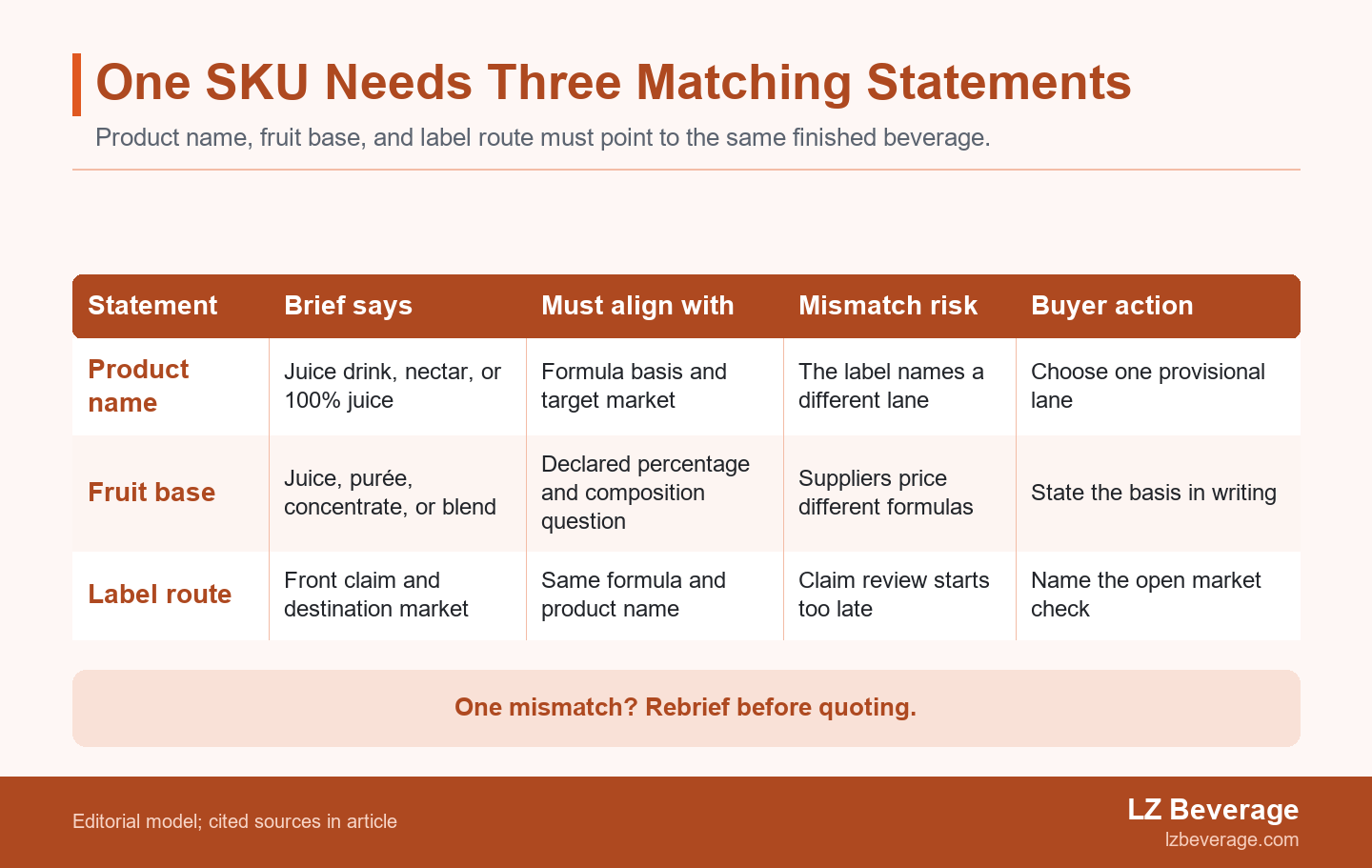
Use the Three-Definition Consistency Check Before Asking for a Quote
The Three-Definition Consistency Check compares the product name, fruit-base formula, front-label statement, and target market for one SKU. Before a quote is compared, ask whether those statements describe one finished beverage. This is a plain-language procurement check: the name identifies the intended lane, the formula states what the drink is built from, and the label route records the claim and destination-market question. If the three statements do not describe one SKU, hold the quotation comparison.
- Read the product name literally. If the working name says fruit nectar, do not let a sample request quietly describe a generic diluted juice drink.
- Read the formula instruction literally. “Mango flavor” is not the same instruction as mango juice, mango purée, or a blend based on concentrate.
- Read the front-label instruction literally. A proposed 100% juice phrase requires a review against the formula and the rules of the destination market; it is not a decorative line for the design agency to resolve alone.
For a bounded US example, FDA guidance states that a non-juice sweetener should not be included in the percentage juice declaration. That is why a proposed 100% juice phrase must stay attached to the actual ingredient list.
The practical outcome is simple. Mark the brief ready for technical review only when the three statements agree, or mark it rebrief required when an item is open. This check does not deliver a legal classification. It prevents the more basic error of asking three manufacturers to price three different products while believing they are responding to one.
Write the Product Definition Into the OEM Brief
The OEM brief should carry the definition decision into the supplier response form. Treat percentage juice and its label basis as an input, not a late-stage decoration. For a US example, 21 CFR 101.30 addresses percentage juice declarations for beverages that purport to contain juice. The buyer does not need to apply those US details to every country; the lesson is that percentage juice and its claim basis belong in the brief early enough for the formula and label route to be checked together.
The FDA’s Food Labeling Guide states that the percentage juice declaration uses specified wording and placement under 21 CFR 101.30. For a buyer, that is a practical reminder to include the proposed declaration basis in the supplier brief rather than leave it to the artwork stage.
For a category conversation that has not yet narrowed to one finished beverage, it can help to review LZ Beverage's beverage categories. The point is not to turn a brief into a catalogue request. It is to choose the finished beverage direction before the supplier guesses at the fruit basis, functional position, or pack format.
State the fruit-component form before comparing samples. Name the component in operational terms: juice, purée, concentrate, pulp, or a blend. Then add the intended fruit species, a proposed percentage or range if one exists, and the sensory reference the team will use to judge samples. Specify whether a visible pulp cue, a smooth drinking texture, or a concentrate-led cost target is intended. Record whether the range is a commercial target or a non-negotiable product requirement. A supplier can say “mango nectar” and still make a different assumption about texture, solids, sweetness, or blend composition unless the fruit-base instruction is written down.
Then, State the Claim and Market Question
Name the market review question and its owner. Pair the working front-label phrase with a named destination market and a question owner. For example: “Proposed product name: mango fruit nectar; market: [country]; open question: does the planned fruit basis support this name and the proposed percentage statement?” That wording is more useful than asking a supplier to “make it label compliant,” because it exposes what still needs a market-specific answer.
Once those two fields are present, the next conversation is about the finished drink rather than a loose flavor idea. The supplier can identify which elements are formula assumptions, which are packaging assumptions, and which still need a target-market answer. That separation is especially useful when commercial teams are comparing sample feedback from more than one factory.
At this stage, the buyer can also ask for a short response format: confirmed inputs, conditional inputs, and questions requiring an owner. This avoids treating a taste approval as an approval of the category name, the declared percentage, or the final artwork wording. The same response should identify what would make the quote change: a different fruit component, an alternative can format, a revised target market, or a request for a different label phrase. That makes later supplier replies easier to compare and gives the buyer a clear reason to reopen the brief when an assumption changes. For company context relevant to that feasibility conversation, review LZ Beverage's manufacturing background.
Separate the Definition Question From the Process Question
A product definition is not a substitute for a named process-and-evidence question. In its stated US context, FDA guidance explains that the Hazard Analysis and Critical Control Point (HACCP) regulation applies to juice sold as juice or for use as a beverage ingredient. Read the FDA’s Juice HACCP questions and answers as a boundary: the ingredient route and the finished-beverage route may need separate questions.
For the OEM brief, ask the supplier to identify the intended pack, distribution condition, processing discussion, and the evidence or technical review still required for that product-market combination. That control approach is not a universal label answer and it is not a substitute for destination-market review. The useful supplier response names what is known, what is conditional, and who owns the unresolved item. It should also make clear whether the stated controls refer to the fruit ingredient, the blended beverage, the chosen pack, or a combination of those elements. If the product is expected to travel through more than one distribution condition, request that the supplier identify which condition each technical statement assumes. This helps the team avoid applying a limited process discussion to a broader commercial plan. It also keeps each technical answer tied to a dated SKU version.
Only after that scope is written down should the team compare the intended ready-to-drink route with the supplier’s technical assumptions. The comparison can then focus on the same pack and distribution premise rather than using one beverage name to imply a complete process path.
A defined route still leaves commercial work to do. Confirm the proposed container size, expected storage and distribution condition, intended launch timing, and the evidence the buyer expects before artwork or production commitment. If a supplier offers an alternative process or pack, record whether it changes the fruit base, product name, percentage presentation, or open review question. Those notes preserve a single version of the SKU while the team evaluates feasible options.
The written record should also distinguish a proposed change from an accepted change. A new processing suggestion may solve a scheduling or pack constraint, yet still require the team to revisit fruit input, sensory target, or label wording. Give the alternative a version number and state which earlier assumption it replaces. This discipline is modest, but it prevents the final technical conversation from being compared with a first quotation that described a different beverage. It also makes it easier for commercial and product teams to decide whether an alternative is a valid option or a reason to issue a revised OEM brief. Keep the version note with the sample record so teams do not compare a current label draft against a superseded formula direction. State who approved the change and when that approval was recorded.
That distinction also keeps the commercial conversation orderly. A product manager can explore beverage-development insights after the core brief is formed, but the live request should stay focused on one formula basis, one pack route, and one set of open questions for the SKU under review.
Illustrative Scenario: Stop a Three-Name Mango Brief Before Sampling
Correct the Brief Before the Second Sample
This is an illustrative composite example, not a real customer order or market approval. It concerns a product manager preparing one 330 mL mango beverage for a distributor launch in one export market. The product sheet says “mango nectar,” the sample request asks for a drink with water and a fruit percentage, and the early front-label draft says “100% juice.” No real production order, formula, or market approval is implied.
Two suppliers can return appealing samples under this request, yet each may be solving a different problem. The buyer has not named which statement governs if the recipe and label instruction conflict. One may assume a fruit-drink route with a stated percentage; the other may assume a purée-led nectar route. The samples may be close in taste, but a matching taste does not establish a matching product definition. It also does not establish a matching percentage basis or front-label path.
Rebrief the same SKU before requesting another comparable sample. The buyer should place price scoring on hold and send both suppliers one revised same-SKU request. It should name the provisional category, fruit-component form, pack, target market, planned front-label phrase, and every question that remains conditional. If a supplier cannot support a requested phrase, that response is useful evidence; it is better than hiding the uncertainty behind a sample approval.
Comparison restarts only when the sample specification, proposed formula basis, draft product name, and market-review question all refer to the same 330 mL SKU. This example is a procurement illustration, not a label approval, process filing, or shelf-life claim.
Send a Definition-Led Feasibility Request
A useful first request to LZ Beverage gives the manufacturer a defined beverage to assess and gives the buyer a way to see what is still uncertain. Include the provisional product definition, target consumer, flavour direction, fruit-component form, intended function, pack format, target market, expected volume, and a short list of claims or percentage statements that need review. Name the open question and its owner instead of hiding it in a price request. For every open item, ask the supplier to name the assumption, the next evidence needed, and the owner of that next step. Share the beverage type, target consumer, flavor direction, function, pack format, target market, and expected volume for an OEM/ODM feasibility review. Then request an OEM/ODM feasibility review.
Frequently Asked Questions
Is fruit nectar the same as a juice drink?
Fruit nectar and a juice drink should be treated as separate possible product directions in an OEM brief from the outset. The destination market and fruit base may assign distinct checks to each direction. A buyer should carry the chosen lane, ingredient basis, percentage input, and unresolved label question into the supplier request rather than using a category word as a complete formula instruction.
Can a 100% juice product contain added ingredients?
It can only be assessed under the relevant market rule and the actual ingredients, so the buyer should never use a 100% juice claim before reviewing both together. In the US context, the percentage-juice rule contains specific conditions for products with non-juice ingredients. In another market, the applicable definition and permitted additions may differ. Treat the claim as an open formula-and-label question until the route is verified.
Which percentage belongs in an OEM juice brief?
State the proposed percentage as a formula input and identify the destination-market rule or label calculation that must verify it. Also state what the percentage refers to: a fruit juice basis, a fruit ingredient basis, or another declared measure. The supplier should not have to infer that meaning from a front-label mock-up. If the value remains undecided, record the range, the decision owner, and the evidence needed to close it.
Should label design start before the first sample?
Start a claim-and-label review early, but keep it provisional until the sample, formula basis, and target market point to the same product definition. Early review helps the team catch a name-and-formula conflict before artwork approval. It should not be used to imply that a first sample has already established the final category or claim. Keep open label questions attached to the SKU brief until they are resolved.
What should suppliers return with an initial quote?
Ask each supplier to state its assumed product definition, fruit base, percentage basis, pack route, target market question, and the owner of every open verification item. The response should distinguish confirmed inputs from conditional assumptions instead of presenting every detail as final. This lets the buyer compare which supplier understood the same brief and which supplier is pricing a different product route. It also creates a cleaner basis for the next sample or technical review.


