For an RTD launch, the useful fruit-base question is which route can deliver the same finished SKU under the intended sensory, landed-cost, pack, and market conditions. That distinction prevents a lower-volume ingredient from being mistaken for a lower-cost beverage, or a familiar bench sample from being mistaken for a production-ready specification. A sound comparison uses one defined RTD, a transparent solids-to-volume illustration, and a route-specific handoff for an OEM/ODM conversation. Destination-market rules, nutrition positioning, and commercial prices still require their own evidence and review.
Keep the Finished RTD SKU Constant Before You Compare Routes
NFC and concentrate can be compared only after the fruit solids, target sensory outcome, pack, and market assumptions refer to one finished SKU. For an LZ Beverage feasibility request, this is the practical starting point: the supplier needs one beverage definition before it can assess whether either fruit-base route fits the brief. The comparison becomes a route-equivalence test rather than a choice between two isolated ingredient names.
Start by fixing the finished beverage, rather than comparing two ingredient quotations in isolation. Record the fruit type, intended juice or fruit-component level, sweetness and acid target, pack size, process assumptions, target market, and expected volume. Then ask each route to answer the same brief. The resulting comparison has three separate questions: how much ingredient volume arrives, whether the sample meets a written sensory target, and whether the route fits the planned storage and supply controls. A route can be credible on one question and still be unproven on the other two.
- Cost: calculate ingredient, freight, water, loss, processing, pack, storage, and commercial terms on the same finished-SKU basis.
- Flavor: compare route-specific samples against one agreed reference, not against a loose “premium” description.
- Supply: state the handling, storage, lead-time, and change-control assumptions that make the selected route workable.
What Changes Between NFC Juice and Reconstituted Concentrate
The cited U.S. rule calculates juice-from-concentrate percentage from Brix and distinguishes directly expressed juice from juice that is concentrated and reconstituted. Read the U.S. percentage-juice rule. It is a U.S.-scope regulatory example, so it helps a buyer declare the route and solids basis without replacing the destination market's own label review.
NFC means not from concentrate: a direct, single-strength juice route with no concentration-and-reconstitution step. Concentrate means juice whose water has been removed to create a higher-solids base; reconstitution means adding water back to reach the agreed condition. Brix is a practical reading of soluble solids used to state the fruit-base basis in a brief. These terms describe a route and a specification input. They do not by themselves settle a label outcome, sensory result, nutrient claim, or commercial value in every market.
| Same-SKU question |
NFC / single-strength route |
Concentrate / reconstituted route |
| Incoming fruit-base volume |
Closer to the intended single-strength volume |
Lower before reconstitution when the solids basis is higher |
| Sensory comparison |
Requires a stated reference and acceptance owner |
Requires a route-specific sample against that same reference |
| Commercial comparison |
Quote the defined fruit basis, freight, storage, loss, process, and pack |
Quote the same defined items, including reconstitution assumptions |
Decision takeaway: route names only become commercially comparable after the buyer declares the finished beverage and the test conditions that will judge it.
Cost: Separate Inbound Volume From Finished-SKU Economics
USDA notes that most ready-to-consume orange-juice weight is water and gives about 11.8 Brix for its NFC orange-juice example. See the USDA orange-juice documentation. The point is not to apply the orange figure to every fruit, but to recognise that water and solids alter the inbound material basis.
That context makes inbound water a real logistics variable. It does not make it a total-cost answer. The following calculation is deliberately illustrative: it shows how a stated solids basis changes incoming fruit-base volume, while leaving actual ingredient prices, loss, process yield, water treatment, pack cost, storage, and freight terms outside the result.
Illustrative 50,000-can calculation. A 330 mL can at 50,000 cans equals 16,500 L of finished beverage. If the brief assumes a 20% fruit component, the single-strength fruit-component equivalent is 3,300 L. Using a stated 13 Brix single-strength basis and a 65 Brix concentrate basis, the concentrate input is 3,300 × 13 ÷ 65 = 660 L before loss. The arithmetic therefore compares 3,300 L of single-strength basis with 660 L of 65 Brix concentrate basis: a five-to-one input-volume relationship under these assumptions.
A five-to-one illustrative incoming-volume difference is a logistics variable, not a finished-cost verdict. It can inform freight and storage questions, but it cannot decide the commercial result until all other finished-SKU inputs are stated.
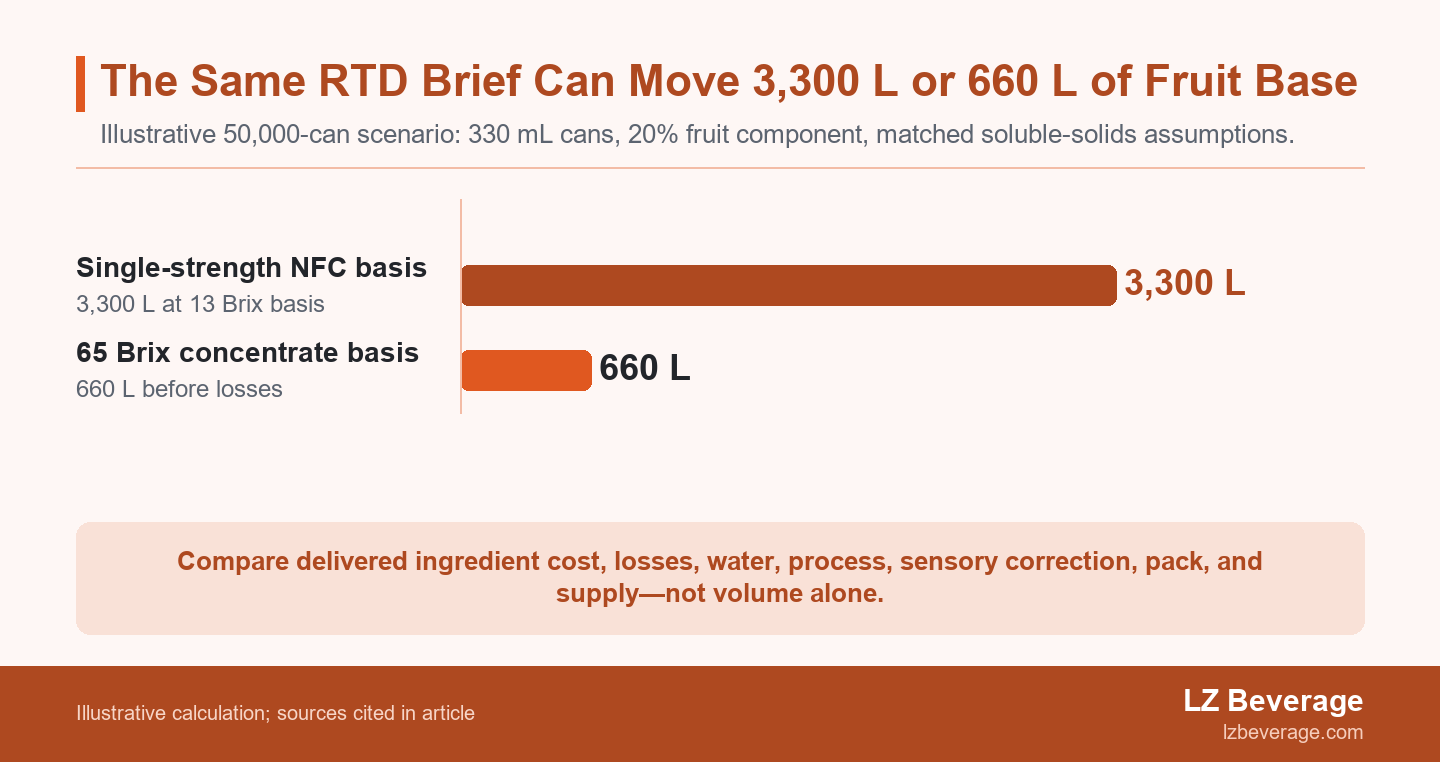
To convert that volume view into a quote comparison, put each term on a per-finished-can or per-finished-litre basis. Include fruit-base price, freight lane, storage regime, reconstitution water and utilities where relevant, expected loss, process time, any aroma or flavor correction work, packaging, duties, and the commercial terms of the order. If a term remains unknown, list it as an open assumption instead of allowing one route to carry a hidden advantage. The most useful output is a range with an owner for each uncertain input—not a headline saving based on transported water alone.
Flavor: Route Labels Do Not Replace a Sensory Benchmark
The reviewed USDA research record treats flavor and aroma retention as a concentration-process concern at high solids. Review the USDA research record. It supports a specific process question, not the broader claim that every concentrate route must deliver the same sensory result.
This is a process boundary, not a universal verdict on concentrate. Fruit variety, concentration technology, recovered components, recipe design, storage, and the finished beverage process can all change the sensory result. The commercial discipline is to replace the shorthand “NFC taste” with a written target that another team can test.
First, Define the Reference Sample
A reference sample needs a stated fruit form, Brix, intended juice percentage, and acceptance owner before it can anchor an OEM brief. Those details make the reference usable across Product, Procurement, and the manufacturing team instead of leaving approval tied to an unrepeatable verbal impression.
Attach the physical sample or a controlled sensory description, then name what must match and what may move. For example, record fruit identity, aroma character, sweetness and acid balance, body, color tolerance, intended juice percentage, and the person or panel that can accept a change. State whether the reference represents an early concept, a target for production, or only a positioning direction. Without that distinction, “match this sample” can hide a change in fruit form, solids, or production route.
Then Test the Actual Concentration and Recipe Route
An apple-juice study found different flavor-compound retention for heat and freeze concentration, so concentration technology is a real boundary. Read the apple-juice technology comparison. A route comparison should therefore record the proposed technology rather than treating “concentrate” as a complete sensory description.
The study is specific to its apple-juice materials and methods, so it should not be stretched into a promise for every fruit or supplier. Its practical value is simpler: a buyer should ask what concentration route is proposed, what portion of the fruit profile will be evaluated in the finished beverage, and how the paired samples will be judged. When an OEM/ODM partner proposes an alternative route, request a controlled comparison at the same target Brix, fruit-component level, pack, and process condition. Accepting a flavor prototype without those conditions may approve a sensory direction while leaving production equivalence unresolved.
Supply: Plan the Route as a Storage and Control System
A 150-day NFC apple-juice study reported different quality-retention outcomes at different storage temperatures. Read the storage-temperature study. It gives a bounded reason to write handling controls into the brief before a procurement decision is treated as a supply release.
The result is a reminder to treat the route as a control system, not merely an ingredient name. The study concerns NFC apple juice under its own conditions; it does not create a shelf-life guarantee for another fruit, formula, package, or distribution route. For a live RTD brief, define the controls that matter to the chosen fruit base: supplier specification, storage temperature range, inventory window, receiving checks, traceability, change notification, and the process or sensory check that applies when a material lot changes.
Procurement should also separate what is known from what is conditional. A supplier may be able to quote an ingredient route, yet the route still needs confirmation against the intended production location, pack format, and distribution environment. Write the decision in stages: “available for pilot,” “accepted after paired sensory review,” and “released after supply and quality conditions are confirmed.” This avoids converting a preliminary quote into an implied long-term availability commitment. For broader formulation and category context, teams can explore beverage-development insights while keeping the SKU brief as the decision record.
Illustrative Scenario: When the Sample and Quote Use Different Routes
A buyer should pause price ranking when the benchmark sample and production quote rely on different, undeclared fruit-base routes. Continuing to rank offers at that point would reward an unstated difference in specification rather than a verified difference in commercial fit.
A comparison breaks when the sample represents one route and the quotation assumes another without making the difference explicit. The following composite scenario shows how to restore comparability. The numbers are briefing assumptions only; they do not represent an LZ Beverage project, a market price, or a recommended formula.
Correct the Brief Before Comparing the Second Sample
A corrected brief separates the route decision, landed-cost assumptions, and sensory acceptance gate so the second sample can be evaluated fairly. It gives each team a clear reason to hold a price comparison until the benchmark and the proposed production basis can be tested together.
A product manager is preparing a 330 mL peach-mango RTD drink for a launch brief and has an internally approved bench sample described as NFC-led. The project is scoped for 50,000 cans, or 16,500 L of finished beverage, with a 20% fruit-component assumption. The team has a sensory reference and a preliminary commercial quote but has not locked the fruit-base route or reconstitution conditions.
The sensory note says to match the NFC-led bench sample but does not state Brix, fruit percentage, or whether restored components are allowed. The commercial quote assumes a 65 Brix concentrate route, which converts the illustrative 3,300 L single-strength fruit component to 660 L of concentrate before loss. Neither document records the intended water specification, concentration technology, sampling stage, or acceptance owner.
The lower incoming volume may change freight and storage exposure, but the quote and sample are not yet equivalent. The buyer is comparing an undeclared direct-juice sensory benchmark with a different process route. Use conditional release: do not rank suppliers or approve a production route until a paired sample plan states fruit type, single-strength or concentrate basis, Brix, reconstitution water, process route, and sensory acceptance owner.
Issue one corrected brief, ask for route-specific pilot samples at the same intended finished beverage specification, and separate the quoted landed-cost assumptions from the sensory decision. Compare the paired samples against the same written acceptance criteria, then confirm that the chosen route remains feasible for the stated 50,000-can scope and pack plan. This is a composite illustration, not a project conducted by LZ Beverage and not a recommendation for a particular fruit or market.
Turn the Route Choice Into an OEM/ODM Brief
An OEM/ODM feasibility request becomes comparable when it names the fruit form, benchmark, Brix or juice percentage, pack, market, volume, and open supply questions. For a first conversation with LZ Beverage, begin with the finished beverage direction rather than a request for an undifferentiated “juice drink” quotation. Teams that are still choosing their category can review LZ Beverage's beverage categories, then bring one provisional SKU into the technical discussion. The brief should state whether NFC, concentrate, or both routes are to be assessed; the intended fruit component; target Brix or juice percentage; a reference sample or sensory description; can size; expected order volume; target market; and any non-negotiable supply, label, or claims questions.
A commercial apple-juice study found that product information affected ratings and NFC and concentrate categories carried different expectations in its tested products. Read the commercial apple-juice perception study. It therefore gives the commercial brief a reason to keep the communicated product story aligned with the route being evaluated.
That evidence is bounded to the tested products and does not establish a single preference in every country or category. It does underline a useful brief question: what will the buyer actually communicate about the fruit route, and is that communication consistent with the ingredient route and evidence available? Keep market positioning, label review, and the sensory acceptance test as separate workstreams. A phrase in a concept deck cannot validate an ingredient specification; a supplier quotation cannot validate how consumers will interpret a label.
Use a simple response template so competing proposals can be read side by side. Ask each supplier to mark every field as confirmed, conditional, or requiring buyer decision. For the fruit base, request the stated solids basis, any reconstitution conditions, expected handling requirements, and the sample plan used to judge fit. For cost, request the assumptions rather than a single unexplained number. For supply, request what must be verified before a pilot can move to production. This structure lets a procurement team compare uncertainty as well as price, and it makes a change in fruit form visible before it becomes a late-stage sample dispute.
Once the route, target sensory outcome, and open questions are clear, the team can compare the intended ready-to-drink route with the proposed pack and production assumptions. That is the right time to ask whether the same brief remains feasible at the planned volume—not before the fruit-base basis has been made explicit.
Prepare a Route-Specific Feasibility Handoff
A useful feasibility handoff makes the route assumptions visible before any supplier compares price, flavor, or supply capability. It also lets the buyer distinguish a decision-ready input from a question that must remain conditional until pilot evidence is reviewed.
Before sending the request, put the following items in one short attachment or email: finished beverage type; target consumer; fruit and flavor direction; intended function; NFC, concentrate, or dual-route assessment; stated fruit-content and Brix basis; the physical or written reference sample; pack format; target market; expected volume; and the issues that remain open. If the team wants two routes priced, ask for them as parallel responses to the same finished-SKU specification. Do not ask the supplier to guess which version of the brief should control the sample, price, or supply response.
Then set three release gates. First, confirm the route and ingredient assumptions. Second, compare paired samples against the named sensory acceptance criteria. Third, confirm the cost and supply assumptions for the intended pack, market, and volume. A route can advance through one gate without being treated as final at the next. This gives Product, Procurement, and the manufacturer a shared record of what changed, what evidence supports the change, and who can approve it.
For an LZ Beverage feasibility conversation, share the facts that define the SKU and the questions that could change it. Share the beverage type, target consumer, flavor direction, function, pack format, target market, and expected volume for an OEM/ODM feasibility review. When the brief is ready, request an OEM/ODM feasibility review.
Frequently Asked Questions
Is NFC juice always better for a premium RTD drink?
No—NFC is a route choice, and a premium RTD claim still needs a validated sensory target, a workable supply plan, and destination-market review. The route may be relevant to the concept, but it does not prove that the finished beverage meets a particular sensory expectation or commercial target. Define the reference sample, permitted route changes, pack, and target market first; then assess whether the selected route supports the intended product position.
Can concentrate match an NFC reference sample?
It can be evaluated, but the comparison is credible only when fruit type, Brix, reconstitution water, process route, and sensory acceptance criteria are held explicit. Treat it as a paired sample test, not as an assumption based on the category name. The buyer should decide in advance who approves the sensory result and what change would require another sample round.
What should an OEM quote include for juice ingredients?
Ask for the fruit form, Brix or single-strength basis, target juice percentage, source assumptions, process loss assumptions, pack, market, and expected volume to be named. Also ask the supplier to separate confirmed facts from conditional assumptions. That makes it possible to compare two quotations without letting differences in storage, freight, processing, or the fruit-base route remain invisible.
Does lower inbound volume guarantee a lower finished cost?
No—the volume advantage changes freight and storage exposure, while fruit price, reconstitution, yield, sensory correction, processing, and pack costs still determine the finished SKU economics. Use a stated same-SKU model and list each missing assumption. A Brix-volume calculation can expose one logistics variable; it cannot forecast a delivered commercial outcome without the remaining inputs.


