Aloe, coconut, and fruit-texture drinks can share a can size or flavour direction while requiring different manufacturing decisions. A useful OEM brief describes the same finished drink for every supplier: its material form, physical acceptance target, process-and-pack assumptions, and verification gate. Processing conditions and regulatory requirements must then be determined for the actual product, pack, and destination market.
Compare the Process Questions Before You Compare Suppliers
Aloe, coconut, and fruit pulp drinks become comparable only when the buyer states the ingredient form, physical acceptance target, process-and-pack assumptions, and verification gate for one finished beverage. That four-field proof packet prevents a supplier from interpreting “with pulp,” “with aloe,” or “coconut drink” as a complete technical brief. It also keeps price, pack, and lead-time discussions attached to the version of the beverage that is actually being evaluated.
Use the fields in this order. First, name the material form. Next, state the physical behavior the drink must retain. Then declare the intended process and pack route, including the target market. Finally, define what observation or test would allow the team to move from a promising sample to commercial review. A fresh sample may answer a sensory question; it does not automatically answer a storage, filling, or route question.
- Describe the finished ingredient form, not only the flavour concept.
- Write the observable physical behaviour that matters after filling.
- Keep process, pack, market, and verification on the same brief version.
In the cited FDA juice guidance, a blended juice that includes a treated fruit puree must receive treatment at the final packaging facility within the stated U.S. scope. That is a narrow regulatory example, not a rule for every market or beverage. Its buyer lesson is practical: a pretreated ingredient does not remove the need to define the finished blend and its intended route. See FDA’s Juice HACCP questions and answers.
Write the input as a form with a job in the finished drink. Pulp refers to pieces of fruit dispersed through a drink, affecting texture and appearance; it is not simply a fruit-flavour cue. Aloe may mean clarified juice, filtered gel material, or visible pieces. Coconut may mean coconut water or another declared coconut base. Those distinctions change the questions an OEM team needs to answer.
Brix is a solids reading used to describe the fruit-base starting point. In pulp beverage OEM manufacturing, it can make a puree or juice input less ambiguous without pretending to set a universal sensory target.
| Declared product form |
What the buyer should state |
What the OEM review still needs to confirm |
| Aloe liquid, gel, or pieces |
Material form, filtration or particle expectation, and visual acceptance |
How the stated material behaves through the proposed route and pack |
| Coconut water or other coconut base |
Base definition, flavour sensitivity, target storage condition, and market |
Which process route is being assessed for that matrix |
| Fruit puree or pulp |
Fruit material, particle expectation, Brix basis, and acceptable sediment or appearance |
Whether the physical target remains acceptable under stated storage conditions |
Before asking a manufacturer to interpret a concept, review LZ Beverage's beverage categories and name the provisional finished category in the brief. The page will not determine a process for you, but it can keep a buyer from mixing a product-direction decision with an unexamined physical-stability claim.
Build the Process Brief Around Physical Behavior
Suspension describes whether drink particles stay spread out over time.
A pulp beverage brief should specify what must remain distributed, how it will be observed, and when the observation counts as a release condition. That definition makes ingredient form, physical behavior, the process brief, and verification part of one decision instead of four disconnected notes.
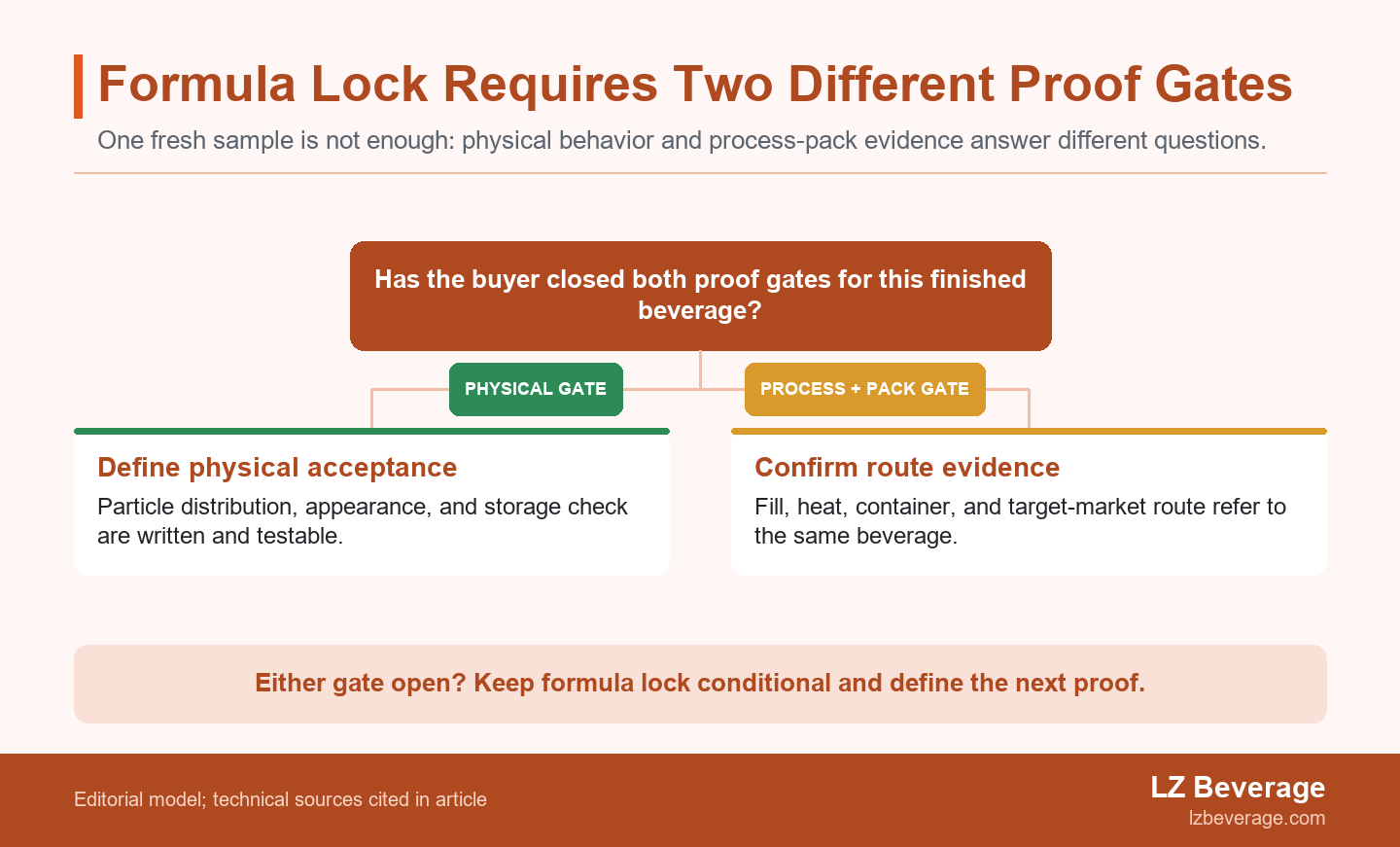
For a sourcing manager, the acceptance statement can be modest and still useful: define the sample orientation, storage window, visual observation, and whether a layer, sediment, or change in pour behavior is acceptable. The goal is to ensure that the supplier, buyer, and quality reviewer are judging the same behavior. It is also useful to name whether a gentle inversion, a pour, or an unopened-package observation is part of the check, because these are different handling conditions.
Record who observes the drink, what they record, and which result triggers the next technical conversation. A short acceptance statement can stop a sample discussion from drifting into subjective preferences. It also gives the buyer an evidence trail when one pilot appears sound at filling but looks different after the intended storage window. For additional context once those questions are clear, explore beverage-development insights.
Specify What Must Remain Distributed
A pineapple-base study evaluated viscosity and particle-size measures when testing suspension stability, showing why a pulp specification needs a physical acceptance check. The finding is matrix-specific; it does not tell an aloe, coconut, or mixed-fruit project what numbers to use. It does show why particle size and viscosity are not decorative line items when the commercial concept depends on a particular appearance or texture. Read the pineapple suspension study.
A workable brief says what the observer will see and under what conditions. For example: “fruit material should remain acceptably distributed after the stated storage window and gentle inversion,” or “a defined sediment is acceptable if the drink returns to the agreed appearance after the stated handling.” The exact rule belongs to the product team and the planned route. Avoid “no separation ever” unless the team can define how, when, and by whom that statement will be evaluated.
Treat Filling and Heat as Part of the Same Specification
The cited FDA inspection guide lists product particle size, consistency or viscosity, formulation, fill, headspace, Brix, and processing conditions among possible critical factors. The reference sits in a specific U.S. inspection context. For an OEM buyer, its practical discipline is to discuss the physical target, filling conditions, container, and thermal route together. See the FDA guide to low-acid canned-food inspections.
Ask the OEM team to show the assumptions behind the proposed route: the declared formula version, ingredient form, pack format, fill conditions, process route being evaluated, and storage condition. If an answer changes one of those fields, record it as a conditional response rather than a confirmed one. This is especially important when a visible-pulp concept is being transferred from a bench sample to a line where filling, heat exposure, and pack geometry may no longer be identical.
Set pH, Process, and Pack as One Decision
FDA's U.S. regulatory information distinguishes acidified and low-acid canned foods through finished product conditions and ties specified shelf-stable hermetically sealed products to process filing requirements. This statement is limited to the cited U.S. framework. It is a reason to put pH, intended process, container, storage status, and destination market in one technical conversation rather than treating them as separate purchasing fields. Consult FDA's acidified and low-acid canned-food information.
A scheduled process is a documented heat-and-container pathway for one declared drink.
For a different market, the buyer still needs local regulatory review. The OEM brief should therefore say “target market pending confirmation” rather than silently importing a U.S. conclusion. That wording helps prevent an apparent formula decision from being separated from the container and route on which it depends.
Pack selection belongs in the first brief, even if final artwork and dimensions come later. State the provisional format, fill volume, closure or can assumption, ambient or chilled intent, and market. A supplier can then identify which points are technically confirmed, which are conditional on trials, and which remain open for specialist review.
Ask Different Questions for Aloe, Coconut, and Fruit Pulp
The reviewed aloe-processing literature identifies filtration and stabilization as relevant process questions and notes that poor filtration can lead to sedimentation during storage. This is not a claim that every aloe drink should be clarified or that one filtration choice solves every product. It tells the buyer to identify the intended aloe material form, its filtration expectation, visible-particle policy, and visual acceptance criteria. See the review of aloe processing.
A coconut-water study compared high-pressure processing and high-temperature short-time treatment during refrigerated storage, so the stated process route is a quality variable for that specific matrix. The study does not establish a universal coconut-water route or a shelf-life promise. In an OEM brief, ask which coconut base is proposed, which route is being evaluated, what storage condition applies, and which sensory or appearance changes matter to the target consumer. See the coconut-water process study.
Fruit-pulp questions are different again: what is the particle expectation, what appearance is acceptable after the stated storage window, and how will the team record the observation? Across all three families, avoid substituting a generic ingredient label for a finished-beverage specification. A good supplier response can say “confirmed,” “conditional,” or “open”—but each status should refer to a named material, route, pack, and test condition.
Illustrative Scenario: Repeated Pulp Settlement Is a Process Escalation Signal
A repeat sediment finding should pause formula lock until the team tests the stated stability conditions across controlled lots. The following is a composite illustration, not an LZ Beverage project, a client result, or a recommended formula. Its purpose is to show how a buyer can change the decision when the same physical issue appears more than once.
Escalate the Evidence, Not Just the Sample Appearance
A controlled retest should compare stated formula, process conditions, storage window, and acceptance criteria before a commercial route is released. In this illustrative scenario, the sourcing manager is preparing an export-oriented fruit-pulp RTD brief with a planning basis of 80,000 cans at 330 mL, or 26,400 L of finished beverage before allowances.
Two pilot lots use the same proposed ingredient description. The early appearance looks uniform, but the storage acceptance condition and process record have not been locked. This is a readiness gap, not evidence that the formula is ready. The order scale makes that distinction meaningful: the commercial question is whether the stated drink can meet a stated acceptance condition through the stated route, not whether a single fresh sample looks appealing.
Pilot lot A develops a visible pulp layer after the stated storage window. Pilot lot B repeats the same layer even though it looks uniform immediately after filling. Because the finding repeats, the team cannot assume it is a one-off handling event. It needs to separate what may be linked to material form, particle and viscosity observation, process window, fill record, pack, or storage condition.
The decision is to hold formula lock, rather than to make a cosmetic adjustment and call the issue closed. The buyer asks for one controlled retest plan that records the formula version, material form, particle and viscosity observations, fill and heat record, pack format, storage window, and pass-fail acceptance statement. That changes an anecdotal sample discussion into a traceable technical question.
The verification gate compares three controlled lots against the same written storage window and acceptance criteria before the commercial route is reconsidered. A pass would not prove that every future market or pack is covered; it would only close the evidence gap stated in this scenario. This composite is informed by the article’s matrix-specific research boundaries and does not present client performance data.
Turn the Questions Into a Comparable OEM/ODM Brief
A comparable OEM/ODM response identifies what is confirmed, conditional, and still open for the same finished beverage. To obtain that response, give every supplier one version-controlled brief rather than three loosely connected ingredient questions. The brief should make it easy for the technical team to point out an assumption that needs a trial, an external review, or a change in product direction. It can also help to compare the intended ready-to-drink route before requesting a final quote.
Use four headings in the request: (1) ingredient form and flavour direction; (2) physical acceptance target; (3) intended process, pack, storage, and market; and (4) verification plan and expected volume. Under each heading, ask the supplier to label its answer confirmed, conditional, or open. That format prevents a conditional process assumption from being mistaken for an approved specification.
Keep the link between the product concept and the technical brief explicit: a pack category is useful context, but it does not demonstrate that an undeclared aloe form or pulp-stability target has been validated. If the can, bottle, storage intent, or market changes, return the request to the relevant proof gate and document the revised assumption.
Prepare the Feasibility Handoff Before You Request a Quote
A useful feasibility handoff makes ingredient form, physical acceptance, process-and-pack assumptions, and verification questions visible before price comparison. Keep the handoff in one current brief, identify the decision owner for every open item, and record the next proof that would change the route from conditional to confirmed. This gives an OEM team a focused starting point without suggesting that the product is already cleared for production.
Share the beverage type, target consumer, flavor direction, function, pack format, target market, and expected volume for an OEM/ODM feasibility review. For an LZ Beverage review, request an OEM/ODM feasibility review.
Frequently Asked Questions
Do aloe drinks need a different OEM brief?
Yes—an aloe brief should state the material form, filtration or particle expectation, visual acceptance criteria, and the intended process route before sampling. “Aloe” can describe a clarified liquid, gel material, or visible pieces, so the supplier needs to know which physical appearance the final drink is meant to retain. The brief should also state the pack, storage intent, and market so that a proposed route is not separated from the context in which it will be assessed.
Can coconut water and fruit pulp share one process?
They can be assessed in one project, but coconut-water quality and pulp suspension create different evidence questions that should not be hidden in one generic process line. Coconut-water work should identify the proposed base, route, and storage condition. Pulp work should identify the particle expectation and written physical acceptance check. A shared supplier project can therefore contain separate evidence tracks while still producing one coherent commercial brief.
What causes pulp to settle in a canned drink?
Pulp settlement can reflect particle, viscosity, formulation, filling, or storage interactions, so a buyer needs a written stability test rather than a visual judgment at filling. Do not diagnose the cause from a single fresh sample. Record the formula version, material form, pack, storage window, and observation method, then decide whether a controlled retest is needed. The point is to close the stated evidence gap, not to promise a universal formulation remedy.
What should a pulp beverage OEM quote include?
A comparable quote should name the ingredient form, physical acceptance target, process and pack assumptions, market, test plan, and expected volume. Ask the supplier to mark each field confirmed, conditional, or open. This makes price comparison more meaningful because competing proposals refer to the same finished beverage and the same unresolved technical questions. Any change to the material form, container, route, or target market should be treated as a new assumption to review.


