A tropical concept becomes expensive when the team treats mango, pineapple, passion fruit, guava, or citrus as interchangeable flavor names. They are not interchangeable once the drink is packed. A lower-cost base can change sweetness-acidity balance, aroma delivery, color, pulp behavior, and the evidence needed for the intended export market. The useful question is therefore not “Which fruit is cheapest?” It is “Which fruit can change without changing the finished beverage that the brand intends to sell?”
Set the Balance Before You Cost the Blend
A viable tropical fruit juice blend formulation starts with a product category, a flavor role for each fruit, and a clear rule for what a cost change may not alter.
For an export-oriented project, that rule normally protects four things: the consumer-facing flavor identity, the intended appearance and mouthfeel, the proposed pack-and-process route, and the category or label assumptions for the destination market. Put these four fields in the brief before a procurement-led substitution is discussed. Doing so turns an attractive bench sample into a decision that can survive a supplier comparison.
- Category: decide what the finished product is intended to be before changing fruit inputs.
- Flavor identity: identify the note a consumer must still recognize after processing and storage.
- Physical acceptance: describe whether clarity, cloud, pulp, or a light sediment is acceptable.
- Release condition: state which sensory, physical, process, pack, and market checks must close before commercial formula selection.
Start With the Product Category, Not the Fruit List
Within the cited EU rules, the Brix level for fruit juice is that of the juice as extracted and should not be modified except by blending with juice of the same species. In this context, Brix is a soluble-solids reading used to describe a fruit base. Read the EU legal text.
That is a regional example, not a universal export conclusion. Its practical value is earlier in the process: the word on the pack is not a late-stage graphic choice. A team cannot sensibly optimize a fruit blend until it has a provisional product category, target country or region, and intended label position. A “juice,” “nectar,” “juice drink,” or another category may lead to different composition, ingredient, and claim questions. Confirm those questions with the relevant market before treating a fruit-base change as approved.
For a manufacturer conversation, category also keeps the brief concrete. Rather than asking whether a supplier can make “a tropical drink,” name the drink type, expected fruit character, sweetness direction, pack format, and intended market. Readers comparing category options can review LZ Beverage's beverage categories as a starting point, then use the resulting product description as the basis for a formulation discussion.
Name the Product Before You Optimize It
A product name should be treated as an early formulation constraint because it influences which composition and label questions the team must verify for the target market.
This does not require a legal conclusion at concept stage. It requires an explicit working assumption. Record the proposed category, destination market, whether the project uses juice, puree, concentrate, or flavor inputs, and which statement on pack is central to the concept. If the team mentions Brix, define it in the brief as a soluble-solids reading used to describe a fruit base; it is a useful specification field, not a universal measure of quality or sweetness.
With that context, a product developer can distinguish a legitimate question from an incomplete one. “Can pineapple replace part of mango?” is incomplete. “Can pineapple replace part of the flexible base in our tropical nectar concept while the stated fruit character, label position, and physical acceptance remain unchanged?” is a formulation question that can be tested and reviewed.
Give Each Fruit a Job
Assigning each fruit a base, flavor-anchor, or accent role makes a cost-sensitive substitution testable against the intended finished-drink identity. Here, the flavor anchor is the fruit note that must remain recognizable in the finished drink.
Use the roles as a planning aid, not as a permanent rule about any fruit. The base supplies much of the body, background sweetness, color, or volume. The flavor anchor is the fruit note that must remain recognizable in the finished drink. An accent supplies lift, tartness, aroma contrast, or a finishing note. A mango-pineapple-passion fruit concept, for example, might retain passion fruit as the anchor while allowing the mango-pineapple base to be explored. Another concept could make mango the anchor and use passion fruit only as an accent. The brief should state the role; it should not assume it.
| Formula role |
Question for the project team |
What must be checked if it changes |
| Base fruit |
Can this input vary without losing the planned body or sweetness-acidity direction? |
Cost exposure, color, solids, cloud or pulp behavior, and sensory balance. |
| Flavor anchor |
Which note must a target consumer recognize after processing and storage? |
Aroma, character, aftertaste, and the named sensory acceptance criteria. |
| Accent |
Which input supplies lift, tartness, or contrast without carrying the full identity? |
Over-acidity, bitterness, color shift, and interaction with the anchor. |
Build a Cost Brief That Cannot Hide a Flavor Loss
A cost comparison is incomplete if it omits the sensory, physical, process, pack, and market checks that the same finished beverage must pass.
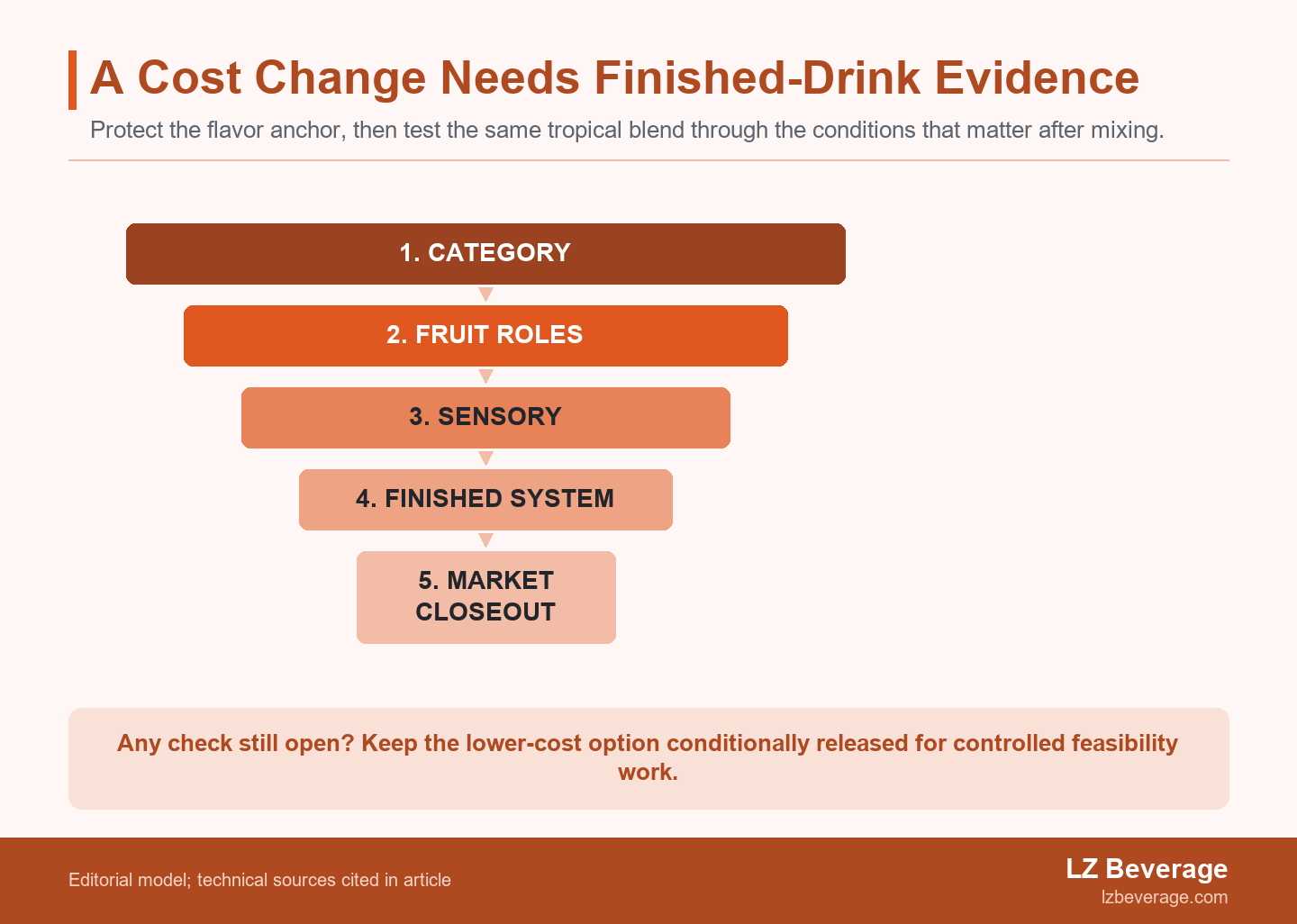
Start by writing one sentence that describes the protected outcome: for example, “a bright tropical RTD drink with a recognizable passion-fruit finish, a uniform cloudy appearance, and a defined 330 mL export pack.” Then state the proposed change and the conditions that must remain true. This small discipline prevents a lower-cost base from being approved merely because it improves a purchase-price calculation or tastes acceptable before packing.
Use one cohesive acceptance card for both formulas. It should list the product category assumption, base-anchor-accent roles, sensory descriptors, visible physical target, intended pack, storage observation window, and target-market review status. The card does not prove safety, shelf life, or compliance. It makes the remaining uncertainty visible and gives every evaluator the same comparison question.
Compare Finished-Drink Exposure, Not Fruit Prices
A lower nominal price for one fruit input does not by itself establish a lower-cost finished beverage because the substitution can create additional flavor, physical, process, pack, or market-review work.
That distinction matters when a base fruit contributes more than volume. A replacement can require more of an anchor, a different acid balance, extra stabilization work, another pilot, or a label review. Compare complete options against complete options: ingredient specification, supporting inputs, trial work, pack behavior, and approval evidence.
A useful worksheet therefore has two columns beside the cost line. One is “what may vary,” such as a flexible base input or a non-defining accent. The other is “what may not change,” such as the declared flavor anchor, the intended appearance, the chosen product category, or a stated pack route. If a proposed saving crosses into the second column, it is not a purchase decision; it is a new formulation hypothesis.
Use a Small, Fixed Sensory Scorecard
In a passion-fruit juice study, passion-fruit flavor affected acceptance positively and sweet aftertaste affected it negatively in the tested samples. Read the study.
The study does not tell another brand what its tropical blend should taste like. It does show why a scorecard should use named attributes rather than one broad question about liking. Choose a short set that matches the concept: aroma lift, anchor-fruit recognition, sweetness, acidity, aftertaste, body, and overall fit. Keep the descriptors, serving conditions, and comparison order consistent for the original and lower-cost options.
Run sensory work in stages. First decide whether the anchor remains recognizable. Next ask whether the base change creates an unwanted aftertaste or shifts sweetness and tartness. Finally, compare the packed pilot with the fresh bench sample. A formula can pass a fresh tasting and still require more work if its post-process flavor delivery no longer supports the intended identity. Record the observation; do not use an unqualified “same flavor” conclusion.
Test the Physical System Alongside the Flavor
A cost-led fruit-base change can alter physical behavior as well as flavor, so cloud or pulp acceptance should be part of the finished-beverage comparison.
This is especially important when the brand wants a naturally cloudy look, visible fruit character, or a light pulp feel. Cloud stability means whether the drink stays visually uniform instead of separating over the stated storage period. It is not a promise that every bottle will look identical forever. The brief should specify what the team will observe, when it will observe it, and what result counts as acceptable for this product concept.
The process question belongs beside the formula question. A mixed-juice study found that its stated processing conditions affected cloud stability, reinforcing that a physical result depends on the beverage matrix and route rather than fruit choice alone. Product teams who need a wider development context can explore beverage-development insights after they have written the physical acceptance question for the specific drink.
Define What “Stable” Looks Like
An NFC orange-juice study used turbidity, pulp sedimentation, and viscosity as stability indicators when examining its stated processing treatment. Read the study.
That is a measurement example, not a target for a tropical formulation. For a buyer brief, translate the concept into an observable statement: “the product remains uniformly cloudy through the declared observation window,” or “a defined light sediment is acceptable if it redistributes with the stated handling instruction.” If the product includes pulp, add the intended particle impression and any unacceptable layer, ring, or separation pattern.
Then state the comparison conditions. Use the same pack, observation window, handling approach, and visual standard for both options. If the substituted blend is brighter, thinner, more opaque, or more prone to a visible layer, that result is evidence to investigate. It is not automatically a failure, nor is it something to erase with a fresh-bottle photograph. The decision depends on the written acceptance card and the finished-product position.
Pack the Comparison Before You Release It
Within the cited U.S. Juice HACCP guidance, in-scope processors must apply controls that achieve the 5-log pathogen reduction performance standard, subject to its stated exemptions and conditions. Read the FDA guidance.
This is a U.S.-scope regulatory example, not an instruction for every export market. Its broader planning lesson is simple: a finished juice blend needs a declared process context. The same guidance explains why process details cannot be inferred merely from a formulation list. Ask which pack is intended, whether the project is shelf-stable or chilled, which process route is under review, and which destination market will assess the final product.
Flavor should be checked in that same context. In one tropical fruit juice study, the reported treatment did not impair aroma and flavor in the formulations examined; that result is matrix-specific. It supports testing the declared blend after its actual process and pack conditions, rather than borrowing a general conclusion about heat, concentration, or flavor retention from another beverage.
Worked Scenario: A Lower-Cost Base Is Conditionally Released
When a packed pilot changes both the declared top note and cloud appearance after the stated observation window, conditional release is safer than commercial formula lock until controlled comparison evidence is complete.
The following composite illustration is not an LZ Beverage project, a client result, a price model, or a recommended fruit ratio. It shows how a team can protect learning from a promising cost idea without allowing incomplete evidence to become a commercial decision.
Retest the Change as a Finished Beverage
A controlled retest should compare the declared ingredient roles, process and pack conditions, sensory criteria, physical criteria, and storage window before commercial formula selection resumes.
A Product Development Manager is preparing an export brief for a mango-pineapple-passion fruit RTD beverage. The planning basis is 60,000 cans at 330 mL, or 19,800 L of finished beverage before normal production allowances. The team wants to explore a lower-cost base while keeping the passion-fruit finish recognizable. A fresh bench blend and a packed pilot both fit the broad flavor direction, but the alternative base has not yet passed the full pack-and-storage comparison.
At fresh tasting, the pilot retains a recognizable passion-fruit top note. After the declared observation window, however, the packed pilot has a weaker top note and a different cloud appearance. Those observations do not prove one cause. They do show that the team is no longer comparing two equivalent finished beverages. The base change may be affecting aroma delivery, physical uniformity, or both after processing.
The team keeps the lower-cost option on a conditional release: permission to continue controlled testing without treating the formula as commercially final. It prepares controlled lots with the same declared base, anchor, and accent roles, then records the formula, process and pack conditions, sensory descriptors, cloud or sediment observations, and the same storage window. The original option is tested against the same acceptance card; neither version receives a special standard.
Commercial formula selection resumes only when the controlled lots meet the defined sensory and physical criteria and the target-market category and labelling review is complete. The outcome might favor the lower-cost base, the original base, or a revised option. This composite example is for decision-making only; it is not an LZ Beverage project, a client result, a price model, or a recommended fruit ratio.
Turn the Formula Into an OEM/ODM Feasibility Brief
A comparable OEM or ODM feasibility response identifies which formulation and route assumptions are confirmed, conditional, and still open for the same finished beverage.
Send the same decision fields to every prospective partner. The beverage brief should identify the provisional category, target consumer, fruit direction, base-anchor-accent roles, desired sweetness and acidity direction, any function under consideration, intended pack format, target market, expected volume, and the sensory and physical conditions that may not change. It should also be explicit about what remains open, such as the final fruit specification, process route, or market review.
Ask for answers in three groups: confirmed for elements that fit the reviewed concept; conditional for elements that require samples, technical assessment, or target-market confirmation; and open for information the buyer has not supplied. This format makes uncertainty comparable. It also prevents a commercial proposal from being mistaken for formula validation. When the pack direction is ready to discuss, readers can compare the intended ready-to-drink route alongside the formulation brief.
Prepare the Export Feasibility Handoff
An export feasibility handoff should make the beverage type, target consumer, flavor direction, function, pack format, target market, expected volume, and non-negotiable acceptance criteria visible before commercial comparison.
Before requesting a review, put the information in one page. Include the product category assumption; the tropical flavor description; the base, anchor, and accent roles; the ingredients that may vary; the sensory descriptors that must remain acceptable; the visual or pulp behavior expected after the stated window; the intended pack; and the destination market. If a lower-cost fruit base is being considered, state whether it is a bench idea, a packed-pilot option, or a controlled-retest option.
This handoff gives an OEM/ODM team a defined beverage to assess rather than a vague request for “tropical flavor.” LZ Beverage can use the same inputs to frame a structured feasibility discussion. Share the beverage type, target consumer, flavor direction, function, pack format, target market, and expected volume to request an OEM/ODM feasibility review.
Frequently Asked Questions
Which tropical fruit should carry the main flavor?
Choose the fruit that must remain recognizable after processing and storage as the flavor anchor, then test lower-cost base options against that declared identity. The anchor can be mango, passion fruit, pineapple, guava, or another note; the choice comes from the intended consumer experience, not a universal hierarchy. Keep the anchor descriptor fixed when comparing options, then decide which base or accent input may vary without changing it.
Can a fruit nectar use the same cost brief?
It can use the same decision method, but the product category, permitted composition, and label wording must be reviewed for the destination market before a cost-led change is approved. The framework still helps because it separates what may vary from what must remain true. Do not use the framework to assume that one market's juice or nectar rules automatically apply in another market.
What should a tropical blend pilot test measure?
A useful pilot records the declared formula, sensory acceptance, appearance or sediment behavior, process and pack conditions, and the storage window used for the decision. Use named sensory descriptors that match the concept, such as anchor-fruit recognition, sweetness, acidity, and aftertaste. For a cloudy or pulpy beverage, record the physical observation and the handling condition. Compare both formula options under the same written conditions.
What should an OEM feasibility request include?
Include the beverage type, target consumer, flavor direction, function, pack format, target market, expected volume, and any non-negotiable sensory or physical acceptance criteria. Also state the provisional product category, the fruit inputs that may vary, and whether the concept is only a bench blend or has been packed for a controlled comparison. This helps the manufacturer identify what can be assessed now and what still needs samples, technical review, or market confirmation.


