The hardest part of a shelf-stable calamansi drink is not getting enough citrus impact into the bench sample; it is protecting a recognisable calamansi character after the formula, cloud, heat, pack, and market category become one finished product.
That changes the development brief. A bright trial glass can still fail when the fresh top note softens after processing, a cloud settles in storage, or the agreed ingredient route no longer fits the intended market category. The practical aim is not to recreate a cut fruit at every point in time. It is to define the sensory promise that matters to the buyer, then make each technical decision answer to that promise.
A Shelf-Stable Calamansi Drink Has Four Linked Decisions
Use one brief for four decisions that are often made separately: what the juice character should signal, whether the finished drink should carry cloud, how heat and pack change the finished sensory result, and what category language the destination market can support. Locking one without the others creates false confidence at bench scale.
- Character: identify the calamansi cues that must survive instead of chasing maximum acidity.
- Physical route: decide whether a clear or cloudy appearance is part of the product promise.
- Finished-product evidence: assess aroma, taste, appearance, and sediment after the intended process and pack.
- Category fit: check the formula and claim language for the market before artwork is treated as final.
| Gate |
What to lock |
What to test before scale-up |
| Juice character |
Target aroma, acidity, sweetness, and peel boundary |
Blind comparison against the written sensory brief |
| Physical route |
Clear or cloudy expectation and acceptable sediment |
Appearance and mouthfeel through the storage screen |
| Process and pack |
Process route, package, and final sample definition |
Finished-product sensory review, not a pre-process sample |
| Market category |
Destination market and intended product description |
Formula and label review before artwork approval |
The table is a decision sequence, not a universal specification. Ingredient choices, process limits, shelf-life targets, and regulatory review all remain product- and market-specific.
A 2012 study of calamansi juice from Malaysia, the Philippines, and Vietnam identified 60 volatile compounds and found non-volatile differences among samples. The peer-reviewed calamansi characterisation study is a useful reminder that origin and juice handling can alter the starting point; it is not a ready-made formulation target. Begin by tasting the intended juice or juice system and writing the desired profile in buyer-relevant language: bright, floral or mandarin-like lift, lime-like acid drive, peel edge, body, and finish.
That brief should identify the non-negotiable cues and the allowable trade-offs. If the product is expected to feel refreshingly sharp, more sweetness may improve immediate liking while making the profile less recognisably calamansi. If it is intended as a fuller tropical citrus drink, body and a softer finish may matter more than a high-impact opening note. Teams that need to place the concept within a broader portfolio can review the wider beverage range before deciding where the citrus profile belongs.
Separate Juice Identity From Sweetness and Acid
A four-descriptor scorecard can keep sweetness and acid corrections from masking a loss of calamansi identity. Score the same finished sample for opening aroma, citrus identity at mid-palate, acid shape, and lingering peel or bitterness. Add an overall acceptance score only after the four descriptors are recorded; otherwise a sweeter or more acidic trial can look stronger simply because it is louder.
Run the screen with a small set of agreed reference samples rather than asking every taster to imagine calamansi independently. A useful output is a short decision statement: keep the opening aroma; reduce the drying peel finish; retain the acid lift; do not raise sweetness. This gives the flavour, juice, and process teams a common correction brief and makes it clear when a correction is masking a character loss rather than solving it.
Treat Peel Exposure as a Process Setting
A citrus-processing review cautions that extraction from unpeeled fruit requires care to avoid introducing undesirable flavoring principles. The citrus-processing review does not say that peel character is always undesirable; it shows why peel contact belongs in the process brief. Define whether the desired finish is clean, gently zesty, or deliberately peel-led, then set the extraction and handling boundary accordingly.
Do not correct an unmanaged peel note by repeatedly adding sweetener or flavour. That route can make the first sip appealing while leaving a bitter or drying finish that returns after heat and storage. Instead, retain the sensory record, the juice source, the extraction condition, and the finished-sample observation together. These notes make it possible to distinguish a formula adjustment from a raw-material or process adjustment.
Choose Cloud as a Sensory Route, Not a Cosmetic Fix
Cloud should be chosen as a sensory and physical route, rather than added late as a cosmetic signal of freshness. A cloudy drink can suggest juice presence and body, but that expectation is only useful if the drink remains visually coherent and the mouthfeel suits the written profile. A clear drink can be equally credible when clarity, a clean finish, and repeatable pack appearance are the more valuable outcomes.
Set an explicit physical expectation before the pilot: acceptable cloud level, permitted sediment, shake-before-use instruction if any, and the point at which a visible change becomes a rejection. Pair it with a sensory expectation. A cloud that improves visual freshness but makes the finish heavy, dulls top notes, or creates a settling problem is not a neutral styling choice.
Start With the Cloud-Loss Mechanism
In citrus juices, pectin methylesterase can change pectin, reduce viscosity, and contribute to cloud instability and precipitation through calcium interactions. Pectin methylesterase (PME), a natural citrus enzyme that can change pectin and weaken a juice cloud, is therefore a mechanism worth testing rather than a label for every settling problem. The technical review of citrus cloud stability explains the pectin–calcium relationship behind this risk.
For the development team, the operational question is simple: when a cloud changes, which part of the system changed with it? Compare a common base across the intended process and storage screen, then record cloud, sediment, viscosity perception, aroma, and acid on the same finished samples. Testing these items separately makes it too easy to solve appearance while introducing a sensory mismatch.
Let the Storage Screen Choose the Honest Route
A clear route can be the more coherent product choice when a cloudy citrus system does not retain its agreed physical and sensory profile through the intended screen. That is not a compromise if the clear route preserves the agreed citrus identity, looks intentional in pack, and gives the buyer a repeatable experience. Conversely, a cloudy route should move forward only when its texture, cloud, and flavour remain compatible through the agreed check.
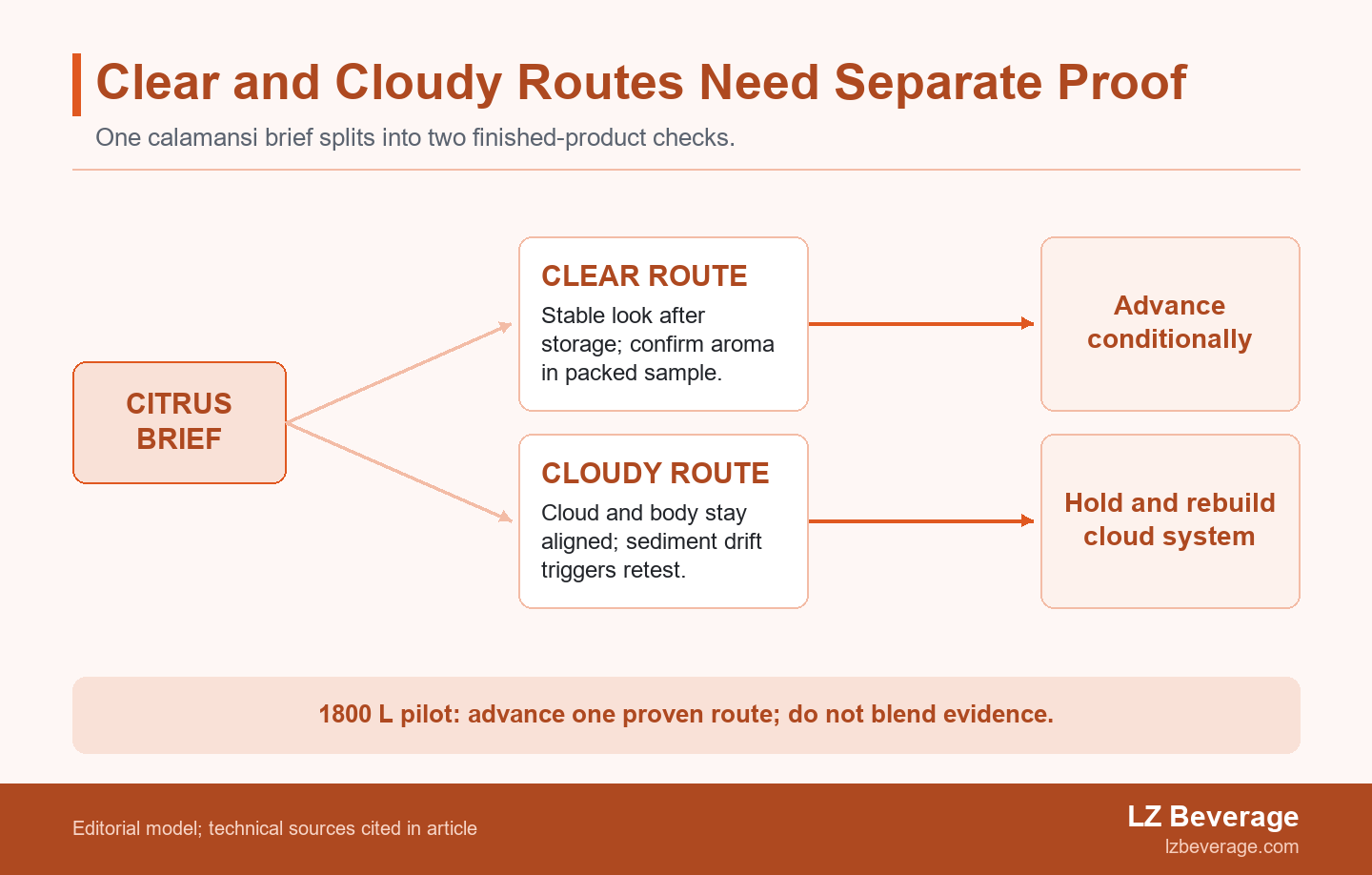
Keep the routes separate through the pilot. A formula that is called “cloudy” at bench scale and “clear enough” after storage does not give a commercial team a clear decision. Each route needs its own sample name, sensory screen, visual standard, and corrective-action record. The chosen route is the one that meets the written promise with the fewest unsupported assumptions, not necessarily the one that looked most like fresh juice on day one.
Validate Heat and Pack Against the Actual Formula
Citrus processing can affect volatile aroma compounds more than non-volatile taste compounds, so the final sensory check must use the processed beverage. The citrus juice quality study supports this direction of risk, not a fixed calamansi processing setting. Taste the filled, processed sample at the same point that you evaluate appearance and sediment. A pre-process sample can still be useful for diagnosis, but it cannot prove that the finished product carries the intended character.
FDA juice guidance recommends that processors consult a process authority to establish control measures for the applicable product and process. A process authority is a qualified technical authority who assesses whether a specific process controls the relevant product hazards. The FDA guidance is a US reference; its 5-log pathogen-reduction framework is not a substitute for destination-market requirements or product-specific validation.
Build a concise process-pack screen around the formula you intend to sell: proposed pack, target shelf-life condition, process route, closure or seam outcome, sensory reference, and acceptance criteria. If the commercial brief calls for a still can format, teams can explore a still RTD development route while retaining the separate decisions on juice character and cloud. Do not use a successful generic beverage process as evidence that a new calamansi formula will keep the same aroma and physical profile.
Choose the Product Category Before Locking Copy
EU rules distinguish fruit juice and fruit nectar by defined composition and ingredient conditions, illustrating why category review must precede label approval. In this EU example, fruit nectar is a regulated product category that can differ from fruit juice in composition and permitted ingredients. The EU fruit juice and nectar rules should be treated as an illustration of category discipline, not as universal advice for every export market.
The formula team should provide the category reviewer with the ingredient list, juice basis, sweetening approach, any flavouring or functional additions, pack format, and destination market. The marketing team should wait for that review before committing to a product name, front-of-pack claim, or imagery that implies a different category. For a concept that may combine citrus with tea cues, it can also help to compare a citrus-led tea beverage route before the proposition and copy are locked.
Use a Split-Route Pilot When Evidence Diverges
When appearance and sensory evidence do not point to the same answer, preserve the route that is closest to the agreed promise and document what prevents the other route from moving forward. This avoids turning a positive observation from one system into a blanket approval for another.
Route separation is particularly useful when development involves multiple functions or markets. It stops a project from treating one promising sensory observation as a blanket approval for an unproven physical system. Teams evaluating fit with a manufacturing partner can review LZ Beverage's manufacturing background alongside the feasibility brief, then use their own route-specific evidence to set the next decision.
Illustrative Pilot: Keep the Clear and Cloudy Routes Separate
The illustrative 1,800 L pilot advances the clear route conditionally and holds the cloudy route for route-specific retesting.
The split keeps the clear route inside a controlled pilot while the cloudy route remains outside commercial formula selection.
Illustrative composite scenario; it is not a customer case or LZ Beverage production record. An R&D manager is developing a Southeast Asia-focused still calamansi beverage in a slim can and needs a shelf-stable route before export artwork can be approved. The illustration uses one 1800 L pilot with 2 route-specific formulas that share a market brief but not a physical-system claim.
Both routes are tasted after the intended pilot process and storage screen. The cloudy route presents a more juice-like appearance before processing but develops a visible sediment line in storage. The clear route loses some opening aroma, yet keeps a consistent visual profile and needs one focused sensory correction rather than a reformulation.
The team does not hide the cloudy-route result with a stronger top note or extra sweetness. It advances the clear route conditionally into the next process-pack check, and it holds the cloudy route until the juice, pectin, and peel strategy can be retested as one system. The decision attaches the evidence to the specific route, so a positive clear-route result cannot be presented as proof for the cloudy formula.
For the next round, record cloud, sediment, aroma, acid, and peel-note observations on the same finished sample; repeat the selected route through the intended thermal and storage screen; and complete category review before artwork approval. The 1,800 L volume, two-route scope, and outcomes are illustrative only. Actual process conditions, shelf life, and market requirements require product-specific validation.
Turn the Formula Into an OEM/ODM Feasibility Pack
An OEM/ODM feasibility request is more useful when it identifies the beverage, consumer, flavor direction, function, pack, market, expected volume, and still-open evidence. This lets the manufacturing discussion begin with choices that can be tested instead of a vague request for a “calamansi drink.” It also makes clear which matters are fixed and which remain open for route-specific development.
- State the beverage format and target consumer, including the occasion and price or positioning context.
- Describe the intended calamansi character: citrus lift, acid profile, sweetness, body, peel edge, and any functional role.
- Specify still or carbonated format, preferred pack, destination market, expected volume, and required timing.
- List the evidence still needed: clear versus cloudy route, shelf-life screen, thermal result, category review, or sensory approval.
Share the beverage type, target consumer, flavor direction, function, pack format, target market, and expected volume for an OEM/ODM feasibility review. If the brief is ready to discuss, share your calamansi beverage brief for feasibility review.
Frequently Asked Questions
What makes calamansi different from lemon or lime in a beverage?
Calamansi is best treated as its own citrus profile because its juice combines mandarin-like aromatic cues with lime-like acidity and a peel-associated edge. A formulation should therefore be judged against a written calamansi sensory target, not against a generic “citrus” benchmark. Juice source, peel exposure, processing, and sweetness can all shift the balance. Start by deciding which cue must lead the experience, then verify that it survives in the processed, packaged drink.
Should a calamansi drink be clear or cloudy?
Choose the route that your target sensory promise and storage evidence can support, not the route that merely looks more like fresh juice at filling. A cloudy route may fit a juice-led proposition, but it needs a defined cloud and sediment expectation. A clear route may be more coherent when it protects the desired flavour and has stable appearance. Treat them as separate formulations until each has passed the agreed finished-product screen.
Can a formula be called fruit juice, nectar, or juice drink?
That name depends on the destination market's product definitions and the finished formula, so the claim should be checked before labels or artwork are approved. The review should use the actual ingredient list, juice basis, sweetening approach, flavours or functional additions, and market of sale. A term that appears workable in one jurisdiction may carry different composition or labelling conditions in another, so category language should never be selected from the bench sample alone.
What should an OEM receive before a calamansi pilot?
An OEM needs the beverage format, target consumer, flavor direction, function, pack format, target market, and expected volume before it can scope a meaningful calamansi pilot. It also helps to identify whether the clear or cloudy route is open, what the sensory reference is, and which proof is still needed before scale-up. With that information, the pilot can be designed to resolve a real commercial decision rather than produce an attractive but inconclusive sample.


