The biggest heat-processing risk in a passion fruit beverage is not simply lower aroma intensity; it is losing the specific top-note relationship that makes the drink recognisable, then hiding that loss with a correction that changes the formula's identity.
That distinction changes the development question. The team should not ask whether the bench sample smells strong enough, then try to restore a lost impression with sweetness or a late flavour addition. It should agree what makes the intended finished drink read as passion fruit, run the intended process and pack, and decide from that sample whether the identity has survived. This keeps sensory work connected to a commercial product rather than to an attractive but unrepeatable bench result.
A Heat-Stable Passion Fruit Drink Is a Finished-Product Decision
A passion fruit beverage should be advanced only when the intended processed and packed sample preserves the agreed sensory identity without an escalating correction loop. In a feasibility conversation with LZ Beverage, that means bringing the processed sample, its sensory record, and the route it experienced into the same decision.
- Write the target as recognisable cues and their balance, not as a request for more fruitiness.
- Record the complete exposure path from blend through heat treatment, pack, and the agreed early storage screen.
- Use finished-sample sensory evidence to interpret chemical measurements; neither one is a substitute for the other.
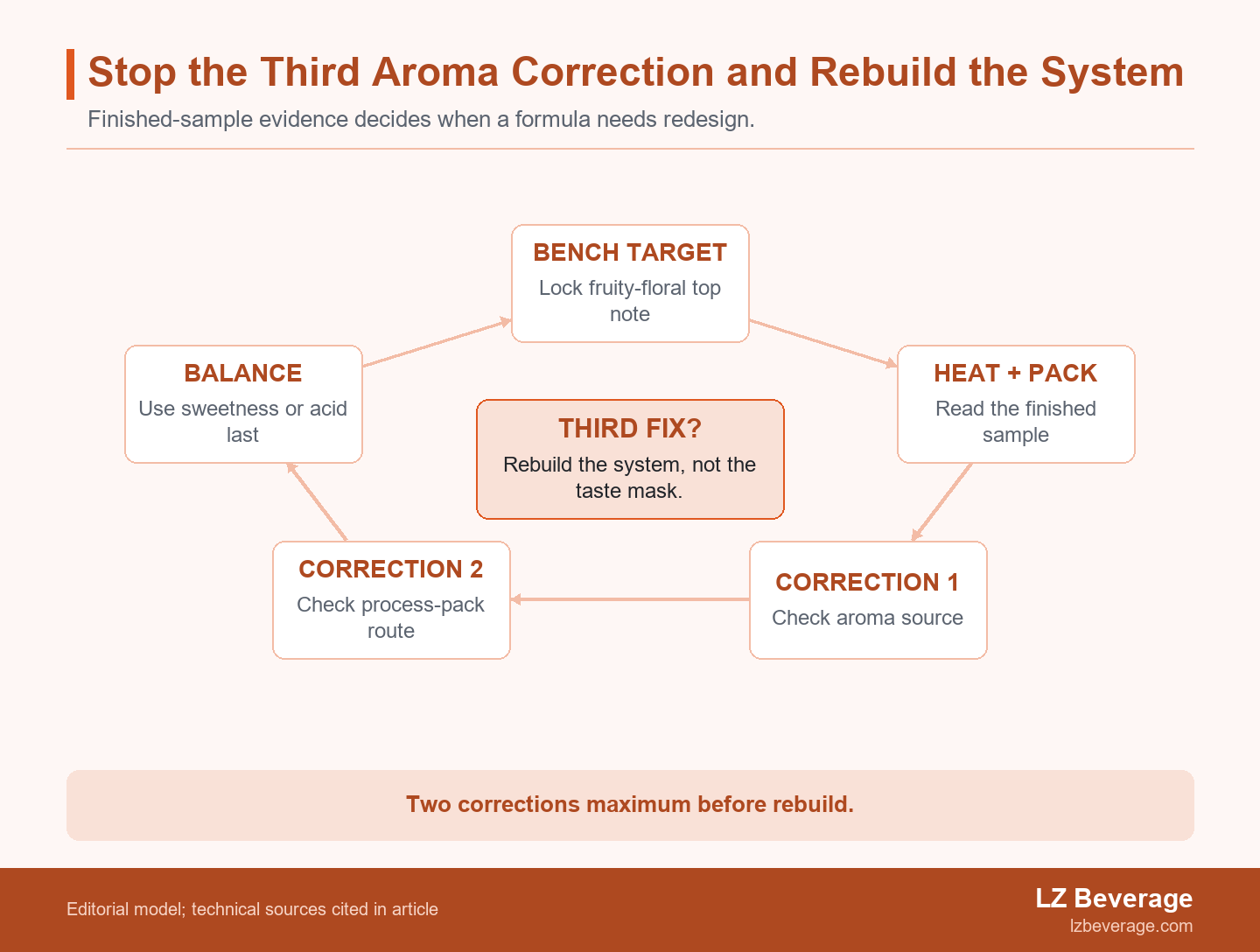
- After two independent corrections fail to restore the target, reopen the aroma source and process-pack assumptions before adding another taste fix.
Define Passion Fruit Identity Before You Heat the Formula
Passion fruit identity is carried by a multi-component aroma profile, so a formulation target should name more than generic fruit intensity. Start with an agreed sensory reference and a small number of observable cues: the first fruity-floral lift, the tart tropical middle, the acceptable degree of rind-like character, and the point at which sweetness makes the profile feel generic. A study of yellow passion fruit aroma across maturity stages and a passion fruit juice aroma study both show why a single flavour name cannot carry the entire target. Ingredient source and intended identity must be specified together.
The target also needs a boundary. It may tolerate a slightly softer top note after processing, but it should not quietly become a sweet, broadly tropical beverage that could be mistaken for another fruit profile. Teams planning a wider line can review the broader beverage product range to frame the intended format and flavour family before deciding whether the passion fruit cue is expected to lead, support, or blend with another profile.
Separate Identity From General Fruity Sweetness
Shifts in odor-active cues can alter passion fruit identity even when a formula remains sweet and generally fruity. Volatile compounds are aroma molecules that readily move into the air and shape the smell of a drink, so they can change the opening impression even when sweetness remains appealing. General fruitiness is therefore an easy false positive. The panel needs separate prompts for balance and recognition, and a yellow passion fruit aroma study gives the odor-active context for keeping those two judgments apart.
This is not a demand for an unnecessarily large trained panel. It is a way to stop one favourable attribute from standing in for the product decision. A compact, repeatable screen can compare a bench reference with the processed and packed sample, require written descriptors for the opening and finish, and flag disagreement before the team treats a broad sensory impression as successful retention.
Set a Correction Boundary Before the Pilot
A two-correction boundary tells the team when to stop adjusting balance and rebuild the system. Use the boundary as a bounded development rule: a correction is one independent attempt to restore recognisability by changing the aroma source, the process-pack route, or taste balance. If two such attempts have not recovered the agreed cues, a third adjustment indicates that the team may be compensating for an unresolved mechanism rather than improving a stable formula.
The value of the boundary is practical. It forces the pilot brief to record which lever changed, what it was intended to restore, and whether the finished sample actually regained the target. It also prevents a late sweetness or acid adjustment from being called “aroma retention” when it has only shifted attention away from the missing top note.
Map Aroma Risk Across the Actual Process and Pack
Thermal treatment and storage can change the aroma profile and sensory attributes of passion fruit products under studied conditions. A formula should be evaluated as a sequence rather than as a blend sheet. A processing comparison in yellow passion fruit purée, a pasteurization-and-storage study at 75°C for 60 s, and a 120-day glass-bottle storage study combining volatile and sensory measures all support that route-level view. In the first study, ester, alcohol, and hydrocarbon amounts in PT- and HTST-treated samples decreased by 40.7–48.0%, 80.3–81.8%, and 66.7–71.3%, respectively. The process path is part of the aroma outcome, not merely a downstream operational choice.
Build a short exposure map that follows the real product: ingredient hold time, blending conditions, the full heat path, transfer, filling, pack closure, cooling, and the initial storage condition selected for the project. The useful record is not a generic claim that the beverage was “pasteurised.” It is a traceable account of what the trial sample experienced, so a sensory change can be discussed against a specific route rather than against memory.
| Decision point |
What to record |
What the sensory screen can reveal |
| Aroma source |
Ingredient lot, addition point, and target cue |
Whether the bench reference has the intended starting identity |
| Heat and transfer |
Actual time-temperature path and equipment route |
Whether the top note changes before filling |
| Pack and early storage |
Format, closure, cooling, and planned screen condition |
Whether the packed drink still reads as the intended fruit |
The table is a handoff tool, not a substitute for validation. It makes the next experiment more informative because each sensory observation can be traced to a route component that the team can test or hold constant. For a still drink concept being scoped with LZ Beverage, teams can assess the ready-to-drink beverage route before asking whether a benchmark result is relevant to the final format.
Record the Whole Heat Exposure, Not Only a Setpoint
A product-specific process needs defined control measures and validation rather than a universal time-temperature recommendation. There is no responsible universal heat recipe for a passion fruit drink because composition, acidity, package, equipment, market, and required safety controls determine what must be validated. Within its U.S. scope, the FDA Juice HACCP guidance recommends consultation with a process authority to establish controls for the required 5-log pathogen reduction. A process authority is a qualified technical expert who assesses the specific food route and its identified hazards; that expert should be involved when a treatment route changes.
For commercial development, capture the setpoint and hold as well as the parts often omitted from flavour conversations: residence time before and after heating, delay before filling, line stoppages, fill temperature, cooling profile, headspace, and the date and condition of the finished-sample screen. The record makes a sensory change traceable without allowing sensory preference to override safety or regulatory requirements.
Let Sensory Evidence Interpret the Chemical Result
A measured change in a passion fruit volatile profile does not by itself prove the direction or magnitude of perceived sensory change. A yellow passion fruit study of analytical and sensory outcomes makes that boundary concrete. Gas chromatography-olfactometry is a method that pairs chemical separation with human smell assessment, so it helps explain why a chemical result and a panel result can diverge. Run the analytical and sensory work against the same finished samples whenever possible, then treat a mismatch as a question for the next trial rather than as permission to select the more favourable result.
Storage is a further reason to keep the packed product at the center of the decision. A same-day bench comparison can miss changes that become apparent only after filling, cooling, and the agreed early screen condition.
Correct Aroma Loss in the Right Order
Correct aroma loss by checking source, process-pack path, and only then balance adjustments. Confirm first that the ingredient lot and addition point can produce the agreed bench cues. Next, compare the actual thermal, transfer, filling, and early-storage route with the route used for the reference. Only after those checks should the team consider sweetness, acidity, or body. This order preserves diagnostic value because it asks whether the intended aroma can survive before it asks how to make a changed profile more pleasant.
Processing alternatives can be useful research paths, but they are not automatic fixes. The practical response is to design a controlled comparison with the intended pack, not to assume that one named technology will solve every formula. If the selected sensory base includes tea, the team can compare the tea beverage direction before changing the fruit cue, because the base itself can change how the passion fruit opening is judged.
When a finished passion fruit sample needs a third independent correction to feel recognisable, rebuild the source-process-pack system instead of adding another taste fix. The stop rule is deliberately conservative. It may delay a pilot, yet it prevents a team from carrying an unstable compromise into scale-up, where a later ingredient, line-condition, or storage change can expose the original identity loss again.
Use the Pilot to Decide Whether to Advance or Rebuild
A pilot should create an advance-or-rebuild decision from finished-sample evidence rather than absorb repeated compensatory corrections. Its value is the clear handoff: either the finished drink meets the agreed identity under the selected route, or the team returns to a defined source-process-pack test instead of continuing to layer in compensatory changes.
Illustrative Pilot: Stop the Third Correction
In the illustrative 2,400 L pilot, the team holds the commercial route after two corrections fail to recover the agreed identity and a third fix would only mask the signal. This is not a client result; it is a composite decision example designed to show when an R&D team should stop treating balance changes as proof of aroma recovery.
An R&D manager is preparing a tropical still beverage for a regional launch and wants a recognisable passion fruit opening after the intended heat treatment. The scenario uses an illustrative 2,400 L pilot in one beverage format, covering 1 proposed formula route across 2 finished-sample sensory rounds, with the pack and market still under feasibility review. Four bench prototypes passed an internal taste screen; one was selected for the intended thermal route and a short storage screen.
The first finished sample kept acid impact but lost the identifiable fruity-floral opening relative to the bench reference. A second version regained sweetness and general fruitiness after two adjustments, yet the panel still described the profile as broad rather than recognisably passion fruit. The useful observation is the mismatch: liking improved, while the target identity did not.
The team therefore holds the commercial route. The two corrections were not evidence that the profile had been recovered; they showed that balance adjustment was masking the loss signal. The next test must compare an adjusted aroma-source route against the intended thermal and pack path, with no third corrective lever added before that comparison.
The route can return to feasibility discussion only when the finished sample is recognisable against the agreed reference and the product-specific validation path and destination-market review are aligned. The scale, prototype count, observations, and decision in this scenario are illustrative. Actual process, shelf life, and market requirements need product-specific validation.
Turn Aroma Evidence Into an OEM/ODM Brief
An OEM/ODM feasibility brief should include the beverage, consumer, flavor direction, function, pack, market, volume, and open evidence. A useful brief turns a vague request for a stronger passion fruit taste into testable decisions. State the expected sweetness and acidity direction, the one or two open sensory questions, the reference sample or descriptor sheet when available, and the expected process route and screen timing. This gives the technical discussion enough context to separate a flavour-source question from a process-pack question.
Where the project needs a manufacturing conversation, the relevant question is whether the requested product and evidence plan fit the intended route, not whether a generic flavour can be offered. Readers can review the LZ Beverage manufacturing context.
Attach the information in the order the next trial needs it: first the target identity and reference, then the formula constraints, then the route and pack assumptions, and finally the commercial variables that may change the choice. Name the market and expected volume early because those inputs can affect which pack, controls, and documentation need to be considered. Keep an open-evidence list as well. It should identify what the team still needs to see from the processed and packed sample, rather than implying that a successful bench tasting has already resolved the feasibility question.
Bring One Complete Question to the Feasibility Review
A complete feasibility question is more useful than a generic request because it connects the intended formula to the process, package, market, and evidence still open. Before the review, prepare the sensory reference or agreed descriptors, the intended process and pack assumptions, the first finished-sample screen plan, and the exact decision that would cause the team to hold the route. This avoids treating the feasibility discussion as a flavour-shopping exercise.
State the brief in one consistent sequence: beverage type, target consumer, flavor direction, function, pack format, target market, expected volume, and the evidence still open. Then state the decision to be made from the next finished sample. That sequence gives the other party a practical starting point and shows which assumptions must be confirmed before commercial scale is considered. It should also name who approves the reference and who releases the next finished-sample decision.
When those inputs are ready, request an OEM/ODM feasibility review with a complete passion fruit brief.
Frequently Asked Questions
Can sweetness compensate for lost passion fruit aroma?
No. Sweetness can rebalance taste and increase general fruitiness, but it cannot prove that the characteristic passion fruit opening survived the intended process. Treat a sweeter result as a separate formulation option, then compare it with the reference and finished sample using an identity-specific prompt. If the recognisable top note remains absent, investigate source and process-pack conditions before adding further balance corrections.
Should passion fruit aroma be tested before or after heat processing?
Test both, but use the intended processed and packed sample for the commercial decision. The bench sample establishes whether the source can create the desired profile. The finished sample shows whether that identity remains after the route the product will actually experience. Adding a defined early storage screen helps reveal changes that occur after filling rather than only during heating.
Does a lower-temperature process always preserve more aroma?
No. Aroma outcome depends on the complete process route, formulation, equipment, package, storage conditions, and the controls needed for safety and market compliance. A lower setpoint in isolation is not enough evidence to choose a route. Compare defined alternatives with the intended pack and finished-sample sensory screen, then have the selected route reviewed for the relevant safety controls.
What should an OEM/ODM partner receive for a passion fruit feasibility review?
Provide the beverage type, target consumer, flavor direction, function, pack format, target market, expected volume, and the sensory evidence that remains open. Include the desired identity cues, the reference sample or descriptors if available, and the intended process assumptions. That information lets the technical discussion focus on feasible test conditions and the evidence needed to make a scale-up decision.


