The costly mistake in a tropical functional drink is not choosing the least fashionable fruit. It is choosing guava, mango, or dragon fruit before the team has defined the functional ingredients’ sensory effect and the sample that will make the commercial decision. A fruit can lift aroma, add body, or create a color cue, but none of those roles proves that it will work with an unspecified functional blend. The best tropical fruit is the one that meets a defined sensory role in the active system and intended format, not the one that appears strongest in a flavor list.
Choose the Fruit After You Define the Functional Job
A useful selection brief starts with a question such as: “Which fruit direction gives a recognisable opening while leaving the functional finish acceptable in this format?” That question is specific enough to test. “Make it tropical” is not. It does not say whether the commercial priority is aromatic lift, a rounded mid-palate, a vivid visual cue, or a way to manage a particular aftertaste.
- Guava is a good first direction when the target is a named aromatic character that the team can recognise and protect through the intended route.
- Mango is a good first direction when fruit body and a rounded profile are central to the intended drink experience.
- Dragon fruit is a good first direction when a red-flesh color cue belongs to the concept and can be screened through the proposed exposure path.
- No fruit direction advances by default. Each one needs to be tested with the same active system and the same finished-product decision conditions.
Format matters because the same flavor direction does not behave as an abstract ingredient. Before the fruit conversation becomes final, teams can review the wider beverage format range and define the base, drinking occasion, and proposed pack that will carry the comparison. That keeps a tropical flavor functional drinks brief tied to a product decision rather than a mood board.
Start With the Functional Off-Note, Not the Fruit Name
A masking decision must be tested against the specific off-note and product system rather than inferred from a tropical fruit name. An active system is the functional ingredients and their combined sensory effect. It may create bitterness, dryness, a mineral edge, a lingering sweetness, or a finish that arrives after the fruit note has faded. A review of physical bitterness-masking approaches explains why the result depends on the bitter compound and the surrounding product matrix. Read the review of physical bitterness masking.
That boundary changes the commercial discussion. Instead of asking a flavor supplier for “the best tropical mask,” ask which fruit direction should be screened against the exact active blend, at the intended use level, in the intended base. The fruit should be asked to perform one defined job against that system.
Define the Off-Note in Four Sensory Moments
Separating onset, mid-palate, finish, and desired fruit cue creates a usable sensory brief for a matched screen. Write the brief in four moments: onset (what the drink gives first), mid-palate (what carries the drink), finish (what remains after swallowing), and fruit cue (the recognisable character the concept must retain). This separates the problem from the remedy. A panel note that says “too bitter” cannot tell a formulator whether the issue is an early sharpness, a late linger, or a lack of fruit identity.
This is not a sensory standard or a promise that any one fruit will correct the result. It is a way to give guava, mango, and dragon fruit the same job description before the trial begins. The named fruit cue also stops general sweetness or vague fruitiness from being mistaken for the character the concept actually needs.
Judge the Intended Finished Sample
A finished sample is a sample made through the intended product route and evaluated in its proposed format. It is the decision sample because active ingredients, processing, pack, and early storage can change the balance that looked promising at bench stage. Functional beverage formulation must consider acceptable sensory characteristics in the finished product context. A functional-beverage processing review treats sensory quality and stability as finished-system concerns, which supports keeping the evaluation close to the route being considered. See the functional beverage processing review.
That does not mean a small bench screen is pointless. It is how the team eliminates clearly unsuitable directions quickly. But a water-based flavor preference, a different active blend, or a different pack should not decide the final fruit direction. For a functional energy concept, this is the point at which LZ Beverage can help a buyer scope a functional energy-drink concept.
Compare Guava, Mango, and Dragon Fruit by What They Must Prove
Guava, mango, and dragon fruit should be compared by the sensory role they must prove, the active-system interaction, the intended exposure path, and the finished-sample test burden. The fair comparison is not “which fruit tastes best?” It is “which fruit direction is most likely to meet this defined functional job, and what evidence must it produce before it moves on?”
| Fruit direction |
Strongest formulation role |
Test it first when |
Do not assume |
| Guava |
A recognisable aromatic tropical cue |
The brief can name the guava character and the active-system finish to assess |
One guava ingredient route will always deliver the same aroma result |
| Mango |
A rounded fruit profile with body |
Texture, flow, and flavor can be assessed together in the intended base |
Aroma preference alone proves a mango formula will feel right |
| Red-flesh dragon fruit |
A light tropical direction with a red visual cue |
Color and flavor can be tested through the proposed exposure and storage screen |
Bench color proves packed-product appearance |
Based on this comparison, choose the first trial according to the failure most likely to matter to the concept. If the opening aroma is the commercial signature, start by proving guava character. If the drink needs a fuller middle, start by testing mango body with the active system. If color is part of the shelf-facing promise, start with dragon fruit only when the intended route includes a color screen. The table is a starting hypothesis, not a sensory scorecard or a universal ranking.
Guava: Test the Aroma Character You Actually Want
Guava volatile composition and sensory results can vary with cultivar and pectinase treatment in the studied juices. Guava therefore needs a more precise request than “fresh tropical.” That is a useful warning against treating guava as a single fixed aroma outcome. Review the guava juice study.
For a functional drink, describe what must survive the formula: a green-fresh lift, a fuller ripe-fruit impression, or another agreed cue. Then screen that cue against the active-system finish. The study does not predict a result in another beverage, and it does not tell a buyer which guava source to use. It does show why a supplier brief should state the target character and the intended processing question rather than relying on the word “guava.”
Mango: Test Flavor and Body Together
The studied mango ready-to-serve beverage evaluated viscosity and flow behaviour alongside sensory acceptability. Mango is often chosen to make a functional drink feel rounded, but that is a body-and-flavor proposition, not simply an aroma proposition. That makes texture relevant when mango is being used to shape the drinking experience. Review the mango beverage study.
The product in that research is not a universal mango formula. The practical lesson is narrower: a mango trial should record whether the base feels appropriately full, whether the functional finish becomes more or less noticeable, and whether the intended process remains workable. If a mango sample wins only because it is thicker in one test cell, the team has not yet proved a mango flavor advantage.
Dragon Fruit: Make Color Exposure Part of the Choice
Heat, pH, antioxidant, agitation, and light influenced betacyanin stability in the studied red-fleshed dragon-fruit models. Red-flesh dragon fruit can add a valuable visual signal, but visual appeal is also a formulation obligation. Read the red-flesh dragon-fruit stability study.
Use that evidence as a reason to ask better questions, not as a stability guarantee. Is the color cue essential to launch? Which exposure conditions are already known? Will the team judge a just-processed sample, a packed sample, or both? A dragon-fruit direction may be the right creative fit, but it should not move forward on a bench color that has not been exposed to the proposed product path.
Do Not Separate the Fruit Choice From Process and Pack
Storage conditions affected betacyanin and physicochemical attributes in a studied red dragon-fruit drink. The process and pack are part of the fruit comparison because they can change the sensory and visual evidence that the team is trying to read. The source does not prove a result for a non-fermented functional RTD, but it supports the need to check a packed sample rather than treating bench appearance as the end point. Read the red dragon-fruit storage study.
For a ready-to-drink concept, the fruit decision should therefore travel with a provisional process and pack route. Teams can review the ready-to-drink formulation route while defining the screen; the point is not to prescribe a process, but to prevent a fruit preference from being approved before the relevant exposure conditions exist.
Use One Exposure Map for Every Trial Cell
Using the same base, active system, process route, pack, and storage screen across cells makes a fruit comparison easier to interpret. Keep those five items constant wherever the trial is meant to compare fruit, and record the fruit direction as the variable being changed. This simple exposure map is not a safety-validation protocol, but it gives the panel a common basis for comparing what they taste and see.
If one cell uses a different active blend, different pack, or a separately adjusted sweetness system, treat the result as a useful development observation—not evidence that one fruit has won. The correction is to separate the variables and test again, not to explain away the ambiguity with a stronger fruit dose.
Use a Matched Pilot Before You Choose a Winner
A matched test matrix protects a fruit selection decision from being confounded by an active-system change. A matched test cell is a comparison sample that changes one defined variable while holding the others constant. For this decision, build fruit-function pairs that share the same base, proposed process route, pack, and evaluation vocabulary. The first pilot question is therefore not “Which fruit did the panel like?” It is “Can the panel result be traced to one fruit-function pairing?” If not, hold the selection.
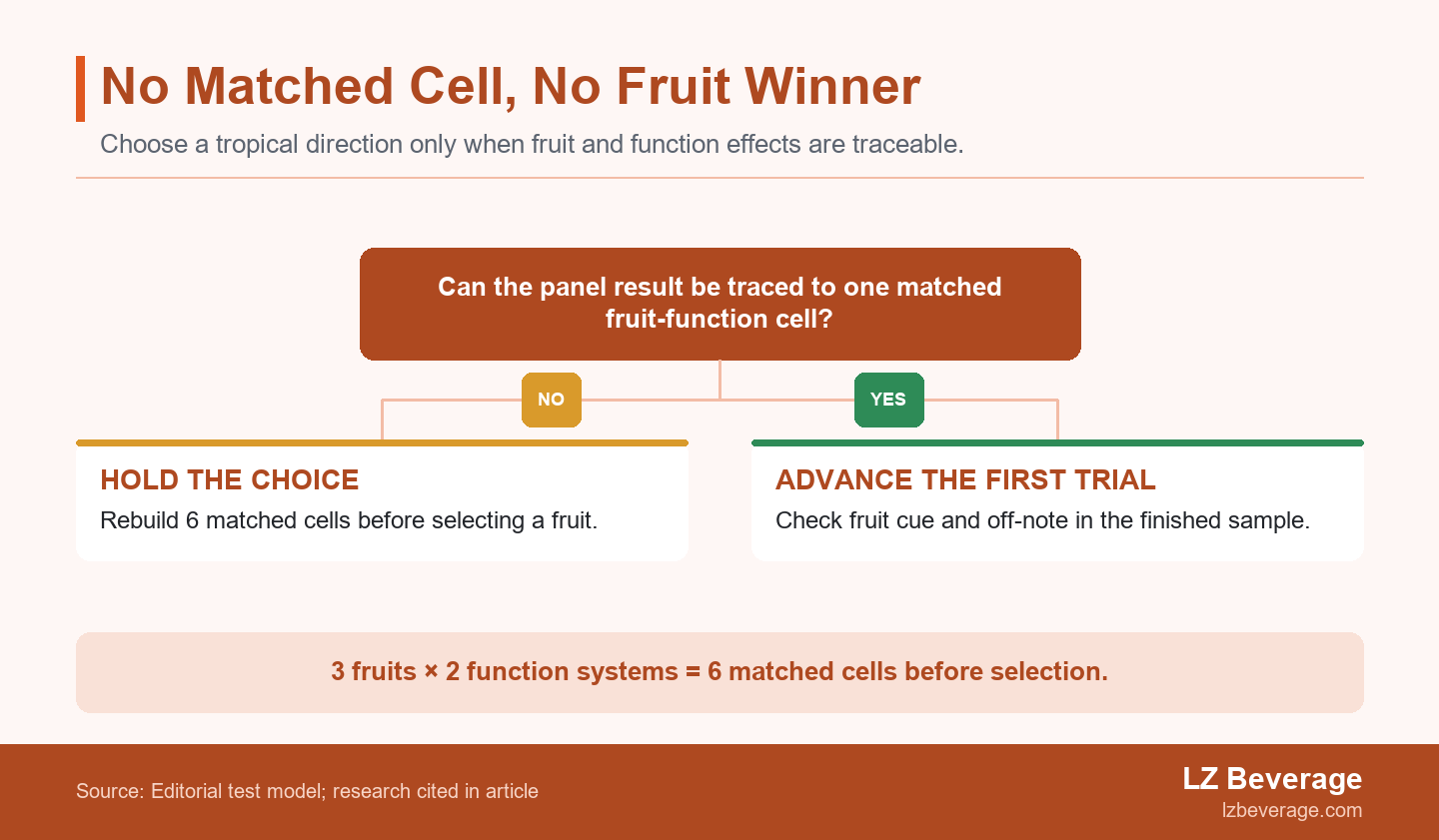
Once the matrix is defined, the manufacturing conversation becomes more practical. The buyer can assess who should review the formulation route, pack, market, and expected volume alongside the fruit comparison without assuming that any partner has run the test already. For provider context at that stage, review LZ Beverage’s manufacturing background.
Illustrative Pilot: Hold the Mixed Comparison Set
Illustrative composite scenario; it is not a customer case or an LZ Beverage production record.
The illustrative pilot holds the fruit choice when the panel set cannot separate fruit effect from function-system effect. An innovation manager is preparing a non-alcoholic functional RTD for a regional concept review and needs to choose guava, mango, or red-flesh dragon fruit. In this illustrative 1,800 L pilot, 3 fruit directions are planned across 2 proposed function systems, while the pack and market remain under feasibility review. Bench work produced a preferred fruit sample for each fruit, but the active system changed between parts of the taste screen.
The mango sample paired with function system A reads rounded, while the mango sample used to compare with dragon fruit contains function system B. Guava and dragon-fruit panel notes describe different aftertastes, but the recorded set cannot separate fruit effect from function-system effect. The mixed pilot panel set may contain useful clues, yet it cannot support a defensible fruit winner.
The analysis is straightforward: the selection evidence is untraceable as a complete comparison set because the cells are not matched. Hold the fruit choice. Do not declare mango more effective, guava more aromatic, or dragon fruit more suitable from these notes. A stronger dose or a new balancing adjustment would only add another variable to a question that has not been separated.
Rebuild the work as six matched cells, re-run each fruit direction against both function systems, and keep formula-to-panel records linked. Advance only when a finished sample meets the agreed fruit cue and off-note criteria in the same function system and format. The scale, observations, and hold decision here are illustrative; actual ingredients, process, shelf life, and destination-market requirements need product-specific validation before production.
Turn the Comparison Into an OEM/ODM Feasibility Brief
A complete brief lets an OEM/ODM review address the real fruit-function decision instead of a generic tropical request. Share the beverage type, target consumer, flavor direction, function, pack format, target market, and expected volume. Add the sensory job still open: for example, “test mango for a rounded mid-palate against the proposed active blend,” or “test dragon fruit with a color screen through the intended pack path.” That gives the feasibility review a real decision to assess.
When those inputs are ready and the unresolved test is stated clearly, the next practical step is to request a tropical-flavor OEM/ODM feasibility review.
Frequently Asked Questions
Which tropical fruit is best for a functional drink?
No single tropical fruit is best for every functional drink; select the option that meets the agreed sensory role in the actual active system and finished format. Guava may be the right first trial when a defined aromatic cue is critical. Mango may be the better hypothesis when body is part of the desired experience. Dragon fruit may suit a color-led concept. Those are trial priorities, not universal verdicts; the matched finished-sample screen decides whether any direction advances.
Can mango hide bitterness from functional ingredients?
Mango may change the overall sensory balance, but only a matched finished-sample test can show whether it improves a specific active-system off-note. It may make a product feel rounder while leaving a late bitter finish unchanged, or it may alter texture in a way that affects panel perception. Define the bitter or dry sensation first, compare mango against the same active system and base, and use the intended format before deciding that mango has improved the result.
Should dragon fruit color be tested after processing?
Yes, dragon fruit color should be tested in the intended processed and packed sample because heat, pH, light, agitation, and storage can change the color result. A bench sample can still be useful for creative direction, but it should not be the release criterion when color is part of the product promise. The exact screen should match the proposed formula, process, pack, and market route; a study model cannot certify stability for another beverage.
What should an OEM or ODM partner receive first?
Provide the beverage type, target consumer, flavor direction, function, pack format, target market, expected volume, and the sensory question still open. Include the active-system off-note, the fruit role to test, and any provisional process or pack assumptions. If guava, mango, and dragon fruit are still being compared, state which variables will be held constant. That lets the partner assess feasibility around a specific product decision rather than make unsupported assumptions about taste, stability, or production readiness.


