The hardest part of tamarind beverage formulation is not making a sour drink sweeter; it is proving that the apparent balance survives the exact formula, process, pack, and market route that will carry it. The finished formula is the identified recipe with its intended process and pack. Until that route is clear, a preferred bench taste is a useful hypothesis, not an export-ready decision. For a product-development team, the practical sequence is simple: define the tamarind experience, compare only matched samples, prove the chosen route, and then assemble the product details needed for destination review.
Balance the Route, Not Just the Sugar
A good tamarind drink can feel bright, rounded, refreshing, or richly dark depending on the concept. None of those words is a formula instruction. The buyer must decide whether the product is still or carbonated, clear or pulpy, full-sugar or reduced-sugar, and which pack will carry it. Those choices affect the sample that deserves a commercial decision. Before a team argues about a sweetener, it helps to review the beverage format range and state the intended drinking occasion and pack.
- Start with the tamarind job. Define the sour opening, the amount of sweetness, and the finish the drink should leave.
- Change one balance lever at a time. A sweeter result is not automatically a better formulation if the fruit character or finish has moved too.
- Judge the intended route. The useful decision sample has been made, packed, and assessed through the route being considered.
- Prepare a destination packet. Export review needs a defined formula and label direction, not a generic tamarind recipe.
This is a formulation guide, not a universal recipe or a legal opinion. It does not prescribe a Brix target, a sweetener, a process condition, or a country permission. It gives the product team a way to make the next adjustment interpretable and the next OEM/ODM conversation specific.
Treat Tamarind Character as an Acid-and-Finish Question
The reviewed tamarind pulp has high organic-acid content, especially tartaric acid reported at 8–12%, which gives the fruit its characteristic taste. The review of tamarind composition is useful here because it explains why a sweet-sour brief cannot start and end with “add more sugar.” The reported pulp figure is not a finished-drink target. Fruit material, extraction, dilution, and the rest of the formula can all change the resulting experience.
The commercial mistake is to reduce the whole discussion to a single sourness complaint. A tamarind concept can fail because the first sip is too sharp, because sweetness arrives too late, because the fruit disappears in the middle, or because the finish lingers after the drink is swallowed. Those are different problems. They may need different formulation questions, even when a panel uses the same word—“sour”—to describe them.
Name the First Sip, Middle, and Finish
Naming the first sip, middle, and finish turns a vague request for less sourness into a testable sensory brief. Ask the team to write one observable target for each moment. For example: the first sip should give a recognisable tamarind lift; the middle should feel rounded rather than thin; and the finish should clear without a heavy sweet linger. The wording must describe the intended drink, not the supplier’s preferred flavor language.
This brief also makes disagreement productive. A commercial lead may want a more approachable entry taste, while a market team wants the recognizable sour identity that makes tamarind distinctive. Both requests can be valid. The formulation task is to show where the conflict appears in the tasting sequence and then decide which variable to test first.
Change One Balance Lever at a Time
Sweetener choice can change aftertaste in an acidic fruit beverage, so a water test is insufficient for a tamarind formulation decision. In a study of passion-fruit juice, sweet aftertaste negatively affected acceptance in the tested acidic fruit matrix. Read the acidic-fruit sweetener study. It does not select a sweetener for tamarind, but it supports the narrower rule: assess the intended drink, not an isolated sweetness solution.
For an early screen, keep the tamarind input, beverage base, route, and pack constant. Then decide whether the single changed variable is sweetener type, sweetener level, tamarind input level, or another agreed balance lever. If two or more of those move together, a preferred sample may be commercially promising, but the team cannot say why it won. That is a reason to run a second matched screen, not to force a conclusion from a confounded one.
Build a Matched Pilot Before You Chase a Better Taste
Three matched pilot cells scored at three sensory moments create nine traceable evidence rows before the formula changes again. A matched pilot cell is a test sample that changes one planned variable while the rest of the route stays the same. This is an illustrative calculation: three cells multiplied by sour onset, sweetness, and finish produces nine observations. It is not a consumer-panel size rule, a release specification, or a claim that nine rows prove market acceptance.
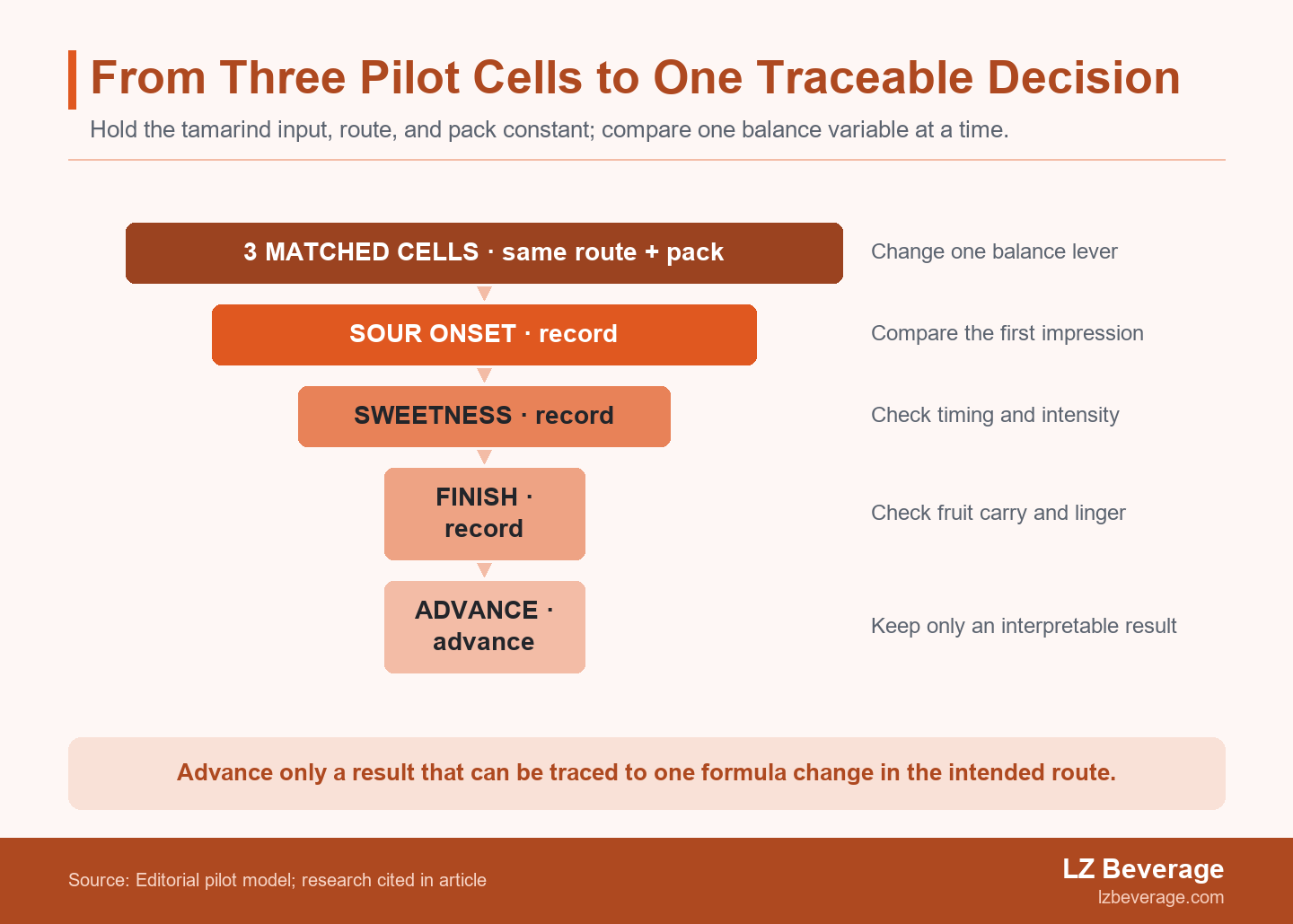
The value of the scorecard is diagnostic. If Cell B softens the opening but makes the finish longer, that is not a reason to average the notes into “better.” It is evidence that the team must decide which moment matters most. The same scorecard can record process observations, but it should not hide them inside a vague overall-liking score.
| What stays fixed |
Cell A |
Cell B |
Cell C |
| Tamarind input, base, route, and pack |
Baseline |
One planned balance change |
One alternative balance change |
| Sour onset |
Record the first impression |
Record the first impression |
Record the first impression |
| Sweetness |
Record timing and intensity |
Record timing and intensity |
Record timing and intensity |
| Finish |
Record fruit carry and linger |
Record fruit carry and linger |
Record fruit carry and linger |
Record the Three Moments Alongside the Measurements
The tamarind study measured total soluble solids, titratable acidity as tartaric-acid equivalent, total sugars, and a sugar-to-tartaric-acid ratio. See the tamarind quality-measurement study. Titratable acidity is the combined amount found by titration. It is useful alongside sensory notes because it gives the team a repeatable acid record; it does not, by itself, tell the team whether the drink tastes balanced.
Use each number as a question prompt. If total soluble solids move but the finish does not, the change may not have solved the consumer-facing problem. If the scorecard improves while a process observation becomes harder to manage, the team has a trade-off to investigate. The point is not to make an instrument reading outrank tasting. It is to preserve enough context that the next trial has a clear reason to exist.
Prove the Chosen Balance Through the Intended Route
The studied tamarind beverage assessed pH, total acidity, soluble solids, color, and storage stability after a defined preparation and pasteurization route. Review the tamarind beverage storage study. The study does not establish a process or shelf-life condition for another product. It does show why a formulation decision needs the route that created the sample, rather than a bench observation presented as a finished-product result.
Bring process and pack into the brief before the pilot becomes a purchase decision. Is the product still or carbonated? Is cloudiness part of the concept? Which pack is intended for the first market? What storage exposure will the sample see before it is judged? Teams can review the ready-to-drink route while answering those questions. The purpose is not to choose a process from a web page; it is to stop a taste result from floating free of the product it is supposed to represent.
Turn the Finished Formula Into an Export Evidence Pack
A product category, ingredient direction, and intended pack must be identified before an export review can assess the actual product. In practice, an evidence pack starts with the proposed product name, tamarind input form, sweetener direction, other ingredients, intended process, pack format, target market, and the balance question still open. That is more useful than sending a supplier a flavor description and asking whether it is “exportable.”
Codex reference material does not replace destination review because national food regulations implement the permitted use of additives in the market of sale. WHO’s food-additives guidance explains the JECFA, Codex, and national-implementation sequence. That boundary matters across Southeast Asia, the Middle East, and Latin America: these regions are commercial priorities, not one regulatory jurisdiction. The actual formula and market must be checked by the appropriate local reviewer.
The product team should therefore treat the sweet-sour brief as part of the export packet. A request such as “tamarind drink, lower sugar, 330 mL can” leaves important questions open. A usable packet adds the exact sweetener direction, intended fruit input, proposed product category, ingredient list status, destination, and the sample route that produced the sensory result.
Let the Formula Define the Product Name and Claim Direction
The Codex general labelling standard says prepackaged food should not be described in a false, misleading, or deceptive manner and addresses food name and ingredient listing. Read the Codex labelling standard. Use that as a discipline for the brief: a product name, fruit presentation, reduced-sugar direction, or functional statement should be checked against the identified formula and the destination review, rather than chosen because it sounds attractive in an early concept deck.
That does not prohibit creativity. It prevents creative language from outrunning the product. If the team changes from pulp to flavor direction, changes the sweetener system, or changes the process route, it should revisit the product description and ingredient record at the same time. A label decision that lags behind formulation is usually harder to repair at the end.
Check Additive and Sweetener Permissions Market by Market
For each destination, record the sweetener or additive name, intended use level, product category, and local reviewer before treating the formula as market-ready. This is a handoff checklist, not a permissions list. It keeps the buyer, formulator, and market reviewer looking at the same finished formula instead of three versions of the concept.
Keep an explicit “open” column in the pack. If the final sweetener, flavor system, or claim wording has not been selected, mark it as open rather than attaching a premature approval label. That small discipline protects the timeline: the team can continue sensory work while knowing exactly what needs destination review before artwork or production commitments move forward.
Give an OEM/ODM Partner a Balance Question They Can Test
An OEM/ODM feasibility brief should state the unresolved balance question, intended route, pack, target market, and expected volume rather than request a generic tamarind flavor. Add the target consumer, product type, sweetener direction, whether the drink should be still or carbonated, and which sensory moment needs improvement. This lets a manufacturer discuss the right development question without implying that a formula, compliance decision, or production plan has already been approved.
A useful handoff might say: “For a still tamarind RTD, screen one baseline and two single-variable balance options. Preserve a recognisable sour opening, reduce late sweetness, use the intended pack route, and prepare the first result for two destination reviews.” The buyer can review LZ Beverage’s manufacturing background.
Once those inputs are defined, share the beverage type, target consumer, flavor direction, pack format, target market, and expected volume to start an OEM/ODM feasibility review.
Illustrative Pilot: Pause the Export Sample When the Finish Trend Moves
Illustrative composite scenario; it is not a customer case or an LZ Beverage production record.
A repeated finish trend without a matched process baseline should trigger a process-matched screen before export-sample release. A product development manager is preparing a still tamarind RTD for two importer reviews. The planned first order is 24,000 L, and 3 pilot lots have created 9 evidence rows. The team wants a recognisable sour opening and a controlled sweet finish, but the final product name and sweetener direction remain open.
Across the three pilot lots, sour onset stays recognisable, but the sweet finish becomes longer after the intended route. The tasting record also shows that one balance adjustment and a route-window change occurred in the same comparison. The notes reveal a repeated pattern, but they cannot say which change produced it.
The correct decision is to pause release of the export sample. A preference trend is not yet a formulation conclusion because the cells were not process-matched. Calling the preferred lot “balanced” would transfer an unresolved question to the label, importer, and production schedule.
The team rebuilds three cells with the same tamarind input, pack, and process window, changing only one balance variable in each cell. It advances only when three process-matched pilot lots meet the agreed onset, sweetness, and finish criteria and the label direction is ready for destination review. The scale and result are illustrative; actual ingredients, process, shelf life, and market requirements require product-specific validation.
Tamarind Formulation Questions That Change the Next Test
What should be fixed before changing tamarind sweetness?
Fix the tamarind input, intended beverage base, process route, pack, and sensory question before changing sweetness, because each can alter the result the panel is asked to judge. Keep those elements constant in the first comparison and identify the one balance lever under test. If the team also changes the fruit input, pack, or process, record the finding as exploratory rather than proof that the sweetness change worked.
Is °Brix enough to judge a sweet-sour tamarind drink?
No, °Brix is useful for recording soluble solids but it does not replace a defined acid measure, sensory scorecard, or finished-sample check when deciding whether a tamarind drink feels balanced. Use it with the same measurement method across matched cells, then compare it with onset, sweetness, and finish notes. A stable number can still describe a drink that fails the intended sensory job.
Can a low-calorie sweetener be chosen from a water test?
No, a low-calorie sweetener should be assessed in the intended tamarind beverage because its aftertaste and the fruit’s sour character can interact differently once the full system is assembled. Test it in the chosen base and route with the same sensory prompts used for the baseline. Do not claim that a sweetener is suitable for the product until the comparison controls the other variables that shape the finish.
When is a tamarind sample ready for export-market review?
A tamarind sample is ready for export-market review when the formula, process route, pack, proposed product name, ingredient list, and destination market are identified well enough for a local compliance check. The balance result should come from the route being considered, not a separate bench sample. If a sweetener, claim, or product category is still open, keep it open in the evidence pack and resolve it before final market approval.


