A private label RTD tea manufacturer should be compared on more than a product catalogue and a price range. The useful question is whether each supplier is responding to the same finished-SKU brief: the intended tea character, the proposed process-and-pack route, the commercial assumptions behind MOQ, and the specific decision a sample must support. When those conditions match, an importer can rank quotations with confidence. When they do not, a low MOQ or a pleasant sample may simply belong to a different product route.
Start With a Comparable RTD Tea Brief
A comparable RTD tea brief connects tea capability, sensory intent, process-and-pack context, MOQ assumptions, and the sampling decision. Separating these choices creates false comparisons: one supplier may be pricing a simpler tea base or package while another is allowing for a more complex development path. Neither response is automatically wrong, but they do not describe the same commercial task.
Write down the decision that the next supplier response must make easier. It might be selecting a tea direction, testing one package route, estimating a launch-scale order, or identifying what must be validated before commercial approval. A concise decision statement helps the supplier distinguish a concept sample from a request for a ready-to-quote SKU. It also lets the buyer preserve open questions instead of treating them as silent assumptions.
The Five Conditions That Make a Quote Comparable
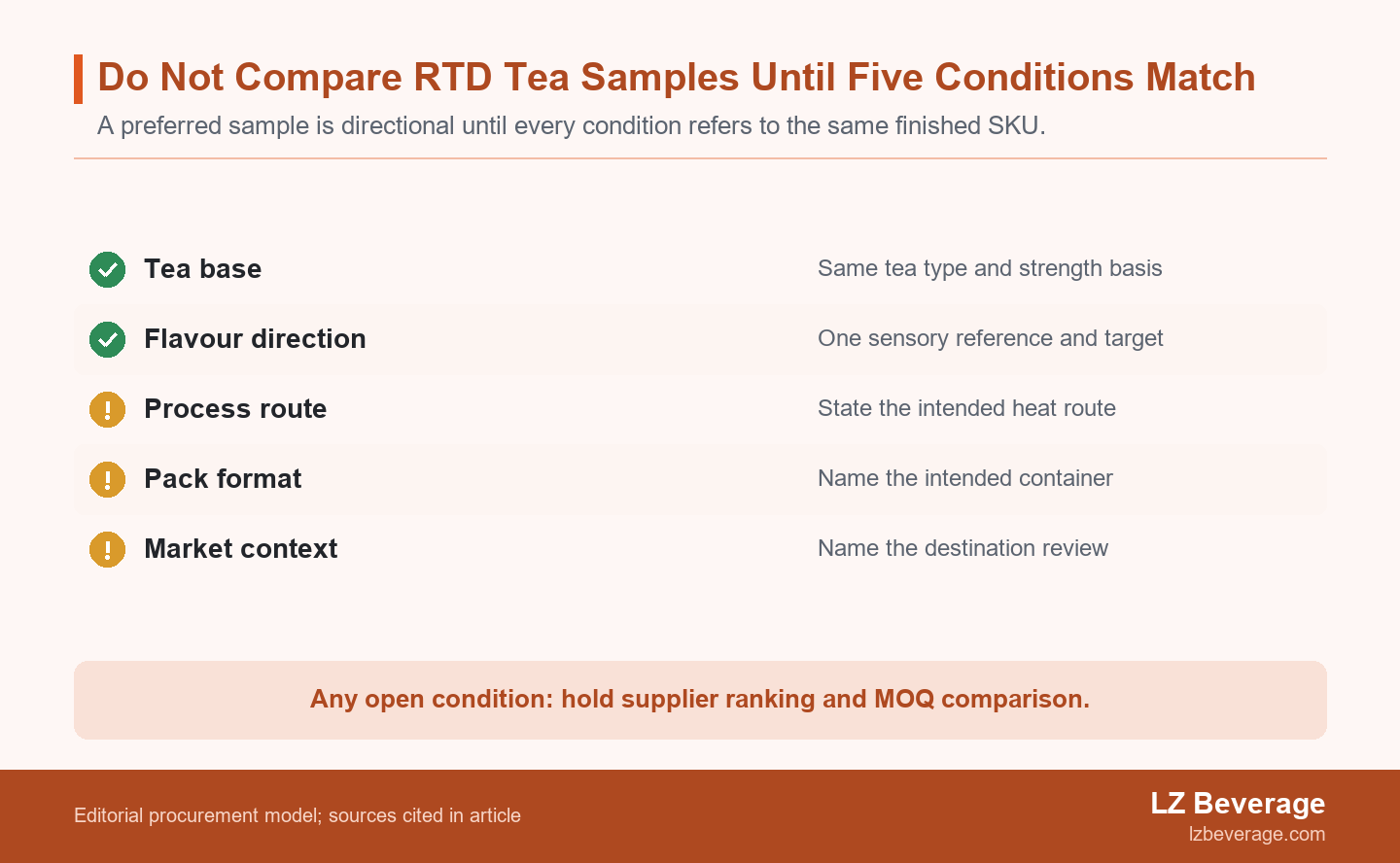
A supplier response is comparable only when the product, sensory, process-pack, commercial, and evidence assumptions are visible together. Use these five conditions as a screening checklist before comparing price, lead time, or minimum order quantity.
- Tea capability: tea type, brewing or extract route, intended tea character, and the flavour direction.
- Sensory target: the reference, the attribute under review, serving condition, and pass-or-revise decision.
- Process and pack: proposed package, distribution setting, and the technical route being considered.
- MOQ basis: the pack, SKU count, component assumptions, development stage, and order profile behind the number.
- Evidence status: what is confirmed, what is directional, and who owns each remaining technical or market question.
A blank condition is not a reason to reject a manufacturer. It is a reason to label the response as exploratory. That distinction prevents a team from approving a commercial number before it knows what product the number actually represents.
Define the Tea Capability Before Requesting a Sample
For early category scoping, buyers can review LZ Beverage's beverage categories before turning a broad idea into one comparable RTD tea brief.
“RTD tea” is a category, not a complete capability description. A buyer should state the intended tea type, expected tea character, proposed flavour direction, desired clarity or texture, pack size, and destination market before asking whether a manufacturer can support the concept. Those inputs give the supplier a defined question to answer rather than an invitation to send an unrelated catalogue sample.
Ask how the proposed tea base will be prepared and what the supplier needs to know before choosing a development route. The answer can reveal whether the team is discussing the same outcome as the buyer: a recognisable black-tea backbone, a lighter green-tea profile, a botanical tea blend, or another direction. It should also make clear which attributes are preferences and which are non-negotiable launch requirements.
Thermal treatment is one reason this precision matters. A peer-reviewed study of green tea infusion reported changes to its aroma-related volatile profile after heat treatment. It does not prescribe a universal RTD tea formula, but it supports testing a tea sample in the relevant route rather than approving flavour from an uncontextualised tasting. See the green tea heat-treatment study.
Turn “Premium Tea Taste” Into a Testable Description
Once the first reference is clear, buyers can explore LZ Beverage's beverage-development insights for related category-development reading without treating that material as a substitute for a finished-SKU brief.
A useful tea brief describes the character the buyer wants a tasting panel to notice, not only a broad quality adjective. State whether the intended finish should be brisk, rounded, roasted, floral, clean, drying, or another sensory direction that the team can compare against a reference. Then state what should not dominate: excessive bitterness, a cooked note, weak tea identity, or a flavour system that masks the tea base.
That language is more useful than asking for a “premium” result because it gives a supplier a measurable development question. It also creates a sensible first sample objective. For example, the first round may test whether a citrus profile leaves the black-tea finish recognisable at the intended serving temperature. It is not yet proof of a final shelf-life, regulatory route, or factory-ready commercial specification.
A peer-reviewed study of green tea beverages identifies aroma stability during thermal processing and storage as a development challenge. This does not make one process route universally correct; it does make a route-representative sample more informative than a tasting without process context. See the research on retort-related green tea aroma.
Confirm the Proposed Process and Pack Before Ranking Flavour
A preferred RTD tea sample should be tied to its proposed process and pack context before it becomes a commercial reference. Ask which package is being considered, whether the sample is directional or route-representative, and what product conditions still need technical review. A sample poured at a meeting may be valuable for flavour direction, but it cannot silently stand in for every processing, storage, and package assumption.
This does not require a buyer to solve the technical route alone. It requires the supplier to distinguish what has been demonstrated from what has not. For a new concept, a transparent response may say that tea direction is confirmed for the next development stage while process-pack fit, storage assumptions, or market-specific questions remain open. That is stronger commercial communication than an unqualified promise.
Use Sampling to Answer One Controlled Question at a Time
A productive RTD tea sampling plan assigns one decision to each round and records the conditions that must stay fixed. The buyer should identify the reference sample, the primary attribute under review, the intended pack context, and the decision that follows from the tasting. This avoids the common situation in which Sample B is preferred but no one can explain whether the difference came from tea base, flavour, sweetness, heat route, or package context.
Begin with a short sample sheet. It should name the tea type, flavour direction, expected tea character, sweetening direction, sample format, tasting temperature, and the specific change being requested. The sheet does not need to become a formula. Its purpose is to make the next conversation auditable: everyone can see what changed, what stayed constant, and why the next sample was requested.
Hold the Other Variables Steady Where Practical
When a buyer requests the next RTD tea sample, the supplier should record the intended variable under review and the main conditions held constant. If the question is tea strength, avoid simultaneously changing flavour intensity, sweetness direction, and packaging assumptions unless the purpose is explicitly exploratory. A controlled change makes the tasting result useful for a commercial decision instead of merely generating new preferences.
Ask for a concise change record with each sample: what changed, what was retained, what the supplier believes the change should demonstrate, and what decision the buyer should make from the result. This is particularly valuable when several people taste samples at different temperatures or on different days. Their feedback can be attached to a shared reference rather than turned into contradictory formula instructions.
Do Not Rank Suppliers Until the Sample Conditions Match
Samples can be ranked across suppliers only after they represent the same tea direction, flavour target, intended process route, package context, and market brief. Until then, the tasting is directional. It may still help eliminate an unsuitable tea style or clarify a flavour preference, but it should not decide supplier ranking or establish the MOQ for a different finished SKU.
Use the checklist below as a meeting control. If one condition is not yet aligned, record it as an open item and set the next comparison point. This keeps the commercial discussion moving without overstating the meaning of an early sample.
Discuss MOQ Only After the SKU Is Comparable
Before putting more weight on a commercial range, buyers can review LZ Beverage's manufacturing background and then ask how that operating context applies to the stated RTD tea brief.
MOQ is meaningful only when the underlying SKU and commercial assumptions are stated. The same manufacturer may need different order assumptions for a different package, tea input, flavour complexity, component programme, development stage, or target distribution route. A buyer should therefore ask what the quoted MOQ includes, what it excludes, and which open inputs could change it.
Do not treat the MOQ as a standalone measure of manufacturing capability. A low number may describe a first trial, a standard package, or a narrow development scope; a higher number may include different components or a more complete path toward commercial production. The useful comparison is not “Which supplier gave the lower number?” It is “Which supplier explained the assumptions behind the same intended SKU?”
| Supplier statement |
Question that makes it comparable |
Commercial status |
| “MOQ: 10,000 units” |
For which tea base, pack, components, SKU count, and development scope? |
Needs assumptions |
| “We can support a smaller first run” |
Is that a directional sample run, a pilot, or a launch-ready production route? |
Needs route definition |
| “Full OEM/ODM support” |
Which tea, pack, market, and validation questions can the team address in the first feasibility review? |
Feasibility discussion |
A supplier that identifies open assumptions is often more useful at this stage than one that gives an unqualified range. The first response should help the buyer decide what must be fixed before commercial terms are finalised, not make a premature commitment appear certain.
Keep Process, Pack, and Evidence in the Same Conversation
When the product route is still being defined, buyers can compare the intended RTD beverage route with the proposed tea brief before turning an early sample into a launch assumption.
Shelf-life and market-readiness discussions should name the intended product, process, package, storage condition, destination market, and the evidence still required. A duration on a quotation is a commercial input, not proof that those conditions have been evaluated for the proposed SKU. Ask the manufacturer which parts of the route are confirmed, which need qualified review, and who owns the next step.
Market and product-route questions belong in the first feasibility brief, alongside the intended pack, storage assumptions, and the evidence still required. A supplier can then distinguish an early product-direction discussion from a route that needs qualified market, process, label, or validation review.
Ask Which Conditions the Proposed Route Must Control
Where 21 CFR 114 applies, the regulation requires acidified foods to achieve and maintain a finished equilibrium pH of 4.6 or lower within the scheduled process. The cited regulation text also addresses thermal processing, testing, and records within that scope. This is a US example only; a qualified reviewer must determine whether a particular product and market route are in scope.
That boundary is useful to buyers because it changes the supplier question. Rather than asking only for a duration, ask what product conditions, package assumptions, testing, documentation, or external review need to be resolved before the duration is confirmed. For a general description of linked technical inputs, the University of Georgia’s process-authority guidance describes assessments that can consider formulation, pH, water activity, processing, packaging, samples, and verification testing.
Name the Owner of Each Open Technical Question
A credible supplier response separates confirmed product choices from questions that still need validation, process review, label review, or market-specific confirmation. The buyer does not need to demand a conclusion before the required inputs exist. The buyer does need to know who will resolve the question and what information that person will use.
FDA’s preventive-controls information describes requirements in its food-and-facility context, including written food safety plans and preventive controls. It should not be used as a generic certification claim for a supplier. Instead, use it as a prompt to ask whether the manufacturer can identify the applicable product, process, and verification discussion for the proposed route.
Illustrative Scenario: Reissue the Brief Before Comparing Price
The Two Quotations Cannot Be Compared Yet
Price and sample comparisons should pause when suppliers are responding to different tea, process, pack, or evidence assumptions. This illustrative composite example is not a LZ Beverage customer case, a formula, a process recommendation, or a market approval.
An importer asks two manufacturers to quote a 330 mL citrus black RTD tea for one retail-market launch, with an illustrative first order of 12,000 cans. The brief names a citrus direction and a less-sweet preference, but does not say how the tea character should present, which package route is intended, or whether the first sample is only directional. Both suppliers can make appealing samples, but each has to fill in different missing assumptions.
One supplier proposes a tea profile with a pronounced black-tea finish and a standard can programme. The other assumes a lighter tea direction, different component availability, and a different development path. Their MOQs and prices look comparable on paper, but the numbers belong to two different commercial tasks. The buyer therefore does not rank the quotations or ask either supplier to match the other’s number.
In this illustrative example, the importer reissues one five-condition brief: tea character, sensory reference, intended process and package context, order assumptions, and a list of open market or validation questions. Each supplier is asked to return a controlled sample plan and identify unknowns. Comparison resumes only when the preferred sample and the commercial response refer to the same 330 mL SKU and market scope.
Send a Feasibility Brief, Not a Vague Flavour Request
A first feasibility review is more useful when the buyer shares market, tea direction, sensory reference, pack format, intended distribution, expected volume, and open questions together. That gives the manufacturer a basis for distinguishing confirmed choices from development work that still needs a technical or commercial owner.
LZ Beverage can use this kind of connected brief to discuss an RTD tea concept in the context of its proposed SKU, rather than treating a broad catalogue request as a finished specification. Buyers ready to discuss a defined request can request an OEM/ODM feasibility review.
Frequently Asked Questions
How Do I Verify an RTD Tea Manufacturer’s Capability?
Verify capability by asking the supplier to respond to one finished-SKU brief, not by relying on a broad category list. The response should address the intended tea type and character, flavour direction, package context, destination market, and the purpose of the first sample. Ask which inputs are confirmed, which require development, and which technical questions need a named owner before a commercial commitment can be made. A useful reply also distinguishes a flavour-direction tasting from a sample that represents the intended commercial route. That distinction lets the buyer compare what each manufacturer can demonstrate now, what it can develop next, and what remains subject to qualified review.
What Must Be Fixed Before Comparing MOQ Quotes?
MOQ quotes become comparable only after the tea base, flavour direction, package, SKU count, market route, and expected order profile describe the same task. Confirm whether each figure includes the same component assumptions and development scope. Ask whether the minimum is tied to a particular can, label, component, production run, or combination of SKUs. If one supplier is pricing a directional trial while another is quoting a more defined production route, the numbers should be treated as different commercial options rather than competing bids. The practical next step is to reissue the same brief, record each unresolved assumption, and compare the revised responses only after they describe one matched SKU.
What Should an RTD Tea Sample Actually Prove?
A first RTD tea sample should prove one defined product-direction question, such as tea character, flavour balance, or sweetness preference at the intended serving condition. It may guide the next development round, but it does not alone establish shelf life, final market fit, or factory readiness. Record the process and pack context, the variable under review, and the decision that will follow from the tasting. The tasting sheet should also say what will stay fixed in the next round, so the team does not mistake a change in tea base, flavour, heat route, or package context for proof that one supplier is better. A sample becomes commercially useful when its purpose and limits are visible to everyone reviewing it.
When Should Market Requirements Enter the Brief?
For products within its stated United States scope, FDA distinguishes acidified and low-acid canned-food categories using finished-equilibrium-pH and water-activity definitions. FDA’s regulatory information is a jurisdiction-specific reference, not a classification decision for every RTD tea or an answer for other markets. Raise destination-market requirements in the first feasibility brief so the supplier can identify label, pack, process, or verification questions that need qualified local review. The buyer should name the intended market before treating a sample, quotation, or stated shelf-life as launch-ready, and should keep open items visible until the appropriate qualified reviewer closes them.


