The costly mistake is not choosing cold brew or hot brew; it is treating that extraction choice as proof of the final beverage. Route selection should begin with the taste direction the buyer wants, then test whether that character still holds after treatment, pack, and review conditions are defined. A clean cold extract can lose its distinction after downstream handling, while a well-managed hot route may land closer to the desired cup profile than its label suggests.
The RTD Tea Decision Is Not Just Cold or Hot
An RTD tea is a ready-to-drink beverage sold as a finished beverage. The finished process is the treatment and pack path after extraction before the beverage is released. Those are different decisions: extraction creates a tea liquid; the finished route determines the beverage that a buyer will assess, quote, and eventually put into market.
For RTD tea, choose the taste direction first, then validate the finished process route. That order keeps a promising bench infusion from being mistaken for a production-ready answer.
- Describe the intended taste, aroma, body, and astringency before naming a brew route.
- Write extraction temperature, time, tea load, water, and filtration as a controlled trial.
- Keep formula, intended treatment, pack, and sensory review conditions aligned across candidate samples.
- Select a route only after a finished-sample comparison shows what remains distinct and acceptable.
This does not set a process schedule or shelf life. It gives the product team a cleaner sequence for deciding what to sample first and what evidence a manufacturer needs before a pilot quote.
Start the brief with a sensory reference: an agreed description of the intended taste, aroma, and mouthfeel. “Fresh tea character with low roughness,” for example, is more useful when accompanied by a note on sweetness, citrus level, color expectation, and whether a light drying finish is acceptable. It tells the development team what to protect without assuming that one route will always create it.
Tea type, brewing temperature, and time can produce different infusion outcomes. The cited work compared 65 °C and 100 °C water over 5- and 10-minute brew periods. The practical implication is simple: a route label is not enough to recreate a sample. State the tea material, extraction temperature, hold time, tea-to-water ratio, water condition, and the point at which the extract will be judged.
Tea brewing temperature and time change the chemical profile of the infusion. The cited green-tea study examined 60 °C and 95 °C across 5–300 minutes. That evidence comes from a green-tea infusion study, not a universal RTD formula, but it is a useful warning against asking a supplier to “make it cold-brew style” without an operating window. The team should agree whether the priority is lifted aroma, fuller body, restrained astringency, deeper color, or a balance among them.
For a product development manager, the first sample request can be deliberately narrow: one tea lot, one target sweetness and acid direction, two extraction routes, and an agreed sensory scorecard. Once the desired character is explicit, it is easier to see whether cold extraction is a useful starting hypothesis or simply a familiar marketing cue. Teams defining the category and format can also review LZ Beverage's tea beverage range before turning the taste direction into a supplier brief.
What Cold Extraction Can and Cannot Signal
Cold extraction is often chosen to explore a smoother, more restrained tea expression. That can be a sensible route to test, particularly when the sensory reference puts a premium on clean finish and modest bitterness. It is not, however, a guarantee of a particular sensory result, stability outcome, or preservation method. Different tea materials, longer contact periods, tea load, filtration, sweetness, acidity, and aroma additions can move the finished beverage in different directions.
Cold extraction is a route specification only when time, tea load, and review condition are written with it. A useful cold-route brief names the extraction window, whether the tea is leaf, cut tea, or powder, the intended solids, filtration approach, and whether the sample is being evaluated as an extract or as the finished beverage. Without those controls, a “cleaner” sample may be cleaner because it used a different tea load or formula rather than because it was cold extracted.
Time Is Part of the Route, Not a Late Adjustment
A longer cold trial should not be treated as a minor adjustment after the first tasting. It changes the comparison itself. Lock a time window before the supplier prepares the pair, and keep it in the sample record alongside tea lot, ratio, and filtration. If the first pair is promising, the next round can explore a narrower time range rather than moving several variables at once.
In one black-tea study, infusion time and tea form were important determinants of antioxidant activity and polyphenol content. The study does not prescribe a universal RTD extraction target, yet it reinforces the operational point: time and tea form belong in the route definition, not in a footnote after the sample arrives.
A Cold Extract Still Needs a Finished-Product Check
A cold extract can look compelling in a bench glass and still need a new judgment after the planned downstream path. The buyer should ask for the sample condition to be named clearly: extract only, blended beverage before treatment, or finished-pack equivalent. Sensory notes become much more useful when everyone knows which of those states they describe.
In one 2026 cold-brew green-tea study, pasteurization produced similar volatile profiles for hot- and cold-brew samples. This is one laboratory study, not a prediction for every formula, treatment, or pack. Its value is directional: a route should be assessed after the intended finished-product treatment, rather than solely by differences seen immediately after extraction.
What a Hot Route Can and Cannot Prove
A hot route is not automatically harsh, and it should not be rejected merely because the product brief uses words such as smooth or refreshing. A controlled hot extraction can be the right candidate when the target needs a more present tea aroma, fuller mid-palate, or a specific tea identity that is difficult to achieve in a lower-temperature trial. The question is whether the finished sample earns that direction against the same reference, not whether “hot” sounds stronger on paper.
At sufficiently high temperatures and longer brewing times, green-tea catechin forms can shift through epimerization. At 85 °C, the cited study reported EGCG reaching 50.69 mg per 100 mL at 3 minutes. That finding is limited to the cited green-tea study context. It still illustrates why a hot route needs a defined temperature and time window, rather than a general instruction to extract “as strong as possible” and correct the outcome later with flavor or sugar.
For the first paired trial, hold the finished formula constant and give the hot route the same discipline as the cold route: tea material, water, target solids, acid system, flavor system, intended pack, and review point. If the hot sample has more aroma but also more drying finish, the team can decide whether that trade-off fits the reference. It should not quietly change leaf mass, lemon level, or treatment condition while the route is being compared.
Thermal treatment and simulated storage changed several aroma compounds in a green-tea beverage study. The study does not establish the same outcome for other tea types or formulations. It does make post-treatment and storage-point aroma review a sensible part of the comparison record, especially when aroma is the reason a hot route is under consideration.
When the drink format, serving expectation, and route are being narrowed together, it helps to compare the intended RTD beverage direction before treating either extract as the commercial winner. The supplier conversation becomes clearer when a preferred taste direction and a required finished-sample condition travel together.
Compare Finished Samples, Not Route Labels
A matched two-route sample set is more decision-useful than an unmatched favorite sample. It lets the buyer attribute a preference to a controlled difference instead of to several hidden changes at once.
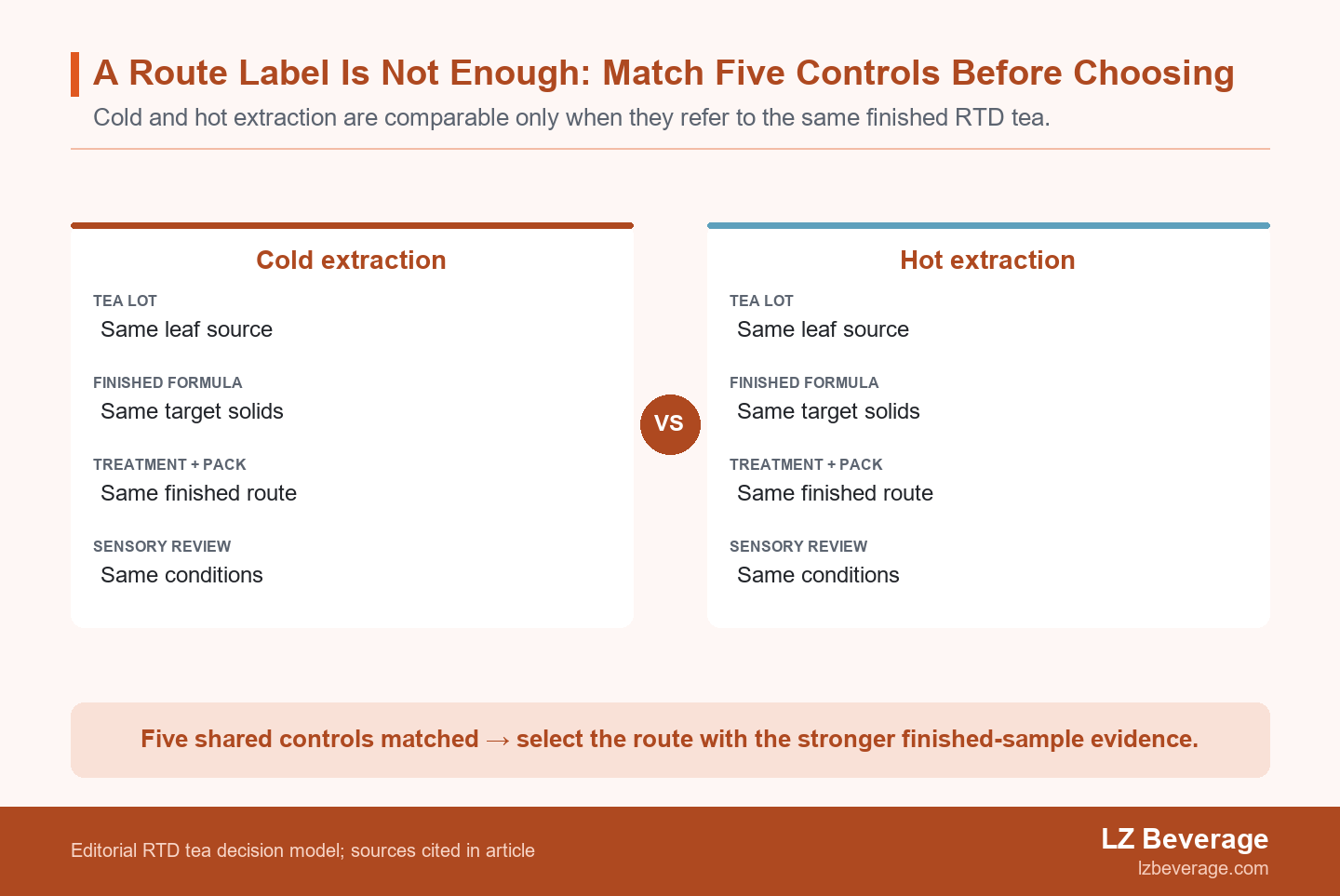
A practical comparison holds the tea lot, finished formula, intended treatment, pack, and review conditions steady. The only planned change should be the extraction direction and its explicitly written settings. This is not a substitute for analytical, microbiological, or shelf-life validation; it is the discipline that makes early sensory feedback interpretable enough to decide what deserves that validation.
| Control |
Cold-route sample |
Hot-route sample |
Why it stays aligned |
| Tea lot and form |
Same named lot and cut |
Same named lot and cut |
Prevents leaf quality from being mistaken for route effect. |
| Finished formula |
Same target solids, acid, and flavor system |
Same target solids, acid, and flavor system |
Keeps sweetness and citrus from hiding a tea difference. |
| Intended treatment |
Named finished-process condition |
Named finished-process condition |
Shows what survives the planned route after extraction. |
| Pack |
Same target can or bottle |
Same target can or bottle |
Avoids comparing a package effect with an extraction effect. |
| Sensory review |
Same panel, temperature, and scorecard |
Same panel, temperature, and scorecard |
Creates a record suitable for a route-selection decision. |
Based on this comparison, a team can select the sample that best matches the sensory reference, then document why. Matched samples, a stated finished process, one tea lot, and a controlled route selection make the decision traceable. If a supplier offers a favorite sample outside those controls, keep it as an inspiration sample rather than use it as proof that one route is superior.
Heat treatment can deteriorate the aroma quality of green tea infusion in the presence of Fe2+. That statement is limited to the ferrous-ion context studied by the authors; it is not a blanket prediction for every tea beverage. It supports adding aroma observations to the finished-sample acceptance record instead of relying only on color, sweetness, or an extract-stage tasting. Product teams that want a broader development reference can explore further beverage-development insights.
Illustrative Scenario: Reissuing a 12,000-Can Pilot Brief
Before route selection reaches a pilot quote, the buyer may also review LZ Beverage's manufacturing background to understand the partner context for the ensuing feasibility discussion.
Why the First Two Samples Cannot Select the Pilot
Illustrative scenario: a product development manager is preparing a 12,000-can pilot for a lightly sweetened lemon black tea, using two candidate 330 mL pilot routes. The team is at pre-quote pilot scoping and has two pleasant bench samples. One is cold extracted; the other uses a different tea ratio and a different lemon system. The samples cannot yet answer the commercial question because they are not a controlled pair.
The cold sample is described as cleaner, but it uses 15 percent more leaf mass. The hot sample has a stronger aroma, but it was not evaluated after the intended finished process. Both versions may be quoted in the same can, yet the preservation path has not been written into the brief. The observed preference therefore cannot be assigned to cold versus hot extraction: tea load, flavor system, and finished-sample condition moved at the same time.
A paired pilot request prevents a route preference from becoming an untraceable production decision. The team holds route selection and reissues the request for two samples that differ only in extraction direction. It asks the manufacturer to use the same tea lot, target solids, lemon system, can, and defined post-extraction process for both versions, then conduct sensory review after that route.
A pilot route should remain unselected while critical sample controls differ. In this scenario, a route can move to the 12,000-can pilot only when the review record identifies a preferred finished sample and no unmatched control remains. This example is illustrative, not a client case, and it does not establish a commercial formula, microbial process, or shelf-life result.
Give the Manufacturer a Split-Route Feasibility Brief
A useful feasibility discussion starts with the paired decision, not with a request for a generic cold-brew quote. Supply the sensory reference, tea type and lot assumptions, two candidate extraction specifications, target formula, intended pack, sales market, pilot scale, and the finished-sample evidence needed to select a route. This gives the manufacturer enough context to identify open questions without inventing certainty from the words “cold brew” or “hot brew.”
For products sold in the United States, an acidified food has a finished equilibrium pH of 4.6 or below and water activity above 0.85. This is an FDA definition, not a determination that a particular RTD tea is acidified or subject to a specific process. It shows why target market and finished-product characteristics belong in the feasibility brief rather than being inferred from a brew label.
- Name the tea material and the sensory reference the finished beverage must meet.
- State the cold and hot extraction windows separately, including time, temperature, tea load, and filtration.
- Hold the finished formula, intended treatment, target pack, and sensory review conditions constant for the paired samples.
- Specify the target market, pilot scale, and the acceptance record needed before route selection or a commercial quote.
With those inputs, a manufacturer can discuss the two routes as a feasibility question instead of guessing at an aesthetic preference. LZ Beverage can use the sensory reference, route details, formula, pack, market, and pilot evidence criteria as the basis to request an RTD tea feasibility review.
Frequently Asked Questions
Does cold-brew tea mean the finished RTD beverage is unheated?
No, cold brew describes the extraction step; it does not automatically state how the finished RTD beverage will be preserved. A cold extract can still be blended, treated, packed, and assessed through a defined finished process. Ask which sample condition is being tasted and what treatment and pack are intended before drawing a conclusion about final flavor or stability.
Which tea types should start with a cold-brew sample?
Start with a cold-brew sample when the target calls for a restrained, clean tea character and the team can control a longer extraction trial. That is a starting hypothesis, not a tea-type rule. The tea material, desired aroma, body, sweetness, acidity, and expected finished process should determine whether a cold route deserves comparison with a matched hot route.
Can hot-brew RTD tea still taste soft and low in astringency?
Yes, a hot-brew route can still taste soft when tea choice, extraction window, blend, and finished process are evaluated together. Do not assume a hot route is automatically harsh, or compensate for a poorly controlled extract after the fact. Compare it against a matched cold route using the same formula, pack, and finished-sample sensory review.
What should a stability test compare before a manufacturer quote?
Compare two samples that use the same tea lot, target solids, acid system, pack, intended treatment, and sensory review conditions. Change only the documented extraction route and its specified settings. The resulting record will not replace formal validation, but it gives the manufacturer and buyer a clear basis for deciding which route should move forward for further technical assessment.


