A sugar-free RTD tea can fail even when the first sip seems sweet enough. The usual cause is not simply an unsuitable sweetener. A tea base can finish too dry, and a fresh aroma can change after the finished process. When those variables move together, a team cannot tell which adjustment created the result. The practical starting point is to keep the same tea base and intended finished process while identifying one sensory question at a time.
The Formula Is a Sensory System, Not a Sugar Swap
Choose the finished sensory system before choosing the sweetness correction. RTD means a ready-to-drink tea sold as a finished beverage, not a fresh bench liquid. That distinction matters because the drink has to carry a coherent opening, tea middle, finish, and aroma through its intended pack and process.
- Set the tea character first, including the drying finish you can accept.
- Describe sweetness across the sip rather than asking for one peak-intensity number.
- Score astringency separately from sweetness, then check aroma after the intended finished route.
- Use matched samples to decide what to change next; do not let one appealing bench sample decide a pilot.
This is a formulation decision framework, not a recipe, a preservation schedule, or a shelf-life promise. Its value is diagnostic: it stops a sweetness correction from being asked to repair an undefined tea base or an unreviewed aroma loss.
Set the Tea Base Before Tuning Sweetness
In one green tea infusion study, water type affected aroma compounds and sensory qualities. That finding does not prescribe a commercial water treatment. It does show why the tea base should be stable before a team judges whether a zero-sugar sweetness system is working.
Write a sensory reference in plain language before a supplier samples the formula: tea type, color direction, fresh or cooked aroma, mid-palate body, and the desired finish. A reference is not a romantic flavor brief. It is the shared description used to decide whether the tea itself needs adjustment before any sweetener is changed.
For example, a delicate jasmine profile may need a lighter, clearer tea presence, while a black-tea profile may intentionally carry more body. Neither direction is automatically easier in a sugar-free drink. The easier starting point is the one that already reaches the desired tea character with the least corrective work. For category context once that direction is clear, readers can review LZ Beverage's tea beverage range.
Keep the base comparable across trials. Changing tea load, source water, extraction conditions, and sweetener at the same time may produce a more pleasant sample, but it produces weak learning. The team has improved a drink without knowing which control earned the improvement.
Build Sweetness Around Time, Not Only Peak Intensity
Noncaloric sweeteners can differ from sugar in sweetness onset, aftertaste, and mouthfeel. Sweetness onset is when sweetness first becomes noticeable after a sip. The temporal profile is how taste develops and lingers from sip to finish. Those two terms make a vague request such as “make it closer to sugar” usable in a tasting room.
Ask reviewers to record three moments. First, does sweetness arrive before the tea is recognizable? Second, does the mid-palate leave enough room for the tea character? Third, does the finish become thin, metallic, herbal, or overly persistent? A high peak sweetness can still leave a poor finish. Conversely, a restrained opening can be appropriate when the intended tea profile needs to remain visible.
Beverage context is not a minor detail. In one study, beverage background influenced liking for stevia. The study does not predict which system every tea should use. It supports the safer commercial rule: assess the sweetness system in the intended tea background, at the intended flavor direction, instead of judging an ingredient in water or in an unrelated drink.
Use a Sweetness Reference, Not a Sucrose Equivalent
Name onset, mid-palate, and finish before deciding on a sweetness correction. A useful reference might say: “sweetness appears with the lemon note, tea remains clear through the middle, and the finish is short enough to leave a clean jasmine impression.” It does not need to state that a substitute must behave exactly like sucrose.
That wording directs the next sample. If the opening is late, test the opening. If the finish lingers, test the finish. If the tea disappears in the middle, revisit the tea base before pushing sweetness higher. This keeps sensory work connected to a specific observation instead of a generic equivalence target.
Choose a Blend Only When It Solves a Named Gap
Choose a blend only when it closes a named sensory gap. Adding components simply because a formula is sugar-free can make diagnosis harder: a smoother onset may arrive with a longer finish, or an aroma change may be mistaken for a sweetness improvement. Keep the initial system as simple as the target allows.
When a blend is tested, record the hypothesis in one sentence. For example: “This revision is intended to shorten the late linger without raising the first sweetness signal.” Then compare it with the same tea base and review conditions. If the stated gap does not move, the next question may belong to tea character or aroma rather than another sweetener change.
Treat Astringency as Its Own Design Variable
Astringency is the drying or puckering mouthfeel associated with tea compounds interacting with saliva. In green tea research, gallate-type and non-gallate-type catechins contribute to astringency. This does not mean catechins are the only reason any RTD tea feels dry. It means a drying finish has a tea-specific sensory source that deserves its own score.
More sweetness can change what a reviewer notices, but it does not automatically remove that source. In one green tea study, sucrose had a weak effect on EGCG-mucin mixture turbidity. That is a limited laboratory measure, not a consumer test. Its useful boundary is simple: do not claim that raising sweetness has solved astringency unless the drying finish itself has improved in a matched sensory review.
Give the tasting sheet a separate “drying finish” line. If it remains high after the sweetness target is reached, return to the tea base, extraction direction, or the interaction with the flavor system. If it falls but tea character also disappears, the team has exposed a trade-off instead of finding a final answer. At this stage, teams can compare the intended RTD beverage direction with the sensory and pack choices written into the brief.
Protect Aroma Through the Finished Process
A fresh bench aroma is a starting observation, not release evidence. Processing and long-term storage can change flavor, aroma, and colour in green tea beverages. The boundary is equally important: the study does not predict what any particular tea, pack, or process will do.
For formulation work, specify the aroma question before testing. Is the lemon note still recognizable after the intended route? Has jasmine become muted, cooked, or separated from the tea? Does the sweetness linger after the aroma fades? These questions make aroma a functional part of the formula rather than a final perfume added to conceal a dry finish.
Review the fresh and finished samples side by side under the same conditions. If the aromatic top note disappears only after finishing, a higher fresh addition may not be the right response. The next experiment should first establish whether the loss belongs to the aroma system, tea base, or process boundary.
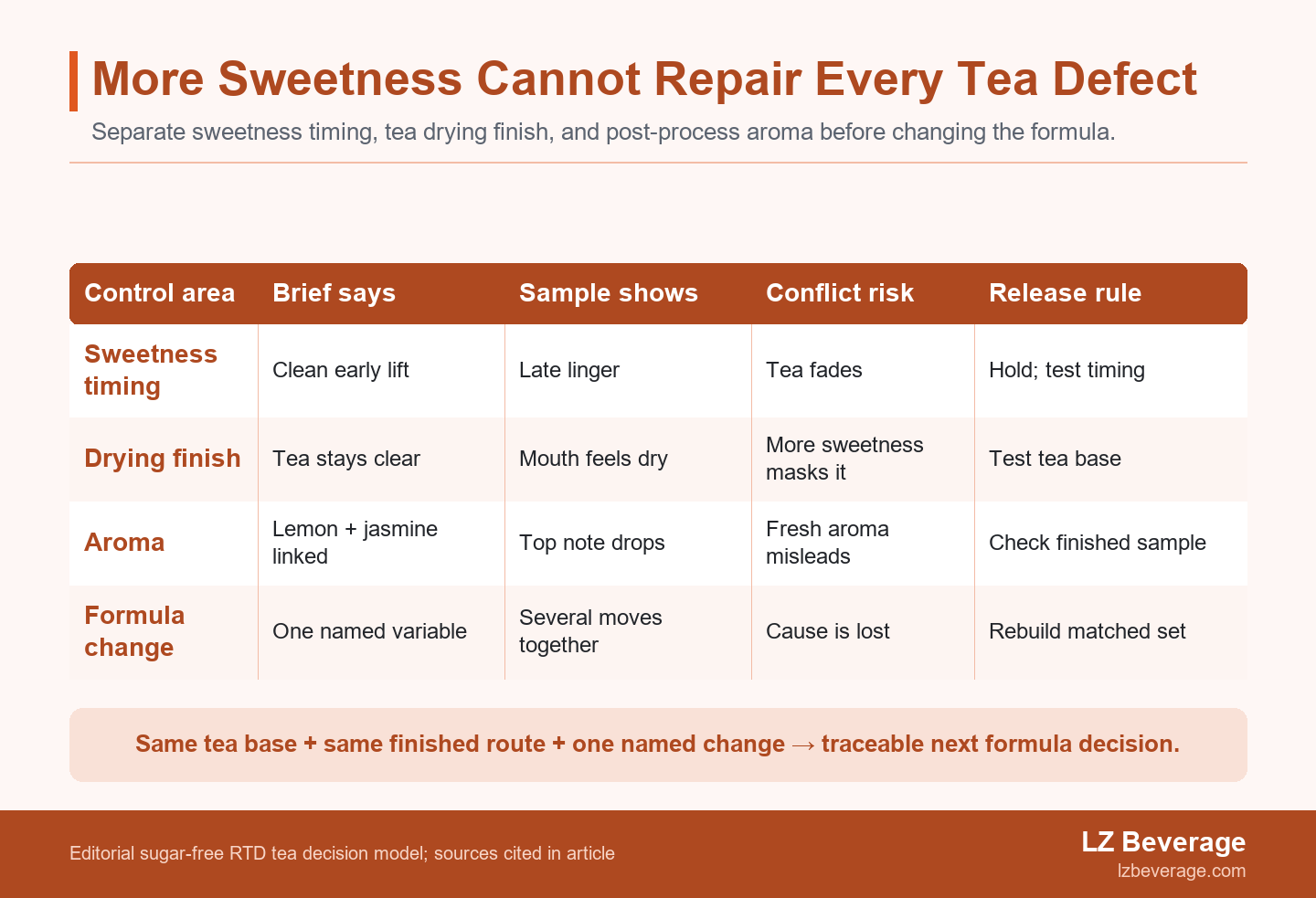
Run a Matched Four-Sample Screen
Hold the tea base and finished route constant while changing one named sensory control at a time. A matched four-sample screen makes sugar-free RTD tea learning traceable because it separates sweetness signal, tea correction, and finished-aroma evidence.
| Sample |
What stays matched |
What changes |
Decision question |
| 1. Base reference |
Tea base, pack direction, review sheet |
No sweetness correction |
Where do tea aroma and drying finish start? |
| 2. Primary sweetness |
Same tea base and review sheet |
One sweetness system |
How do onset, mid-palate, and linger move? |
| 3. Tea-base revision |
Same sweetness system and finished route |
One tea-base adjustment |
Did the drying finish improve without losing tea character? |
| 4. Finished sample |
Selected base and sweetness system |
Intended finished process |
Does the finished aroma support the release decision? |
The decision is not “pick the sweetest sample.” It is “keep the same tea base and finished process, then decide whether the sweetness system, drying finish, and aroma review point to the same next revision.” If the causes remain mixed, hold the formula decision. The method does not replace stability, analytical, or market validation, but it prevents an OEM discussion from starting with a sensory mystery. Readers who need related development context can explore further beverage-development insights.
Illustrative Scenario: Reworking a 15,000-Can Launch Trial
A pleasant bench sample cannot approve a launch trial when its sensory causes are mixed. Consider an illustrative R&D manager planning a 15,000-can launch trial for a 330 mL zero-sugar lemon-jasmine tea. The bench sample has appealing early sweetness, but it shows a late herbal note and dry finish after the intended process check. The first sweetener adjustment raised peak sweetness, yet the dry finish remained.
The team then considers a stronger lemon top note because the first sniff becomes more attractive. That would be a risky shortcut. The tea base, sweetness correction, aroma correction, and process state have not been separated, so nobody can assign the late note to a single cause. The correct decision is to hold the launch trial and request the matched four-sample sequence: base reference, primary sweetness, tea-base revision, and finished sample.
Before the release discussion reaches the carrier test, the buyer can review LZ Beverage's manufacturing background while assessing a potential partner. That check belongs after the sensory brief is clear, not before it.
Why the Bench Favorite Cannot Approve the Trial
Hold launch-trial approval until the sensory causes are separated. The revised request keeps the tea base and process route constant, then uses one common sheet for sweetness onset, mid-palate tea character, drying finish, and retained aroma. A release decision can follow only when the preferred finished sample has a traceable reason for winning.
This is an illustrative product-development scenario, not an LZ Beverage customer case or a production-process prescription. Its point is commercial as well as sensory: a 15,000-can trial in a 330 mL lemon-jasmine tea should test a defined question, not magnify a bench preference whose causes are still mixed.
Give a Manufacturer a Brief That Can Be Tested
FDA describes high-intensity sweeteners as sugar substitutes that are many times sweeter than sucrose. That general definition is not a decision on allowable use, labeling, or formula compliance for any specific product. It is a reminder to describe the sweetness system precisely rather than asking a manufacturer to “remove sugar” without a sensory target.
A useful feasibility brief names the beverage type, target consumer, flavor direction, function, pack format, target market, and expected volume. It should also state the tea base under review, the desired sweetness timing, the drying-finish concern, the aroma question after the intended process, and the four-sample sequence requested. These details let an OEM/ODM team respond with the right formulation, pack, and validation questions instead of guessing at the cause of a taste preference.
If those inputs are ready, request a sugar-free RTD tea feasibility review with the beverage type, target consumer, flavor direction, function, pack format, target market, and expected volume. The first discussion can then focus on the next sample question rather than an unstructured sweetness request.
Frequently Asked Questions
Can sugar-free RTD tea taste as sweet as sugared tea?
Yes, a sugar-free RTD tea can reach a high perceived sweetness, but matching a sugared tea also depends on timing, finish, and tea background. A sample may hit the desired peak sweetness while still showing a late linger, thin body, or dry tea finish. Set the target as a sequence across the sip, then assess it in the intended finished beverage rather than treating sweetness intensity as the only criterion.
Does more sweetener always reduce tea astringency?
No, more sweetener may change perception but it does not automatically remove the tea-derived drying finish that should be reviewed separately. If astringency remains after the sweetness target is reached, return to the tea base, extraction direction, or flavor interaction. Score sweetness and drying finish on separate lines so the team can see whether a correction actually improved both outcomes.
Which tea bases are easiest for sugar-free RTD development?
Start with the tea base that already expresses the intended aroma and drying finish with the least corrective work in a matched tasting. There is no universal easiest tea, because the preferred character may be light and floral, deep and roasted, or brisk and citrus-led. Compare candidate bases under the same water, sweetness system, and review method before selecting the one that needs fewer sensory repairs.
What sample set should be reviewed before an OEM quote?
Review a base-tea sample, a primary-sweetness sample, a tea-base-adjustment sample, and the intended finished-process sample under one scorecard. Keep the tea base and finished route matched except for the named variable in each sample. Record sweetness onset, mid-palate tea character, drying finish, and retained aroma so the manufacturer can identify the next formulation question before discussing a pilot.


