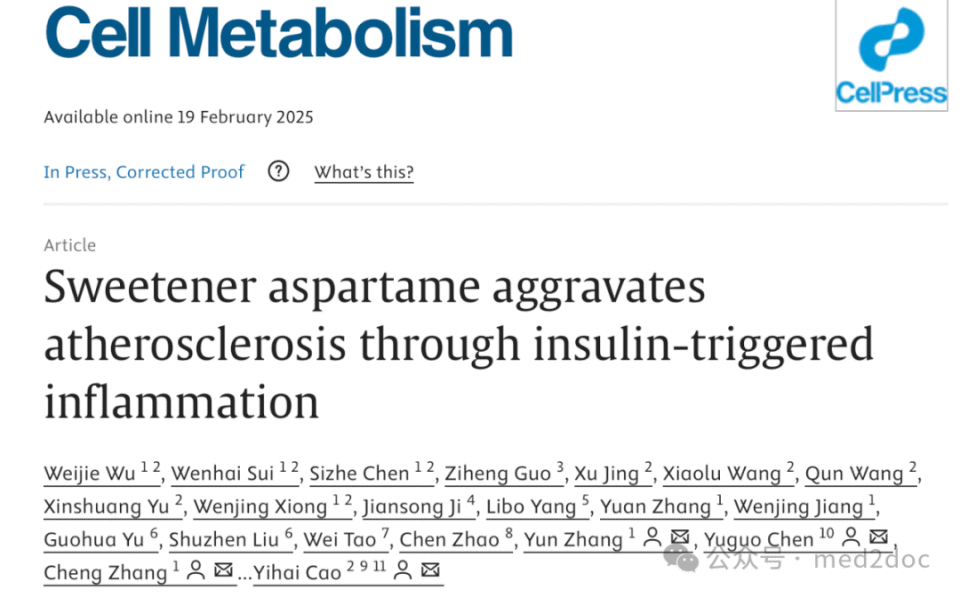
The latest Chinese study published in the Cell sub-journal found that aspartame can aggravate atherosclerosis and damage the cardiovascular system through an insulin-dependent mechanism, so some friends dare not drink beverages with sugar substitutes.
The latest Chinese study published in the Cell sub-journal found that aspartame can aggravate atherosclerosis and damage the cardiovascular system through an insulin-dependent mechanism, so some friends dare not drink beverages with sugar substitutes.
Under the trend of "sugar control", various sugar-free foods and sugar-free beverages are highly sought after by everyone. They are characterized by high sweetness and "0 calories", and various sweeteners (sugar substitutes) play a major role, among which aspartame is the most famous.
However, there is news recently that the latest Chinese study published in the Cell sub-journal found that aspartame can aggravate atherosclerosis and damage the cardiovascular system through an insulin-dependent mechanism. This makes many people who like to drink sugar-free drinks feel nervous again: What is this study about? Is aspartame safe? Can we still drink sugar-free drinks?
Let me first talk about the conclusion. Drinking some sugar-free drinks appropriately does not need to worry about aspartame exacerbating atherosclerosis. The shocking conclusion that has been circulated online is an over-interpretation of a normal research result. Let's talk about it in detail.
What is this study about?
First of all, it must be pointed out that this latest study is an animal study and does not involve humans. The researchers conducted experimental models on mice and monkeys respectively.
Scientists conducted an experiment on the sugar substitute aspartame: after they fed mice and monkeys food containing this sweetener, they found that their insulin levels (an important hormone for controlling blood sugar) quickly increased. For further research, they chose a special type of mouse-these mice were genetically modified and were naturally prone to vascular problems, similar to human arteriosclerosis.
The experiment lasted for three months, and the mice were fed aspartame (about 600 mg) every day, which was equivalent to an adult drinking 3 cans of sugar-free cola. The results showed that compared with ordinary mice, the mice that ate aspartame had more plaques (similar to scale in water pipes) in their blood vessels, these plaques were larger in size, and the inflammatory response in the body was also more obvious.
This finding suggests that long-term consumption of artificial sweeteners may affect cardiovascular health through this special mechanism. However, it should be noted that the experimental subjects are mice, and the impact on humans needs further verification. However, when discussing this study online, rigorous and comprehensive statements are often omitted, and it is simply said that sugar-free beverages can also harm the cardiovascular system, are not good for blood vessels, and harm the heart.
So, does aspartame really harm the cardiovascular system and increase the risk of atherosclerosis and cardiovascular disease?
How do you view this study?
-
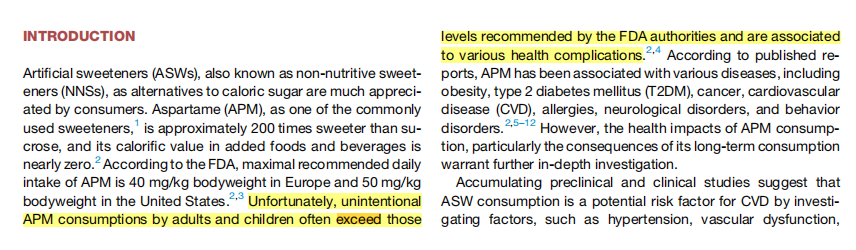
This study is an animal study - mice and monkeys, and this result has not been confirmed in humans. There is still a big difference between animals and humans. At present, no human studies have found that sugar-free beverages can harm the cardiovascular system.
-
The mice used in this study are a special type of experimental mice - ApoE-/- mice, which are naturally prone to heart disease even if they eat a normal diet. This type of mouse was specially bred by scientists to study cardiovascular disease. Even if they eat ordinary food, their total cholesterol is as high as 300-500 mg/dL. If they are fed a high-fat diet, cholesterol levels can even exceed 1000 mg/dL, which will accelerate the process of atherosclerosis. This chaotic metabolic state will gradually accumulate fatty plaques on the blood vessel walls, forming atherosclerosis. Scientists prefer to use this type of mouse for experiments because they can quickly simulate the decades of vascular damage in humans. For example, after feeding a high-fat diet, obvious plaques can be seen in 12 weeks, which is very convenient for testing cholesterol-lowering drugs or studying pathogenesis. However, such a mouse model may not be able to fully simulate the occurrence and development of human atherosclerosis.
-
In the section on the limitations of the study, in addition to re-emphasizing the limitations of animal research, the paper also clearly mentioned that due to technical difficulties and feasibility limitations, the current study did not evaluate the direct effect of aspartame on atherosclerosis in the monkey model.
It seems that everyone does not have to be afraid of sugar-free drinks at all, so some friends may ask, even if it does not cause cardiovascular problems, is aspartame itself safe?
Is aspartame safe?
Aspartame is an artificial sweetener. You can think of it as a "super sugar" - it has only 1/200 of the calories of ordinary sugar, but it can bring 200 times the sweetness. This property makes it a common guest in foods such as sugar-free cola, chewing gum, and low-calorie snacks.
Regarding safety, food safety agencies in more than 90 countries around the world have reached a consensus: normal consumption of aspartame is safe. For example, after decades of research, the U.S. Food and Drug Administration (FDA) and the World Health Organization (WHO) have determined that adults will not have health risks if they consume no more than 40 mg per kilogram of body weight per day (equivalent to a 60-kilogram person drinking 9 cans of sugar-free cola per day).
The latest assessment of the World Health Organization in 2023 reconfirmed this conclusion. Although rumors that "aspartame causes cancer" occasionally appear on social media, so far, all authoritative studies have found no evidence that aspartame is harmful to the human body at normal doses. However, it should be noted that people with phenylketonuria (a rare genetic disease that cannot metabolize phenylalanine normally) must avoid eating foods containing aspartame.
Of course, this does not mean that healthy people can consume aspartame without restraint. Scientists specifically remind that the safety conclusion of aspartame is based on "reasonable use". In addition, even if aspartame itself is safe, it may still have other effects on our health.
Because sugar-free beverages using aspartame, long-term and large-scale drinking may affect taste preferences and make people more and more dependent on sweets. This may make us more inclined to look for other sweets, indirectly increasing the risk of consuming high-sugar foods. Therefore, whether it is a drink or food, in addition to reducing sugar, you should also pay attention to reducing excessive addiction and dependence on sweetness, such as trying to replace sweet drinks with water and tea in daily life.

